


Identity theft protection worth it 2026 means paying a service to watch for identity misuse and help when fraud happens. For most Americans, paid protection is optional, not the first defense. Start free by freezing all 3 credit files, checking reports, enabling bank alerts, and securing important accounts, as noted by Baltimore Chronicle.
“A credit freeze is always a good idea.”
Federal Trade Commission, Consumer Advice, guidance on credit freezes and fraud alerts.
That recommendation matters because a freeze blocks access to your credit file for new-account decisions. It costs $0 to place or lift under federal law. It also does not reduce your credit score. You must freeze Equifax, Experian, and TransUnion separately for the strongest coverage.
Key takeaways
- Most adults can build strong basic identity protection for $0 using credit freezes, account alerts, and regular credit-report reviews.
- Paid plans mainly buy monitoring breadth, faster notifications, restoration assistance, insurance benefits, and simpler protection for several family members.
- Paying makes more sense after repeated breaches, existing identity theft, heavy financial activity, or difficulty managing security tasks yourself.
A subscription cannot make your Social Security number secret again after a breach. It also cannot guarantee that fraud never occurs. Monitoring usually detects suspicious activity rather than stopping every type of identity theft. The strongest setup combines preventive controls with alerts and recovery planning.
If your budget is tight, spend $0 first. Freeze credit, strengthen logins, review reports, and activate financial alerts before buying another subscription.
In plain English
Think of identity theft protection like a smoke alarm combined with an emergency-response service. The alarm watches for trouble. The response team helps after something goes wrong. Neither service makes your house fireproof.
A credit freeze works more like locking a door. It can stop many criminals from opening new credit accounts using your identity. That makes the free freeze unusually powerful compared with monitoring alone.
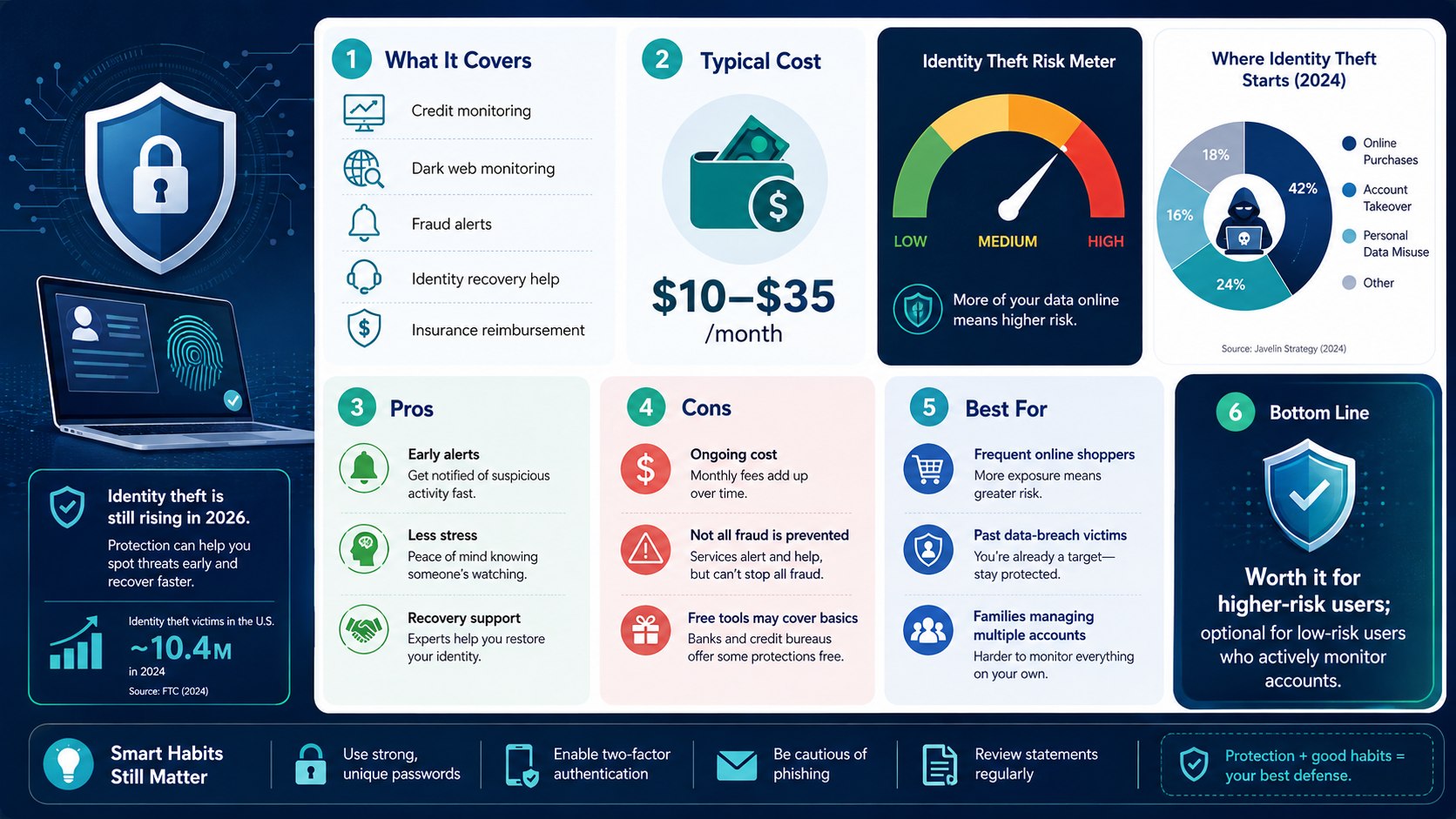
Paid services such as Aura, LifeLock, IdentityForce, and Experian IdentityWorks add different combinations of monitoring and recovery tools. They may watch credit files, dark-web records, addresses, financial accounts, or public records. Features vary significantly by plan.
This distinction becomes important after a wallet or Social Security card disappears. Baltimore Chronicle explains additional steps in its guide to replacing a lost Social Security card in 2026.
How it actually works
An identity-protection company first collects information that you authorize it to monitor. That might include your Social Security number, email addresses, phone numbers, bank accounts, or credit profile.
The service then compares those details against the sources included in your plan. A credit-monitoring feature might detect a new inquiry or account. Dark-web monitoring can flag credentials found in known compromised datasets.
If something suspicious appears, the company sends an alert. You still have to determine whether the activity is legitimate. A mortgage inquiry you authorized should not trigger the same response as an unknown credit card.
Higher-tier plans often include restoration specialists and identity-theft insurance benefits. Coverage terms, exclusions, reimbursement limits, and renewal prices differ. Read the current policy before treating an advertised dollar limit like guaranteed cash.
If theft has already occurred, use IdentityTheft.gov. The Federal Trade Commission provides recovery plans and documents for different types of identity misuse.
Identity theft protection worth it 2026: what are you actually paying for?
Identity theft protection worth it 2026 depends less on the brand name than the work you want outsourced. The free option requires more personal administration. A subscription puts several monitoring functions into one dashboard.
Current advertised prices show how quickly that convenience becomes a recurring household expense. Aura lists an individual annual plan at about $12 monthly equivalent and around $15 with monthly billing. IdentityForce advertises individual protection starting near $19.90 monthly, while higher credit-monitoring tiers can cost around $34.90 monthly. Prices and promotional terms should always be checked before enrollment.
Here is the practical comparison for a US consumer in 2026:
| Option | Typical cost | Main value | Main limitation |
|---|---|---|---|
| DIY credit freeze | $0 | Blocks many new-credit applications | You manage 3 bureaus yourself |
| Fraud alert | $0 | Tells lenders to verify identity | Less restrictive than a freeze |
| Aura Individual | About $12–$15/month | Combined identity and credit monitoring | Recurring subscription cost |
| IdentityForce UltraSecure | About $19.90/month | Identity monitoring and recovery tools | Base tier has different credit features |
| Higher IdentityForce tier | About $34.90/month | Broader credit monitoring | More than $400 yearly |
| LifeLock | Varies by tier | Several monitoring and restoration tiers | Introductory and renewal pricing differ |
The cost difference becomes substantial over several years. A $15 monthly service costs $180 over 12 months. A $34.90 monthly subscription reaches $418.80 before any price change. That may be reasonable after serious fraud, but it may be unnecessary for someone comfortable managing free protections.
Insurance alone should not decide the purchase. The more relevant question is whether you need active monitoring, centralized alerts, and professional assistance if something goes wrong.
Home buyers should also consider timing before freezing or lifting their files. A lender usually needs credit access during underwriting. Baltimore Chronicle explains this process in its guide to mortgage pre-approval in the USA.
What to do free before paying anything
The strongest no-cost strategy requires several separate actions. None requires buying an identity-monitoring subscription.
- Freeze your credit with Equifax, Experian, and TransUnion.
- Review credit reports for accounts, inquiries, and addresses you do not recognize.
- Turn on transaction alerts for checking accounts and credit cards.
- Use unique passwords and multifactor authentication for financial accounts.
- Protect your primary email account because it controls many password resets.
- Create an IRS Online Account and Social Security account before a criminal tries.
- Use a free fraud alert if your circumstances make one appropriate.
- Report confirmed identity theft through IdentityTheft.gov and follow its recovery plan.
A fraud alert and a credit freeze are not identical. An initial fraud alert is free and lasts 1 year. Contacting 1 nationwide credit bureau triggers notification to the other 2. A freeze must be placed separately with each bureau and remains until you lift or remove it.
You should also review credit reports rather than relying only on a credit score. Reports show accounts, payment history, inquiries, addresses, and other information. AnnualCreditReport.com is the federally authorized source for free reports from the 3 nationwide credit bureaus.
Paid monitoring is most valuable after the free preventive layer is already working. Otherwise, you may pay to hear about damage you could have made harder to cause.
People preparing for a home purchase should coordinate freezes with loan applications. Credit information can directly affect approval and pricing. See Baltimore Chronicle’s explanation of credit scores for buying a house in 2026.
Who it matters to in 2026
Parents protecting children
Children can have clean identity records that criminals may exploit for years. Parents can request freezes for children under 16, and federal guidance allows these freezes without a fee.
A family subscription may become worthwhile when managing several identities feels unrealistic. Compare exactly how many adults and children each plan covers. Do not assume every family plan monitors each person equally.
Homeowners, renters, and active borrowers
People frequently applying for mortgages, apartments, auto loans, or credit cards create more legitimate credit activity. That can make continuous monitoring more convenient.
However, frequent borrowing also makes a permanent freeze less convenient. You may need temporary lifts when lenders require access. The inconvenience is administrative, not financial, because lifting a freeze remains free.
Freelancers and people already exposed
Freelancers often combine business payments, personal banking, tax records, email accounts, and several payment platforms. A compromised email or reused password can therefore affect several parts of their finances.
Paid identity theft monitoring can make sense after repeated data breaches or previous account takeover. Restoration assistance may also have value for someone without time to manage disputes personally.
Common myths
Marketing around identity theft protection services can blur prevention, detection, and recovery. These claims deserve separate treatment.
- Myth: Paid monitoring prevents identity theft. Correction: it mainly detects selected warning signs and supports recovery.
- Myth: A credit freeze hurts your score. Correction: placing a freeze does not affect your credit score.
- Myth: You need a breach before freezing credit. Correction: anyone can request a freeze at any time.
- Myth: One freeze covers all bureaus. Correction: Equifax, Experian, and TransUnion must each be frozen.
- Myth: Identity insurance guarantees reimbursement. Correction: policies contain eligibility rules, limits, and exclusions.
A subscription should therefore be judged as a service package. The most useful pieces are usually monitoring breadth and recovery assistance. Insurance can add value, but policy wording matters. Dark-web alerts are useful signals, not proof that an account was stolen.
A freeze remains more preventive for new-credit fraud. Strong account security still matters for existing accounts. Someone with 2 credit cards and stable finances may prefer DIY protection, while a household managing children, investments, mortgages, and business accounts may value centralized alerts.
FAQ
Is identity theft protection really worth paying for in 2026?
It can be worth paying for when you want continuous monitoring and professional recovery assistance. Free identity theft protection is enough for many organized consumers. Start with freezes, reports, alerts, and secure logins.
Can I protect myself from identity theft for free?
Yes. Credit freezes, fraud alerts, credit-report reviews, bank notifications, and strong account authentication can all reduce risk without a subscription.
What is better, a credit freeze or identity theft monitoring?
They solve different problems. A freeze restricts access to your credit file for new accounts. Monitoring looks for suspicious events and alerts you afterward.
Should I freeze my child’s credit?
Parents concerned about child identity theft can request a free freeze for a child under 16. Documentation requirements differ by bureau.
Does identity theft protection cover bank account fraud?
Some plans monitor linked financial accounts or include reimbursement benefits. Coverage differs by provider. Review current policy terms before buying.
What should I do first if my identity was already stolen?
Secure affected accounts and place credit protections immediately. Then use the FTC recovery process at IdentityTheft.gov and follow the steps for your specific fraud type.
Earlier we wrote about PPF vs Vinyl Siding Cost 2026: Prices, Lifespan and Installation