

How to fight a speeding ticket in Maryland 2026 starts with one decision: do not pay the citation if you intend to contest it. Maryland generally gives drivers 30 days to respond to a payable traffic citation. You can request a trial and plead not guilty, or request a waiver hearing and plead guilty with an explanation. Preparing the request takes about 20–40 minutes, while the court date may arrive several weeks later, as the editorial team at Baltimore Chronicle notes.
For a genuine challenge to the allegation, choose a trial rather than a waiver hearing. A trial lets you dispute the officer’s evidence, present documents and call witnesses. A waiver hearing is different: you accept guilt and ask the judge for leniency, a reduced fine or probation before judgment.
Key takeaways
- Respond within 30 days and request a trial if you want to plead not guilty.
- Do not prepay the ticket before court if your goal is to contest the speeding charge.
- Collect evidence early, because road conditions, signs, dashcam files and witness memories can disappear quickly.
Maryland Courts states that paying a payable citation counts as an admission of guilt. The resulting conviction is reported to the Maryland Motor Vehicle Administration, which determines applicable points. Those points can also affect how an insurer evaluates your driving history.
What you need before challenging a Maryland speeding ticket
A useful defense starts before the hearing notice arrives. Keep the original citation and build a small case file containing everything that could explain what happened.
- the original Maryland Uniform Traffic Citation;
- driver’s license and current contact information;
- photos or video of the road, signs and surrounding area;
- dashcam footage, if available;
- names and contact details of witnesses;
- vehicle documents if a mechanical issue is relevant;
- a calendar containing the ticket date and 30-day response deadline;
- several hours for a court appearance and travel;
- money for any fine or costs the judge ultimately imposes.
Photograph the location from a safe place and at roughly the same time of day. Record the posted limit, nearby intersections and anything affecting visibility. Save dashcam footage in at least 2 locations. Write down your recollection before small details become uncertain.
Also inspect every line of the citation. Confirm the vehicle, location, alleged speed, posted limit and statutory section. A clerical mistake does not automatically cancel a charge, but factual inconsistencies can matter when they relate to identification or evidence.
Drivers managing other Maryland paperwork may recognize the same rule: deadlines matter more than assumptions. Baltimore Chronicle’s guides to Baltimore licensing and administrative procedures and University of Maryland Baltimore housing paperwork follow the same practical principle: preserve documents and verify requirements directly.
Step 1: Decide whether you need a trial or waiver hearing
If you believe the speeding allegation is wrong, request a trial and plead not guilty. Maryland Courts identifies this as the procedure for drivers who want the state to prove the violation before a judge.
A Maryland traffic court hearing called a waiver hearing serves another purpose. You plead guilty with an explanation and can ask for a lower fine, a waived fine or probation instead of a conviction. The citing officer and witnesses are generally not present because guilt is not being contested.
Common mistake: choosing a waiver hearing while planning to argue that you never committed the violation. That procedure is designed for mitigation, not a not-guilty defense.
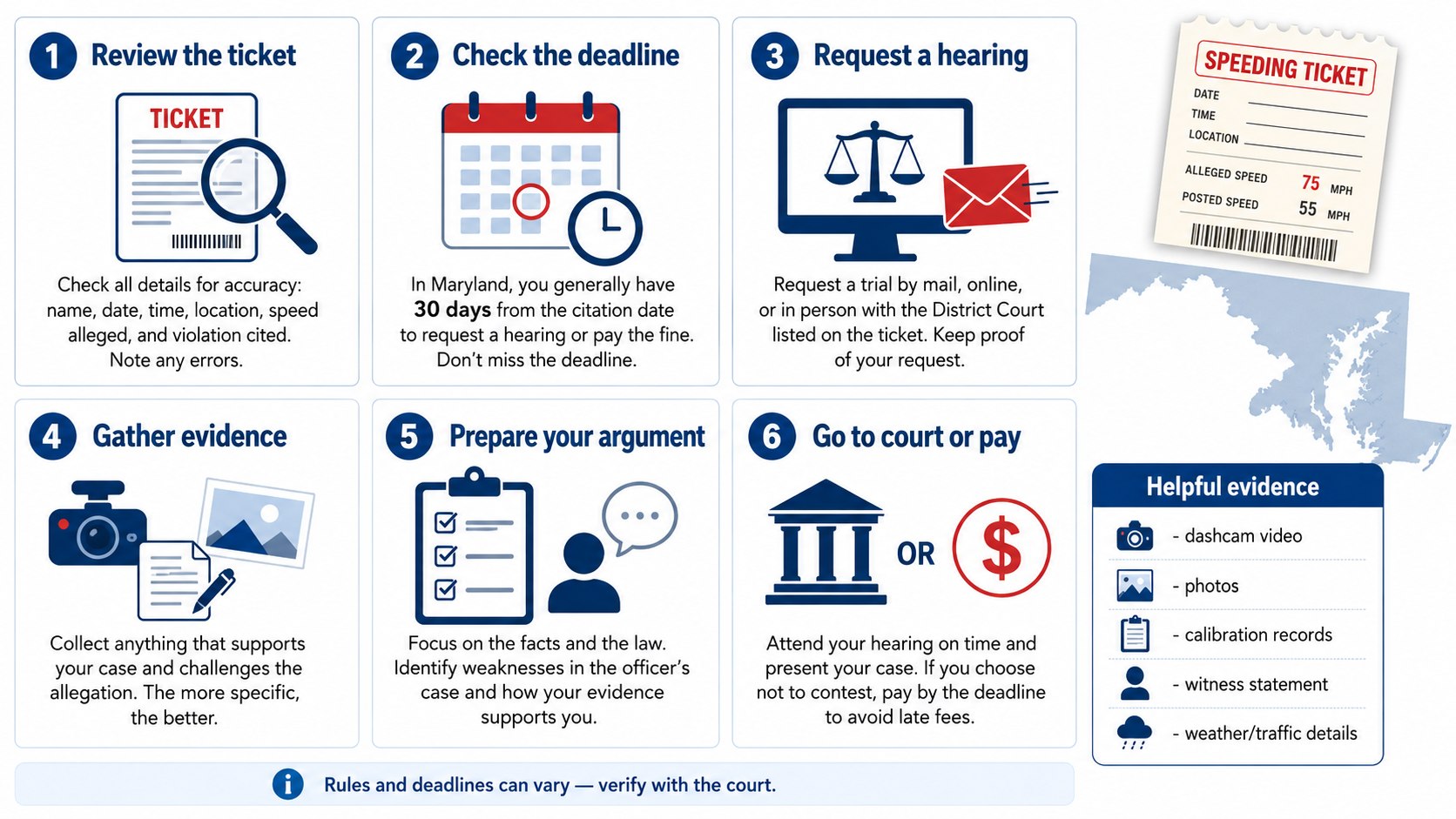
Step 2: Respond within Maryland’s 30-day deadline
Check “Request a Trial” on the option form if you are contesting the citation. Sign and date it, then send it to the District Court Traffic Processing Center at P.O. Box 6676, Annapolis, MD 21401.
This must normally be done within 30 days after receiving a payable citation. Maryland Courts warns that failing to select an available option may lead to notification of the MVA and possible license action.
Keep a copy of the completed form before mailing it. Use trackable mail when practical, especially if the deadline is approaching.
Common mistake: paying first and expecting to dispute the same charge later. Maryland specifically tells drivers requesting a trial or waiver hearing not to pay the fine beforehand.
Step 3: Check the alleged speed, fine and possible points
The consequences depend heavily on the speed alleged. The Maryland District Court fine schedule effective from October 1, 2025 remains the current official schedule located for this 2026 guide. It includes preset fines and corresponding point assessments.
| Alleged speed above limit | Preset fine | Points shown in schedule |
|---|---|---|
| 1–9 mph | $80 | 1 |
| 10–19 mph | $90 | 2 |
| 20–29 mph | $160 | 2 |
| 20–29 mph above a 65 or 70 mph maximum | $290 | 5 |
| 30–39 mph | $290 | 6 |
| 40 mph or more | $530 | 6 |
These amounts show why checking the exact charge matters. A driver accused of 8 mph over faces a very different record consequence from someone accused of 30 mph over.
The official schedule also lists higher preset fines for certain work-zone and school-zone speeding offenses. A work-zone allegation of 10–19 mph over, for example, carries a $300 preset fine in the current schedule.
Maryland MVA uses accumulated points when deciding administrative action. Its current guidance lists a warning letter at 3–4 points, Driver Improvement Program requirements at 5–7, suspension notice at 8–11 and revocation notice at 12 or more.
For someone already carrying points, the driving-record consequence may be more important than the dollar amount printed on the ticket.
Step 4: Build the evidence for your Maryland speeding ticket defense
A successful Maryland speeding ticket defense usually depends on evidence, not a long explanation about being late. Start by identifying what the state must prove and what evidence supports or undermines the allegation.
Useful material can include dashcam footage, photographs of obscured speed-limit signs, GPS records, eyewitness testimony or evidence identifying the wrong vehicle. The usefulness of each item depends on the specific facts.
Prepare your evidence in a simple sequence:
- Write the alleged speed and posted limit at the top of your notes.
- Identify exactly where the officer says the violation occurred.
- List each piece of evidence supporting your version.
- Separate facts you personally observed from assumptions.
- Prepare 3–5 questions about disputed details.
- Bring printed or otherwise court-accessible copies of important evidence.
Do not turn the hearing into a general complaint about police enforcement. Focus on observable facts. If visibility was limited, show why. If a sign was obstructed, document it. If another vehicle could have affected identification, explain where it was.
A witness can also be useful when that person actually observed something material. Maryland Courts says defendants are responsible for notifying their own witnesses about the date, time and location of trial.
Step 5: Understand what happens at the speeding ticket hearing
At a trial, the officer who issued the citation can testify. You then have an opportunity to present your side before the judge decides the case.
“At your trial, the officer who issued your ticket will testify.”
— District Court of Maryland, Traffic Citation Information, explanation of the trial process.
Listen before responding. Take notes while the officer speaks and identify specific points you disagree with. Short questions are usually more effective than arguments disguised as questions.
If the evidence supports the charge, the hearing can still affect the outcome. However, do not assume that appearing automatically eliminates the ticket or guarantees probation before judgment.
Common mistake: interrupting testimony or giving a long story before addressing the disputed facts. Court is structured around evidence and legal findings, not who speaks longest.
Step 6: Know when probation before judgment may matter
Probation before judgment in Maryland, often called PBJ, can matter because it differs from a standard conviction. At a waiver hearing, Maryland Courts expressly allows a driver to ask the judge for probation rather than a conviction.
PBJ is discretionary. A clean record, the seriousness of the offense and circumstances surrounding the citation can affect how a judge views mitigation. Drivers should present supporting facts rather than assume that being a first-time offender guarantees a specific result.
A practical mitigation file might include a current driving record, evidence of a generally clean history and a concise explanation. Avoid exaggerated claims such as needing to speed for work unless the explanation is both accurate and relevant.
One procedural difference is important. Maryland Courts states that a probation-before-judgment disposition cannot be appealed, while a guilty verdict generally carries appeal rights.
Step 7: Prepare for the court date and possible delay
The District Court says scheduling a trial may take several weeks. If no trial date arrives within 6 weeks, its guidance recommends contacting the District Court in the county where the ticket was issued.
Check your mail carefully. Court correspondence is particularly important after you request a hearing. If your address changes, notify the court directly because updating the MVA address alone does not update the court’s records.
If you cannot attend, request a postponement rather than simply missing the hearing. A postponement is not automatic and remains subject to judicial approval.
Step 8: Decide whether a lawyer makes sense
Many routine drivers represent themselves in Maryland traffic court. A lawyer becomes more relevant when the potential consequences extend beyond a modest payable citation.
Consider obtaining legal advice when the case involves several citations, a commercial driver’s license, an existing high point balance or a serious speeding allegation. The current Maryland schedule separately identifies reckless driving involving 30 mph or more above the posted limit as a must-appear charge carrying 6 points.
Do not assume every ticket stating 30 mph over automatically means the same procedural situation. Read the exact statutory section printed on your citation and verify whether additional charges were issued.
How to fight a speeding ticket in Maryland 2026: trial versus waiver hearing
The choice between these procedures becomes easier when reduced to your actual objective. One disputes guilt. The other asks for leniency after accepting guilt.
| Option | Your position | Officer normally present? | Main purpose |
|---|---|---|---|
| Pay citation | Guilty | No | Resolve the ticket without court |
| Waiver hearing | Guilty with explanation | No | Request mitigation, reduced fine or PBJ |
| Trial | Not guilty | Officer can testify | Contest the charge and present evidence |
If your argument is “I was not traveling at that speed,” request a trial. If your position is “I committed the violation, but there were mitigating circumstances,” a waiver hearing is usually the procedure matching that objective.
Do not make the decision solely by comparing the fine with the value of your time. A conviction can become part of your Maryland driving record, and the MVA assigns points after qualifying convictions.
Drivers with existing points, provisional licenses or commercial driving responsibilities should examine those consequences before choosing the quickest resolution.
Troubleshooting common Maryland traffic ticket problems
Procedural problems often appear after the citation rather than during the traffic stop. These situations have specific solutions.
- You lost the ticket: Maryland Courts provides a lost or missing traffic citation option form and Case Search information.
- No court date arrived: contact the relevant District Court if approximately 6 weeks pass without a trial date.
- You moved: notify the court directly instead of relying only on an MVA address change.
- You cannot attend: submit a postponement request with an explanation and supporting documents.
- You already paid: payment of a payable citation is treated as an admission of guilt, so do not use payment as a placeholder while planning a trial.
Keep confirmation of every document you submit. Record the citation number and case number separately from the paper ticket. That makes it easier to contact the clerk if correspondence disappears.
Do not ignore a hearing because you expect the officer to be absent. Maryland warns that failure to appear can lead to MVA notification and license suspension action.
If a serious charge accompanies the speeding citation, read every citation together. The procedural rules for a payable ticket differ from offenses marked “must appear.”
FAQ
Can you fight a speeding ticket in Maryland without a lawyer?
Yes. Drivers can request a trial themselves and present evidence. A lawyer may become more useful when substantial points, multiple charges, a CDL or a must-appear offense is involved.
How long do I have to request a speeding ticket hearing in Maryland?
For a payable traffic citation, Maryland Courts generally requires a response within 30 days after receipt. A driver can pay, request an eligible payment plan, request a waiver hearing or request a trial.
Should I request a trial or waiver hearing?
Request a trial if you plead not guilty and want to challenge the allegation. Request a waiver hearing when you plead guilty with an explanation and want the judge to consider mitigation.
Does paying a Maryland speeding ticket mean pleading guilty?
Yes. Maryland MVA states that paying a payable citation constitutes an admission of guilt. The resulting conviction is reported to the MVA, where applicable points are assessed.
How many points can a speeding ticket add in Maryland?
The amount depends on the violation. The current District Court schedule lists 1 point for 1–9 mph over, 2 points for many 10–29 mph violations and 6 points for 30 mph or more over the limit. Special circumstances can change the assessment.
What happens if the officer does not appear?
The outcome depends on what happens in your specific case and what evidence is available. Do not treat officer absence as an automatic dismissal or skip court based on that assumption.
Earlier we wrote about Is Identity Theft Protection Worth It in 2026? What Americans Can Do for Free