


How to settle a debt with a collector 2026 starts with 3 actions: verify the debt, decide what you can pay, and demand written settlement terms before sending money. A straightforward case can often be prepared in 30–60 minutes, although negotiations may take several calls or letters. Never give a collector unrestricted access to your checking account, and never rely on a verbal promise, as Baltimore Chronicle notes.
A settlement can reduce an unaffordable balance, but the unpaid portion may create a federal tax issue. The safest approach is to separate 3 questions: Is the debt valid? What payment solves the account? What happens after the creditor forgives the remainder?
Key takeaways
- Verify the creditor, balance, account history, and collector before discussing a settlement amount or providing payment information.
- Get the final amount, deadline, account treatment, and remaining balance confirmed in writing before paying anything.
- Plan for possible Form 1099-C reporting because canceled debt can become taxable income under federal rules.
A collector’s first offer does not set the final settlement price. Payment capacity matters more than an aggressive opening demand. Old debt also deserves extra caution because state limitation periods differ.
California, Texas, New York, Florida, and other states can apply different rules. A settlement should solve the account without creating another cash-flow problem.
The useful number is not the lowest settlement percentage imaginable. It is the lowest amount that closes the account under written terms you can actually meet.
What you need before contacting the collector
Prepare the file before negotiating. A collector such as Midland Credit Management, Portfolio Recovery Associates, or another agency may already have account data available.
- The validation notice and every letter from the collector.
- Original creditor name and the last 4 digits of the account.
- Your recent statements, payment records, and relevant court papers.
- A monthly budget showing cash available for a lump sum or installments.
- A separate email folder or physical file for settlement records.
- A payment method that does not expose unnecessary bank access.
Keep copies rather than mailing original documents. Record dates, representative names, and reference numbers after each call. Do not send Social Security documents merely because someone requests them.
Confirm the agency through independently obtained contact information. If a lawsuit has already been filed, settlement discussions should not replace attention to court deadlines.
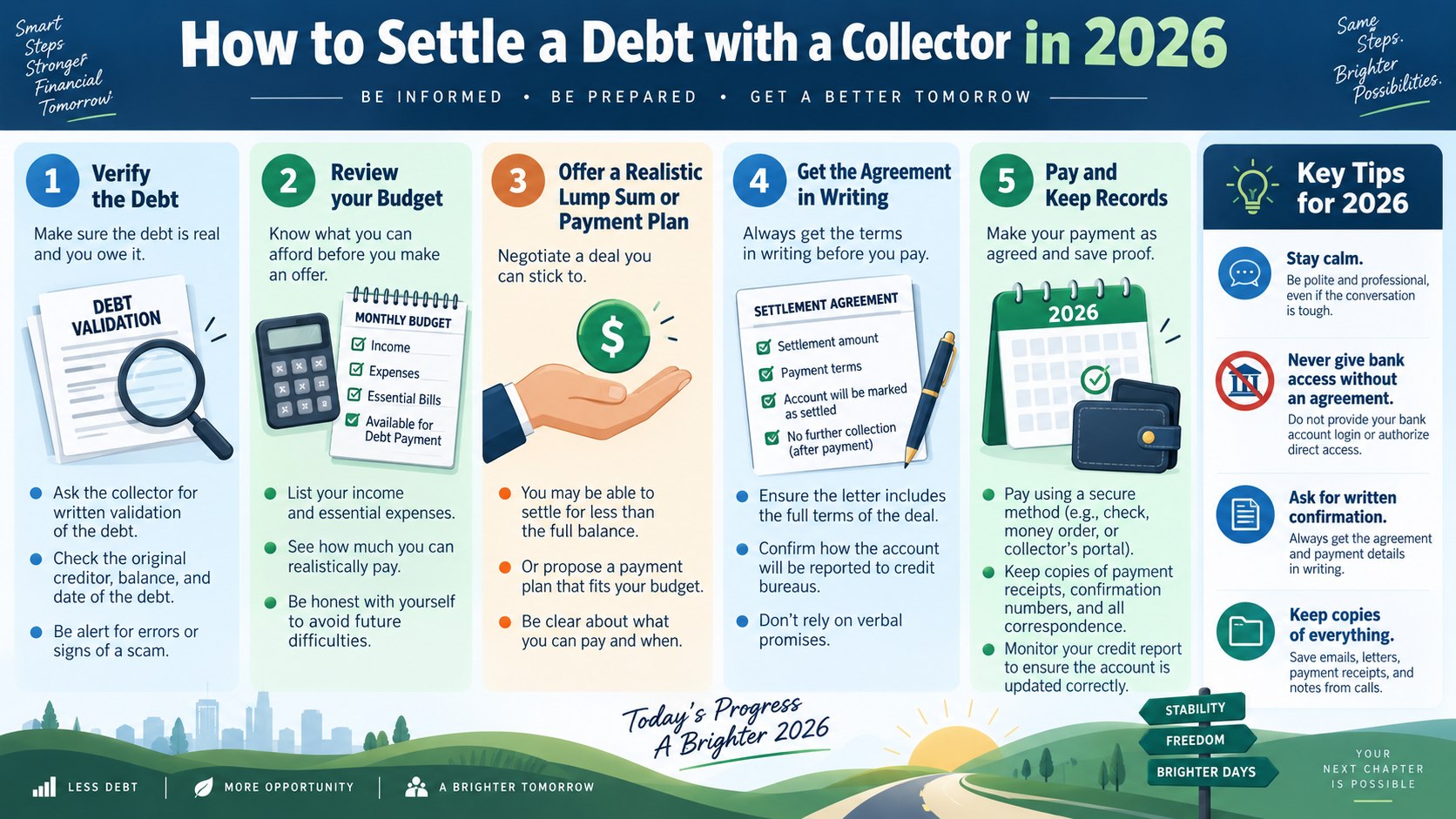
Step 1: How to settle a debt with a collector 2026 starts with validation
Ask for the creditor name, current balance, account number, and an itemization of interest, fees, payments, and credits. The Consumer Financial Protection Bureau says validation information generally includes these details and identifies the deadline for disputing the debt.
Why it matters: paying the wrong company does not necessarily resolve the underlying obligation. A written dispute sent within the applicable 30-day validation period can also require collection activity on the disputed amount to pause until verification arrives.
“Once you’ve disputed the debt, the collector can’t call or contact you to collect the debt until they’ve responded with verification.”
Consumer Financial Protection Bureau, federal consumer agency, Ask CFPB guidance on disputed debts.
The common mistake is negotiating before confirming ownership and balance. That is particularly risky with an unfamiliar agency or very old account.
Step 2: Calculate your settlement ceiling before making an offer
Decide what you can pay without missing rent, mortgage, utilities, insurance, groceries, or required loan payments. A debt settlement offer should come from available cash, not from a number chosen during a stressful phone call.
Suppose a collector claims $7,500 and you have $2,000 available. That $2,000 is a ceiling, not necessarily your opening proposal. A collector may reject an initial amount, counteroffer, or propose installments.
| Situation | Possible approach | Main risk |
|---|---|---|
| $5,000 balance, $1,500 cash available | Negotiate a lump-sum settlement below your ceiling | Spending emergency savings |
| $8,000 balance, limited monthly surplus | Request a fixed installment settlement | Missing a payment may void terms |
| Balance or ownership disputed | Request verification before bargaining | Paying an incorrect claim |
| Lawsuit already filed | Address court deadlines while negotiating | Default judgment |
Settlement percentages are not fixed by federal law. Account age, creditor policy, documentation, and available cash can change the offer.
A lump sum may be attractive because it closes the transaction quickly. Installments can protect cash reserves but require careful written terms. Never promise a payment schedule that depends on uncertain future income.
Freelancers should be particularly conservative when monthly revenue varies.
Step 3: Make the offer and control the negotiation
Contact the collector using a verified telephone number or mailing address. State that you want to resolve the account and can offer a specific amount if it satisfies the agreed obligation.
For example, a consumer with a $6,000 validated balance might open below the maximum available cash. The objective is a settle debt for less agreement that remains affordable after rent, food, transportation, and emergency costs.
- State the amount you can offer.
- Ask whether it settles the agreed account balance.
- Request all conditions in writing.
- Confirm the payment deadline and accepted method.
- Ask how the account will be reported after payment.
Do not become distracted by arguments about percentages. Keep returning to the dollar amount you can actually fund. Never claim hardship that does not exist.
Do not provide debit-card information simply to demonstrate seriousness. If the representative changes the terms, request a revised document. End the call without paying when material conditions remain unclear.
Consumer debt and government debt are different subjects, but higher borrowing costs affect households and public finances alike. For broader context, 4thebike.de has separately covered US debt and rising interest costs in 2026.
Step 4: Get a debt settlement letter before paying
A debt settlement letter should identify the collector, consumer, account, payment amount, deadline, and treatment of the unpaid balance. Avoid language that leaves the remaining amount collectible after your payment.
A practical letter or email can use wording like this:
Re: Account ending [1234]. I offer $[amount] to resolve this account. Before payment, please confirm in writing that accepting this amount satisfies the agreed settlement and state any remaining balance after payment.
Add the payment deadline and method. Ask the collector to identify how the account will be updated in its records.
Keep the signed or issued agreement permanently with proof of payment. A vague phrase such as “payment toward balance” is not the same as a settlement. The common mistake is paying immediately after a representative says, “We have a deal.”
А settlement document should answer one simple question without interpretation: what, exactly, will you owe after the promised payment clears?
Step 5: Pay safely and preserve proof
Use the payment method permitted by the written agreement. Retain the confirmation number, receipt, bank record, and a copy of the settlement terms.
Consumers often prefer a one-time payment method rather than giving a collector continuing authorization. The important point is control. A collection agency settlement should not create unexpected future withdrawals.
After payment, check that the collector’s records reflect the agreement. Save correspondence even after the account appears closed.
Credit reporting and debt ownership are separate issues, so do not assume every settlement produces a particular credit-score change. A common mistake is discarding the file as soon as the payment clears.
Step 6: Check the tax cost before treating the deal as finished
Debt forgiveness can have a second price: federal income tax. The IRS generally treats canceled debt as income unless an exception or exclusion applies. Bankruptcy and insolvency are among the possible exclusions.
For 2026 information reporting, applicable entities generally file Form 1099-C when $600 or more of debt is canceled after a qualifying event. The $600 figure is a reporting threshold, not a rule making smaller canceled amounts automatically tax-free.
“In general, if your debt is canceled, forgiven, or discharged for less than the amount owed, the amount of the canceled debt is taxable.”
Internal Revenue Service, Topic No. 431, federal guidance on cancellation-of-debt income.
Consider a $10,000 balance settled for $4,000. The $6,000 difference may create canceled debt income, depending on the facts and applicable exclusions.
A consumer who was insolvent immediately before cancellation may qualify to exclude some amount using Form 982. Keep records of assets and liabilities if insolvency could apply.
The IRS explains the federal treatment at Topic No. 431 on canceled debt. Federal treatment does not automatically answer every state tax question.
Verify current state rules before filing in places such as California, New York, Pennsylvania, or Massachusetts. The common mistake is budgeting only for the settlement payment and ignoring possible tax liability.

Troubleshooting common debt settlement problems
Negotiations do not always follow a clean script. These situations require a different response rather than a larger payment.
- The collector refuses your offer: ask whether another amount or payment structure is available, then compare it with your ceiling.
- The debt looks unfamiliar: stop negotiating the price and request verification of the account and creditor.
- The collector demands immediate payment: request written terms first and avoid giving unrestricted account access.
- You received court papers: track the response deadline even while discussing a settlement.
- A 1099-C looks wrong: contact the issuer and compare the form with the actual settlement records.
A rejected offer does not require an immediate counteroffer. An unfamiliar balance should be treated as a documentation problem first.
Court paperwork deserves separate attention because negotiation does not automatically stop litigation deadlines. Incorrect tax documents should be addressed with the issuer.
Records become especially valuable when a collector, creditor, or tax form later describes the transaction differently.
FAQ about settling debt with a collector in 2026
How much should I offer a debt collector to settle?
There is no federally mandated settlement percentage. Base the offer on verified debt, available cash, the collector’s response, and your ability to complete the agreement.
Should I pay a debt collector before getting a letter?
No payment should depend only on a verbal settlement promise. Obtain written terms identifying the account, amount, deadline, and treatment of any remaining balance.
Can settling debt create a tax bill?
Yes. Forgiven debt may be taxable federal income unless an exception or exclusion applies. Form 1099-C may be issued for qualifying cancellations of $600 or more.
Does paying a settlement automatically remove the collection from a credit report?
No. Settlement, collection records, and credit reporting are related but separate issues. Ask how the collector intends to report the account and preserve that response.
What if the debt is too old to sue over?
State statutes of limitation differ, and the facts can be important. Verify the applicable state rule before making payments or written acknowledgments on an old account.
What records should I keep after settlement?
Keep the validation notice, settlement agreement, payment receipt, correspondence, account records, and any Form 1099-C. These documents can resolve later disputes.
Earlier we wrote about New House Quotes for 2026: 10 Meaningful Messages for Moving Day