


Debt snowball vs avalanche 2026 comes down to one choice: save more interest or create faster psychological wins. Most borrowers should use the avalanche because it attacks the highest APR first, but snowball can be better when motivation repeatedly collapses. That distinction matters more than financial slogans, as Baltimore Chronicle notes.
If 2 people owe the same $13,000 and make identical monthly payments, payment order can change their interest bill. Yet the mathematically cheaper strategy loses its advantage when someone quits after 4 months. The practical winner is the method that survives rent increases, school expenses, car repairs, and irregular freelance income.
Key takeaways
- Avalanche targets the highest APR first, so it usually produces the lowest total interest cost.
- Snowball targets the smallest balance first, creating quicker account closures and stronger visible progress.
- Pay every required minimum first, then send the entire extra debt budget toward one target account.
Both systems require the same foundation. Housing, utilities, food, insurance, transportation, and essential medical costs come before aggressive extra payments. Every debt also needs its required minimum payment.
Borrowers building that foundation can use Baltimore Chronicle’s personal budgeting framework. A realistic $500 monthly surplus works better than a theoretical $900 payment funded by new card purchases.
The Federal Trade Commission also advises consumers who cannot pay balances fully to make at least their minimum payments. Missing due dates can create fees and credit problems.
At a glance
The difference between the debt snowball method and avalanche is payment priority. Neither system changes the underlying APR, loan contract, or required minimum unless the creditor separately changes those terms.
| Factor | Debt snowball | Debt avalanche |
|---|---|---|
| First target | Smallest balance | Highest APR |
| Main goal | Fast visible wins | Lower interest cost |
| Motivation | Usually stronger early | Can feel slower |
| Interest efficiency | Usually lower | Usually higher |
| Best for many small debts | Strong fit | Depends on APRs |
| Best with wide APR gaps | Usually weaker | Strong fit |
| Required minimums | Continue on all debts | Continue on all debts |
| Complexity | Very simple | Simple after APRs are listed |
A borrower with 6 scattered balances may value removing monthly bills quickly. Another person may carry only 3 cards, including one charging a substantially higher APR. Their best repayment order can differ.
The Consumer Financial Protection Bureau describes both approaches in its official debt-reduction guidance. CFPB says the highest-interest approach removes the most expensive debt first. Snowball can provide faster evidence of progress.
The central trade-off is measurable: avalanche optimizes the arithmetic, while snowball optimizes the sequence of psychological rewards.
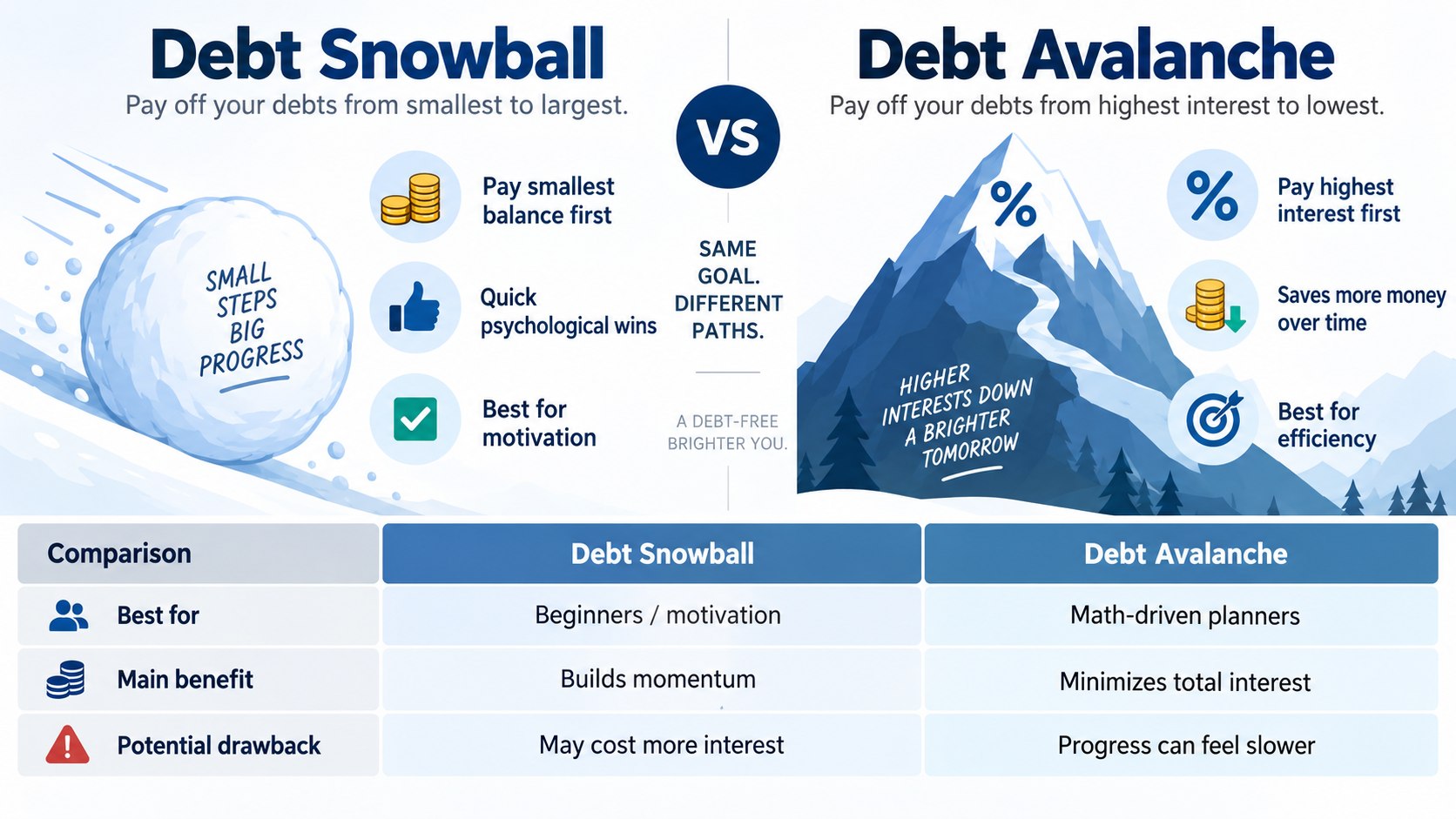
Debt snowball vs avalanche 2026 through actual math
A simple example shows why APR order matters. Assume 3 revolving debts total $13,000, with $650 available for monthly debt payments.
- Card A: $1,200 balance at 18% APR, with a $40 assumed minimum.
- Card B: $4,000 balance at 29% APR, with a $120 assumed minimum.
- Card C: $7,800 balance at 24% APR, with a $230 assumed minimum.
These figures are illustrative, not advertised card terms. Actual minimum-payment formulas and APR calculations vary by issuer. Chase, Citi, Capital One, Discover, and American Express each disclose terms in their card agreements.
Under the avalanche, extra money targets Card B because 29% is the highest APR. Card C comes next at 24%, followed by Card A at 18%.
Under snowball, Card A disappears first because its $1,200 balance is smallest. The plan then moves toward Card B and Card C.
Using monthly interest for a simplified comparison, avalanche clears this example in about 26 months. Estimated interest is about $3,790. Snowball takes roughly 27 months and produces about $3,993 in interest under identical assumptions.
That is roughly $203 more interest for choosing the smaller balance first. Actual statements can differ because cards commonly calculate interest using daily balances.
“The sooner you pay off all or some of your balance, the less interest you will pay.”
Consumer Financial Protection Bureau, consumer guidance on credit-card interest calculations.
The example exposes the cost of carrying a 29% balance while attacking cheaper debt. It also shows that snowball is not automatically disastrous. The difference depends heavily on balances, APR spreads, payments, and payoff time.
Debt avalanche favors math and expensive APRs
The debt avalanche strategy orders debts by interest rate rather than balance. Make minimums everywhere, then direct every extra dollar toward the costliest APR.
This method becomes especially compelling when rates are far apart. Paying a 29% credit card before a 7% personal loan prevents the costlier balance from compounding longer. The advantage grows when the high-rate balance is large.
- List every balance, APR, minimum payment, and due date.
- Set minimum payments on every current account.
- Rank debts from highest APR to lowest APR.
- Send all available extra cash toward the highest-rate balance.
- Roll its former payment into the next debt after payoff.
The process should remain stable unless an APR changes or a promotional period expires. Constantly switching targets weakens the method.
Homeowners planning another mortgage application may also need to consider credit utilization and recent account activity. Baltimore Chronicle’s guide to checking a credit score for free in 2026 explains where reports and scores differ.
Avalanche has one behavioral weakness. A large high-rate balance can take months before the first account reaches $0. Someone carrying $9,000 at 27% may make substantial progress without experiencing a quick account closure.
For a borrower who can follow a spreadsheet without needing frequent milestones, avalanche is usually the stronger default.
Debt snowball favors motivation and visible progress
The debt snowball strategy ignores APR ranking and attacks the smallest balance. Once that account disappears, its previous payment joins the amount targeting the next-smallest debt.
Imagine balances of $350, $1,900, $5,600, and $11,000. Eliminating the $350 account may happen quickly, even when its APR is not highest. That removes one bill from the monthly routine.
The benefit is behavioral rather than mathematical. A borrower who repeatedly starts repayment plans but abandons them may benefit from frequent measurable wins.
CFPB’s consumer guidance describes the same trade-off. Smallest-balance repayment can show progress quickly, while higher-cost debts may continue accumulating interest.
Snowball can create faster progress signals, but expensive balances may keep generating higher costs.
Paraphrase of Consumer Financial Protection Bureau debt-reduction guidance.
Snowball fits people managing numerous modest medical bills, retail cards, and personal balances. It can also simplify a complicated payment calendar.
It fits poorly when one large credit card carries a dramatically higher APR than every other debt. Leaving that account untouched for months can make motivation expensive.
When motivation can beat the cheaper calculation
A spreadsheet assumes every scheduled payment happens. Real households face broken transmissions, child-care bills, reduced work hours, and expensive insurance renewals.
That makes adherence part of the financial calculation. A strategy projected to save $800 is not cheaper when it fails halfway through.
Before choosing a method, look for these signals:
- You have abandoned 2 or more previous payoff plans after several months.
- Removing individual monthly bills gives you a strong sense of progress.
- Your balances are similar enough that APR differences create limited savings.
- You manage many small accounts and want fewer due dates quickly.
- Your income varies and simple targets are easier to maintain.
Those conditions lean toward snowball. A borrower with steady income, strong automation, and large APR differences usually has less reason to sacrifice interest savings.
Freelancers should avoid treating an unsigned contract or expected invoice as available repayment cash. Send irregular income toward debt only after money reaches the account.
A small emergency reserve also matters. Sending the last $1,000 to Visa and then charging a $900 car repair creates little durable progress.
Which should you choose in 2026
For most financially disciplined borrowers, highest interest debt first is the practical default. It directly attacks the balance charging the greatest price for time.
- If APR savings matter most, choose avalanche.
- If previous repayment plans repeatedly failed, consider snowball.
- If one small debt can disappear within weeks, snowball may provide useful momentum.
- If one card has a much higher APR, avalanche deserves priority.
- If minimum payments are unaffordable, contact creditors before choosing either system.
Neither method fixes negative monthly cash flow. If required bills already exceed income, changing payment order only rearranges an unsustainable budget.
Consumers facing unaffordable minimums should contact creditors before missed payments accumulate. The FTC also warns against companies promising easy debt fixes or demanding questionable upfront payments. Its consumer debt guidance explains additional protections and collection issues.
Do not automatically close every paid-off credit card. Annual fees, spending temptation, account history, utilization, and upcoming loan applications can affect that decision.

How to set up either payoff method
The implementation takes one careful review and a short monthly update. Statements should supply the numbers rather than estimates from memory.
- Collect current statements for every credit card and loan.
- Record balances, APRs, minimums, fees, and promotional expiration dates.
- Calculate monthly cash remaining after essential expenses.
- Choose avalanche or snowball and identify one target debt.
- Automate every minimum payment where account cash flow allows.
- Schedule the extra target payment immediately after reliable income arrives.
- Review the plan monthly without changing methods impulsively.
One account can carry different purchase, cash-advance, or promotional APRs. Read the statement carefully before ranking it.
Do not divide an extra $400 evenly across 4 cards merely because equal payments feel balanced. Concentrated payments are what make both snowball and avalanche accelerate.
Bonuses and tax refunds can shorten either schedule. They should supplement the recurring monthly amount, not replace a workable base payment.
FAQ
Is debt snowball or avalanche better in 2026?
Avalanche is usually better when minimizing interest is the main goal. Snowball can be better when quick account payoffs improve consistency.
Does the debt avalanche always save more money?
With identical payments and no changing rates, prioritizing higher APR debt generally reduces interest. The exact savings depend on every balance and rate.
What debt should be paid first with the snowball method?
Pay required minimums on every debt. Direct extra money toward the smallest outstanding balance, regardless of its APR.
What debt should be paid first with the avalanche method?
After all minimums are covered, send extra money toward the debt carrying the highest applicable interest rate.
Can debt snowball improve a credit score faster?
There is no guaranteed score advantage from the method itself. Payment history, reported balances, utilization, and other credit-file factors also matter.
Should emergency savings come before extra debt payments?
Essential expenses and minimum payments come first. A modest cash buffer can prevent an unexpected repair from returning directly to a credit card.
Earlier we wrote about How to Screen a Tenant Legally in USA in 2026: Credit, References and Fair Housing Rules