


How to screen a tenant legally in USA starts with written standards, lawful reports, documented consent, and consistent decisions. A careful screening can take under 1 hour once documents arrive. The process protects both rental income and applicants’ rights, as the Baltimore Chronicle editorial team notes.
The safest rule for 2026 is simple. Decide what qualifies an applicant before seeing names, photos, family status, or other personal details. Then apply those standards to every applicant in the same order.
Key takeaways
- Use the same written income, credit, rental-history, and reference standards for every applicant.
- Consumer reports trigger Fair Credit Reporting Act duties, including notices after certain unfavorable decisions.
- Federal rules are only the baseline. State and city laws can restrict fees, criminal screening, and deposits.
A screening policy should answer predictable questions before applications arrive. It should explain income evidence, credit standards, rental history, references, occupancy rules, and screening fees. Keep the document with the application records for each property. Consistency is easier to prove when the criteria existed before the decision. This also limits impulsive exceptions that create fair-housing problems.
Tenant screening is safer when it measures documented rental risk instead of assumptions about the applicant.
What you need
Prepare the screening file before advertising a house or apartment. Owners planning their first rental can also use Baltimore Chronicle’s 2026 guide to renting out a house.
- A written rental application with consistent questions.
- Published qualification criteria for income, credit, rental history, and occupancy.
- Applicant authorization when required for screening reports.
- A legitimate consumer-reporting service or rental application platform.
- Income documents such as pay stubs, offer letters, tax records, or bank statements.
- Previous landlord contact details and rental addresses.
- A system for recording application dates, decisions, and notices.
- About 30–60 minutes per complete application, excluding delayed reference responses.
Screening costs depend on the service and local law. Zillow lists its reusable rental application at $35 per applicant in 2026. It includes an Experian credit report and background screening. TransUnion SmartMove commonly offers packages in the $25–$49 range, depending on included reports. Always confirm current pricing before charging an applicant. Some states and cities restrict application fees.
That last point matters because screening and move-in charges are different legal categories. A higher deposit cannot automatically replace a weak application. Baltimore Chronicle’s guide to security deposit laws in 2026 explains why state limits must be checked separately.
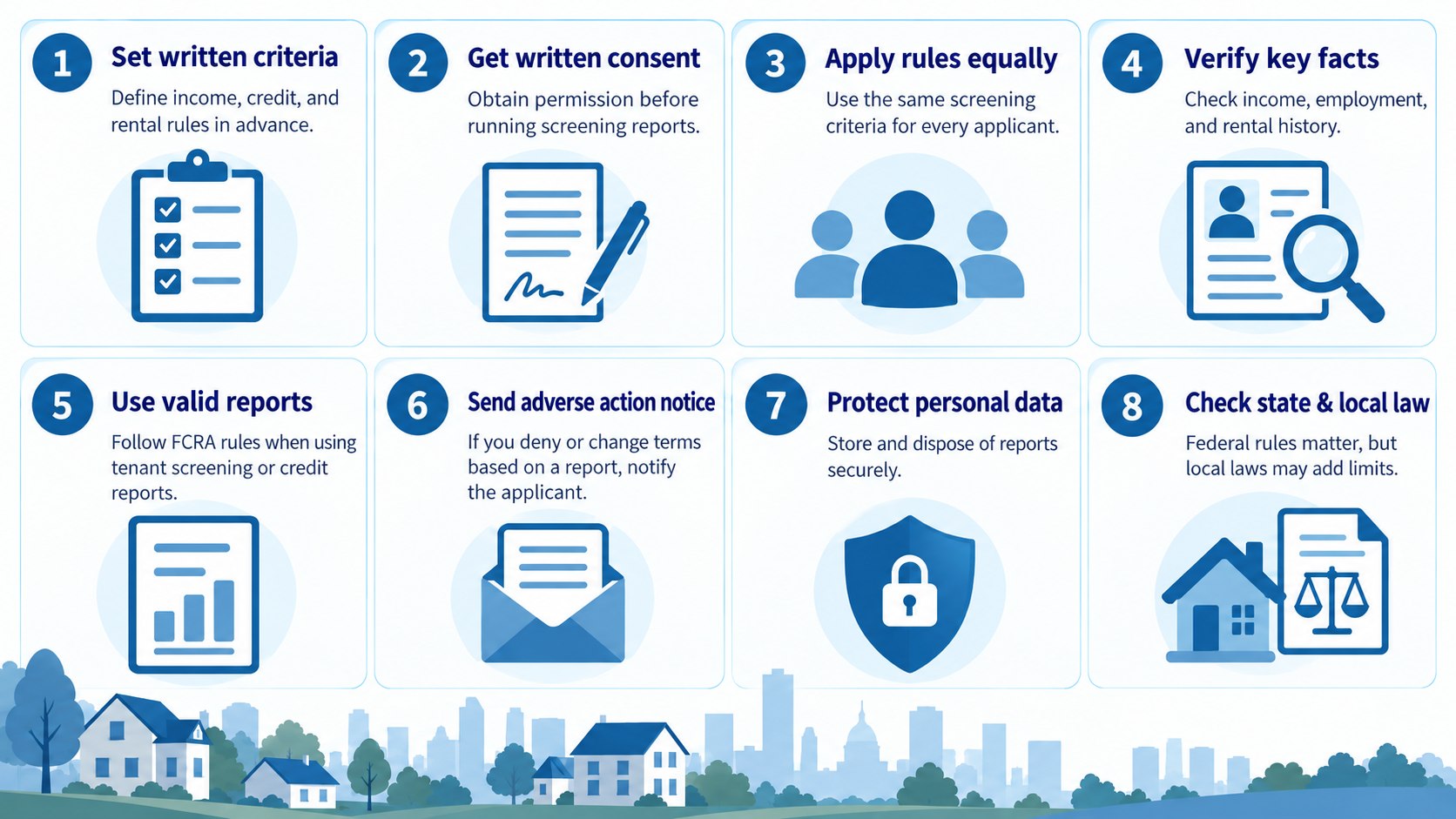
Step 1: Create written screening standards before accepting applications
Write measurable requirements covering income, credit, rental history, references, occupancy, and permitted background information. Avoid standards built around vague concepts such as whether someone “looks responsible.”
The federal Fair Housing Act prohibits housing discrimination based on race, color, national origin, religion, sex, familial status, and disability. HUD summarizes those protections in its official Fair Housing Act guidance. State and local laws may protect additional categories.
“You can only get a consumer report if you have a permissible purpose.”
Federal Trade Commission, guidance for landlords using consumer reports.
A common mistake is changing standards after meeting an applicant. For example, requiring one applicant to earn 3 times rent while accepting 2.5 times from another creates unnecessary legal risk.
Fair housing tenant screening therefore begins before the credit check. The policy itself should be relevant to tenancy, measurable, and applied consistently, mentioned by redaction mypacko.com.
Step 2: Collect the same application information from everyone
Use one application form for comparable applicants. Request information that serves a legitimate rental purpose, including identity, income, residence history, and landlord references.
A practical application can request:
- Legal name and contact information.
- Current and previous rental addresses.
- Employment or other verifiable income sources.
- Expected occupants and move-in date.
- Previous landlord or property manager contacts.
- Consent needed for permitted consumer reports.
Do not ask questions designed to reveal religion, ethnicity, pregnancy, disability, or other protected characteristics. Keep conversations focused on lease obligations and objective qualifications. Ask the same core questions in the same sequence. Record when each complete application was received. Define in advance whether qualified applicants are processed first-complete-first-reviewed or through another lawful system.
Rental references become useful when questions concern payment history, lease compliance, and documented tenancy rather than personality.
A frequent mistake is casual prescreening. A friendly phone call can drift into questions that would never appear on a compliant application.
Step 3: Verify income and rental references without improvising
Confirm whether the applicant meets the income rule already published. Evidence may include recent pay stubs, an employment letter, tax documents, benefit records, or other lawful proof.
Income verification should test ability to pay, not employment prestige. Freelancers, contractors, retirees, and self-employed applicants may document income differently. A rigid demand for only one document can create unnecessary exclusions.
Reference calls should also follow a standard script. Ask previous housing providers factual questions about the tenancy.
- Were rent payments made under the lease terms?
- What were the verified tenancy dates?
- Was documented lease damage charged at move-out?
- Did the tenant provide required notice before leaving?
- Would available records confirm the information supplied?
Document who supplied the reference and when. Independently verify a landlord’s contact information when practical. Applicants can provide outdated numbers, while fraudulent references also exist. Avoid asking a former landlord for opinions about family, disability, nationality, or personal lifestyle. A useful reference concerns the lease relationship. Missing references should be handled under the same written policy for every applicant.
The common mistake is treating a former landlord’s subjective opinion as stronger evidence than payment records and documented lease history.
Step 4: Order credit and background reports through a lawful process
A tenant credit check can reveal payment patterns, collections, debt obligations, and other reportable credit information. It should support a defined standard rather than act as an automatic verdict.
When landlords obtain consumer reports, the Fair Credit Reporting Act applies. The FTC identifies tenant background checks as consumer reports. Its guidance for landlords using consumer reports explains permissible purpose and adverse-action requirements.
Landlords using tenant consumer reports must comply with the Fair Credit Reporting Act.
Federal Trade Commission, Using Consumer Reports: What Landlords Need to Know.
The choice of provider also affects price and workflow. Figures below reflect typical listed 2026 pricing and should be verified before use.
| Service | Approximate 2026 cost | Typical included information | Payment structure |
|---|---|---|---|
| Zillow Rental Manager | $35 | Application, credit, background report | Applicant pays; reusable for 30 days |
| TransUnion SmartMove Basic | About $25 | ResidentScore and criminal report | Landlord or applicant where permitted |
| TransUnion SmartMove Plus | About $40 | Credit, criminal, eviction-related reports | Landlord or applicant where permitted |
| TransUnion SmartMove Premium | About $49 | Expanded reports plus income insights | Landlord or applicant where permitted |
Prices do not determine whether a screening method is legally appropriate. Local law can restrict what a report contains or how much an applicant pays. California, New York, Maryland, and other states use different rental rules. Some cities add further restrictions. Screening companies may filter records differently by jurisdiction. Owners should confirm the settings for the property’s location before ordering reports. The common mistake is assuming a national platform makes every local decision automatically compliant.
Step 5: Evaluate credit, criminal history, and references consistently
The central question is whether the information relates to the written rental criteria. A rental background check should not become a search for reasons to reject someone.
Credit deserves context. A score alone may reveal less than payment history, housing debt, recent collections, or verified income. Apply the same credit threshold and exceptions to comparable applicants.
Criminal-history screening requires particular care. HUD has warned that overly broad screening can create Fair Housing Act concerns. An arrest should not automatically be treated as proof of criminal conduct. Relevant restrictions also vary among states and cities.
The same principle applies to eviction records. A filing does not necessarily prove that a tenant was evicted or owed money. Records can contain errors, duplicate cases, dismissed actions, or mismatched identities.
Credit, eviction, and criminal databases are inputs to a decision. They are not substitutes for a documented screening policy.
For landlords planning rent changes after a new lease term, separate screening rules from pricing decisions. Baltimore Chronicle’s overview of rent increase laws in 2026 covers another area where state rules differ sharply.
The common mistake is using a hidden cutoff that never appeared in the published screening criteria.
Step 6: Approve, condition, or deny the application with a paper trail
Compare the completed file against the criteria. Record the reason for the decision without adding personal judgments that were never part of the policy.
If a consumer report influenced an unfavorable decision, FCRA adverse action notice rules can apply. This includes more than outright rejection. The FTC lists requiring a co-signer or larger deposit among possible adverse actions.
An adverse-action notice must provide required information about the consumer reporting agency. It also tells applicants about dispute and report-access rights. Under FTC guidance, applicants can request a free report from the reporting company within 60 days.
A practical decision file should preserve:
- The application and submission date.
- The version of the screening criteria used.
- Income and reference verification notes.
- The screening provider and report date.
- The objective reason for approval, conditions, or denial.
- Any required adverse-action notice.
Store sensitive information securely and limit access. Screening files can contain Social Security numbers, birth dates, financial records, and addresses. Do not email full reports to unrelated parties. Set a reasonable retention policy based on applicable legal and business requirements. Destroy records securely when retention is no longer necessary. The common mistake is keeping applicant documents indefinitely in an unsecured inbox or shared drive.

Troubleshooting common tenant screening problems
Not every application fits neatly into an automated workflow. These recurring situations require a documented response rather than an improvised exception.
- Tenant screening without credit history: use the same approved alternatives, such as income records, references, or a lawful guarantor policy.
- Applicant disputes a report: direct the applicant to the reporting agency and preserve the original decision records.
- Former landlord does not respond: follow the prewritten rule for unavailable references rather than assuming the worst.
- Income changes monthly: review the same defined evidence period used for other freelancers or self-employed applicants.
- Local law conflicts with platform options: follow the applicable law and disable screening criteria that cannot lawfully be used.
Problems often arise when landlords create a solution for one applicant but refuse it to another. A written alternative-document policy reduces that risk. The same rule should govern applicants with comparable circumstances. Screening software cannot replace local legal requirements. It also cannot verify every record’s accuracy. Keep human review focused on the written criteria and supporting documents.
FAQ about legal tenant screening in the USA
Can a landlord legally run a credit check in 2026?
Yes, when there is a permissible housing purpose and applicable FCRA requirements are followed. A third-party consumer report can also trigger adverse-action obligations.
What should landlords look for in tenant references?
Focus on factual rental history. Useful subjects include payment history, tenancy dates, documented lease compliance, and move-out obligations.
Can a landlord reject anyone with a criminal record?
A blanket rule can create legal problems. Screening should follow applicable federal, state, and local requirements and use relevant, defensible criteria.
Does a low credit score automatically justify rejection?
Not necessarily. The landlord should follow the published credit policy and evaluate the report according to consistent standards.
How much does tenant screening cost in 2026?
Common online services fall around $25–$50 per applicant. Zillow lists $35, while SmartMove packages are roughly $25–$49. Local fee restrictions may apply.
What is the safest way to screen tenants legally?
Use written criteria, identical applications, documented verification, lawful consumer reports, and consistent decision records. Check state and city restrictions before collecting fees.
Earlier we wrote about When Should You Replace an HVAC Filter? 2026 Schedule for Pets, Smoke and Heavy Use