

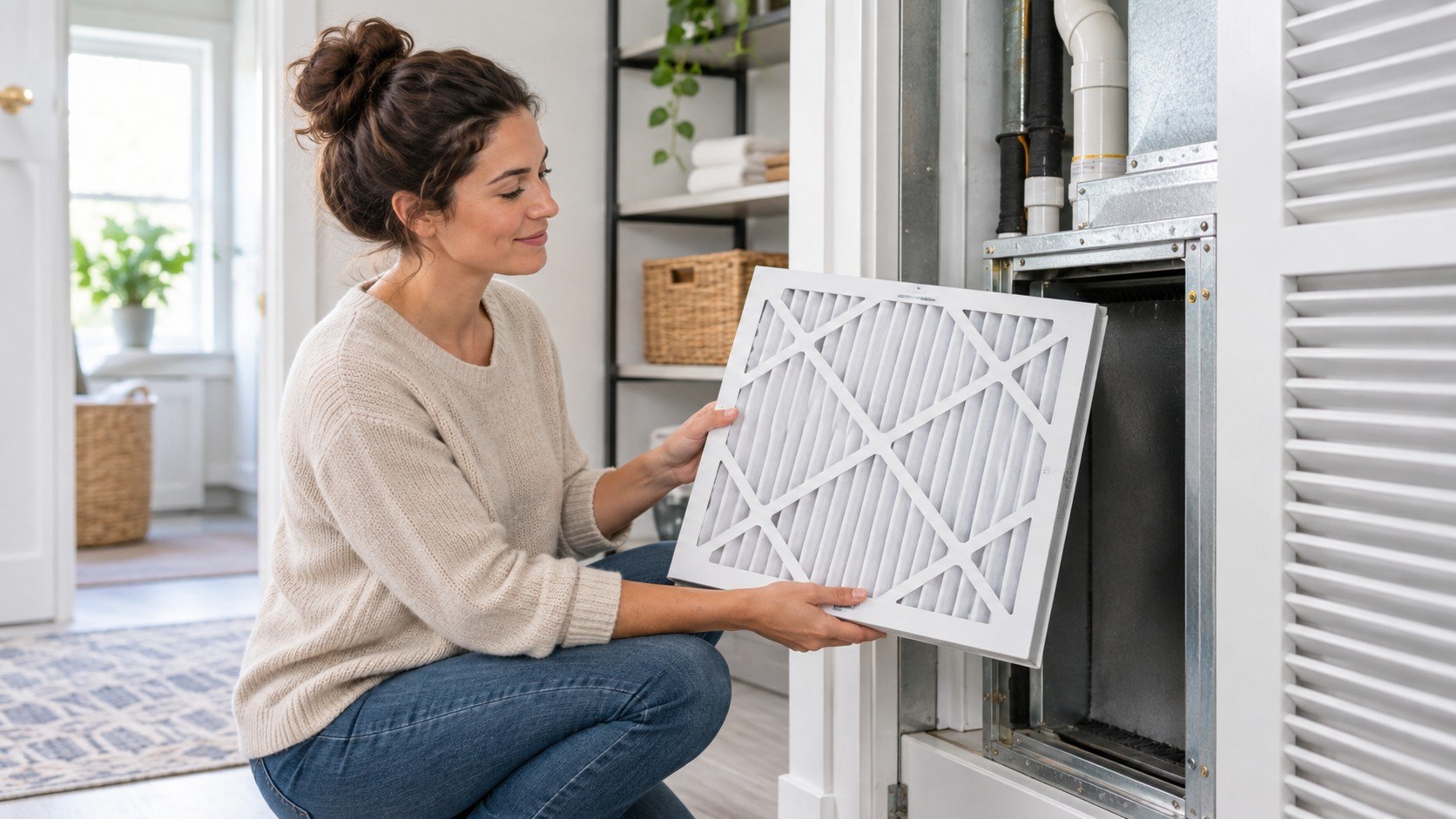
How often to change HVAC air filter depends on filter depth, MERV rating, pets, smoke, and system runtime. Check the filter every 30 days. Replace most 1-inch filters every 30–90 days, while deeper media filters often last 6–12 months, as noted by the Baltimore Chronicle editorial team.
A fixed 90-day rule is too simple for many US homes. A MERV 11 filter in a Maryland townhouse may load faster than the same filter elsewhere. Pets, wildfire smoke, remodeling dust, and continuous fan operation can shorten its useful life.
Key takeaways
- Inspect any central HVAC filter every 30 days, even when its package promises a longer service interval.
- Most 1-inch disposable filters need replacement within 30–90 days under ordinary residential conditions.
- Choose MERV 13 only when the furnace, heat pump, air handler, and filter slot can support it.
The calendar sets the inspection date. The filter’s actual condition should determine the replacement date.
What you need
Changing a furnace or central AC filter requires little equipment. The important details are the correct size and airflow direction.
- Correct replacement filter
- Existing filter dimensions
- HVAC manual or equipment model number
- Flashlight
- Permanent marker or phone reminder
- 5–10 minutes
- About $5–$30 for many common 1-inch filters in 2026
Keep a spare filter near the furnace or air handler if storage conditions are dry. Write the installation date on its cardboard frame. A phone reminder helps households avoid stretching a 90-day filter into 6 months.
Filter prices vary substantially by size, MERV rating, quantity, and brand. Common names include Filtrete, Nordic Pure, Honeywell Home, Filterbuy, and Rheem. Thick media filters usually cost more than basic fiberglass products.
Do not buy solely by the highest number printed on the package. MERV, FPR, and MPR are different rating systems. MERV provides the most useful standardized reference for comparing particle filtration.
Homeowners dealing with broader cooling maintenance can also review this step-by-step air conditioner cleaning guide. Filter replacement cannot correct dirty coils, blocked drains, or mechanical airflow problems.
The filter should also fit without bending or leaving gaps. Air bypassing the frame reduces the value of buying a more efficient filter.
Step 1: Decide how often to change HVAC air filter
Start with a 30-day inspection schedule rather than an automatic replacement schedule. ENERGY STAR advises homeowners to inspect, clean, or change central HVAC filters once each month.
“Inspect, clean, or change air filters once a month.”
This recommendation comes from the ENERGY STAR HVAC maintenance checklist. It applies to central air conditioners, furnaces, and heat pumps.
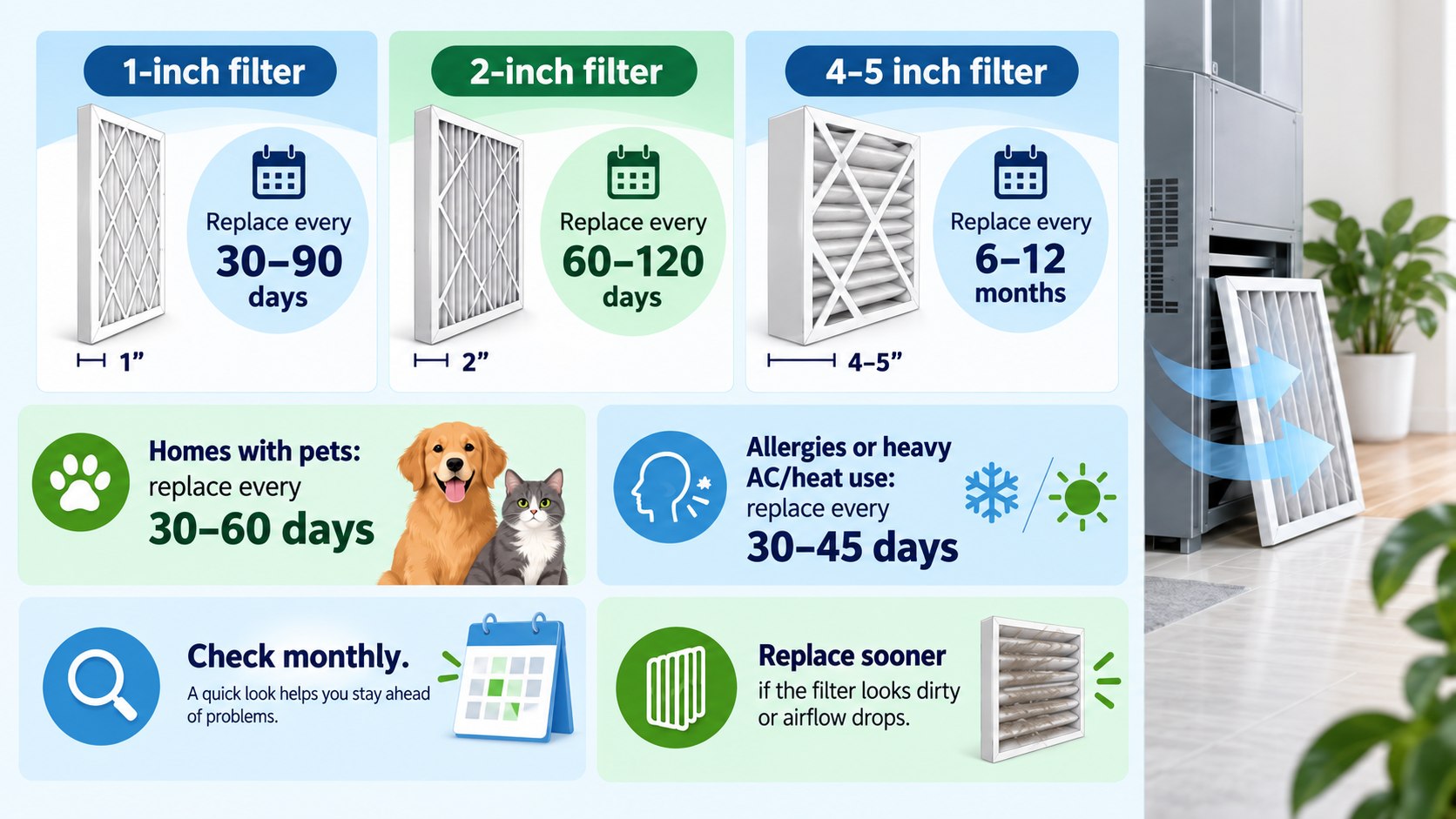
For many ordinary 1-inch pleated filters, a practical replacement window is 30–90 days. A lightly used vacation property may go longer. A busy home with pets may need changes near the lower end.
| Household condition | Inspection schedule | Practical replacement range |
|---|---|---|
| No pets, normal HVAC use | Every 30 days | About 60–90 days |
| 1 pet | Every 30 days | About 45–60 days |
| Several pets | Every 30 days | About 30–45 days |
| Renovation or heavy dust | Every 2–4 weeks | When visibly loaded |
| Wildfire smoke exposure | More frequently during events | Based on loading and airflow |
| 4–5 inch media filter | Monthly visual check | Often 6–12 months |
These ranges are operating guidelines, not universal manufacturer requirements. Filter depth matters because a 4-inch pleated filter has much more media area than many 1-inch products.
Runtime matters too. Florida cooling systems can operate heavily during humid summers. Minnesota furnaces may accumulate more filter hours during long heating seasons.
A home near construction may also collect fine dust quickly. Open windows, candles, cooking particles, and pet hair can add load.
Continuous fan settings move more air through the filter. That can improve filtration, but it can also load the media sooner.
The common mistake is replacing by date without looking at actual conditions. Another mistake is trusting a “90-day” package claim regardless of household use.
Step 2: Match the MERV rating to the HVAC system
Check the current filter and equipment manual before increasing filtration efficiency. MERV rating measures how effectively a filter captures particles across defined size ranges.
The EPA recommends MERV 13, or the highest rating the system can accommodate. Higher efficiency should not come at the expense of required airflow.
“Select a filter rated at least MERV 13 or as high as your system will accommodate.”
The guidance comes from the US Environmental Protection Agency. EPA also advises consulting an HVAC professional when system compatibility is uncertain.
A MERV 8 filter remains common in residential systems. MERV 11 adds finer particle capture. MERV 13 can capture smaller particles more effectively when the equipment supports it.
A higher MERV number is not automatically a better choice for every furnace or air handler.
The common mistake is installing an unusually restrictive filter without checking blower capability. Symptoms can include weak airflow or abnormal system behavior.
Step 3: Read the size and airflow arrow before removal
Turn the HVAC system off at the thermostat before opening the filter compartment. Note the dimensions printed on the existing filter frame.
Common residential sizes include 16x20x1, 16x25x1, and 20x25x1 inches. Nominal dimensions can differ slightly from actual dimensions. Use the size specified for the equipment.
- Locate the filter at the return grille or equipment cabinet.
- Photograph the existing airflow arrow before removing it.
- Pull the filter straight out without dumping loose dust.
- Confirm length, width, and depth before opening the replacement.
- Clean loose debris around the filter slot if accessible.
The arrow normally points toward the blower and away from the return-air side. Installing it backward can increase resistance and reduce proper filter performance.
Some systems use more than one return filter. Others use a single media cabinet beside the furnace. Never assume every house uses the same arrangement.
Renters should also establish who handles filter replacement. Lease terms can assign the task to either the tenant or landlord.
If the filter slot is difficult to locate, check the equipment manual. Forcing panels or removing service covers can expose electrical components.
The common mistake is buying filters from memory. A 20×20 filter will not substitute for a 20×25 opening.
Step 4: Inspect the filter instead of judging only its color
Hold the removed filter under good light. Look for dense dust, matted pet hair, debris, warping, moisture, or damage.
A gray filter is not automatically exhausted. Some media naturally darkens as it collects particles. Airflow restriction and heavy loading matter more than color alone.
- Replace it when dust heavily covers the pleats.
- Replace damaged or collapsed media immediately.
- Investigate any wet filter before installing another.
- Inspect sooner during remodeling, wildfire smoke, or heavy pet shedding.
- Check unusual odors separately rather than blaming the filter automatically.
Moisture deserves attention because a normal return filter should not routinely become wet. Nearby drain problems or condensation may require service.
A clean filter also cannot repair a dirty evaporator coil. It will not solve a failing blower motor or damaged ductwork.
Homeowners comparing maintenance costs with replacement costs can review 2026 HVAC replacement costs in the US. A complete system costs thousands of dollars more than routine filtration maintenance.
Filter condition can also reveal household changes. Construction dust or unusually heavy debris may appear long before another HVAC symptom develops.
The common mistake is waiting until airflow becomes noticeably weak. By then, the filter may have been overloaded for weeks.
Step 5: Install the replacement and record the date
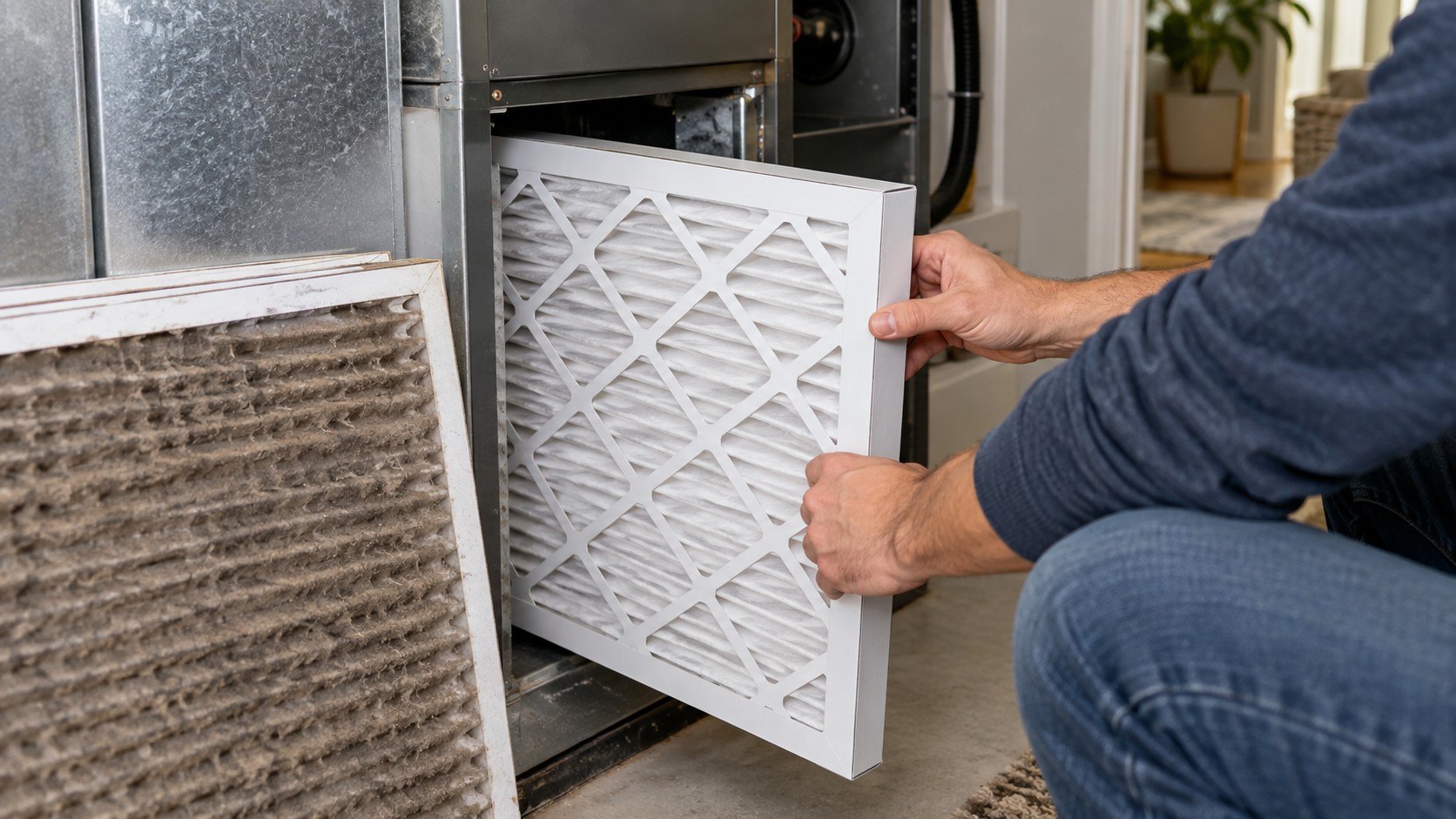
Slide the new filter into the slot with its airflow arrow pointing toward the blower. The frame should sit flat and fit snugly.
For HVAC filter replacement, avoid crushing pleats or forcing an oversized product into the cabinet. Gaps around an undersized filter allow unfiltered air to bypass the media.
Write the installation date on the frame. Then create a 30-day inspection reminder, even if the manufacturer advertises longer service.
In 2026, basic disposable filters can cost only several dollars each. Higher-MERV pleated products commonly cost considerably more. Specialty sizes and thick media filters can reach $30 or more per filter.
Buying multipacks can reduce the per-filter cost. However, stockpiling the wrong size creates no savings.
The common mistake is treating filter price as a direct measure of HVAC compatibility. Brand, package quantity, MERV level, and proprietary ratings all affect price.
Step 6: Build the replacement schedule around your home
A useful air filter replacement schedule starts with monthly inspections. Adjust replacement timing after observing 2 or 3 filter cycles.
A household changing a loaded filter every 40 days should not wait for day 90. Conversely, replacing a nearly clean deep media filter monthly can waste money.
- Check the filter 30 days after installation.
- Photograph its condition for comparison.
- Check again after another 30 days when appropriate.
- Record the actual replacement date.
- Shorten the cycle when seasonal conditions increase dust or smoke.
- Review the schedule after adding pets or changing fan settings.
Seasonal HVAC use changes the equation. Air conditioning demand in Texas or Arizona can create long summer runtimes.
Cold-weather heating can do the same in northern states. A fan set to “On” also processes more air than “Auto” operation.
Filter maintenance may help prevent avoidable airflow problems. ENERGY STAR notes that dirty filters can increase energy costs and contribute to equipment damage.
For a broader look at household HVAC waste, Baltimore Chronicle explains how HVAC use can affect electric bills in 2026.
The common mistake is setting one annual calendar for every season. Heavy cooling or heating months can require faster replacement.
Troubleshooting common HVAC filter problems
A fresh filter should fit cleanly and allow normal system operation. Persistent symptoms can point to problems beyond routine maintenance.
- Filter turns dirty within weeks: inspect for renovation dust, pets, open windows, smoke, or unusually long fan runtime.
- Filter bends or gets pulled inward: verify size, installation, filter restriction, and system airflow.
- Airflow stays weak after replacement: dirty coils, duct restrictions, blower issues, or closed registers may be involved.
- Filter is wet: check condensate drainage and nearby moisture sources before installing another dry filter.
- Dust returns quickly: inspect filter fit and confirm air cannot bypass gaps around the frame.
A technician becomes appropriate when changing the filter does not restore normal airflow. Repeated icing, water leakage, burning smells, and unusual noises also need diagnosis.
Do not increase MERV ratings repeatedly to solve visible dust without checking the system. Some household dust settles before reaching a central return.
Portable air cleaners can supplement central filtration in specific rooms. EPA distinguishes these devices from furnace and central HVAC filters.
HEPA filtration is common in portable air cleaners. Standard residential HVAC equipment should not automatically receive a HEPA-style filter.
For most households, furnace filter replacement remains a simple maintenance task. The harder question is selecting a schedule that matches actual system use.
FAQ
How often should a 1-inch HVAC filter be changed?
Many 1-inch pleated filters need replacement every 30–90 days. Inspect them every 30 days and shorten the interval when loading appears quickly.
Does a MERV 13 filter need changing more often?
Not automatically. Replacement depends on filter area, airflow, dust loading, runtime, and manufacturer instructions. Higher efficiency also requires system compatibility.
How often should you replace an HVAC filter with pets?
Start with a 30-day inspection. Homes with several shedding pets may need replacement every 30–45 days, depending on actual filter loading.
Can a dirty filter increase an electric bill?
Yes. Restricted airflow can make HVAC operation less efficient. ENERGY STAR warns that dirty filters can increase energy costs and harm equipment.
Should an HVAC filter be changed every month?
Every filter should be inspected monthly. Actual replacement can occur later when the filter remains clean and the manufacturer allows a longer interval.
Is MERV 13 always better than MERV 8?
No. MERV 13 captures smaller particles more effectively, but the HVAC system must support its airflow requirements. Use the highest suitable rating for the equipment.
Earlier we wrote about Apple Shared Photo Library in 2026: How iPhone Invites, Storage and Permissions Work