


Can a landlord raise rent in USA 2026? Usually yes, but not whenever or however the landlord wants. A fixed lease often protects the current rent until renewal. Month-to-month tenants can face increases after legally required notice. State and local rules may also cap the amount, as noted by the editorial team at Baltimore Chronicle.
The practical answer depends on 4 questions: where the property is located, what the lease says, how much rent increases, and when notice arrives. California, New York, Oregon, and Maryland illustrate how different those rules can be. A tenant receiving a $200 increase should therefore check the lease before deciding whether the notice is valid.
Key takeaways
- Most private US landlords can raise rent after a lease ends, but state and local restrictions can limit the increase.
- Notice periods commonly range from 30 to 90 days, although several states use different rules based on tenancy length.
- A rent increase may be invalid if it violates a fixed lease, rent-control law, notice requirement, or anti-retaliation protection.
In plain English
Think of a lease as a price agreement with an expiration date. If a tenant signs for 12 months at $1,800 monthly, that price normally lasts through the agreed term.
The landlord generally cannot simply announce $2,000 rent halfway through that lease. An exception may exist if the written agreement specifically permits an adjustment allowed by applicable law. Once the lease expires, different rules apply.
The legal question is not only whether rent can rise. The timing, notice method, tenancy type, and local law matter just as much.
Month-to-month arrangements work differently. They continue without a new annual contract, so rent can often change after proper advance notice. That flexibility exists for both sides.
For renters comparing lease costs, Baltimore Chronicle’s guide to renting in Baltimore explains how deposits, utilities, parking, and neighborhood prices affect the real monthly bill.
“Legal” does not automatically mean “immediate.” A landlord may have authority to increase rent but still provide an invalid notice.
That distinction explains many disputes involving rent increase laws in 2026.
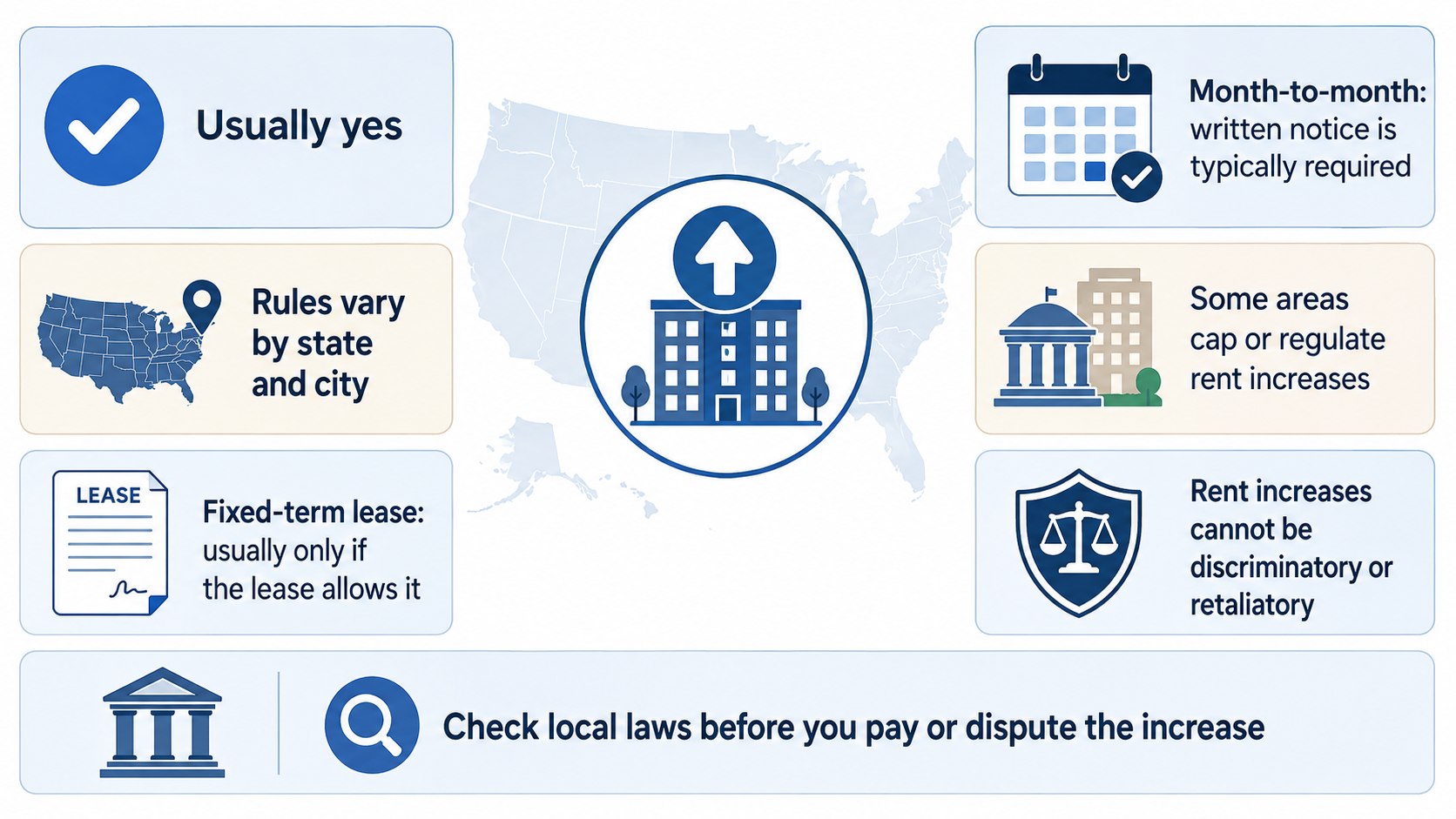
How it actually works
A rent increase normally begins with the lease. Check the current rent, lease expiration date, renewal provisions, and any clauses covering adjustments.
For a fixed-term lease, the landlord usually proposes the higher price for the next term. The tenant can accept, negotiate, or leave according to the lease and applicable notice rules. Rent-controlled housing may provide additional protections.
Month-to-month tenants need to identify the notice rule in their state and city. Some jurisdictions use a standard period. Others change the deadline according to tenancy length or percentage increase.
A practical review follows this order:
- Confirm whether the tenancy is fixed-term or month-to-month.
- Read the lease provisions covering rent and renewal.
- Calculate the percentage increase from the current lawful rent.
- Check state, county, and city rules for caps and notice periods.
- Keep the notice, envelope, email, portal message, and lease copy.
After those steps, compare the effective date with the legal notice period. Do not calculate only from the next rent-due date. Several statutes count actual days before an increase becomes effective.
A $150 increase on $2,000 rent equals 7.5%. A jump from $2,000 to $2,400 equals 20%. That difference can trigger different rules in states such as California.
The form of notice can also matter. Maryland law, for example, requires written notice and specifies permitted delivery methods for residential leases.
Tenants dealing with deposits at the same time can also review 2026 security deposit rules. Deposit limits and rent-increase limits are separate legal questions.
Can a landlord raise rent in USA 2026 by any amount?
There is no single nationwide percentage that governs every private residential rental. How much can a landlord raise rent depends mainly on state and local law.
California provides a prominent statewide example. Under the Tenant Protection Act, many covered properties generally face an annual cap. It is 5% plus the applicable cost-of-living change, or 10%, whichever is lower.
The California Attorney General confirmed these limits in updated July 2026 guidance. Local ordinances can establish stricter limits.
Oregon also uses a statewide formula for many covered tenancies. The maximum allowable increase for many covered Oregon rentals is 9.5% during 2026. Certain manufactured-home facilities are subject to a 6% limit.
New York takes another approach. Rent-stabilized apartments follow regulated increases. Many market-rate apartments do not have the same percentage cap.
Location can change the answer from “yes” to “yes, but only within a cap” within the same national rental market.
The examples below show why a national answer needs state-level context.
| State | Selected 2026 rule | Typical notice issue |
|---|---|---|
| California | Many covered units face a statewide annual cap | 30 days for increases of 10% or less; 90 days above 10% |
| New York | Regulated units have separate limits | More than 5% can require 30, 60, or 90 days |
| Oregon | Many covered rentals have a 9.5% 2026 maximum | State notice requirements apply before increases |
| Maryland | No single statewide percentage cap for ordinary rentals | Often 90 days for tenancies longer than 1 month |
| Texas | No general statewide rent-control cap | Lease terms and lawful notice remain central |
| Florida | No general statewide percentage cap | Local and lease requirements must still be checked |
This comparison is not a substitute for city rules. Los Angeles, New York City, and other jurisdictions can regulate housing beyond statewide standards.
Property type matters as well. Subsidized housing, mobile-home communities, rent-stabilized apartments, and newer buildings may follow different frameworks. Certain owner-occupied properties can also qualify for exemptions.
The safest comparison uses the exact address and property category. A state rule alone may not answer the entire question.
Rent increase notice periods by state
Landlord rent increase notice requirements can determine whether an otherwise permitted increase takes effect on the proposed date.
California generally requires written notice at least 30 days before an increase of 10% or less. An increase exceeding 10% generally requires 90 days. Mailing can add additional time.
New York uses another system for increases above 5% in many non-regulated apartments. Notice depends on how long the tenant has occupied the home.
The typical New York schedule is:
- Less than 1 year of occupancy: at least 30 days.
- More than 1 year but less than 2 years: at least 60 days.
- At least 2 years: at least 90 days.
- Rent-stabilized housing follows additional renewal and increase rules.
Those periods also demonstrate why a verbal conversation may not settle the issue. Written notice creates a record of the proposed rent and effective date.
Maryland provides another useful contrast. State law generally requires 90 days for a residential tenancy longer than 1 month. Tenancies longer than 1 week but not exceeding 1 month generally receive 60 days.
For weekly arrangements, Maryland uses shorter periods. A written weekly lease generally requires 7 days. Certain weekly tenancies without a written lease require 21 days.
The underlying Maryland provisions appear in the state’s Real Property §8-209. Local ordinances can provide stronger protections.
Who it matters to in 2026
Renters approaching lease renewal
A tenant receiving a renewal offer should compare the new price with the existing lease before signing. Check whether the landlord supplied enough notice under state and city law.
Suppose monthly rent rises from $1,900 to $2,050. The increase is $150, or about 7.9%. Whether that amount is lawful depends on the property location and regulatory status.
For renters already facing property-condition disputes, retaliation rules also deserve attention. Baltimore’s recent housing enforcement issues show why licensing and tenant protections can intersect. Baltimore Chronicle has reported on alleged unsafe and unlicensed rental practices.
Landlords setting renewal prices
Owners should not treat market rent as automatic permission to charge any new amount. A comparable apartment renting for $2,300 does not erase a statutory cap on a $1,900 tenancy.
The correct process begins before the renewal deadline. Owners need the lawful maximum, required notice period, permitted delivery method, and lease terms.
Documenting the calculation and delivery date can prevent a routine renewal from becoming an avoidable dispute.
Month-to-month tenants
Month-to-month renters have fewer long-term price guarantees than tenants with active fixed leases. However, that does not mean rent can change overnight.
Proper notice remains essential. Some jurisdictions also restrict increases through rent stabilization, anti-gouging rules, or local tenant protections.
A tenant should preserve every version of the agreement. Payment records can help establish the existing rental rate if the parties disagree.
When a rent increase may be challenged
Not every rent increase notice period dispute is about the number of days. The landlord’s reason and the property’s legal status can matter.
Several warning signs deserve closer review:
- The increase begins before an active fixed-term lease expires.
- The amount exceeds an applicable state or local rent cap.
- Required written notice was never delivered.
- The effective date provides fewer days than state law requires.
- The increase follows a protected tenant complaint and appears retaliatory.
- The property receives subsidies or belongs to a regulated housing program.
- The notice misstates the current rent or percentage calculation.
A tenant who identifies one of these problems should avoid relying on an informal assumption. Keep paying the undisputed lawful rent unless qualified legal guidance says otherwise.
State housing agencies, attorney general offices, legal-aid organizations, and local housing departments can explain jurisdiction-specific procedures. A defective notice may delay an increase rather than permanently prohibit one.
Landlords also benefit from correcting defective notices early. Trying to enforce the wrong effective date can create payment disputes and complicate later proceedings.
Retaliation rules deserve separate attention. Raising rent because a tenant made a good-faith safety complaint can violate state law even where ordinary increases remain legal.
A market-rate unit can still carry legal restrictions concerning notice, retaliation, discrimination, lease terms, or local housing regulations.

Common myths
Several assumptions repeatedly create confusion about tenant rights rent increase rules.
- “There is a federal 10% limit.” No universal 10% cap applies to every private rental nationwide.
- “A landlord can change rent anytime.” A fixed lease usually prevents unilateral mid-term increases without lawful authorization.
- “30 days is always enough.” California, New York, Maryland, and other states can require longer periods.
- “No rent control means no rules.” Notice, retaliation, discrimination, and contract rules can still restrict an increase.
- “A text message always counts as notice.” Delivery requirements depend on state law and the specific tenancy.
The lease remains the first document to read. State statutes come next, followed by county and municipal ordinances.
Rent-control status should also be confirmed rather than assumed. Two apartments several blocks apart may fall under different rules because of building age or jurisdiction.
Keep copies of communications and proof of payment. A clear paper trail helps establish both the old rent and the date a new demand arrived.
For substantial increases, legal-aid advice can be more useful than general online calculators. The exact address often determines which local protections apply.
FAQ
Can a landlord raise rent during a 12-month lease in 2026?
Usually not when the lease fixes rent for the entire term. An increase may be possible if the agreement contains a lawful adjustment provision.
Can a landlord raise rent without notice?
Generally, a landlord must follow applicable notice requirements before changing rent for an existing tenancy. The required period depends on state and local law.
Is there a maximum rent increase in the United States?
There is no single nationwide maximum for every private rental. California and Oregon have statewide restrictions covering many units. Other states rely more heavily on local rules.
How much notice must a landlord give before raising rent?
It can range widely. Some increases require about 30 days, while certain situations require 60 or 90 days. Maryland commonly requires 90 days for tenancies exceeding 1 month.
Can rent be increased because a tenant complained about repairs?
A retaliatory increase can violate state law when connected to protected complaints or enforcement activity. Tenants should preserve written evidence of both the complaint and increase.
What should a tenant do after receiving a rent increase?
Read the lease first. Then calculate the percentage increase and check state and local rules. Preserve the notice and verify the effective date before responding.
Earlier we wrote about Why Is Your Electric Bill High in 2026? US Rates, HVAC Waste and Peak-Hour Fixes