

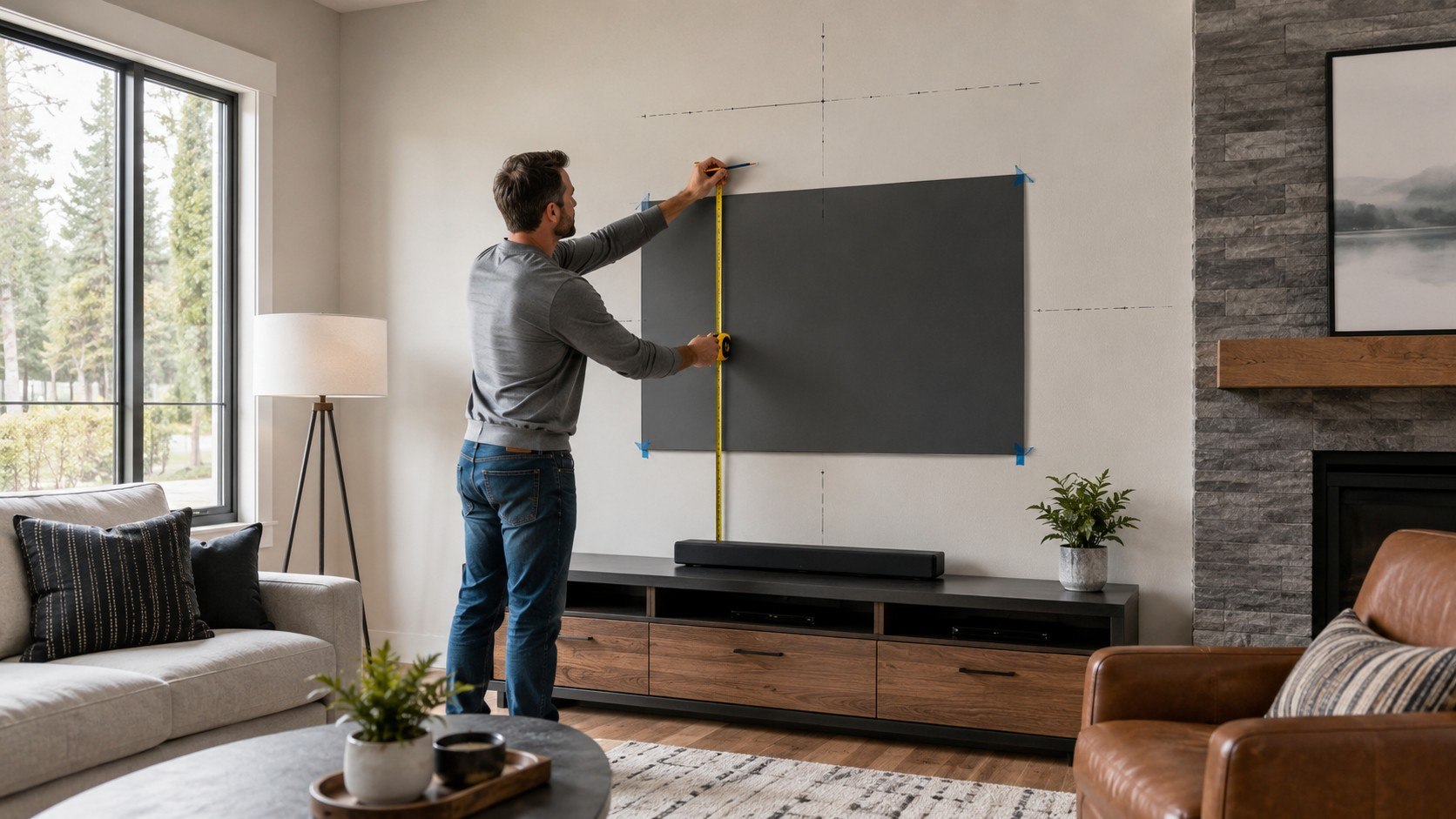
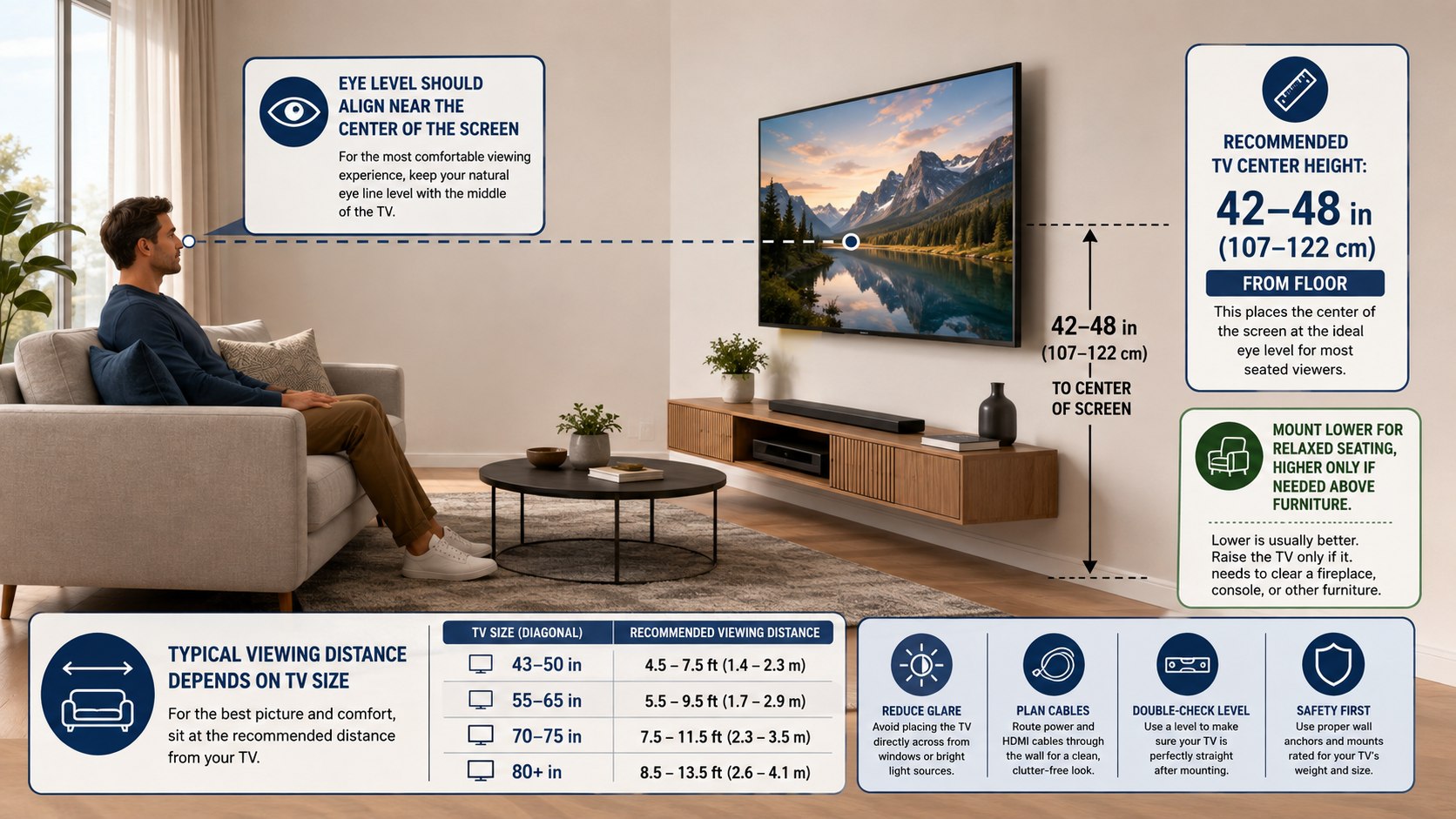
Standard TV height for living room 2026 means placing the screen center close to seated eye level, usually around 42 inches from the floor. It is a starting point, not a universal building standard. The correct height depends on sofa height, viewer posture, screen size, and mounting location, as noted by Baltimore Chronicle.
For most US living rooms, sit where television viewing normally happens and measure from the floor to the viewer’s eyes. Use that number as the target for the screen center. A 40–44-inch center height suits many conventional sofas, while reclining seating can justify a slightly higher position.
The strongest practical rule is simple: measure the person and the seat before measuring the wall.
Samsung’s official US mounting guidance gives about 42 inches from the floor to the television center as a useful living-room reference. The company also recommends measuring actual seated eye level when possible.
Key takeaways
- Start near 42 inches from the floor to the screen center, then adjust for actual seated eye level.
- Measure from the sofa first because seat height and reclining angle matter more than the television’s diagonal size.
- Avoid automatically centering a television between floor and ceiling, especially above fireplaces or tall media consoles.
A larger television does not automatically need a higher screen center. In fact, keeping the center near eye level means larger screens extend farther downward. That detail prevents the common mistake of raising every 75-inch or 85-inch television simply because it looks large. Furniture underneath can force a compromise. A modest downward tilt can sometimes compensate for a slightly higher installation. The final position should still feel natural during a full movie, not only while standing in the room.
The useful measurement is floor-to-eye height while seated, not the decorative midpoint of the wall.
In plain English
Think of a television like a large framed picture that must meet your eyes rather than decorate empty wall space. When sitting normally, the middle portion of the screen should appear almost straight ahead.
This explains why a television mounted high over a fireplace can look balanced while someone stands nearby. Once that person sits, the screen may require an upward head angle for hours. Samsung specifically warns that fireplace installations often place televisions above normal seated eye level. It also advises considering heat exposure before choosing that location.
The same principle applies in Maryland, Texas, California, Florida, and every other state. There is no single national residential rule that makes 42 inches mandatory for ordinary living rooms. Ideal TV mounting height is primarily an ergonomic and room-layout decision.
Renters have another constraint. Wall construction and lease terms can matter as much as screen height. Baltimore Chronicle’s guide to mounting a TV on drywall safely explains why bracket design, studs, anchors, and television weight must be considered together.
How it actually works
Start from the viewing position, not from the television. Sit naturally on the main sofa or chair. Avoid sitting unusually upright just for the measurement.
Measure from the finished floor to eye level. If 2 adults use the room equally, measure both and choose a practical midpoint. Families can prioritize the adults’ normal viewing position because children often sit at different heights.
Next, mark that eye-level number on the wall with painter’s tape. That mark represents the proposed center of the screen. It is the most useful reference for TV height from floor calculations.
Then measure the television’s actual vertical screen height. Do not use the advertised diagonal measurement. A 65-inch television describes its diagonal, not its height.
Use this sequence before drilling:
- Measure seated eye level from the finished floor.
- Mark that height on the proposed television wall.
- Measure the television vertically from its top edge to bottom edge.
- Confirm where the bracket attaches relative to the screen center.
- Tape the television outline on the wall and sit down again.
- Check the console, soundbar, outlets, cables, and mounting hardware.
The outline test catches mistakes before expensive hardware reaches drywall. A 2-inch change can noticeably affect the space below a large screen. A soundbar may need several inches of clearance. Some mounts also position the bracket plate away from the screen’s exact midpoint. Electrical outlets can interfere with the bracket. Full-motion arms create different structural demands than fixed mounts. Baltimore Chronicle’s 2026 furniture retailer guide can help when the media console also needs replacement.
TV height guide by screen size
The figures below assume a 16:9 screen and a 42-inch screen-center target. Actual television dimensions vary slightly because bezels and chassis designs differ.
| TV size | Approx. screen height | Center target | Approx. bottom edge |
|---|---|---|---|
| 43 inches | 21.1 inches | 42 inches | 31.5 inches |
| 50 inches | 24.5 inches | 42 inches | 29.8 inches |
| 55 inches | 27.0 inches | 42 inches | 28.5 inches |
| 65 inches | 31.9 inches | 42 inches | 26.1 inches |
| 75 inches | 36.8 inches | 42 inches | 23.6 inches |
| 85 inches | 41.7 inches | 42 inches | 21.2 inches |
These measurements show why screen size should not dictate center height by itself. An 85-inch set can have the same 42-inch center target as a 55-inch model. Its bottom edge simply sits lower. A 30-inch-tall console may therefore conflict with the ideal position. Moving the screen upward can solve the furniture conflict but changes the viewing angle. Replacing an overly tall console may produce a better result. Always measure the physical television before drilling because product dimensions differ.
Standard TV height for living room 2026 by eye level
The best TV eye level measurement comes from the person who actually uses the room. A generic number becomes less reliable when furniture departs from conventional sofa dimensions.
Consider a sofa where seated eye level measures 39 inches. Setting the screen center at 42 inches creates only a small upward shift. That may remain comfortable, especially when the viewer reclines slightly.
Now consider a taller sectional where eye level measures 45 inches. Mounting at 42 inches could place the screen below the viewer’s natural sightline. Raising the center closer to 44–45 inches is more logical.
The measure rule can be written in one line:
Screen-center target = seated eye height, adjusted modestly for normal reclining posture and room constraints.
Samsung’s US support guidance follows the same basic approach. It recommends having someone measure floor-to-eye height while the viewer sits in the preferred position. Its 42-inch figure serves as an approximate fallback rather than a compulsory measurement.
If the screen looks perfect while standing but too high while seated, the wall was measured from the wrong perspective.
Who it matters to in 2026
Homeowners installing 65-inch and larger TVs
Larger screens magnify planning mistakes because they occupy more vertical wall area. A 65-inch TV mounting height should still begin with eye level rather than an arbitrary high-wall position.
Samsung also recommends considering viewing distance. Its current guidance calculates distance by dividing television size by 0.55. That works out to roughly 118 inches for a 65-inch screen and 136 inches for a 75-inch model.
That formula is a manufacturer recommendation rather than a federal requirement. Room dimensions can make a different distance unavoidable. A smaller room does not automatically require raising the television.
Renters and apartment residents
Renters in Baltimore, New York, Boston, Chicago, and other dense cities often face plaster, drywall, metal studs, or restrictive lease terms. Height is only one part of the installation decision.
A freestanding media stand can eliminate wall drilling. It also makes future moves easier. For households still choosing seating, Baltimore Chronicle’s guide to buying a sofa online explains how seat depth and room measurements affect layout.
Parents and shared households
Families rarely have one perfect eye height. Adults, teenagers, and children may all use the same screen from different seats.
Choose the primary viewing position first. Then test the proposed screen outline from secondary seats. A slightly larger viewing distance often reduces the effect of small height differences.
When furniture changes the answer
A media console often determines whether the theoretical height works in practice. Samsung suggests leaving roughly 4–6 inches between the television and furniture when the usual 42-inch center position creates insufficient space.
That does not mean every screen requires exactly 4–6 inches. Soundbars, center speakers, game consoles, decorative objects, and ventilation needs can change the arrangement.
Use these checks before choosing a final position:
- Confirm the console’s finished height.
- Leave space for a soundbar without blocking the screen.
- Check that cabinet doors can open normally.
- Keep cables away from pinch points.
- Confirm the mount reaches appropriate framing or approved anchors.
- Locate electrical outlets before drilling.
- Test glare from windows during daytime viewing.
Furniture should support the viewing position rather than push the screen toward the ceiling. A low console usually provides more flexibility with 75-inch and 85-inch televisions. Floating cabinets can also preserve wall space. Tall dressers are harder to combine with eye-level mounting. Soundbars need enough clearance for controls and upward-firing speakers. Console depth also affects how close the screen appears to the seating area. The best arrangement balances eye level, equipment clearance, structure, and traffic flow.
Common myths
Several familiar rules about how high to mount a TV sound precise but fail once real rooms are measured.
- “The center must always be exactly 42 inches.” Correction: 42 inches is a useful reference, not a universal requirement.
- “Bigger televisions should always hang higher.” Correction: screen center can remain near the same eye-level target.
- “The television should be centered on the wall.” Correction: seating position matters more than decorative wall symmetry.
- “Above the fireplace is the premium location.” Correction: heat and high viewing angles can make it unsuitable.
- “Tilting fixes any mounting height.” Correction: tilt helps moderate compromises but cannot fully correct an excessively high screen.
The myths share one problem: they begin with the wall instead of the viewer. Large US living rooms sometimes tolerate greater mounting flexibility because seating sits farther away. Small apartments usually make poor angles more obvious. Fireplace placement introduces heat as another variable. Full-motion mounts add leverage and require careful structural installation. Television model manuals should always be checked for bracket compatibility and ventilation. Eye level remains the strongest first measurement for a conventional living room.
Earlier we wrote about When Should You Replace a Microwave? 2026 Lifespan, Safety Checks and Repair Costs