

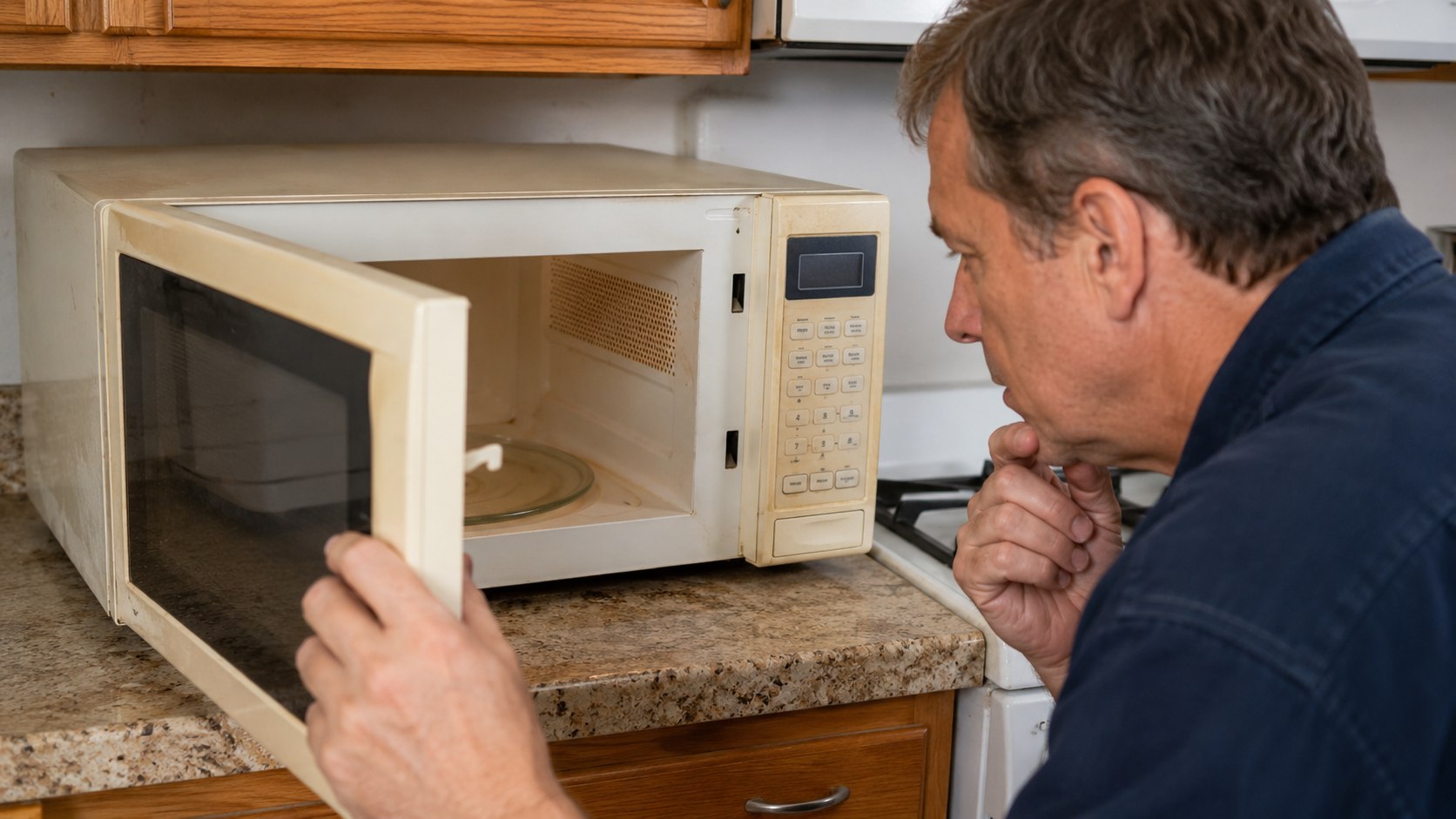
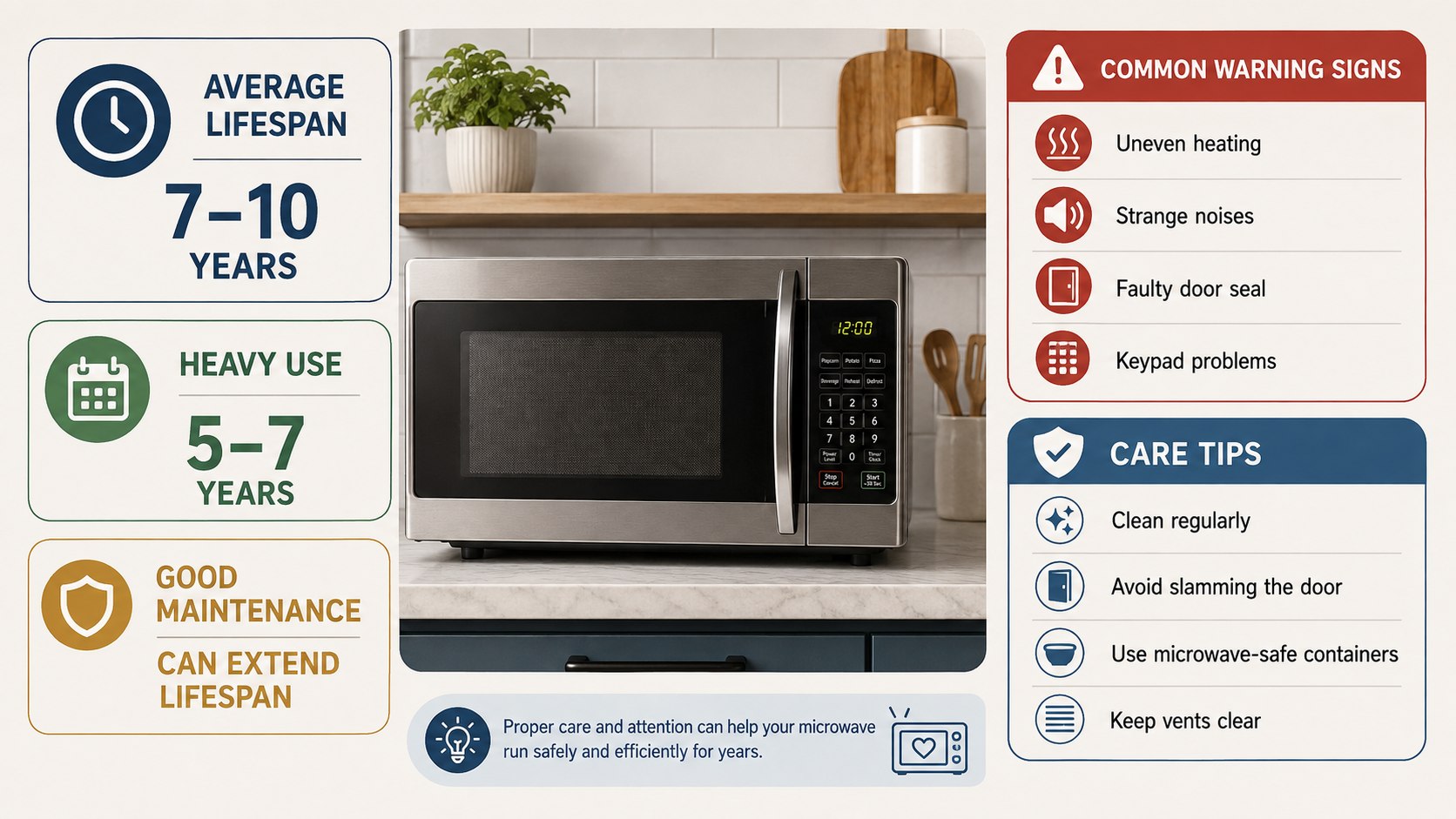
How long do microwaves last 2026 means the realistic service life of a household microwave before reliability, safety, or repair costs justify replacement. Most US households can expect roughly 7–10 years from a conventional microwave under normal use. Heavy daily use may shorten that lifespan, while a lightly used countertop model can last longer. If an older unit heats slowly, makes new noises, smells burned, or has door damage, replacement deserves serious consideration, as noted by Baltimore Chronicle.
A microwave does not become unsafe simply because it reaches a certain age. Magnetrons, switches, cooling fans, capacitors, door hardware, and electronic controls wear at different rates. A 9-year-old appliance that works normally can remain useful, while a 4-year-old model with a damaged latch may need immediate service.
Key takeaways
- Most household microwaves provide about 7–10 years of practical service, depending on use, maintenance, and design.
- Weak heating, electrical odors, unusual noises, control failures, and door damage are stronger warning signs than age alone.
- Repair often makes more sense on newer built-in units, while inexpensive countertop models may be cheaper to replace.
In plain English
Think of a microwave like a compact car used for hundreds of short trips. It is not running all day, but every start creates heat and electrical stress. Inside a microwave, the magnetron produces microwave energy while fans, relays, switches, and controls support each cooking cycle.
A household reheating 2 dinners each evening places less stress on the appliance than a family using it 10 times a day. Office break rooms and large households can accumulate years of residential-level use much faster.
Microwave age is a useful benchmark, not an expiration date printed on the appliance.
Design also affects longevity. A basic countertop microwave has relatively few integrated systems. An over-the-range model combines cooking, ventilation, lighting, and mounting hardware, while a built-in unit may involve custom trim and cabinetry.
How long do microwaves last 2026 by type?
The practical average microwave lifespan depends on construction, cooking frequency, ventilation, cleanliness, and repair history. Around 7–10 years remains a useful planning range for conventional household models, although it is not a manufacturer guarantee.
Replacement prices in 2026 vary significantly by size, finish, power, features, ZIP code, and installation needs.
| Microwave type | Practical lifespan | Typical 2026 US replacement cost | Main consideration |
|---|---|---|---|
| Countertop | About 6–10 years | About $80–$300 | Low replacement cost can make major repairs uneconomical |
| Over-the-range | About 7–10 years | About $200–$700+ | Installation and ventilation add expense |
| Built-in | About 8–12 years | About $500–$2,000+ | Cabinet fit can make repair more attractive |
| Premium speed oven | Varies by design and use | About $1,000–$3,500+ | More electronics and cooking systems increase complexity |
Price differences matter when deciding whether to repair. Spending $180 on a 9-year-old countertop microwave that originally cost $120 is usually difficult to justify. The same repair bill may be reasonable for a newer built-in model installed in custom cabinetry.
Over-the-range owners also have to consider removal and mounting. Baltimore Chronicle’s guide to installing an over-the-range microwave explains venting, brackets, cabinet preparation, and electrical access.
Location affects labor costs more than appliance lifespan. Service prices can differ between Maryland, California, Texas, Florida, and smaller US markets. Parts availability also varies between brands and individual model lines.
Households replacing several aging appliances can also compare Baltimore Chronicle’s 2026 refrigerator brand guide. Repair access and parts availability can matter almost as much as the initial price.
How it actually works
A microwave starts a cooking cycle only after its control system confirms that the door is securely closed. Safety interlocks are designed to stop microwave production when the door opens. The magnetron then converts electrical energy into microwave energy.
Those microwaves reflect inside the metal cavity and transfer energy into food. Water molecules respond to that energy, producing heat. The US Food and Drug Administration explains microwave operation and safety on its official microwave oven guidance page.
“Microwave energy will not leak from a microwave in good condition.”
US Food and Drug Administration, consumer guidance on microwave ovens.
Heating performance depends heavily on the magnetron and high-voltage components. Fans remove heat from internal parts, while turntable motors or distribution systems help expose food more evenly to microwave energy.
Door switches also operate every time the appliance opens and closes. Over thousands of cycles, one component may fail before the rest of the machine.
A worn switch can stop operation completely. A weakening magnetron may cause poor heating, while a deteriorating fan can lead to overheating or unfamiliar noise.
A microwave that still lights up is not necessarily a microwave that still works correctly.
Signs your microwave is reaching the end
The most useful signs a microwave needs replacing are changes in behavior. Compare current performance with how the appliance worked 6 or 12 months earlier. A cup of water taking noticeably longer to heat can indicate declining performance.
Several symptoms justify troubleshooting or professional service:
- Microwave not heating properly despite normal settings and suitable cookware.
- New buzzing, grinding, rattling, or unusually loud fan noise.
- Burning odors, visible scorching, smoke, or repeated electrical smells.
- Controls freezing, restarting, or failing to respond.
- Intermittent turntable movement without an obvious obstruction.
- Damaged door latches, hinges, seals, or alignment.
- Repeated tripping of the correct household circuit.
- The same problem returning shortly after previous repairs.
A dirty cavity can create unpleasant odors without indicating complete appliance failure. Food residue around vents may also restrict airflow. Cleaning should come before assuming that the microwave has reached the end of its life.
Door problems are more serious. The FDA advises against operating a microwave when its door does not close firmly. Bent, warped, or otherwise damaged doors also require attention.
Sparking does not always mean the magnetron has failed. Metallic cookware, foil, food deposits, or damaged cavity coatings can cause arcing. Stop operation and identify the cause before using the appliance again.
Electrical smells require faster action. A countertop microwave can be unplugged when it is safe to do so. Hardwired or mounted models may require qualified service rather than DIY disassembly.
Repair or replace an old microwave?
The microwave repair or replace decision becomes easier when age, repair cost, appliance value, and installation expenses are considered together. Brand name alone should not determine the answer.
A practical process looks like this:
- Find the model number and approximate purchase date.
- Check whether the manufacturer warranty still applies.
- Identify whether the problem involves heating, controls, ventilation, or the door.
- Request a repair estimate if the appliance has meaningful replacement value.
- Compare the estimate with a similar replacement, including installation.
Countertop microwaves are usually the simplest case. When a 7-year-old budget model requires major internal repair, replacement can cost less than diagnosis, parts, and labor.
Built-in units change the calculation. A replacement may need a matching trim kit, and cabinet dimensions can limit available models. An over-the-range microwave can involve mounting labor, duct alignment, and electrical work.
Minor problems can still justify repair. A turntable component, light, filter, or accessible switch may cost far less than replacing an otherwise healthy appliance.
High-voltage microwave components can retain dangerous electrical energy. Internal repairs are not comparable to changing a filter or turntable roller. Cabinet removal and high-voltage work should be handled by qualified technicians.
Households dealing with several aging appliances can also use Baltimore Chronicle’s guide to how long refrigerators last in 2026 when prioritizing replacement costs.
Who it matters to in 2026
Homeowners with an aging kitchen
A homeowner with an 8- to 12-year-old appliance package may face several failures close together. Replacing a microwave during a range, cabinet, or ventilation project can simplify installation and help keep dimensions consistent.
Built-in owners should measure carefully before buying anything. Width alone is not enough. Cabinet depth, trim requirements, outlet position, ventilation, and door clearance all affect compatibility.
Renters with a landlord-supplied microwave
Renters should report abnormal operation instead of opening the appliance. Photos of door damage, scorching, or error messages can help document the problem. The model number is also useful when requesting service.
If the microwave belongs to the rental property, responsibility depends on the lease and applicable state or local rules. Procedures can differ between Maryland, California, Texas, and other states.
Families using the microwave throughout the day
Parents and larger households may put far more cycles on a microwave than a single-person household. Breakfast, bottles, leftovers, snacks, vegetables, and evening meals can make it one of the busiest kitchen appliances.
Heavy use makes ventilation and cleaning more important. Intake and exhaust areas should remain unobstructed, while grease and food residue should be removed before buildup becomes difficult to clean.
Common myths
Many microwave myths confuse age, radiation, and cooking performance. Federal standards focus on appliance condition and emissions rather than a universal retirement age.
- “Every microwave must be replaced after 10 years.” There is no fixed federal replacement age for a normally operating household microwave.
- “An old microwave automatically leaks radiation.” Age alone does not prove leakage. Door condition and proper operation matter more.
- “If the light works, the microwave works.” Lights and controls can operate even when the heating system fails.
- “Weak heating always means replacement.” Some faults may be repairable, particularly on valuable built-in units.
- “A damaged door is only cosmetic.” Hinges, latches, seals, and alignment are safety-related components.
The FDA requires microwave ovens sold in the United States to comply with federal radiation safety performance standards. Door interlocks are designed to stop microwave production when the door opens.
These standards do not mean visibly damaged equipment should remain in service. Physical condition remains an important part of safe operation.
“Don’t operate a microwave oven if the door does not close firmly.”
US Food and Drug Administration, consumer microwave safety guidance.
Radiation is also not the source of most microwave-related household injuries. According to the FDA, reported injuries commonly involve heat, hot containers, overheated foods, or liquids. Safe handling remains necessary even when the appliance works correctly.
FAQ
How many years should a microwave last?
A reasonable planning estimate is about 7–10 years for a conventional household microwave. Actual lifespan depends on frequency of use, ventilation, cleanliness, design, and component quality.
Is a 10-year-old microwave safe to use?
Age alone does not make a microwave unsafe. The door should close firmly, the controls should work normally, and the appliance should show no significant damage.
A microwave with damaged hinges, latches, seals, or abnormal electrical behavior should not simply remain in service because it still heats food.
How do you know when a microwave is dying?
Common warning signs include slower heating, repeated control failures, unusual buzzing, electrical odors, intermittent operation, or recurring repair needs. Door damage deserves immediate attention.
Is it worth repairing a 7-year-old microwave?
It depends on the type and cost of the repair. Repair may make sense for a built-in or premium model. Replacing a basic countertop unit is often more economical after a major component failure.
Which microwave brands last the longest?
There is no credible single lifespan that applies to every Whirlpool, GE, Panasonic, LG, Samsung, Frigidaire, or KitchenAid microwave. Model design, usage, service access, and parts support can matter as much as the brand.
Can cleaning make a microwave last longer?
Regular cleaning can reduce grease and food buildup around the cavity and ventilation areas. It cannot prevent every component failure, but good airflow and cleanliness can reduce avoidable stress.
Earlier we wrote about Repair or Replace Your AC in 2026? Best Timing, Costs and Warning Signs