

How to choose a dehumidifier pint capacity starts with 2 measurements: the square footage of the space and its actual humidity. For most US rooms under 2,000 sq ft, ENERGY STAR guidance places portable units roughly between 20 and 50 pints per day, depending on dampness. A basic sizing check takes about 10 minutes with a tape measure and hygrometer, as the Baltimore Chronicle editorial team notes.
A mildly damp 700 sq ft basement does not need the same machine as a 700 sq ft basement with condensation and seepage. Square footage sets the starting point, while relative humidity, drainage, temperature, and moisture sources determine whether capacity should move upward.
Key takeaways
- Measure both square footage and relative humidity before comparing the pint number printed on a dehumidifier.
- Choose extra capacity for wet basements, laundry areas, open floor plans, seepage, or humidity above roughly 75%.
- A slightly oversized unit usually reaches its target faster, while an undersized machine may run almost continuously.
These ranges describe moisture-removal capacity, not the size of the water bucket. A 50-pint machine may have a much smaller reservoir and require repeated emptying unless continuous drainage is installed.
For related operating-cost questions, Baltimore Chronicle has examined whether dehumidifiers are worth buying in 2026 and the electricity costs behind long runtimes.
What you need
Gather the basic measurements before shopping. Expensive instruments are unnecessary for a normal bedroom, basement, apartment, or home office.
- A tape measure or reliable floor-plan dimensions.
- A digital hygrometer for relative humidity readings.
- About 10–20 minutes for measurements and inspection.
- Access to a grounded outlet near the intended location.
- A drain, sink, or condensate pump plan if continuous drainage is needed.
- A 2026 budget of roughly $150–$350 for many portable models, depending on capacity and features.
Take humidity readings over several hours rather than trusting one moment after a shower or open window. Measure with the HVAC system operating normally. Inspect walls, pipes, flooring, and window frames for condensation or damp patches.
Check whether the room communicates freely with hallways or adjoining spaces. Include those connected areas when air moves between them without closed doors. Also decide where collected water will go before selecting a model with a small bucket.
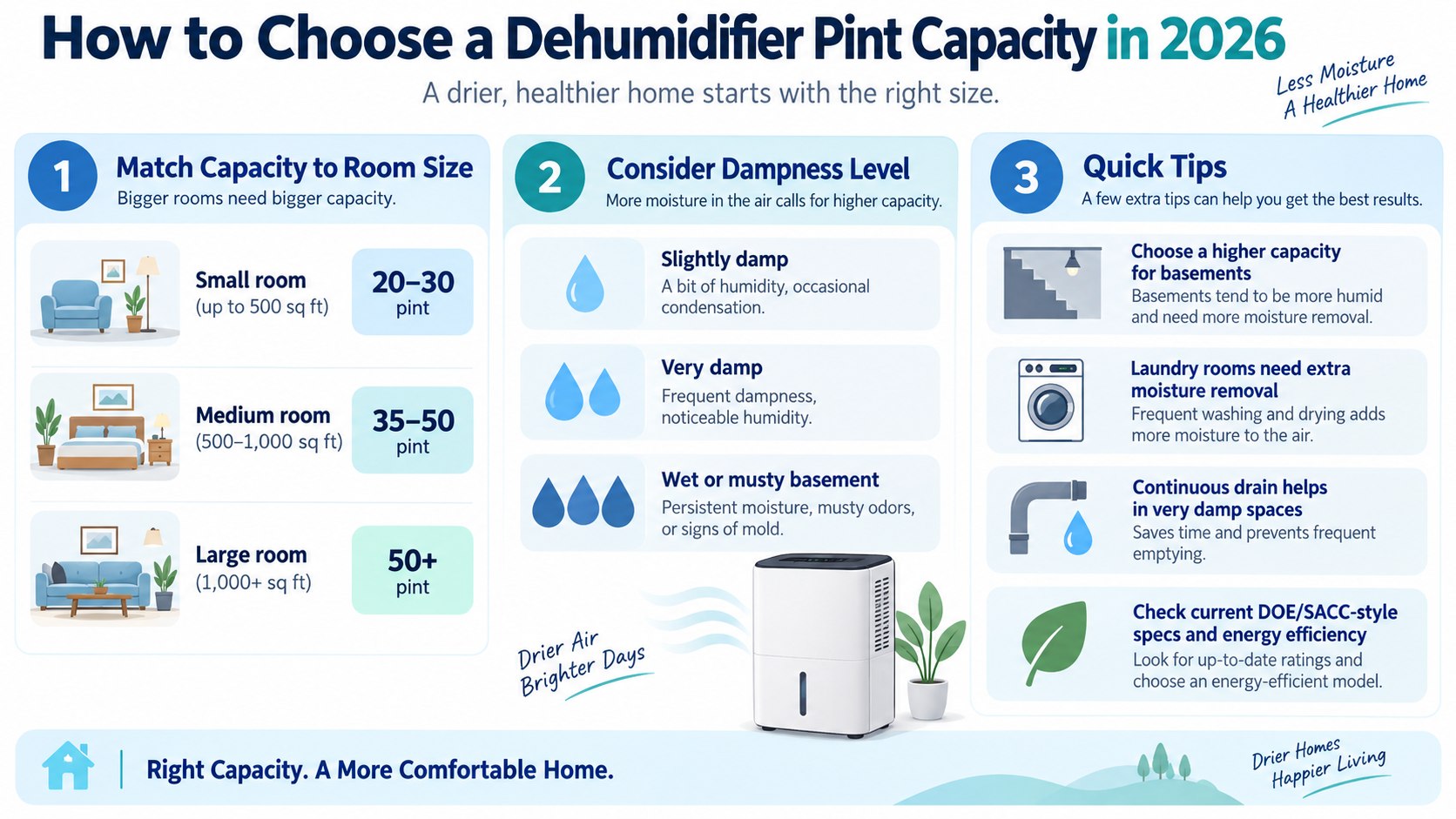
Step 1: How to choose a dehumidifier pint capacity by square footage
Measure the room’s length and width, then multiply them to calculate square footage. A 25-by-30-foot basement, for example, covers 750 sq ft.
If several connected rooms share open doorways, calculate their combined floor area. This matters because the machine is effectively processing moisture from the whole connected air volume, not only the corner where it stands.
| Space and condition | Practical capacity starting point | Typical use |
|---|---|---|
| Under 2,000 sq ft, moderately damp | 20–30 pints/day | Bedrooms, offices, smaller basements |
| Under 2,000 sq ft, very damp | 25–40 pints/day | Damp basement or laundry area |
| Under 2,000 sq ft, wet | 30–50 pints/day | Condensation, seepage, heavy moisture loads |
| Over 2,000 sq ft, moderately damp | 30+ pints/day | Large basement or open living area |
| Over 2,000 sq ft, very damp | 40+ pints/day | Large humid lower level |
| Over 2,000 sq ft, wet | 50+ pints/day | Large spaces with serious moisture |
The ranges align with current ENERGY STAR buying guidance for portable dehumidifiers. Capacity means pints removed during 24 hours under standardized test conditions, not guaranteed household collection.
A 50-pint rating therefore does not mean every home will produce 50 pints of condensate daily. Actual removal depends on temperature and moisture load. Closed bedrooms can need less capacity than an equally sized basement.
High ceilings add air volume without increasing floor area. Open stairways also let humid air migrate from other levels. The common mistake is buying solely from a retailer’s claimed room-coverage number.
“It’s better to oversize than undersize!”
ENERGY STAR, US Environmental Protection Agency program, dehumidifier buying guidance.
Step 2: Measure dampness instead of guessing from room size
A hygrometer gives the second half of the sizing calculation. The US EPA recommends keeping indoor relative humidity below 60% and ideally around 30%–50%.
Square footage tells how much space the appliance serves; humidity tells how hard it must work inside that space.
ENERGY STAR describes roughly 50%–75% RH as slightly to moderately damp, 75%–90% as very damp, and 90%–100% as wet conditions. Those categories help explain why identical basements can require different dehumidifier capacity by square feet.
- Record RH before running a dehumidifier.
- Check again during the dampest part of the day.
- Look for musty odors, condensation, sweating pipes, and damp wall areas.
- Move toward the upper capacity range when several moisture signs appear together.
Do not measure immediately beside a shower, dryer, or open exterior door. Local moisture can distort the reading. Place the hygrometer around normal breathing height and away from direct HVAC airflow.
Basement readings often deserve several checks because outdoor weather changes the moisture load. Florida and Louisiana homes may face long humid seasons, while Arizona and Nevada homes generally present different conditions. Maryland basements can also see seasonal humidity even when upper floors remain comfortable.
Step 3: Add capacity for basements, laundry and water intrusion
A dehumidifier for basement square footage should be sized more conservatively than a dry bedroom. Concrete walls, below-grade floors, laundry, open sump pits, and foundation seepage can continuously add moisture.
Move toward 40–50 pints per day when damp spots appear regularly in a space under 2,000 sq ft. For larger wet areas, 50-pint portable machines may become the practical minimum rather than an oversized luxury.
The EPA also stresses that a dehumidifier does not replace repairs. Leaking plumbing, roof problems, wet foundations, or water intrusion must be corrected at the source. Wet materials should generally be dried promptly, ideally within 24–48 hours after a leak or spill.
Homeowners comparing moisture control with cooling should also understand that these appliances solve different problems. Baltimore Chronicle’s window AC versus portable AC comparison explains why air conditioning capacity should not be substituted for a dehumidifier pint rating.
Step 4: Decide whether a 35-pint or 50-pint dehumidifier makes sense
The common 35 pint vs 50 pint dehumidifier decision usually comes down to moisture severity and runtime. A 35-pint model can fit a moderately damp medium-sized room, while 50-pint units offer more margin for wet basements and large open areas.
Brands such as Frigidaire, GE, Midea, Honeywell, hOmeLabs, and Hisense commonly compete in these capacity classes. Typical 2026 portable pricing often falls near $150–$250 for smaller or mid-capacity models and roughly $200–$350 for many 50-pint units.
Retail promotions, pumps, Wi-Fi controls, and ENERGY STAR certification can move prices outside those ranges.
Paying for capacity that shortens excessive runtime can make more sense than saving $30–$60 on an undersized machine.
Do not compare today’s pint ratings with a much older unit without checking its testing standard. DOE test procedures changed, and newer labels can show lower capacities than older products that appear physically similar.
The mistake to avoid is assuming the highest pint rating is automatically best. A small bedroom held near 50% RH may gain little from a large compressor, especially when noise and floor space matter.
Step 5: Check drainage, efficiency and operating cost
Capacity becomes inconvenient when the bucket fills faster than someone can empty it. A damp basement used with a 50-pint unit often benefits from gravity drainage or an integrated condensate pump.
ENERGY STAR-certified models can also differ in efficiency. Its current criteria measure integrated energy factor in liters of moisture removed per kilowatt-hour, with requirements varying by capacity class.
- Choose gravity drainage when a floor drain sits below the outlet.
- Choose a pump when water must travel upward to a sink or drain.
- Check hose routing before buying the appliance.
- Compare ENERGY STAR certification across similar pint capacities.
- Check the filter-access design if the machine will run frequently.
A machine that shuts off because its bucket is full cannot control humidity. Continuous drainage is especially useful in vacation homes and rarely visited basements.
Pump-equipped models usually cost more than basic gravity-drain versions. Filters also need routine cleaning because restricted airflow reduces performance. Noise deserves attention in bedrooms and home offices.
For electricity budgeting, Baltimore Chronicle’s 2026 guide to lowering household electricity costs provides broader HVAC context.
Step 6: Set the target humidity and verify the result
After installation, start near 50% RH and monitor how the room responds. The EPA recommends an indoor range around 30%–50% where practical, while keeping humidity below 60% helps limit moisture problems.
A correctly sized unit should gradually reach the set point and cycle rather than operate endlessly under ordinary conditions. Continuous operation during the first day can be normal in a damp basement because furniture, concrete, wood, and stored materials also hold moisture.
Give the appliance enough clearance for airflow. Keep doors and windows closed while evaluating performance, unless the manufacturer instructs otherwise.
Clean the filter on schedule. Record RH after 24 hours and again after several days. If the reading remains above 60%, investigate both sizing and the source of incoming moisture.
For standardized sizing information, ENERGY STAR dehumidifier guidance remains more useful than broad advertising claims such as “covers 4,500 sq ft.” Coverage language can vary by manufacturer, while pint capacity gives a standardized performance measure.
Troubleshooting common dehumidifier sizing problems
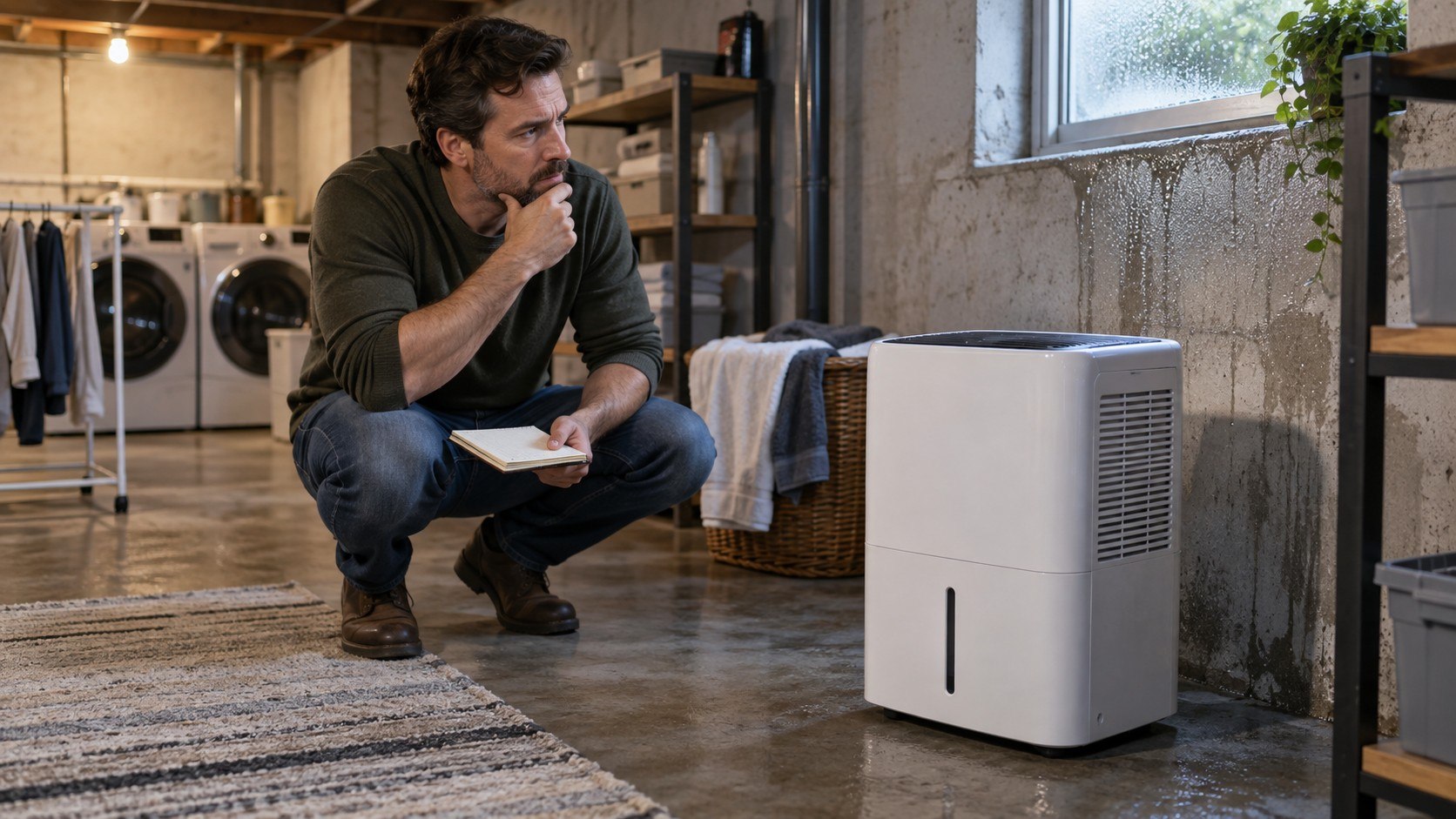
A unit that seems ineffective is not always too small. Placement, drainage, room temperature, open windows, and an active leak can produce the same symptoms.
- Humidity stays above 60%: close exterior openings, clean the filter, confirm airflow, then reassess capacity and moisture sources.
- The unit runs constantly: the space may be wetter or larger than expected, or new moisture may be entering continuously.
- The bucket fills several times daily: install continuous drainage if supported rather than downsizing the appliance.
- Humidity drops but musty odor remains: inspect stored materials, carpet, drywall, and hidden surfaces for existing moisture damage.
- Little water is collected: verify the hygrometer reading and room temperature before assuming the unit has failed.
Low collection can be perfectly normal once humidity reaches the set point. It can also happen when the room is cool because refrigeration-based dehumidifiers perform differently at lower temperatures.
A warm, humid laundry room creates a very different load from an unheated cold basement. Constant operation deserves investigation when RH never reaches the target. Water entering through foundations or plumbing must be corrected separately.
A larger machine should solve an air-moisture load, not conceal a building defect.
FAQ
What pint dehumidifier do I need for 1,000 sq ft?
For 1,000 sq ft, start around 20–30 pints per day when the area is only moderately damp. Consider 25–40 pints when it is very damp and 30–50 pints when condensation, seepage, or other wet conditions are present.
Is a 50-pint dehumidifier too big for 500 sq ft?
Not necessarily. A 50-pint machine can make sense in a wet 500 sq ft basement, especially with seepage or laundry moisture. In a mildly damp bedroom, that capacity may be unnecessary.
What does 50 pint mean on a dehumidifier?
50 pint dehumidifier capacity means the machine is rated to remove up to 50 pints of moisture per 24 hours under specified test conditions. It does not mean the bucket holds 50 pints.
Should a dehumidifier be sized by square feet or humidity?
Use both. Square footage estimates the area being treated, while humidity and physical dampness indicate the moisture load. Sizing by floor area alone can underestimate a wet basement.
What humidity should a basement have?
The EPA recommends keeping indoor relative humidity below 60% and ideally around 30%–50%. A setting near 50% is a practical starting point for many basements.
Is it better to oversize or undersize a dehumidifier?
ENERGY STAR recommends favoring adequate extra capacity rather than undersizing. A modestly oversized machine can reach the target sooner, while an undersized model may struggle during humid weather.
Earlier we wrote about When Should You Replace a Roof? The 2026 Homeowner Inspection Guide