


How to refinance a mortgage in USA 2026 starts with 3 numbers: your current rate, total refinance costs, and monthly savings. A prepared homeowner can compare offers within several days, while underwriting and closing commonly take several weeks, as the Baltimore Chronicle editorial team notes.
The decision is mainly mathematical. A lower advertised rate does not automatically create savings. Refinancing works when the interest reduction, new loan structure, or equity access justifies closing costs before the homeowner expects to move.
Key takeaways
- Calculate your break-even month before accepting a lower mortgage rate or paying discount points.
- Compare several Loan Estimates using APR, lender fees, points, cash-to-close, and the new loan term.
- Avoid restarting a 30-year repayment clock without comparing lifetime interest against your existing mortgage.
A homeowner saving $220 monthly after spending $5,500 to refinance reaches break-even after 25 months. Staying 7 years could make that transaction useful. Selling after 18 months could leave the borrower behind.
Market rates also move quickly. Baltimore Chronicle’s review of fixed and adjustable mortgage rates in 2026 shows why borrowers should compare same-day offers rather than historical averages.
Credit quality, property type, loan-to-value ratio, occupancy, points, and lender pricing can materially change an individual quote.
What you need before refinancing
Most lenders request many of the same records used for a home purchase. Preparing them before requesting formal quotes can prevent underwriting delays.
- Government-issued identification and Social Security number.
- Recent pay stubs or other verifiable income records.
- W-2 forms, 1099 forms, or tax returns when required.
- Recent bank and investment account statements.
- Current mortgage statement and estimated payoff balance.
- Homeowners insurance information and property tax records.
- HOA documents when the property belongs to an association.
- Cash for appraisal, closing costs, or prepaid expenses.
Self-employed homeowners may need additional tax returns and business records. Lenders can also request explanations for large deposits or recent credit activity. Keep document versions consistent across competing applications. Do not move large amounts between accounts without keeping a clear paper trail. A borrower with organized records can respond faster when underwriting requests additional evidence.
A refinance application should begin with documentation and arithmetic, not with an advertised interest rate.
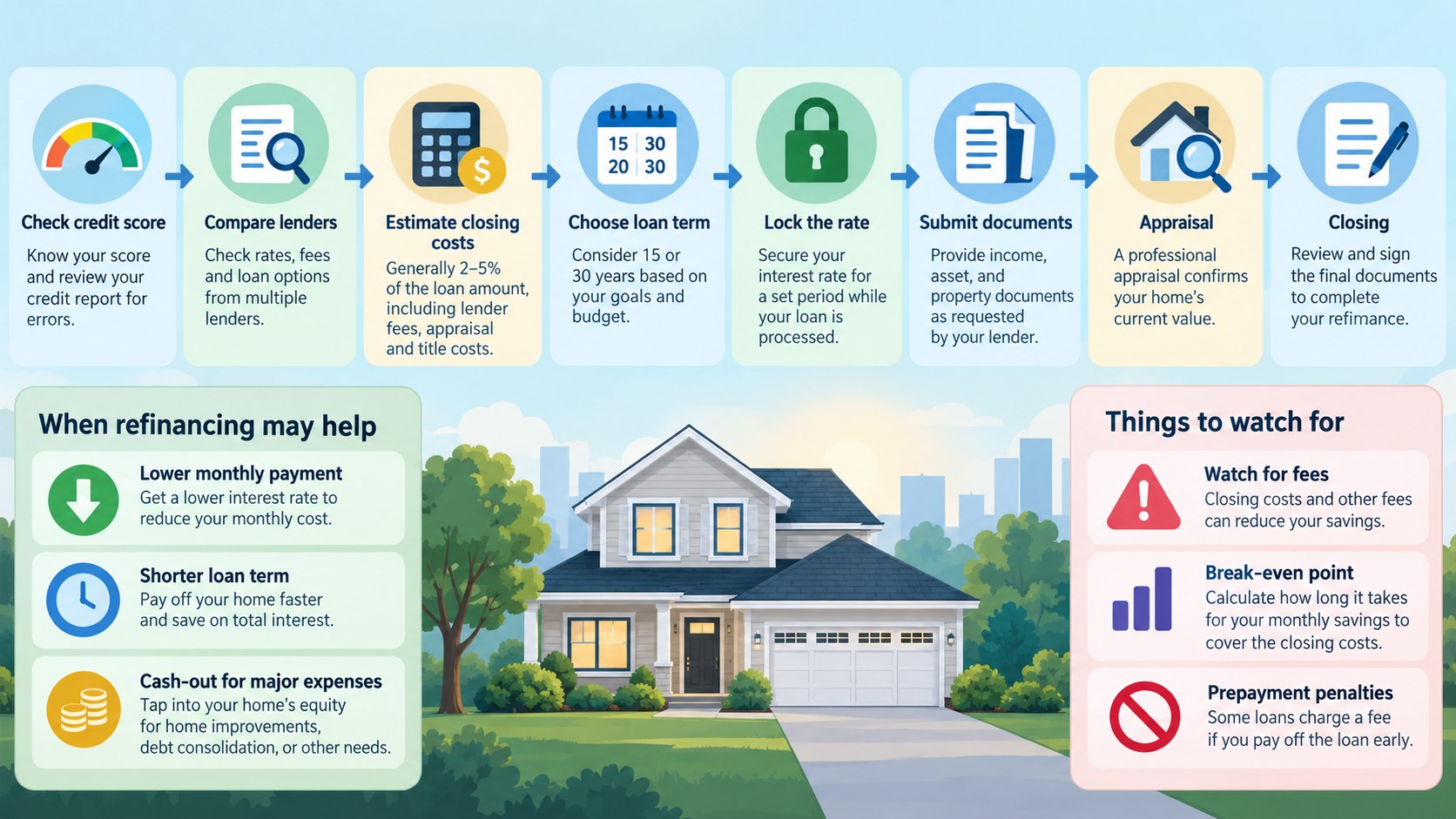
Step 1: Calculate the break-even point
Start by estimating every cost that exists only because of the refinance. Then divide those costs by expected monthly savings.
For example, assume closing costs total $6,000. If the new mortgage reduces principal and interest by $250 monthly, the simple break-even period is 24 months.
This calculation matters because the homeowner needs enough time after closing to recover the transaction cost. The common mistake is comparing monthly payments while ignoring upfront expenses.
| Refinance costs | Monthly savings | Approximate break-even |
|---|---|---|
| $3,600 | $150 | 24 months |
| $5,000 | $200 | 25 months |
| $6,000 | $250 | 24 months |
| $7,200 | $300 | 24 months |
These examples use simple break-even calculations rather than full amortization analysis. They do not include opportunity cost on cash paid at closing. They also exclude future changes in property taxes and insurance. A refinance extending the repayment term requires another calculation. Compare the remaining interest on the old mortgage with projected interest on the replacement loan.
Step 2: Check your current loan before requesting offers
Find the interest rate, remaining principal, remaining term, loan type, and payoff information. Also determine whether the loan carries mortgage insurance.
Someone with 22 years remaining should not compare only the old payment against a new 30-year payment. The new payment can fall partly because repayment has been extended by 8 years.
Homeowners considering a shorter term can review Baltimore Chronicle’s 30-year versus 15-year mortgage comparison. The common mistake is treating monthly payment reduction as total financial savings.
“Mortgage refinance is when you take out a new loan to pay off and replace your old loan.”
Consumer Financial Protection Bureau, official mortgage guidance.
Step 3: Check credit, income and home equity
Lenders price mortgage refinance rates in 2026 according to borrower and property risk. Credit history, debt obligations, income stability, equity, occupancy, and loan size can all affect pricing.
Estimate home equity by subtracting the mortgage balance from the property’s approximate market value. A $500,000 home with a $300,000 mortgage has about $200,000 of gross equity before transaction costs.
Why it matters: loan-to-value ratios can affect eligibility, pricing, and mortgage insurance. Avoid applying for new credit, financing a vehicle, or carrying unusually high card balances immediately before underwriting.
A 0.25 percentage-point rate difference can matter, but only after fees, points, and repayment length enter the comparison.
Step 4: Choose the refinance structure
A rate-and-term refinance replaces the existing mortgage without using the transaction primarily to withdraw equity. A cash-out refinance USA creates a larger mortgage and returns part of the homeowner’s equity as cash.
Cash-out refinancing can fund renovations or consolidate expensive debt. It also converts home equity into secured debt and increases the balance exposed to foreclosure risk.
FHA borrowers have another route. HUD’s official FHA Streamline Refinance guidance states that eligible existing FHA mortgages can use limited documentation and underwriting.
“Streamline refinance refers only to the amount of documentation and underwriting that the lender must perform.”
U.S. Department of Housing and Urban Development, FHA Streamline Refinance guidance.
HUD also explains that streamline refinancing does not mean the transaction has no costs. The existing mortgage must already carry FHA insurance. The loan must generally be current. The transaction must produce the required net tangible benefit. Cash back is tightly restricted under the streamline program.
Step 5: Request several Loan Estimates
Contact banks, mortgage companies, credit unions, and qualified brokers during a short shopping period. Chase, Bank of America, Wells Fargo, Rocket Mortgage, and local credit unions may price the same borrower differently.
Ask for comparable scenarios using the same loan amount and term. Compare interest rate, APR, discount points, lender credits, origination charges, and projected cash-to-close.
The CFPB explains how borrowers receive a Loan Estimate. Once required application information is submitted, lenders generally must provide that document within 3 business days.
Why it matters: a 6.50% offer with expensive points can cost more than a slightly higher rate. The common mistake is choosing whichever lender advertises the smallest headline percentage.
Step 6: Compare closing costs and lender credits
Mortgage refinancing costs may include origination charges, appraisal fees, title services, recording charges, credit reports, prepaid interest, and escrow funding. Actual amounts vary considerably by loan, lender, state, and property.
A “no-closing-cost” refinance usually does not eliminate economic cost. The lender may charge a higher rate, provide a lender credit, or incorporate permitted costs into the financing structure.
Homeowners unfamiliar with settlement expenses can compare the categories with Baltimore Chronicle’s guide to closing costs on a house. California title practices can differ from Maryland, Texas, Florida, or New York practices.
Why it matters: two loans with similar rates can produce very different break-even periods. Avoid draining emergency savings simply to secure a marginally lower rate.
Step 7: Complete underwriting and the appraisal
After selecting a lender, submit requested records quickly. The underwriter may verify employment, income, assets, debts, insurance, title, and property information.
Conventional refinancing often requires an appraisal, although some qualifying transactions can receive appraisal waivers. FHA Streamline transactions can follow different requirements.
Do not open credit cards, change jobs without discussing it, or make unexplained bank deposits before closing. Lenders can recheck financial information before funding.
Why it matters: approval depends on the borrower still matching the lender’s risk assumptions. A common mistake is assuming initial approval makes later financial changes irrelevant.
Step 8: Review the final documents and close
Compare the Closing Disclosure with the earlier Loan Estimate. Check the loan amount, rate, term, monthly principal and interest, points, lender credits, and cash-to-close.
For covered mortgages, borrowers generally receive the Closing Disclosure at least 3 business days before closing. Use that period to challenge unexplained changes rather than discovering them at signing.
After closing, confirm where future payments should go. Refinancing replaces the old mortgage, but servicing rights can later transfer to another company.
Why it matters: the final documents govern the actual transaction. The common mistake is reviewing only the monthly payment while overlooking loan term and total costs.
How to refinance a mortgage in USA 2026 without resetting your finances
The most useful comparison places the existing mortgage beside the proposed replacement. Examine both the short-term cash flow and long-term interest burden.
| Factor | Existing mortgage | Proposed refinance |
|---|---|---|
| Principal balance | Current payoff amount | New financed balance |
| Interest rate | Current contractual rate | Locked refinance rate |
| Remaining term | Actual years left | New repayment term |
| Monthly payment | Current principal and interest | New principal and interest |
| Transaction costs | $0 if retained | Actual closing costs |
| Break-even | Not applicable | Costs divided by monthly savings |
This side-by-side view exposes term extensions that can hide behind lower monthly payments. A borrower with 18 years remaining could request both 15-year and 20-year refinance options. That comparison preserves a payoff date closer to the original schedule. Another borrower may deliberately choose 30 years because immediate cash flow matters more. The important number is not merely the new payment but the cost of achieving it.

Troubleshooting common refinance problems
Some applications fail because the rate is poor. Others fail because the property, documentation, or borrower profile no longer fits lender requirements.
- Appraisal comes in low: request a reconsideration with credible comparable sales, add cash, or evaluate another loan structure.
- Debt-to-income ratio is too high: reduce revolving balances or avoid new monthly obligations before applying again.
- Closing costs erase the savings: compare lender credits, fewer points, or postpone refinancing.
- Income is difficult to document: prepare tax returns, 1099 records, business statements, and requested explanations.
- Rate moves before locking: ask exactly how long the lock lasts and what extension fees apply.
A denied refinance does not necessarily mean the property cannot be refinanced elsewhere. Underwriting overlays vary among lenders. Pricing also changes between conventional, FHA, and other eligible programs. Fixing a specific weakness can create a better application than immediately submitting more requests. Homeowners should keep copies of every Loan Estimate because written comparisons reveal differences that sales calls often obscure.
FAQ
How much lower should my mortgage rate be before refinancing?
There is no universal percentage-point rule. Calculate closing costs, monthly savings, remaining loan term, and expected ownership period. A smaller reduction can work on a large balance with low costs.
How do I calculate the refinance break-even point?
Divide total refinance costs by monthly savings. Spending $4,800 to save $200 monthly creates a simple 24-month break-even period. A full comparison should also consider term changes.
Can I refinance with the same lender?
Yes. The current lender can offer a replacement mortgage, but homeowners can also compare competing banks, credit unions, brokers, and mortgage companies.
Does refinancing require an appraisal?
Many refinance transactions require one, but exceptions exist. Some conventional borrowers may qualify for appraisal waivers. Eligible FHA Streamline refinances can follow separate rules.
Does a refinance restart the mortgage at 30 years?
Only if the borrower chooses a new 30-year term. Depending on lender offerings, 10-year, 15-year, 20-year, and other terms may be available.
When is refinancing usually a poor financial move?
It can be unattractive when closing costs exceed expected savings before a planned sale. Extending the term can also increase lifetime interest despite lowering the monthly payment.
Earlier we wrote about How to Clean Gutters Safely Without a Ladder: Ground Tools and 2026 Costs