

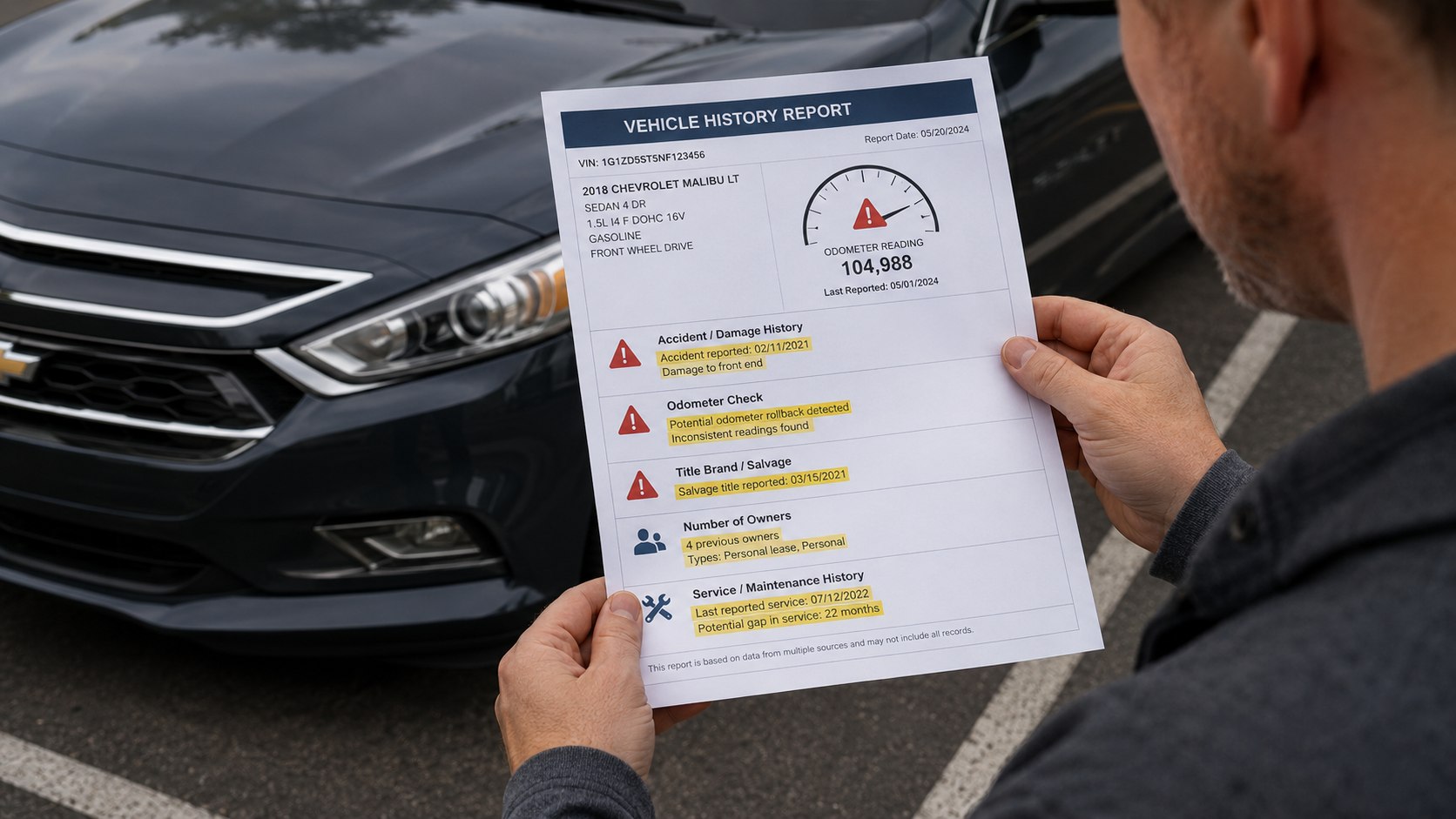
How to read a CARFAX before buying 2026 starts with checking the title, mileage, accident history, ownership changes, and maintenance timeline. A careful review takes about 15–25 minutes and can expose reasons to reject the vehicle before paying for an inspection, as the Baltimore Chronicle editorial team notes.
Start with the report’s most serious entries rather than its vehicle summary or estimated value. A salvage brand, mileage inconsistency, structural damage, flood record, or unexplained ownership change deserves immediate investigation. If the seller cannot document what happened, do not treat a low price as compensation for uncertainty.
Key takeaways
- A clean-looking summary does not guarantee that every accident, repair, or ownership event reached CARFAX.
- Title brands, odometer inconsistencies, structural damage, and rapid ownership changes are the strongest warning signs.
- Use the report to guide an independent inspection, not to replace one or justify skipping it.
What You Need Before Reading the Report
Collect the listing and seller information before opening the report. You need enough material to compare the seller’s claims against recorded events.
- The complete 17-character vehicle identification number, or VIN
- A current CARFAX Vehicle History Report for that exact VIN
- The dealer advertisement or private seller’s listing
- A photo of the dashboard odometer
- The asking price and advertised trim level
- A phone or computer for checking dates and locations
- About 15–25 minutes for the first review
- Money reserved for an independent pre-purchase inspection
Confirm that the VIN appears identically on the report, dashboard, driver-side door label, title, and sales paperwork. A single wrong digit can produce a history belonging to another vehicle.
Compare the trim, engine, body style, and model year with the listing. Sellers sometimes copy specifications from another advertisement. Buyers preparing to finance the purchase should also review their free credit reports and scores before applying. This reduces the risk of negotiating the vehicle price while overlooking expensive loan terms.
How to Read a CARFAX Before Buying 2026: The Red-Flag Order
Do not simply read the report from top to bottom. Use a risk-based order that places permanent legal and safety issues before routine service entries.
| Report section | What to examine | Major red flag | Recommended response |
|---|---|---|---|
| Title history | Brands and state records | Salvage, rebuilt, flood, junk, or lemon | Verify with the issuing state and insurer |
| Odometer history | Mileage sequence | Rollback, sudden drop, or long unexplained gap | Compare records and inspect physical wear |
| Damage history | Severity and impact area | Structural damage or airbag deployment | Require frame and restraint-system inspection |
| Ownership | Owner count and duration | Several owners within short periods | Ask why each owner sold the vehicle |
| Service records | Maintenance intervals | Missing records after major damage | Request invoices and inspect independently |
| Vehicle use | Rental, fleet, taxi, or personal | Heavy use inconsistent with mileage | Inspect wear and adjust the offer |
| Registration locations | States and dates | Move after a hurricane or flood event | Inspect for hidden water damage |
The strongest red flags usually appear in combinations. A Florida registration followed by an auction entry and a new title in another state deserves more scrutiny than any event alone.
A collision followed by regular repairs may be explainable, while structural damage followed by missing records is much riskier. Also compare dates rather than counting events. Several entries on one day may describe the same transaction.
Your task is to reconstruct the vehicle’s timeline, not react to the report’s length.
CARFAX is best treated as a map of questions. Every unusual date, state change, mileage jump, or vague damage entry should produce a specific question for the seller.
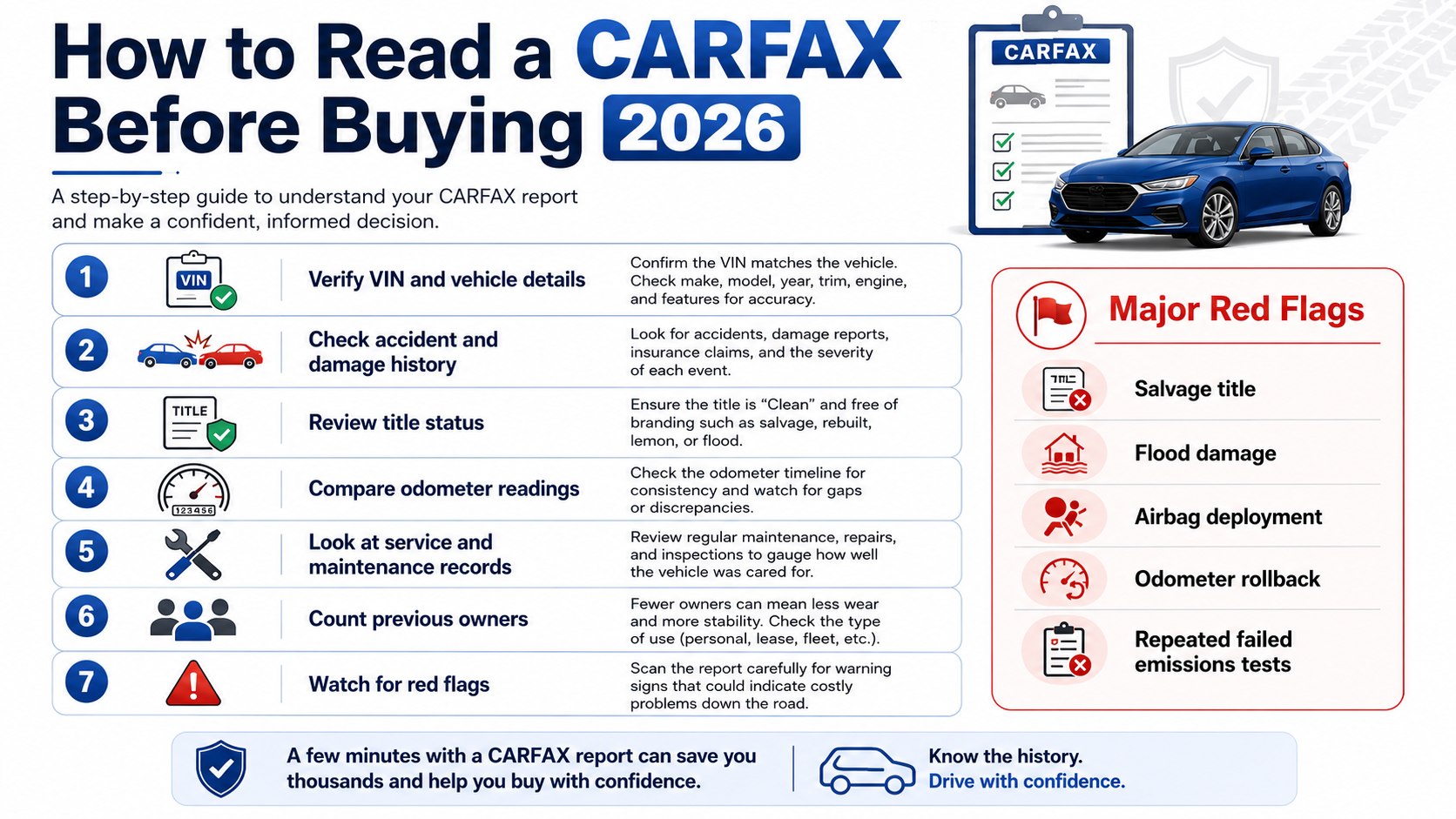
Step 1: Confirm the VIN and Vehicle Identity
Match the report’s VIN with the number visible through the windshield and on the driver-side door label. Confirm the year, make, model, engine, drivetrain, and trim.
This matters because a report for a similar Honda CR-V, Ford F-150, Toyota Camry, or Tesla Model 3 cannot describe the vehicle you are buying. The common mistake is trusting a report link supplied by the seller without checking the VIN physically.
Step 2: Read the Title History Before Accident Records
Look for title brands such as salvage, rebuilt, reconstructed, flood, junk, lemon, or odometer not actual. Title terminology varies among California, Texas, Florida, New York, Maryland, and other states.
A branded title can affect registration, comprehensive insurance, financing, warranty coverage, and resale value. The mistake is assuming that “rebuilt” means the vehicle was restored to factory condition. It usually means the vehicle met a state process for returning to the road.
For an additional title check, use an approved provider connected to the US Department of Justice’s National Motor Vehicle Title Information System. NMVTIS focuses on title, brand, salvage, total-loss, and recent odometer information.
Step 3: Trace Every Odometer Reading
Read the mileage entries chronologically. They should generally rise through title transfers, inspections, emissions tests, dealer services, and repairs.
A lower reading after a higher one may indicate an input error, instrument replacement, or odometer rollback. The common mistake is dismissing the issue because the difference appears small. Even a modest discrepancy can undermine the advertised mileage and resale value.
Compare the recorded mileage with physical wear. A vehicle showing 42,000 miles should not normally have heavily worn pedals, a polished steering wheel, a collapsed driver’s seat, and missing button labels. Those signs do not prove fraud, but they justify deeper inspection.
Step 4: Separate Minor Damage From Structural Damage
Review the date, severity, impact location, airbag status, and any structural notation. “Minor damage” may describe cosmetic repairs, while structural damage can involve load-bearing components.
This distinction matters because a repaired bumper is different from compromised frame rails, pillars, crumple zones, or suspension mounting points. The common mistake is treating every “accident reported” entry equally.
“A vehicle history report is not a substitute for an independent vehicle inspection.”
Federal Trade Commission, consumer guidance for buying a used car from a dealer.
The Federal Trade Commission’s used-car guidance recommends an independent mechanical inspection even when a dealer calls the vehicle certified. Ask the mechanic to measure paint depth, inspect welds, scan all control modules, and check airbag warning systems.
Step 5: Examine Ownership Changes and Vehicle Use
Check how many owners appear, how long each kept the vehicle, and whether the report identifies personal, lease, rental, fleet, commercial, or government use. Usage labels provide context, not an automatic verdict.
A well-maintained rental vehicle may be safer than a neglected one-owner car. However, several owners selling within 6–12 months can indicate unresolved defects, unpleasant driving characteristics, or repair costs.
Watch for these ownership warning signs:
- Ownership lasting only several weeks or months
- Repeated dealer auctions without normal registration periods
- A private-use claim that conflicts with fleet history
- High annual mileage followed by unusually low mileage
- Registration transfers between distant states without explanation
- A recent purchase followed by an immediate resale
Ask the seller when they acquired the vehicle and why they are selling it. Compare that answer with the report’s dates.
A dealer may have bought the car at auction only days earlier, which is normal. A private seller claiming years of ownership should appear in the title timeline. Missing alignment does not always prove deception, but it means the buyer needs documents before continuing.
Step 6: Reconstruct the Service History
Look for oil changes, tire service, brake work, inspections, transmission repairs, cooling-system maintenance, and manufacturer-recommended services. Then compare those records with the model’s maintenance schedule.
Service gaps matter most when the vehicle has high mileage, a turbocharged engine, all-wheel drive, or a history of heavy use. The common mistake is assuming that missing CARFAX entries prove maintenance never happened.
Independent shops and owners may not report every repair. Ask for invoices, digital service records, and receipts.
For example, a Toyota with 120,000 miles should have evidence of routine fluid and wear-item maintenance. A luxury BMW or Mercedes-Benz may require stronger documentation because deferred repairs can become expensive quickly.
A long service list is not automatically a warning. Regular maintenance entries often show that the owner addressed wear before it became a breakdown.
Step 7: Check State Changes, Flood Exposure, and Auctions
Follow registration locations across the full timeline. Pay special attention to vehicles that moved from hurricane-prone regions shortly after severe weather.
Flood damage may cause corrosion, electrical faults, mold, restraint-system problems, and intermittent module failures. The common mistake is expecting every water-damaged vehicle to carry a flood title.
Inspect under the carpet, beneath seats, around spare-tire wells, inside electrical connectors, and behind interior trim. Look for silt, water lines, rusted seat hardware, mismatched upholstery, and strong deodorizer.
An auction entry is not automatically bad, since dealers routinely buy inventory at auctions. However, an auction immediately after a total loss, title change, or unexplained mileage event deserves caution.
Step 8: Compare the History With the Price and Seller’s Claims
Place the asking price beside comparable vehicles with similar mileage, trim, condition, and title status. Do not compare a rebuilt-title vehicle with clean-title retail listings.
A 2026 asking price should reflect accident severity, title branding, ownership history, missing service records, tire condition, and required repairs. The common mistake is negotiating only from the advertised price rather than the vehicle’s documented risk.
Before discussing payment, write down every inconsistency and estimated repair. Buyers using credit should calculate the total loan cost, not only the monthly payment.
Baltimore Chronicle’s guide for drivers using personal vehicles for paid delivery work also explains why insurance, maintenance, fuel, and mileage costs can change the real value of a purchase.
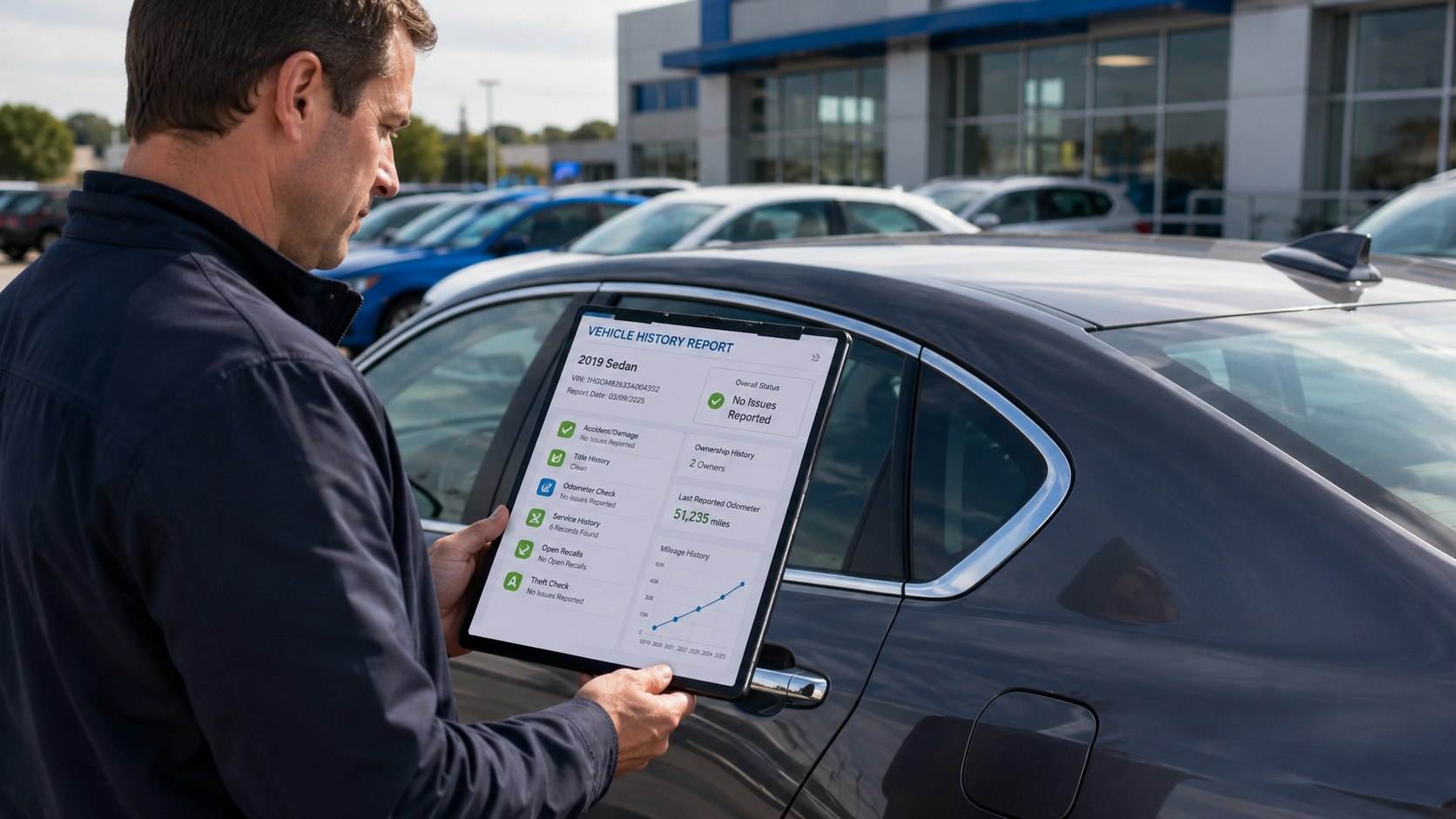
Red Flags That Usually Justify Walking Away
No single CARFAX entry decides every purchase. However, several findings create more risk than most buyers should accept.
- A salvage, junk, flood, or rebuilt title that was not disclosed.
- Structural damage without complete repair invoices and measurements.
- An odometer rollback or mileage sequence the seller cannot explain.
- Airbag deployment without proof of proper replacement and system testing.
- A recent total-loss record followed by an immediate interstate title transfer.
- The seller’s ownership story conflicts with the recorded timeline.
- The seller refuses an inspection by a mechanic chosen by the buyer.
- The VIN differs between the vehicle, title, listing, and report.
Walking away is usually cheaper than proving why a suspicious history should not matter. Used-car supply is large enough that another option will appear.
Do not let a deposit, travel cost, or emotional attachment control the decision. Those expenses are smaller than frame repairs, electrical diagnostics, or title disputes. Keep screenshots of the listing and report when statements appear misleading. They may become useful during a complaint or payment dispute.
Troubleshooting Common CARFAX Problems
Reports can contain missing, delayed, duplicated, or incorrect records. Use the following responses when the timeline does not make sense.
- The accident has no details: Request repair invoices, insurance documents, photographs, and a body-shop inspection.
- The mileage suddenly drops: Compare title documents, inspection records, service invoices, and dashboard wear.
- A service entry is missing: Ask for receipts and contact the named repair shop with the owner’s permission.
- The seller says the report is wrong: Require the owner to request a correction and provide supporting documents.
- The report looks clean but the car looks repaired: Trust the physical evidence and order an independent inspection.
Do not accept “CARFAX is always wrong” as a complete explanation. Databases can contain errors, but the seller should produce evidence.
Likewise, do not assume a clean report proves a clean vehicle. Some events never reach private databases. Records may also appear weeks or months later.
Base the purchase on documents, inspection findings, title verification, and the seller’s consistency.
FAQ
Can a CARFAX report miss an accident?
Yes. An accident may be absent when nobody reported it to an insurance company, police agency, repair facility, auction, or participating data source. A clean report does not replace a physical inspection.
Is minor damage on CARFAX a reason not to buy?
Not automatically. Confirm where the damage occurred, how it was repaired, and whether safety systems were affected. Cosmetic damage with documented repairs carries less risk than structural damage.
What does a damage report without an accident mean?
Damage can result from hail, falling objects, vandalism, flooding, transport incidents, or other events. Ask for repair documentation and inspect the affected area.
Should you buy a vehicle with a rebuilt title?
Only after checking state rules, insurance availability, lender restrictions, repair quality, and resale expectations. Many mainstream lenders and insurers apply stricter conditions to rebuilt vehicles.
Does CARFAX show every maintenance record?
No. It shows records received from participating sources. Work completed by an owner or a non-reporting shop may not appear, so request invoices and receipts.
What should you do after the report looks acceptable?
Arrange an independent inspection, verify the title and seller’s identity, check open recalls, compare prices, and review the final Buyers Guide. Never send full payment based only on a report.
Earlier we wrote about How to Fix a Dishwasher Not Draining in 2026: Filter, Hose and Valve Checks