

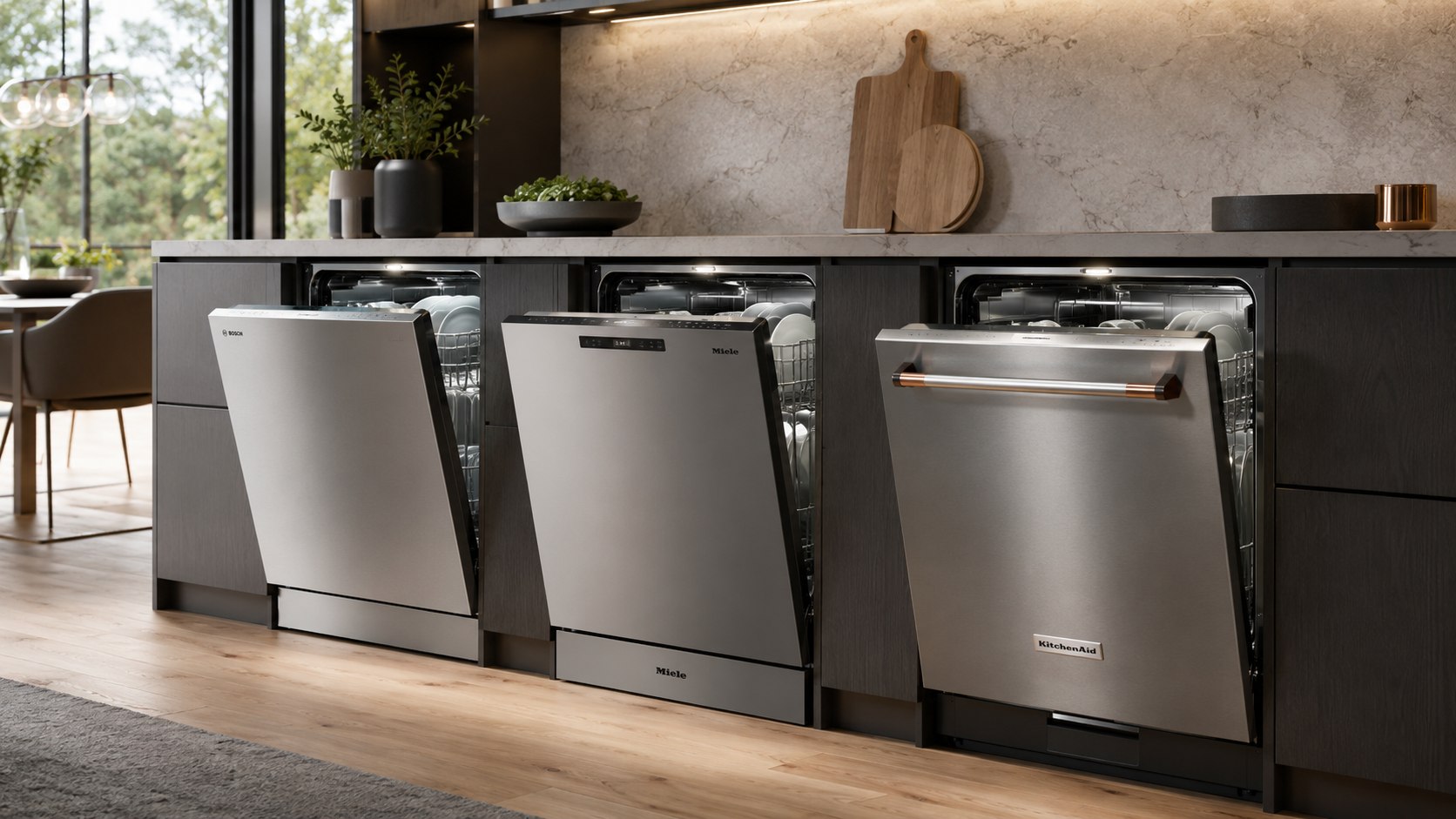
Bosch vs Miele vs KitchenAid dishwasher 2026 shoppers should usually choose Bosch for the strongest balance of quiet operation, cleaning performance, and price. Miele is better for premium construction and long-term ownership, while KitchenAid suits households that regularly wash bulky cookware, as noted by Baltimore Chronicle.
A Bosch 800 Series model is the safest all-around choice for most US kitchens. Pick Miele when durability, refined racks, and controlled drying matter more than price. Choose KitchenAid when bowls, mugs, baking tools, and large cooking utensils create daily loading problems.
Key takeaways
- Bosch offers the best balance of low noise, effective drying, flexible loading, and moderate premium pricing.
- Miele costs more but emphasizes build quality, automatic detergent dispensing, and long-term ownership.
- KitchenAid provides unusually useful third-rack space for cups, bowls, utensils, and cookware-heavy loads.
Before replacing any appliance, compare repair access in your ZIP code. The best machine on paper can become frustrating when the nearest authorized technician is 120 miles away.
At a glance
The comparison below uses representative 24-inch dishwashers available in the United States during 2026. Retail prices change during promotions, while installation and haul-away charges depend on location.
| Factor | Bosch | Miele | KitchenAid |
|---|---|---|---|
| Typical 2026 price | About $1,000–$2,000 | About $1,500–$4,100 | About $900–$1,800 |
| Representative noise | Commonly 38–46 dBA | Commonly 39–45 dBA | Commonly 39–44 dBA |
| Cleaning strength | Excellent daily cleaning and targeted zones | Excellent consistency and controlled programs | Strong coverage for mixed and bulky loads |
| Drying approach | PureDry, AutoAir, or CrystalDry | AutoOpen and condensation-based systems | Heated or fan-assisted ProDry systems |
| Rack advantage | Flexible third rack and adjustable middle rack | Precise baskets and separate cutlery tray | Deep third rack for cups and bowls |
| Installation | Standard 24-inch opening; verify connections | Careful leveling and authorized service preferred | Standard opening; some models use flush designs |
| Long-term outlook | Good when local parts and service are available | Tested by Miele for extended simulated service | Depends strongly on model and local service access |
| Best climate fit | Suitable nationwide with correct indoor installation | Suitable nationwide with controlled indoor conditions | Suitable nationwide with correct ventilation |
| Best user | Most homeowners and open-plan households | Premium buyers planning long ownership | Families using large cookware daily |
Noise differences become noticeable in open kitchens, compact apartments, and homes with bedrooms near the kitchen. A 39 dBA machine is quieter than a 44 dBA model, although cabinetry and flooring also affect perceived sound.
Prices in California, New York, Maryland, Texas, and Florida can differ because of taxes and local labor rates. Standard installation often adds roughly $150–$350 as of 2026. New wiring, plumbing changes, permits, or cabinet work can raise the total.
Do not treat simulated testing as a guaranteed lifespan. Water hardness, detergent, loading habits, maintenance, and repair availability all influence actual service life.
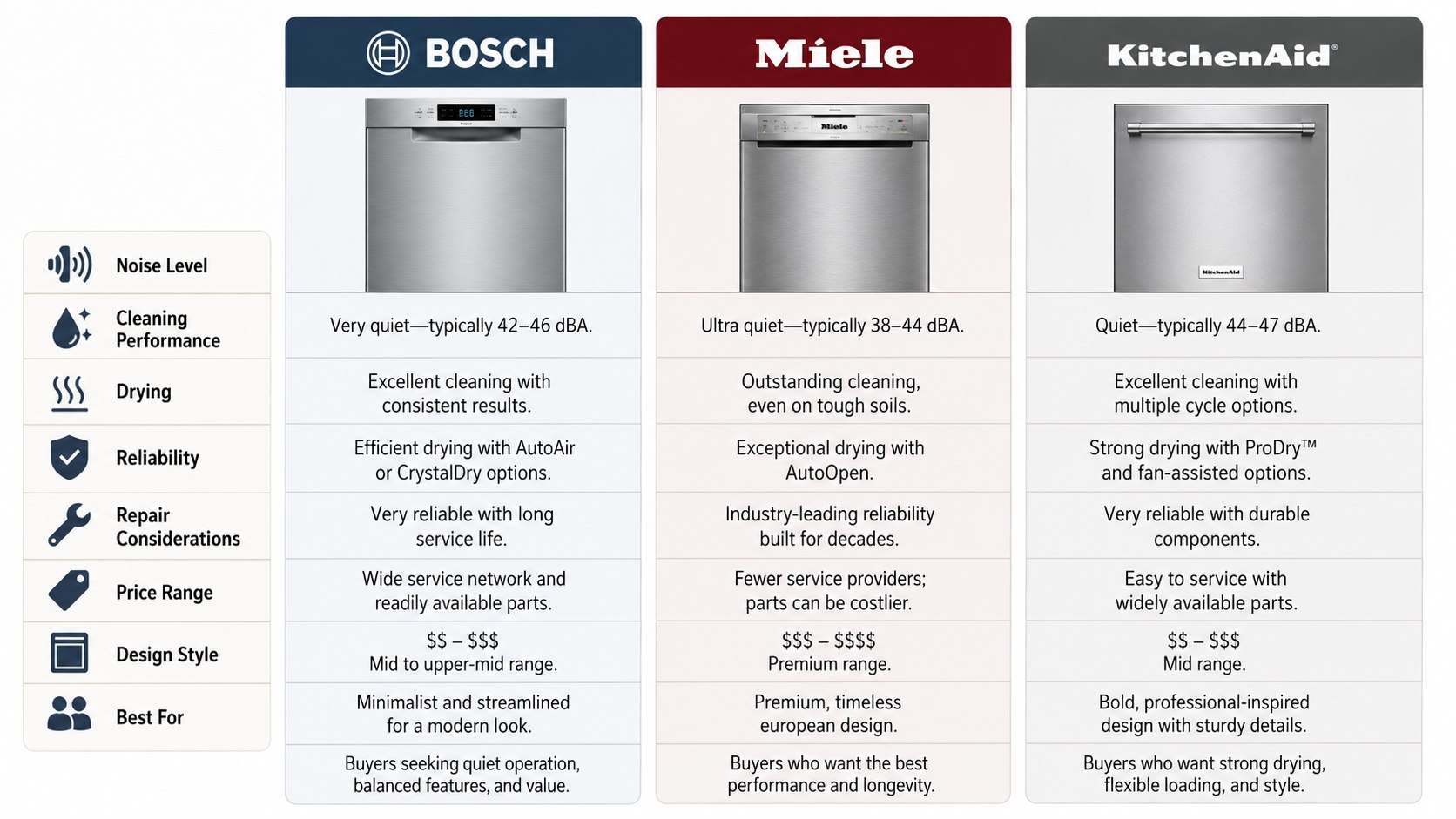
Bosch vs Miele vs KitchenAid Dishwasher 2026: quiet, clean, and repair
Quietness should never be evaluated alone. A silent dishwasher that leaves plastic wet or depends on unavailable parts can become an expensive compromise.
Bosch has the clearest mainstream advantage in noise control. Its US range includes many machines in the low-40 dBA category. Higher series can reach about 39 dBA or lower, depending on the exact model.
Miele competes closely at the premium end. Several G 7000 models operate near 39–42 dBA. KitchenAid also offers 39 dBA machines, although many popular configurations remain around 44 dBA.
For an open-plan kitchen, target 44 dBA or quieter. Paying extra for a model below 40 dBA makes sense when the machine runs during calls, television, or sleep.
Cleaning differences are smaller than marketing materials often suggest. All 3 brands can handle ordinary dishes when users load correctly, maintain filters, and use suitable detergent.
Repair access creates the largest geographic difference. KitchenAid belongs to Whirlpool Corporation’s appliance network, which may provide broader service coverage. Bosch support is strong in many metropolitan areas. Miele coverage should be confirmed before purchase, particularly outside large cities.
Bosch: the best all-around choice for most households
The Bosch 800 Series represents the brand’s strongest balance. Representative models in this range often cost about $1,300–$1,700 before installation in 2026, depending on finish and promotions.
CrystalDry is one of Bosch’s main advantages. The mineral-based system is designed to improve drying, including difficult plastic containers that often remain wet after condensation-only cycles.
Bosch also offers PureDry and AutoAir on other models. PureDry avoids an exposed heating element, while AutoAir opens the door after the cycle. Buyers should inspect the exact model number because drying systems vary by series.
Bosch advantages
- Very quiet operation across many midrange and premium models.
- Strong cleaning performance without complicated daily controls.
- Flexible RackMatic middle racks and practical third-rack designs.
- Several drying systems across different price levels.
- Broad availability through national and regional appliance dealers.
Bosch is particularly convincing for glasses, plates, flatware, and ordinary family loads. Its racks favor organized loading rather than very large mixing bowls.
Some buyers dislike the closely spaced tines. Deep American-style bowls can require experimentation, and cookware may need to be angled carefully.
The filter also needs periodic manual cleaning because Bosch systems commonly lack a traditional food disposer. This takes only a few minutes but should not be ignored.
Readers planning a wider kitchen upgrade can also consult Baltimore Chronicle’s guide to refrigerator brands in 2026. Service networks often overlap within the same region.
Ideal Bosch buyer: a homeowner seeking a quiet dishwasher below roughly $1,600 without entering the luxury price tier.
Miele: premium engineering and a higher ownership commitment
Miele positions its dishwashers above the mainstream market. Entry and midrange built-in models often cost about $1,500–$2,500 in 2026. Flagship configurations can exceed $4,000.
The main appeal is not one dramatic feature. It is the combination of basket precision, quiet operation, controlled washing, AutoOpen drying, and carefully finished components.
“Tested for the equivalent of 20 years’ service life.”
Miele USA product statement for selected dishwashers. This describes laboratory testing and does not represent a 20-year warranty.
AutoDos models use a PowerDisk for automatic detergent dispensing. The system is convenient because it adjusts dosing across cycles, but it creates an ongoing proprietary supply cost.
Buyers who prefer ordinary powder or tablets can choose models without AutoDos. That choice lowers recurring costs and reduces dependence on one detergent format.
Miele advantages and limitations
- Excellent rack construction and a dedicated cutlery tray.
- AutoOpen drying helps release moisture after the cycle.
- Premium models can operate near 39–42 dBA.
- QuickIntenseWash offers a faster program on selected models.
- Purchase price, accessories, and specialized service can cost more.
Miele makes the strongest case when the buyer expects long ownership and has nearby authorized support. It is harder to justify in a rental or a home that may be sold soon.
Check the service locator before ordering. Ask whether the local company handles warranty work, routine repairs, built-in panel adjustments, and parts ordering.
A premium machine can lose much of its value when service requires a long-distance technician. This issue is more common in rural areas and smaller regional markets.
Ideal Miele buyer: a detail-focused owner who values refinement, controlled drying, and long-term product support over initial savings.
KitchenAid: the practical choice for cookware-heavy kitchens
KitchenAid’s defining feature is its deep FreeFlex third rack. Selected versions can hold mugs, short glasses, bowls, utensils, and cooking tools.
That design frees the lower racks for plates, skillets, baking dishes, and large cookware. It works particularly well for parents, frequent bakers, and households that cook most meals at home.
Bosch and Miele third racks often prioritize flatware and shallow items. KitchenAid treats the upper level as a meaningful loading zone rather than an accessory tray.
Current models range from approximately 44 dBA to premium 39 dBA configurations. Newer designs may include 360-degree wash jets, Advanced ProDry, flush installation, and interior lighting.
KitchenAid advantages
- One of the most useful third racks for cups and bowls.
- Strong spray coverage across multiple loading levels.
- Good fit for baking sheets, mixing bowls, and cooking utensils.
- Familiar controls and wide US retail availability.
- Potentially easier regional service through a large appliance network.
Its main weakness is value consistency. KitchenAid prices move frequently during promotions, making direct model comparisons more difficult.
A discounted premium machine may represent strong value. Another configuration can approach Bosch 800 Series pricing without offering the same noise level or drying performance.
Standard limited warranties are commonly 1 year from delivery, although exact coverage varies by model. Buyers should read the warranty supplied with the specific dishwasher.
For broader appliance planning, see the Baltimore Chronicle comparison of top-load and front-load washers in 2026.
Ideal KitchenAid buyer: a family that regularly struggles to fit bowls, cups, utensils, and cookware into 2 conventional racks.
Repair costs and service access
No national repair price applies to every model or state. Labor rates in major coastal cities often exceed rates in smaller Midwestern or Southern markets.
As a practical 2026 planning range, a diagnostic visit may cost about $100–$200 before parts. A pump, control board, drying component, or leak repair can push the final invoice several hundred dollars higher.
Use this checklist before paying a deposit:
- Search each manufacturer’s authorized service network using your ZIP code.
- Call 2 local companies and confirm they service the exact brand.
- Ask about diagnostic fees, travel charges, and appointment delays.
- Check whether parts must be ordered from a regional warehouse.
- Confirm warranty exclusions for labor, racks, electronics, and tubs.
- Measure the cabinet opening, water connection, drain route, and door clearance.
- Request separate prices for installation, haul-away, and permit work.
This process matters more in Alaska, Hawaii, rural Maine, western Texas, and mountain communities. Authorized technicians can be scarce outside large population centers.
Renters should involve the property owner before ordering. Changing electrical connections or cabinetry without approval can violate a lease.
Owners should also confirm who keeps the dishwasher after move-out. A portable or countertop model may be more practical in some rentals.
Homeowners experiencing other appliance failures can use the Baltimore Chronicle refrigerator troubleshooting guide before scheduling a service call.
A repair-friendly purchase includes accessible local service, documented model numbers, and available parts. Brand reputation cannot replace those basics.
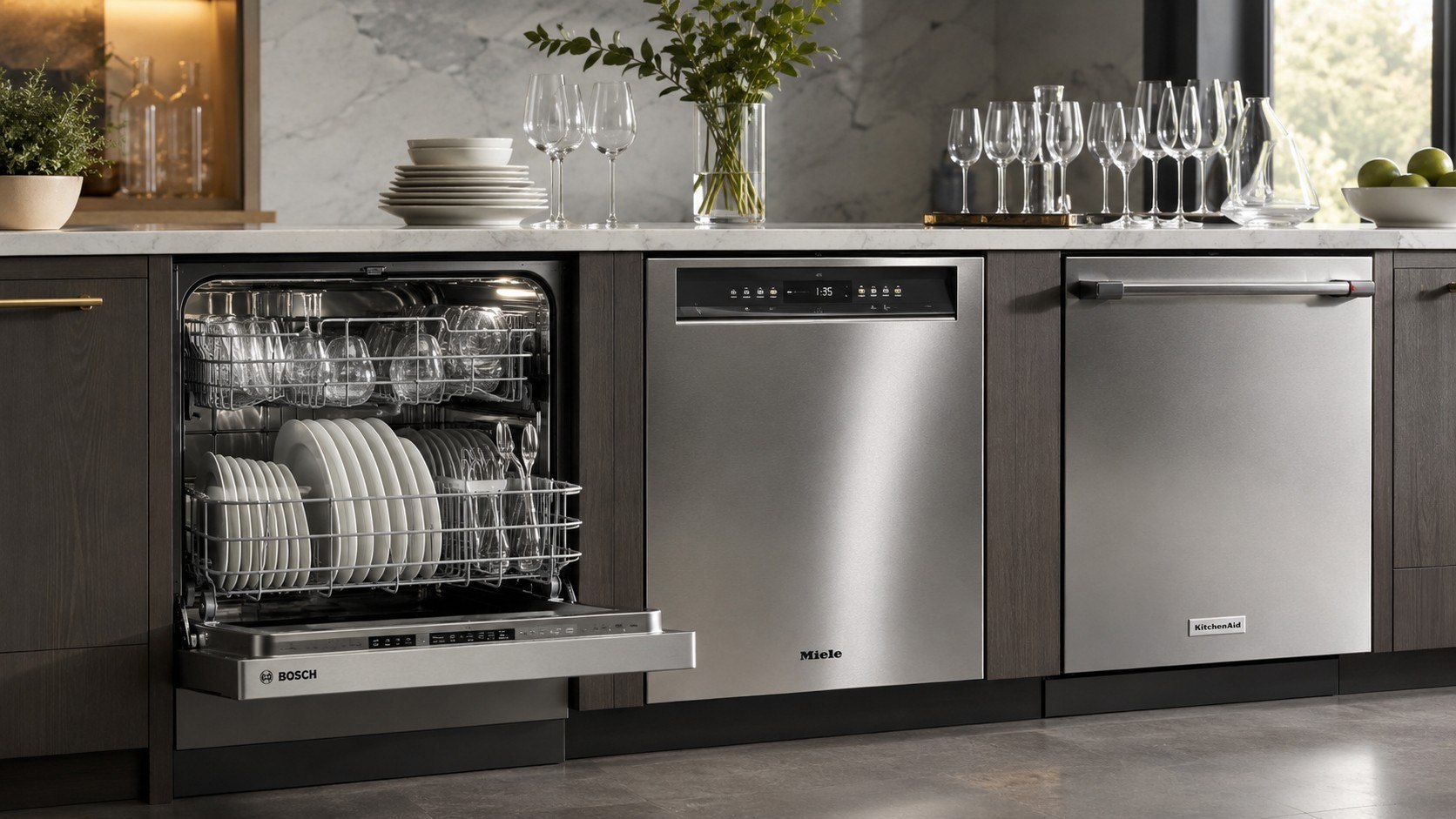
Which should you buy in 2026?
The final choice should follow the household’s real loading pattern. Do not pay for premium programs that will remain unused.
- If quietness and balanced value matter most, buy Bosch, preferably a 500 or 800 Series model.
- If premium construction and controlled drying matter most, choose Miele with confirmed local service.
- If bowls and cookware overload the lower rack, choose KitchenAid with a FreeFlex third rack.
- If the budget stays below $1,000, compare discounted KitchenAid and entry-level Bosch models.
- If repair coverage is limited locally, choose the brand supported by the nearest authorized technician.
Most households should start with Bosch 800 Series pricing. Compare its installed cost against a KitchenAid model rated between 39 and 44 dBA.
Miele becomes the logical upgrade when superior fit, finish, and ownership expectations justify another $500–$2,500. The price gap is easier to defend for owners planning to remain in the same home.
Bring several dishes to a showroom when possible. Test dinner plates, cereal bowls, wine glasses, travel mugs, and a large skillet.
Rack geometry often decides long-term satisfaction more reliably than an extensive feature list. A dishwasher that fits the household’s real dishes will be easier to load every day.
FAQ
Is Miele better than Bosch in 2026?
Miele offers more premium construction and selected convenience features. Bosch usually provides better value for the average US household. Local service access can reverse that decision.
Which dishwasher is the quietest?
Selected Bosch, Miele, and KitchenAid models reach approximately 39 dBA. Compare exact model specifications because noise ratings vary within each brand.
Which brand dries plastic best?
Bosch CrystalDry models are designed to improve plastic drying. KitchenAid Advanced ProDry models also target residual moisture. Miele uses AutoOpen drying on selected machines.
Which dishwasher has the best third rack?
KitchenAid’s FreeFlex rack is especially useful for mugs and bowls. Bosch offers flexible designs, while Miele emphasizes cutlery organization and precise loading.
How much should dishwasher installation cost in 2026?
A straightforward replacement may cost roughly $150–$350. Plumbing, wiring, permits, panel installation, and cabinet changes can increase the total.
Should I repair my old dishwasher or replace it?
Repair makes sense when the machine is otherwise sound and parts remain available. Replacement becomes more practical when several components are failing or corrosion appears.
Earlier we wrote about How to Sell on Facebook Marketplace Safely 2026: Scam Signs, Pickup Rules and Payment Tips