

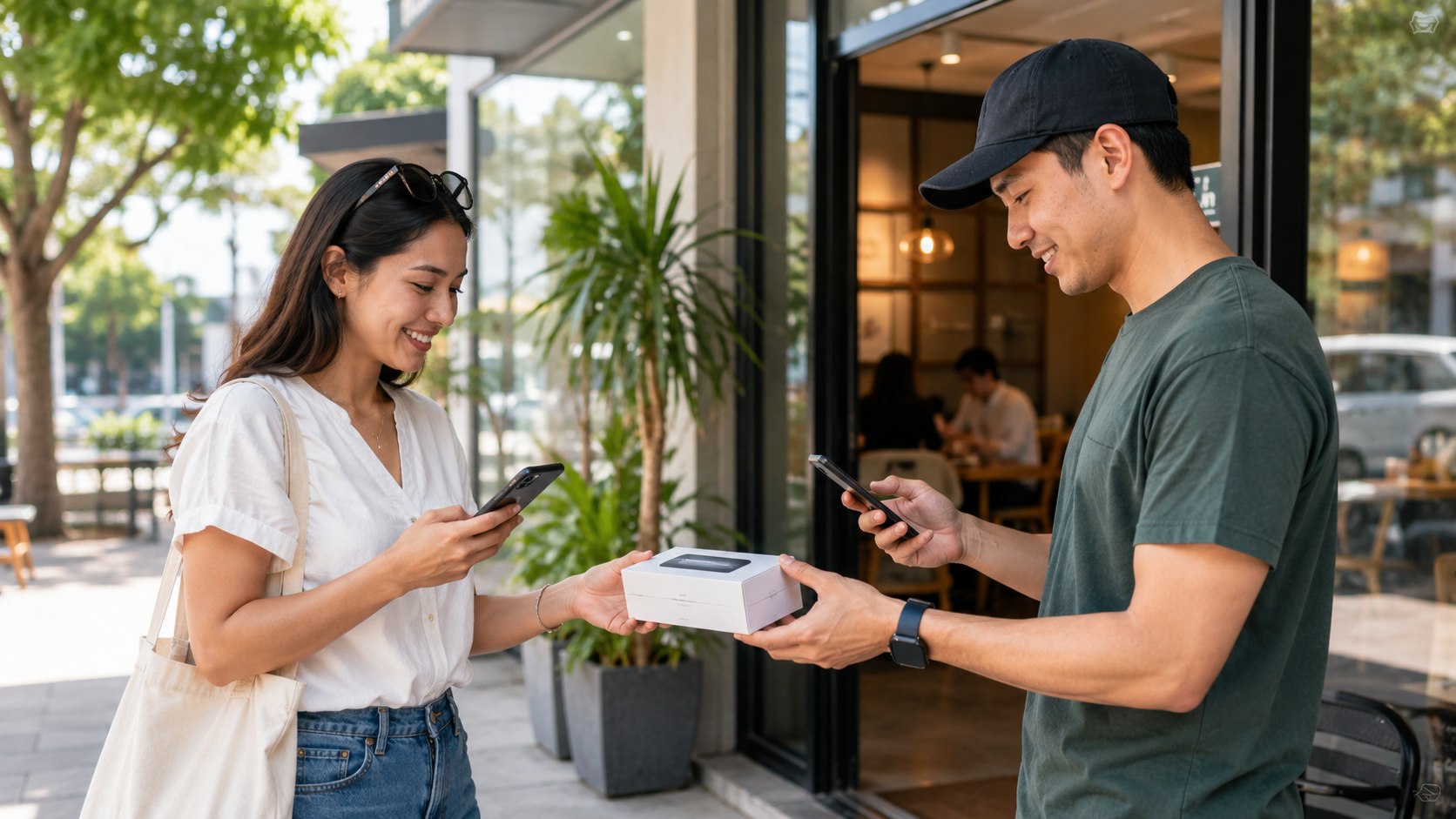
how to sell on facebook marketplace safely 2026 comes down to 3 decisions before you answer the first buyer: price the item realistically, keep every message inside Facebook, and plan a public or controlled pickup before payment is discussed, as noted by Baltimore Chronicle. A safe sale can usually be prepared in 30–45 minutes if you already have photos, measurements, and a payment plan.
This guide is built for US sellers listing furniture, phones, tools, baby gear, bikes, small appliances, auto parts, and household items. The goal is simple: sell without giving away your address too early, accepting a fake payment, or walking into a risky pickup.
Key takeaways
- Use Facebook Messenger only, because moving to text or email makes phishing and fake-payment tricks easier.
- For pickup, choose daylight, a public place, or a police-station exchange zone for portable items.
- Do not release the item until payment is visible inside your own banking or payment app.
What you need before listing
Before posting, prepare the sale like a small transaction, not a casual chat. Most problems start when sellers improvise after a buyer appears.
You need:
- Facebook account with Marketplace access;
- 6–10 clear photos of the actual item;
- brand, model, size, age, condition, and defects;
- pickup city or neighborhood, not your full address;
- cash, Zelle, Venmo, PayPal, or bank-app plan;
- receipt, serial number, or proof of ownership for expensive items;
- a second adult present for home pickup;
- 30–45 minutes to photograph, post, screen, and schedule.
For bulky items, also measure doorways, stairs, elevator access, and parking distance. A $350 used sectional can become a failed sale if the buyer arrives with a compact sedan and no helper. Sellers clearing a house before a move may also use the Baltimore Chronicle guide on changing your address everywhere when moving to avoid missed mail after a local sale.
The safest Marketplace sale is usually not the fastest reply. It is the buyer who asks specific questions, accepts ordinary pickup rules, and does not pressure you to leave Facebook.
Step 1: Price the item so real buyers respond
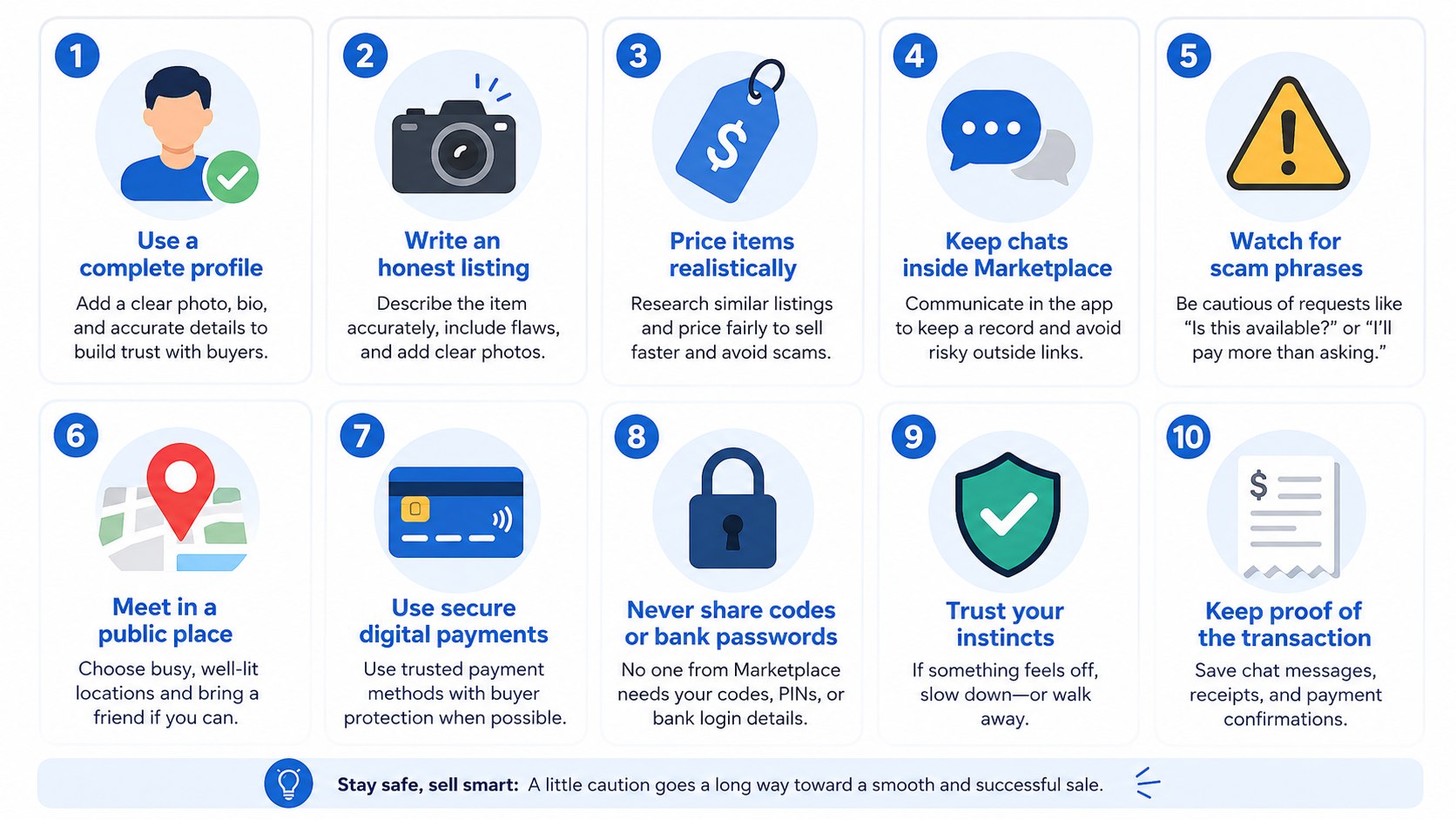
Search Facebook Marketplace, OfferUp, Craigslist, eBay sold listings, and local resale groups for the same item in your city or state. For 2026, common used household items often move faster when listed around 30%–70% below current retail, depending on condition and brand.
This matters because realistic pricing filters out long negotiations and makes scammers less likely to target you with exaggerated “full price now” offers. A buyer offering $500 instantly for a $220 used IKEA dresser is not necessarily serious.
Do not price from memory. A 2021 Peloton Bike, Samsung washer, DeWalt tool set, or Graco stroller may have a different resale value in Maryland than in Texas, California, or Florida.
Step 2: Write a listing that reduces scam messages
Include brand, model, condition, dimensions, pickup area, payment preference, and defects. Use direct wording such as “cash or verified Zelle only,” “no shipping,” “pickup near Towson,” or “will meet at public exchange location.”
This matters because vague listings attract vague buyers. A complete description helps legitimate buyers decide quickly and gives scammers less room to steer the conversation.
Do not write “DM for details” on expensive items. That forces every buyer into a conversation and increases the chance of phishing, off-platform requests, or fake-payment screenshots.
Step 3: Screen buyers before sharing pickup details
Check the buyer’s Facebook profile, account age, Marketplace activity, mutual context, and message style. Ask 1 practical question: “Can you pick up today at 6 p.m. near [area]?” Real buyers usually answer directly.
This matters because Facebook Marketplace scams often begin with urgency, overpayment, third-party pickup, or a request to switch to text. Meta advises users to stop communicating and report suspected scams when activity looks suspicious.
Do not send your phone number, email, home address, or payment handle before the buyer confirms a normal pickup plan. The Federal Trade Commission warns that fake payment notifications and bogus refund requests are common in online selling scams.
| Buyer behavior | Risk level | Seller response |
|---|---|---|
| Asks about size, condition, pickup time | Low | Continue inside Messenger |
| Offers full price immediately with no questions | Medium | Ask for pickup details first |
| Wants your phone number or email | High | Keep chat on Facebook |
| Sends a payment screenshot before pickup | High | Verify inside your own app |
| Claims they overpaid and needs a refund | High | Do not refund; stop the deal |
This comparison is especially useful for phones, laptops, gaming consoles, bikes, furniture, and car parts. Those categories attract both real buyers and organized fraud attempts. For related resale preparation, see Baltimore Chronicle’s guide on selling used furniture fast in the USA.
If the buyer’s story changes, slow the deal down. A common pattern is simple: one person messages, another person “picks up,” a third account sends a fake payment notice. That is not a normal local sale.
Step 4: Choose a safe Facebook Marketplace pickup
For portable items, meet during daylight at a police-station exchange zone, bank parking lot, grocery-store lot, or busy public location with cameras. For large furniture or appliances, use curbside pickup, garage pickup, or a doorway handoff with another adult present.
This matters because safe Facebook Marketplace pickup reduces theft, intimidation, and address exposure. Some US police departments offer designated exchange areas, but availability varies by city and county in 2026.
Do not invite a stranger deep inside your home. Move the item near the entrance, garage, porch, lobby, or curb before the appointment.
Use these pickup rules:
- Meet before dark whenever possible.
- Keep pets, children, wallets, and mail out of view.
- Do not let buyers “test” phones or laptops while walking away.
- For bikes, hold the buyer’s ID or keys during a test ride only if local norms allow it.
- For vehicles, meet near a DMV, bank, or mechanic, not an isolated lot.
- Tell someone the buyer’s first name, meeting point, and time.
The main point is not fear; it is control. Public pickup creates witnesses. Daylight improves visibility. A second adult stops the transaction from feeling private. If the buyer refuses ordinary safety rules, the buyer is not worth the sale.
Step 5: Handle payment without trusting screenshots
Accept cash for small local sales or verify digital payment inside your own Zelle, Venmo, PayPal, Cash App, or bank app before handing over the item. For high-value goods, meet at the buyer’s bank and complete payment there.
This matters because a fake payment notification can look convincing. The FTC specifically warns sellers about fake payment messages and claims that money was sent twice.
Never refund an “accidental overpayment” from money you cannot independently verify. If there is a real payment problem, the buyer can resolve it through their bank or payment provider.
“They send you a fake payment notification and hope you send the item before you realize it’s a scam.” — Federal Trade Commission, consumer alert on selling items online.
For 2026, payment safety is less about which app is fashionable and more about where you verify the money. Screenshots, emails, and buyer demonstrations are not proof.
Step 6: Protect yourself on high-value items
For iPhones, MacBooks, PlayStation 5 consoles, cameras, e-bikes, tools, tires, jewelry, and vehicles, record serial numbers, remove personal data, and confirm ownership documents. For phones, erase the device only after backups and account removal are complete.
This matters because high-value items are easier to resell and easier to dispute. A buyer may later claim the item was locked, broken, stolen, or not as described.
Do not let a buyer leave with an unlocked phone, signed-in laptop, saved browser passwords, or a device still connected to Apple ID, Google, Samsung, or Microsoft accounts.
| Item | Before pickup | Safer handoff rule |
|---|---|---|
| iPhone or Android phone | Factory reset, remove account lock | Let buyer inspect after payment is ready |
| Laptop | Wipe drive, reinstall OS | Show startup screen, not personal files |
| Power tools | Photograph serial numbers | Test briefly in public or garage |
| Bike or e-bike | Record frame number | No solo test ride without collateral |
| Car or motorcycle | Check title, VIN, lien status | Use bank, DMV, or notary setting |
This format keeps the sale clean. It also gives both sides a shared understanding before money changes hands. A serious buyer will not object to basic verification. A scammer often will.
Step 7: Close the sale and leave a clean paper trail
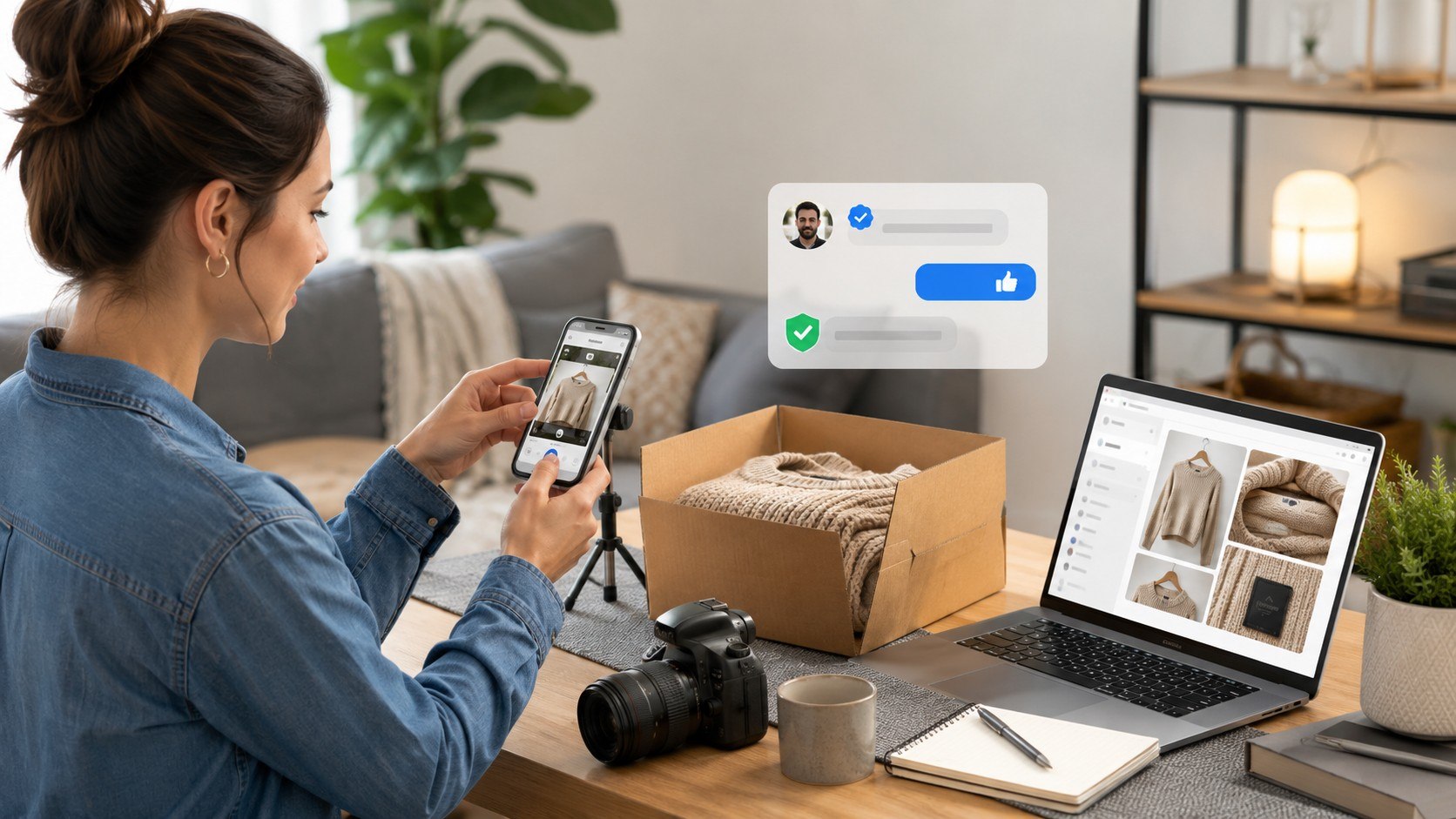
Once payment is verified, mark the item sold, archive the chat, and keep photos, messages, and payment confirmation for at least 30 days. For expensive goods, use a simple bill of sale with names, date, item, price, and “sold as-is.”
This matters because a clean record helps if the buyer later claims non-delivery, damaged condition, or payment confusion. This is more important for $800 tools, $1,200 laptops, and used cars than for a $25 lamp.
Do not delete the conversation immediately. Keep the Marketplace thread until you are confident the sale is finished.
For sellers preparing multiple household sales during relocation, Baltimore Chronicle’s home improvement cost guide is useful for estimating whether to sell, repair, or replace fixtures before moving or renovating. Local selling decisions often overlap with home maintenance budgets.
Troubleshooting
Even careful sellers run into awkward situations. The safest response is usually to slow down, verify independently, or cancel.
- Buyer wants shipping after agreeing to pickup: decline unless you fully understand Facebook’s current shipping and protection rules.
- Buyer says Zelle requires a business upgrade: stop. That is a known payment-app scam pattern.
- Buyer sends more money than asked: do not refund from your own balance; tell them to contact their bank.
- Buyer arrives with less cash: accept the lower price only if you are comfortable. Do not negotiate under pressure.
- Buyer wants to enter your home: move the item outside or cancel. Safety beats the sale.
After any suspicious message, use Facebook’s report tools and stop communicating. Meta’s Marketplace safety guidance tells users to report suspected scams and avoid continuing with suspicious buyers. The rule is simple: if a transaction requires secrecy, speed, or unusual payment steps, it is not a normal Marketplace sale.
FAQ
Is Facebook Marketplace safe for sellers in 2026?
Yes, it can be safe if you keep communication on Facebook, verify payment inside your own app, and use controlled pickup. The highest-risk moments are off-platform messages, fake payment screenshots, overpayment claims, and home pickup without preparation.
What is the safest payment method for Facebook Marketplace?
Cash is simple for low-value local pickup. Zelle, Venmo, PayPal, and Cash App can work, but only if the payment appears inside your own account. Do not rely on buyer screenshots, emails, or text alerts.
Should I give my address to a Facebook Marketplace buyer?
Give only a general area first. Share the exact address only after the buyer confirms time, payment method, and pickup details. For small items, avoid sharing your home address and use a public meeting point.
How do I avoid Facebook Marketplace scams as a seller?
Watch for urgent full-price offers, requests to text, third-party pickup stories, overpayment claims, fake Zelle or Venmo notices, and links asking you to verify payment. Keep everything inside Facebook until the deal is complete.
Can local pickup qualify for Facebook Purchase Protection?
Facebook’s help materials state that local pickups, Messenger transactions, third-party sites, and other messaging services do not qualify for Purchase Protection. Sellers should verify current Meta rules before relying on platform protection.
What should I do if I think the buyer is a scammer?
Stop communicating, do not send money, do not release the item, and report the account through Facebook. If there is theft, fraud, or a physical safety concern, contact local law enforcement.
Earlier we wrote about How Much Does a Vehicle Title Transfer Cost in 2026? DMV Fees, Taxes, and State Rules