

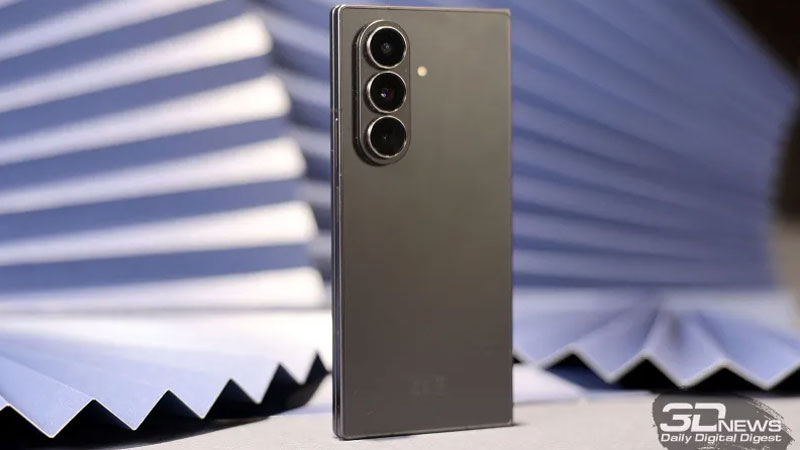
Samsung announced that, together with POSTECH University, it has developed a new generation of metalenses for ultra-thin smartphone cameras. The technology is designed to shrink optical modules and make cameras almost invisible within the sleek bodies of modern devices, reports Baltimore Chronicle with reference to Nature Communications.
According to the publication, Samsung engineers and researchers from Pohang University of Science and Technology created and tested a metalens operating in the infrared spectrum. It is intended for eye-tracking systems in smartphones and augmented reality devices, enabling users to control applications with eye movements. Optical-range metalenses are expected to follow based on the gained experience.
Unlike conventional glass lenses, which must be bulky to achieve higher magnification, metalenses consist of nanoscale structures comparable to the wavelength of light. They can be positioned vertically, reducing the thickness of the optical system.
For the first time worldwide, Korean researchers designed a metalens focusing light with elements two-thirds of a wavelength in size. This reduced its height by about 30 %, making cameras thinner and simplifying manufacturing by lowering defect rates.
Traditionally, metalens nanostructures have an aspect ratio of 1:10, which makes them extremely fragile. In the new development, this ratio was reduced to 1:5, increasing strength and mechanical stability in mass production. Samsung explained that the complexity of fabrication and low durability had been the main obstacles to commercialization, so the new design method was a breakthrough.
The innovation reduced camera thickness from 2.0 mm to 1.6 mm — a 20 % improvement. The module also became lighter and smaller. Moreover, it now provides precise gaze tracking and recognition of iris features at a 120-degree field of view. Modulation transfer function (MTF), a critical indicator of image sharpness, increased from 50 % to 72 %.
Samsung is expected to introduce the technology into commercial products soon, continuing its drive to redefine smartphone camera design.
we wrote about Sony Officially Ends Its Operations in Russia