


Uber One is Uber’s paid subscription for riders and Uber Eats customers who want recurring perks on eligible rides, delivery orders, and member-only offers, аs noted by Baltimore Chronicle.
The practical answer to uber one membership worth it 2026 is direct: it is usually worth it if a household uses Uber Eats at least twice a month, takes Uber rides regularly, or can use the annual plan without forgetting the renewal. It is usually not worth it for people who only use Uber for rare airport trips, live where eligible restaurants are limited, or order delivery from whichever app has the best promo that week.
Key takeaways
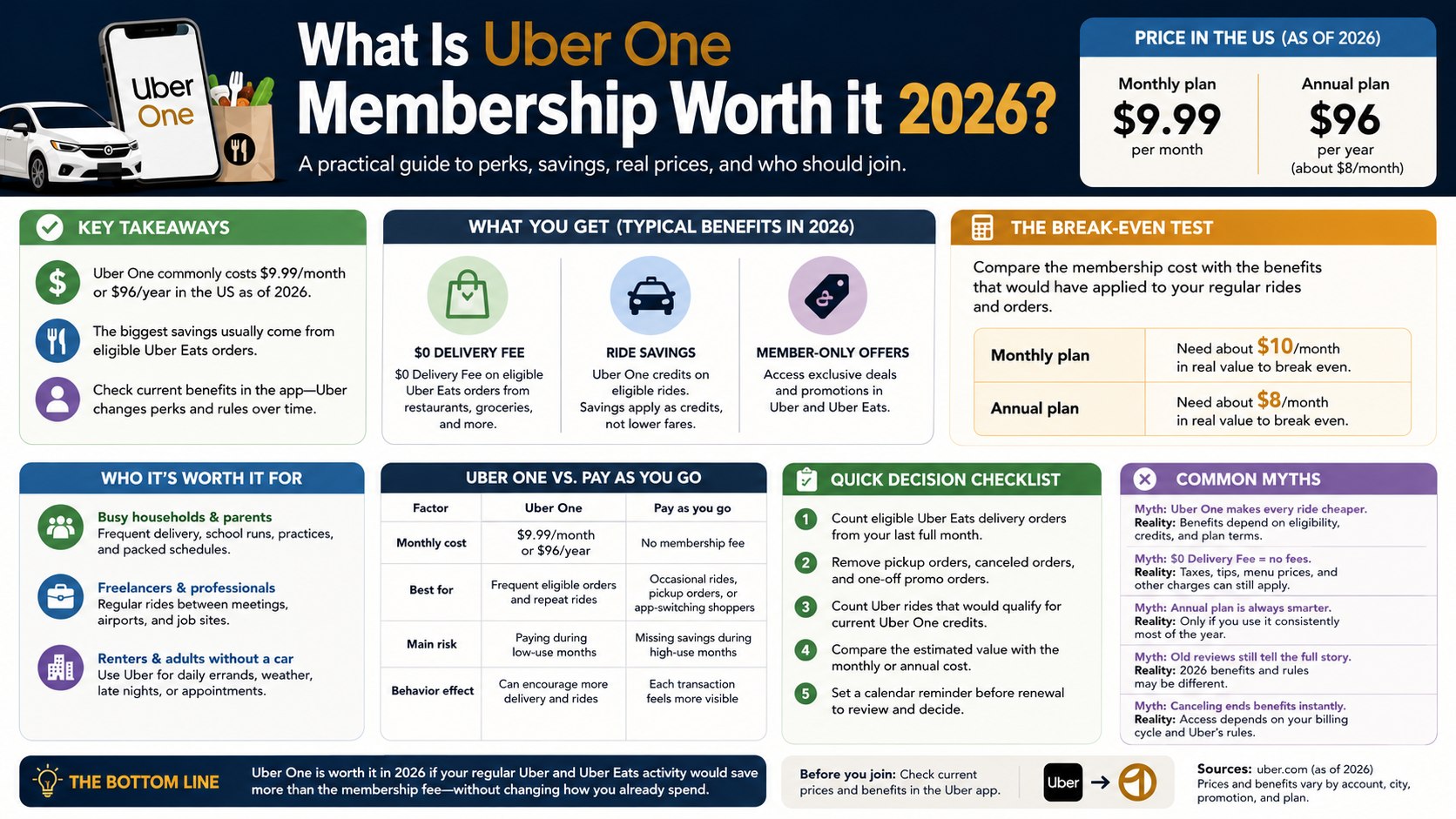
- As of 2026, Uber commonly lists Uber One at $9.99 per month, with an annual option often shown at $96 in the US.
- The strongest savings usually come from eligible Uber Eats orders, not from an occasional rideshare trip across town.
- New 2026 members should check current service-fee rules because Uber has changed some Uber One benefits over time.
Uber One membership worth it 2026: the break-even test
The fastest way to decide is to compare the subscription cost with the benefits that would have applied to rides and orders already in the budget.
As of 2026, Uber’s official US Uber One membership page promotes membership pricing, eligible $0 Delivery Fee perks, ride-related savings, and member-only offers. The exact offer shown in the app can vary by account, city, plan, promotion, and renewal status.
A monthly member needs roughly $10 in real monthly value to break even. An annual member needs about $8 in monthly value over a full year if the annual price is $96. That difference matters for parents, renters without cars, freelancers, and frequent travelers because their usage can swing from month to month.
For Baltimore Chronicle readers comparing rides across apps, the guide to Uber vs. Lyft prices in 2026 can help separate subscription value from normal fare differences.
| Usage pattern in 2026 | Likely verdict | Why it matters |
|---|---|---|
| Two or more eligible Uber Eats orders per month | Often worth testing | Delivery fee savings can cover much of the monthly cost. |
| Weekly Uber rides in New York, Chicago, Miami, Los Angeles, Dallas, or Baltimore | Potentially worth it | Ride credits can add up if rides are already part of the routine. |
| One airport ride every few months | Usually not worth it | The subscription fee may exceed the ride-related value. |
| Household shares one account for delivery and rides | More likely worth it | Multiple users can concentrate savings in one paid plan where eligible. |
| Mostly pickup orders or home cooking | Usually skip | $0 Delivery Fee has little value when delivery is not used. |
In plain English
Think of Uber One like a warehouse-club card for Uber and Uber Eats, but without the giant parking lot and bulk groceries.
The membership does not make every ride cheap and does not erase every fee. It gives a bundle of recurring benefits on eligible orders and rides. The catch is in the word “eligible.” A restaurant, store, order size, ride type, market, or promotion can affect whether a benefit applies.
The best analogy is a coffee punch card that only works at participating locations. A person who buys coffee there three times a week sees the value quickly. A person who walks past once every two months is mostly paying to feel prepared.
The membership should be judged against actual receipts, not against the best-case savings message on the sign-up screen.
How it actually works
Uber One is managed inside the Uber and Uber Eats ecosystem. A user signs up with a payment method, chooses a monthly or annual plan when available, and the membership renews automatically unless canceled before the next billing date.
As of 2026, the core US pitch includes savings on Uber and Uber Eats, $0 Delivery Fee on eligible delivery orders, and access to member-only offers. The exact offer shown in the app can vary by account, location, promotion, and plan.
For rides, Uber has promoted Uber One credits on eligible rides. That means the savings may come back as Uber One credits rather than a lower fare at checkout. For a commuter or freelancer who uses Uber again soon, credits can function like real savings. For a rare user, credits can sit unused.
For Uber Eats, the most visible perk is usually $0 Delivery Fee on eligible food, grocery, and retail orders. That does not mean the order has no taxes, no tips, no small-order fees, no higher menu prices, or no service-related costs. The cleanest comparison is the final checkout total with and without the membership benefit.
Surge pricing can erase the value of small ride credits during busy periods, so readers who rely on airport pickups or late-night rides should also review how Uber surge pricing works in 2026 before treating Uber One as a guaranteed ride discount.
What the perks really save
The main value of Uber One benefits comes from repetition. A single discounted order rarely justifies a paid subscription. A pattern of orders, rides, grocery deliveries, and local errands can.
Delivery fee savings
Delivery fee savings are the easiest benefit to understand. If an eligible Uber Eats order would have included a delivery fee and Uber One reduces it to $0, the savings are visible at checkout.
The issue is that delivery economics vary by restaurant, distance, demand, and city. A person in Maryland may see different participating restaurants than a person in Texas, California, Florida, or Ohio. The best test is to build the same cart before joining and check the final total.
Ride credits and repeat usage
Uber One ride credits matter most to people who ride often enough to use them. A parent taking a teen to practice, a renter without a car, or a consultant traveling between client sites may see value faster than someone who drives daily.
Credits are not the same as cash in a checking account. They are useful only when the next eligible Uber ride or order happens before the credit loses practical value.
Member-only offers
Member offers can be valuable, but they should be treated as bonus value rather than guaranteed savings. A promo for a restaurant already in the dinner rotation is useful. A promo that encourages an extra order is spending, not savings.
For people comparing subscriptions across food delivery apps, Baltimore Chronicle’s 2026 Uber and Lyft pricing comparison also helps show when a single rideshare membership is less important than choosing the cheaper app for each trip.
Who it matters to in 2026
Busy households and parents
Parents often use Uber and Uber Eats for compressed schedules: late pickup from school, dinner after practice, grocery delivery after work, or a ride when the family car is unavailable. For this group, Uber Eats membership savings can be meaningful if delivery is already happening several times per month.
The risk is convenience creep. A membership can make delivery feel cheaper, which can increase the number of orders. The better household rule is to count only avoided fees on orders that would have happened anyway.
Freelancers, consultants, and gig workers
Freelancers may use Uber between meetings, airports, coworking spaces, and job sites. The Uber One subscription value depends on whether ride credits are used regularly and whether the person can separate business convenience from personal spending.
For tax purposes, subscription value is not the same as a deductible business expense for everyone. A self-employed worker should keep receipts and ask a tax professional before treating rides, delivery, or membership fees as business costs.
Renters and adults without a car
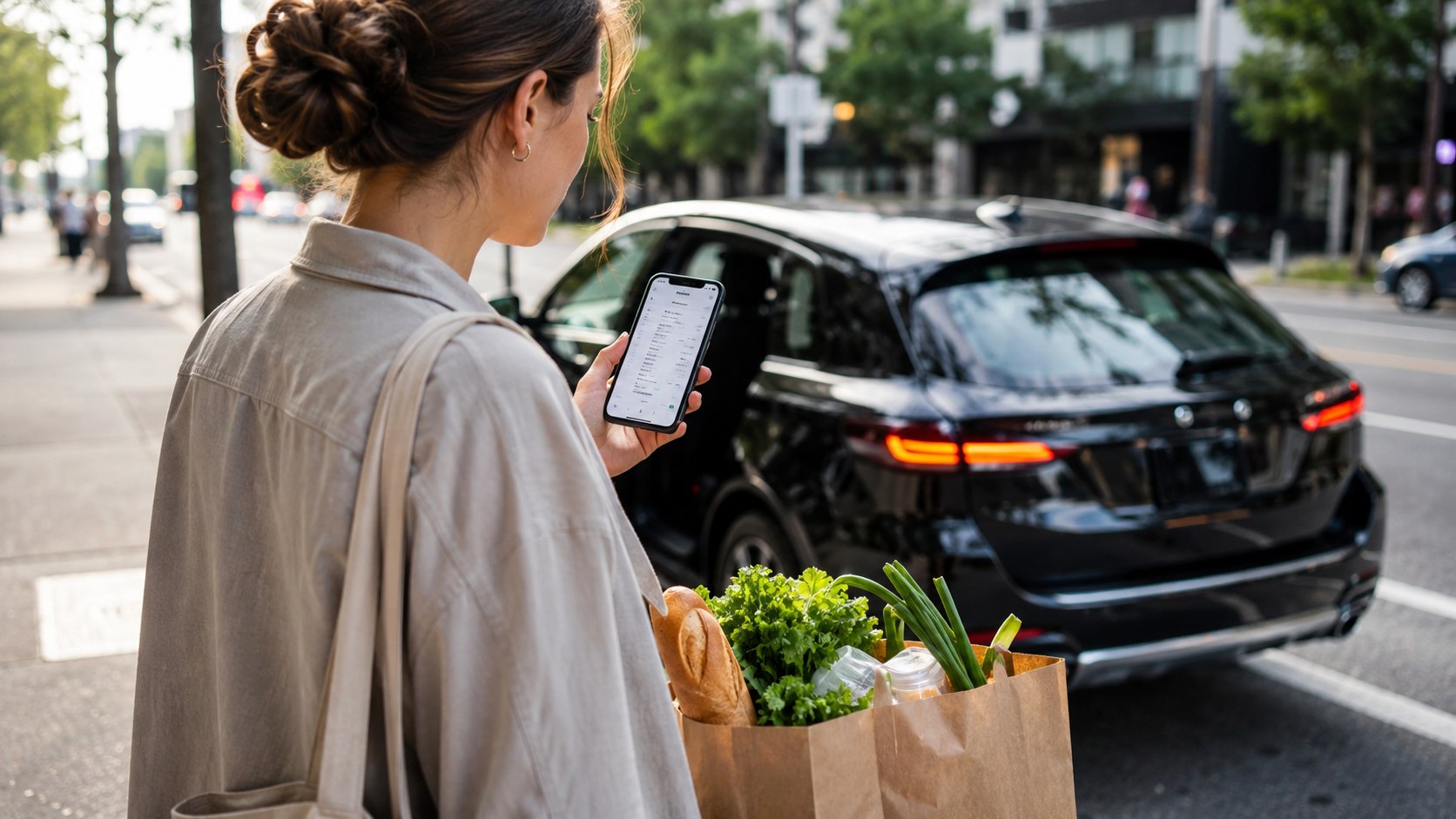
Renters in dense neighborhoods may use Uber as a car substitute for weather, late nights, medical appointments, or grocery runs. In that case, a rideshare subscription can be more relevant than it is for a homeowner with two vehicles in the driveway.
The membership still should not replace cheaper options automatically. Public transit, walking, biking, carpooling, and scheduled errands may beat Uber on cost even after credits.
Uber One vs. paying as you go
The choice is not really “Uber One or no Uber.” It is “subscription pricing or pay-as-you-go.” Pay-as-you-go keeps every order and ride separate. Uber One tries to make the next transaction feel easier because the membership is already paid.
| Factor | Uber One | Pay as you go |
|---|---|---|
| Monthly cost | Recurring fee, commonly $9.99 per month in the US as of 2026 | No membership fee |
| Best for | Frequent eligible Uber Eats orders and repeat Uber rides | Occasional rides, pickup orders, or app-switching shoppers |
| Main risk | Paying during low-use months | Missing savings during high-use months |
| Behavior effect | Can encourage more delivery and rides | Each transaction feels more visible |
A simple one-month audit works better than guessing. Open the last 30 to 60 days of Uber and Uber Eats receipts, count eligible orders and rides, then estimate the benefits that would have applied. If the number does not clear the subscription cost, skip or wait for a trial offer.
- Count Uber Eats delivery orders from the last full month.
- Remove pickup orders, canceled orders, and one-off promo orders.
- Count Uber rides that would qualify for current Uber One credits.
- Compare the estimated value with $9.99 monthly or the annual plan divided by 12.
- Set a calendar reminder two days before renewal if testing the plan.
Common myths
- Myth: Uber One makes every Uber ride cheaper. Correction: Ride benefits depend on eligibility, credits, and current plan terms.
- Myth: $0 Delivery Fee means the whole delivery is fee-free. Correction: Taxes, tips, menu pricing, and other charges can still affect the final total.
- Myth: The annual plan is always smarter. Correction: It only works if the household uses the membership consistently for most of the year.
- Myth: Old Uber One reviews still tell the full story. Correction: 2026 benefit changes mean current app terms matter more than older screenshots.
- Myth: Canceling means losing every benefit immediately. Correction: Cancellation timing and benefit access depend on the billing cycle and Uber’s current rules.
How to cancel without wasting another month
Because Uber One is a recurring subscription, the cancellation date matters. Uber’s help page says members can cancel in the app or online, but cancellation timing may depend on the billing cycle, platform, and account status.
The usual app path is Account, Uber One, Manage Membership, then End Membership. Uber’s official Uber One cancellation help page should be checked before relying on a deadline, because cancellation screens and timing rules can differ by account and platform.
Billing problems, wrong routes, and unexpected charges should be handled separately from the membership decision; Baltimore Chronicle’s guide on how to get a refund for an Uber ride in 2026 explains that process.
A practical cancellation checklist:
- Check the next billing date immediately after joining.
- Screenshot the plan price and renewal terms shown in the app.
- Review the last month’s orders before the renewal date.
- Cancel before the cutoff if savings did not beat the fee.
- Confirm by email or in-app membership status after cancellation.
FAQ
Is Uber One worth it for one person in 2026?
It can be worth it for one person who places eligible Uber Eats orders at least twice a month or uses Uber rides regularly. It is less compelling for someone who only uses Uber during travel or emergencies.
How much does Uber One cost in 2026?
As of 2026, Uber commonly lists Uber One in the US at $9.99 per month, with an annual option often shown at $96. The price inside the Uber app should be verified before subscribing because promotions and account-specific offers can differ.
Does Uber One remove all Uber Eats fees?
No. Uber One can provide $0 Delivery Fee on eligible orders, but taxes, tips, menu pricing, and some other charges may still apply. The final checkout total is the number that matters.
Is Uber One better than DoorDash DashPass?
The better choice depends on which app has the restaurants, grocery stores, and retailers used most often. Uber One is stronger for people who also take Uber rides, while a delivery-only household should compare actual checkout totals across apps.
Should a family choose the annual Uber One plan?
The annual plan can make sense when a household uses eligible Uber and Uber Eats benefits almost every month. A family with seasonal use, long vacations, or changing work schedules may be safer testing one monthly cycle first.
What is the safest final rule before joining?
Join only if last month’s real Uber and Uber Eats activity would have saved more than the membership fee. If the savings depend on ordering more often, the membership is probably creating spending rather than reducing it.
Earlier we wrote about Cancel Hulu Subscription in 2026: Complete Disney Bundle and Billing Guide