

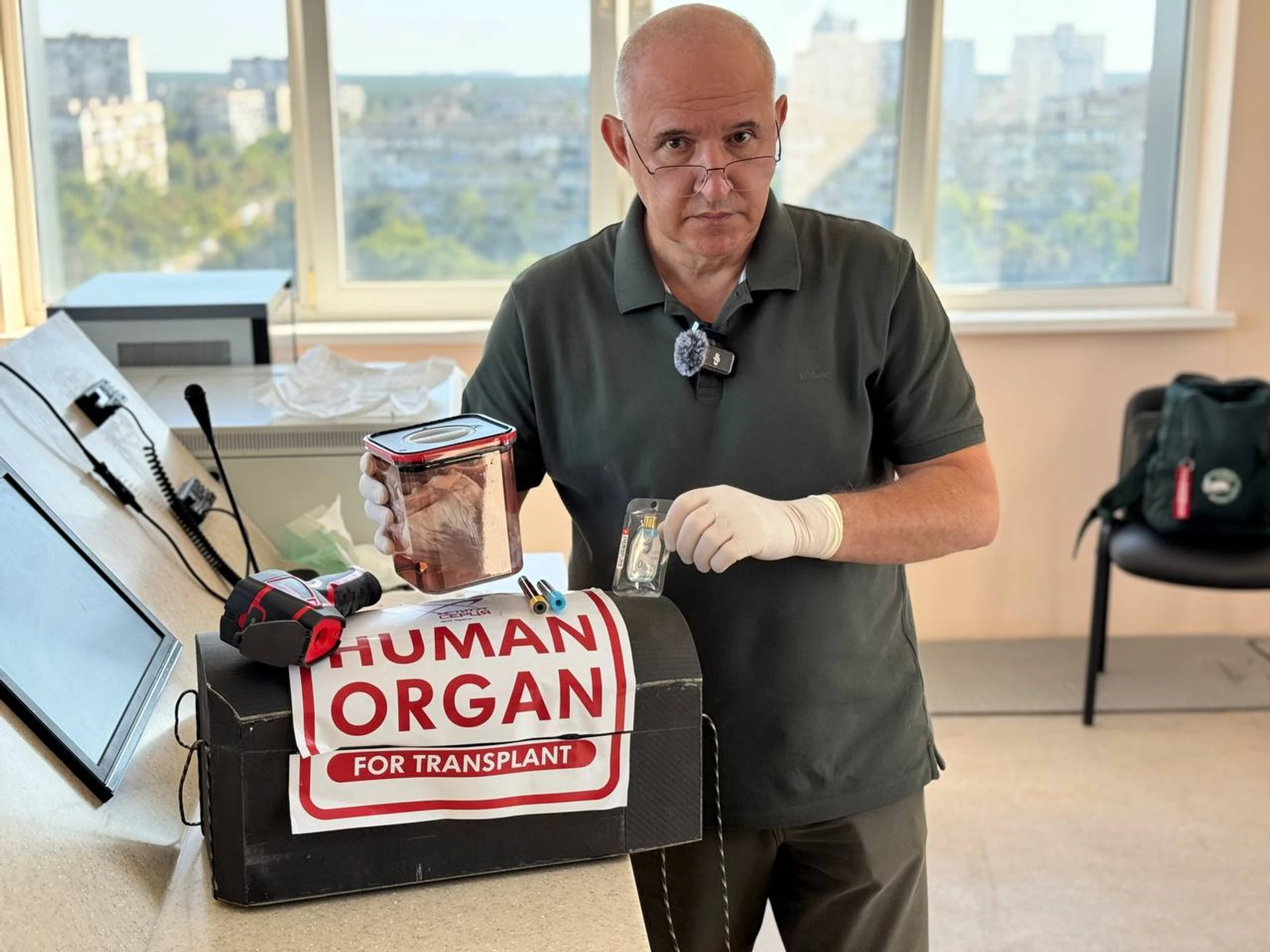
Ukraine is actively developing unmanned systems designed for various battlefield operations, which are already showing potential for civilian applications, reports Baltimore Chronicle with reference to the Oboronka. One promising area is transplantology: to speed up and optimize the transport of donor organs, the “Heart Institute of the Ministry of Health of Ukraine” plans to use drones currently employed in military operations, explained the clinic’s director, Professor Borys Todurov, in an interview with “Oboronka”.
Time is critical for transplants: a heart can remain viable outside the human body for about four hours. Previously, helicopters were used for transporting organs from remote regions, but due to Ukraine’s closed airspace, organs are now transported by road. Specialists at the Heart Institute have extended the heart’s viability to 6-7 hours, making it possible to deliver organs, for example, from Zaporizhzhia to Kyiv. Road transport poses risks due to traffic, traffic lights, mechanical issues, and refueling, whereas drones can cover distances almost twice as fast without endangering the medical team.
Currently, the clinic is testing two Ukrainian military UAVs equipped with cameras and communication systems, which have already seen combat use. The first is a hybrid drone that takes off and lands vertically but flies like an airplane: at an altitude of 50 meters, its gasoline engine engages, accelerating it to 150 km/h and allowing it to cover up to 700 km while carrying up to 10 kg. This appears to be the PD-2 drone from the company “Ukrspecsystems.” The second is a copter-type drone capable of carrying up to 20 kg over approximately 50 km, but with additional batteries, its range could increase to 70–100 km, covering the entire Kyiv region.
To ensure organs remain viable, test flights are conducted at a military airfield: a pig heart with erythrocyte mass is placed in a thermal box and lifted into the air for four hours, after which temperature, myocardium condition, blood quality, and vibration effects are analyzed. Experiments in different weather conditions (-10 °C and +30 °C) produced successful results.
The idea of using drones for organ transport emerged in 2021. The first flight was planned for March 2022, but the full-scale invasion delayed the project. The clinic has secured investors for the hybrid and copter drones and continues preparations for the program launch. Collaboration with military operators returning from the front is also planned, leveraging their experience for civilian medical applications.
Drones can be used not only for transporting organs but also for delivering medical equipment, medicines, blood, or plasma where conventional transport cannot reach. Interest in Ukrainian developments is also growing abroad: in the U.S., particularly Texas, drones are proposed for delivering antivenom from snakebites over long distances. Thus, Ukrainian military technologies have the potential for civilian applications both within the country and internationally.
Earlier we wrote that Trump says Ukraine could regain borders after talks with von der Leyen.