

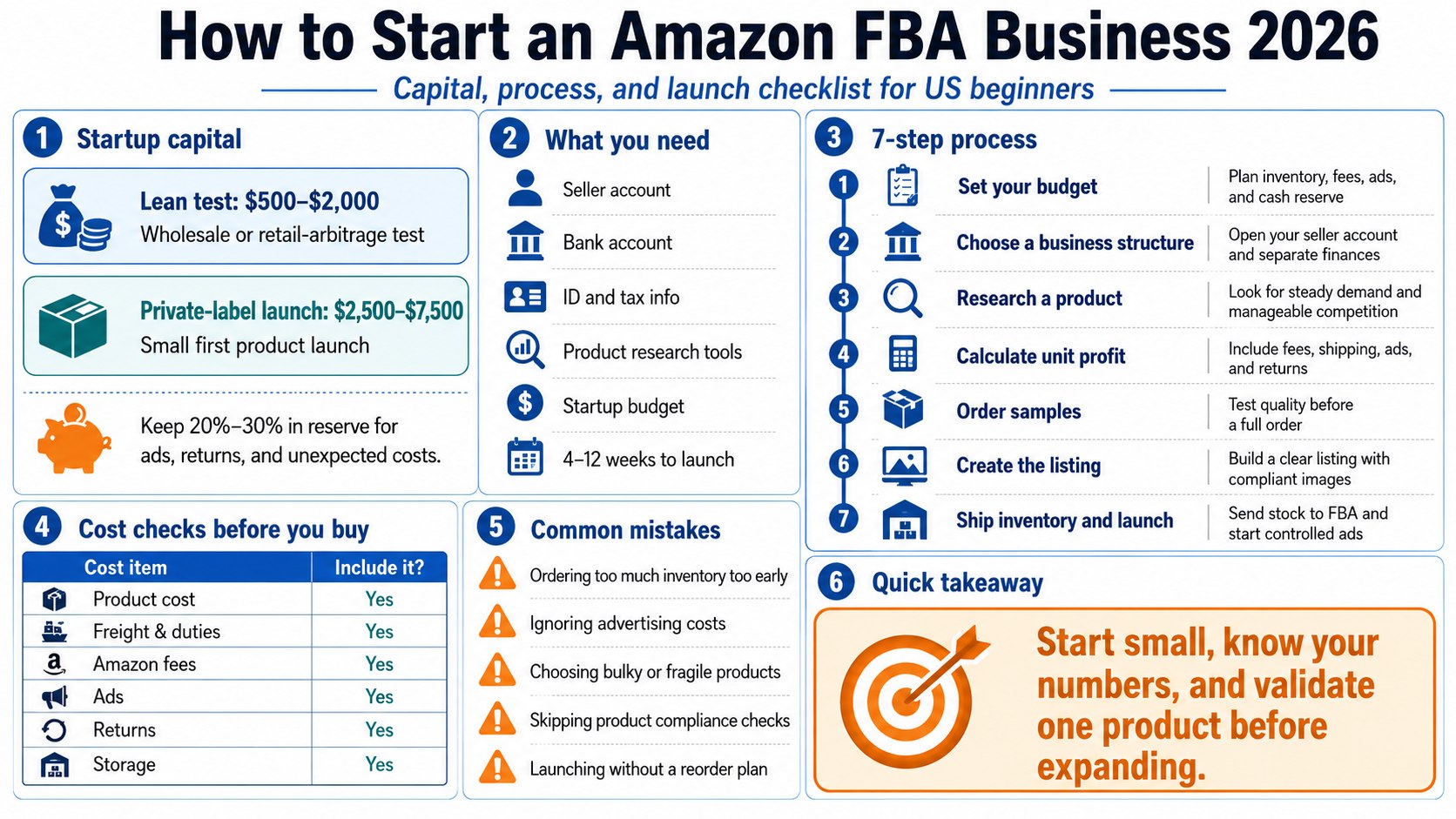
How to start an Amazon FBA business 2026 comes down to six actions: set a realistic budget, choose a legally compliant product, open a seller account, calculate every unit cost, order a small test batch, and send inventory to Amazon. A focused first launch usually takes four to twelve weeks, depending on supplier location, product requirements, and shipping method, аs noted by Baltimore Chronicle.
Plan on roughly $2,500 to $7,500 for a small private-label launch in the USA. A lean wholesale or retail-arbitrage test can start closer to $500 to $2,000, but lower capital usually means fewer units, tighter margins, and less room for advertising or mistakes.
Key takeaways
- Validate demand and profit before buying inventory; sales volume alone does not make a product financially viable.
- Keep at least 20% of the launch budget uncommitted for advertising, returns, storage, and unexpected supplier costs.
- Start with one simple product, a small order, and clear reorder rules instead of building a large catalog immediately.
What you need
- A government-issued photo ID, chargeable credit card, bank account, phone number, and proof of address.
- A Social Security number or Employer Identification Number for tax verification.
- A computer, spreadsheet software, product-research tools, and access to Seller Central.
- Ten to twenty hours for initial research, plus weekly time for inventory, advertising, and account management.
- About $500 to $2,000 for a limited resale test or $2,500 to $7,500 for a small private-label launch.
- A separate cash reserve for reorders, returns, advertising, taxes, and unexpected fees.
Step 1: Set your Amazon FBA startup capital
Build a written budget before researching individual products. Divide available cash among inventory, samples, freight, packaging, Amazon fees, advertising, business registration, insurance, and a reserve fund.
This matters because an FBA seller usually pays suppliers and shipping costs weeks before receiving sales proceeds. A product can be profitable on paper and still create a cash shortage when the next inventory order becomes due.
Avoid spending the entire budget on the first purchase order. Keep at least 20% available, and preferably closer to 30% when ordering overseas or selling a seasonal item.
| Launch expense | Lean test | Small private-label launch |
|---|---|---|
| Business setup and documents | $0–$500 | $100–$1,000 |
| Product samples | $0–$150 | $100–$400 |
| Initial inventory | $300–$1,200 | $1,500–$4,000 |
| Freight and preparation | $50–$300 | $300–$1,200 |
| Launch advertising | $100–$400 | $400–$1,200 |
| Cash reserve | $100–$500 | $500–$1,500 |
These are planning ranges rather than fixed prices. Supplier location, product weight, carton dimensions, tariffs, state filing fees, and advertising competition can move the total significantly in 2026.
The Professional selling plan is listed at $39.99 per month, while referral fees vary by category. Amazon also applies FBA fulfillment, storage, inbound placement, disposal, return, and optional service charges. Check Amazon’s official selling-fee page before committing to a purchase order.
New sellers comparing fulfillment methods, account plans, and listing requirements can also review this practical guide on how to sell on Amazon as a beginner in 2026.
Step 2: Choose a business structure and seller account
Decide whether to operate as a sole proprietor or form an LLC or corporation under the rules of the state where the business is based. Owners in California, Texas, Florida, New York, Maryland, and other states may face different registration fees, annual reports, sales-tax procedures, and local licensing requirements.
The structure matters because it affects tax filing, recordkeeping, ownership, and personal liability. An LLC does not automatically reduce federal taxes, but it can separate business operations from personal affairs when maintained correctly.
Local requirements may also apply when inventory is stored at home, employees are hired, or a commercial space is used. Maryland-based sellers can compare the process with Baltimore Chronicle’s overview of starting a small business in Baltimore, including licenses, permits, and early setup decisions.
Apply directly through the IRS EIN service when an EIN is required or useful for banking and account setup. The IRS does not charge for an EIN.
Create a dedicated business checking account and use it for supplier payments, Amazon deposits, software, shipping, and advertising. Mixing personal and business purchases makes bookkeeping and tax preparation harder.
When opening the Amazon seller account, make sure the legal name, address, bank information, tax details, and identity documents match. A common mistake is entering abbreviations or outdated addresses that do not match bank statements or government records.
Step 3: Research a product with measurable demand
Look for products with steady demand, manageable competition, simple compliance requirements, and enough selling price to absorb Amazon fees. Beginners often find it easier to evaluate compact, durable items priced around $20 to $70 than oversized, fragile, electronic, or highly regulated goods.
This matters because product size, weight, category, return rate, and selling price directly affect the Amazon FBA business model. A lightweight item can support a workable margin, while a similar bulky item may lose money after fulfillment and storage charges.
Use Amazon search results, Best Sellers Rank, review counts, price history, and estimated monthly sales as signals rather than guarantees. Compare established brands with newer listings to see whether demand is concentrated among one or two dominant sellers.
- List ten product ideas connected to recurring needs rather than short-lived trends.
- Remove restricted, patented, hazardous, ingestible, medical, and easily breakable products.
- Estimate the selling price from current competing listings.
- Check whether several independent sellers appear to generate consistent sales.
- Identify a practical improvement in material, size, bundle, packaging, or instructions.
- Reject any item that cannot meet the target margin under conservative assumptions.
Do not choose a product only because a research tool shows high revenue. Revenue estimates can hide aggressive advertising costs, price cuts, returns, intellectual-property complaints, and expensive inventory requirements.
Products tied to recognizable characters, patented mechanisms, sports teams, or major brands require additional caution. Selling an item without the necessary authorization can result in an intellectual-property complaint, listing removal, or account restrictions.
Step 4: Calculate profit before contacting suppliers
Create a unit-economics spreadsheet that includes the product cost, packaging, inspection, freight, customs duties, tariffs, preparation, inbound shipping, referral fee, FBA fulfillment fee, storage, advertising, returns, and expected discounts.
This calculation matters because Amazon FBA fees in 2026 are only one part of the cost. Sellers must also account for supplier price changes, seasonal storage, inbound placement, customer refunds, removal orders, and advertising.
| Example unit economics | Amount |
|---|---|
| Selling price | $34.99 |
| Product and packaging | -$8.00 |
| Freight, duties, and preparation | -$2.50 |
| Estimated referral fee | -$5.25 |
| Estimated FBA and related fees | -$5.50 |
| Advertising allowance | -$5.00 |
| Returns and overhead allowance | -$1.50 |
| Estimated operating profit | $7.24 |
The example uses assumptions, not a quote for a particular product. Enter exact dimensions, shipping weight, category, price, and destination into Amazon’s revenue calculator before ordering.
A common mistake is calculating profit without advertising or return allowances. A launch may require substantial sponsored-ad spending before organic sales become consistent.
Run a second calculation with a selling price 10% lower and costs 10% higher. If the product becomes unprofitable under that scenario, the launch has little protection against price competition or supplier increases.
Step 5: Source samples and place a small order
Contact several manufacturers, authorized distributors, or US wholesalers. Ask each supplier for pricing at multiple quantities, sample costs, lead time, payment terms, packaging options, product certifications, carton dimensions, and shipping terms.
This matters because the cheapest quote is not always the lowest landed cost. A supplier offering stronger quality control, safer packaging, smaller minimum orders, or faster production may reduce returns and cash-flow risk.
For private-label sourcing, order samples from at least two or three suppliers and test them under normal customer conditions. Check measurements, materials, durability, labeling, packaging, instructions, odors, sharp edges, and possible safety issues.
Avoid approving a product from photos alone. Also avoid paying an unfamiliar supplier outside the protections offered by the sourcing platform or a documented commercial payment process.
Documents to request
- A formal quotation showing unit price, minimum order quantity, and production lead time.
- Product specifications, materials, dimensions, weight, and packaging details.
- Applicable test reports, safety documents, or compliance certificates.
- A commercial invoice and packing list for the final shipment.
- Written confirmation that the supplier may apply required product and carton labels.
Brand owners should search existing trademarks and consider filing for federal trademark protection before investing heavily in packaging. Amazon Brand Registry can add listing and brand-protection tools, but enrollment requirements should not delay basic product validation.
A first order should be large enough to test real demand but small enough to exit without a severe loss. The appropriate quantity depends on expected weekly sales, supplier lead time, freight time, and Amazon receiving delays.
Step 6: Create the listing and prepare inventory
Create the product listing with a clear title, accurate bullet points, complete specifications, compliant images, and search terms based on how US shoppers describe the item. Explain the product’s dimensions, materials, compatibility, quantity, and limitations without unsupported claims.
This matters because selling on Amazon with FBA still requires the seller to control listing accuracy, inventory planning, advertising, and compliance. Amazon stores the inventory and handles eligible fulfillment tasks, but it does not repair weak economics or misleading product information.
Create an FBA shipment in Seller Central and follow the assigned preparation, labeling, packing, and routing instructions. Products may require an Amazon barcode, manufacturer barcode eligibility, poly bags, suffocation warnings, bubble wrap, expiration labels, or special carton preparation.
Avoid printing thousands of retail boxes before Amazon approves the listing details and the final sample passes inspection. Packaging changes after production can create relabeling costs and launch delays.
Record the dimensions and weight of every finished unit and shipping carton. Small measurement differences can change the fulfillment tier and reduce the expected margin across hundreds of orders.
Step 7: Ship inventory and launch the product
Choose between air freight, ocean freight, ground transportation, parcel shipping, and Amazon-partnered carrier options based on order size and timing. Small US shipments may move through UPS, FedEx, or USPS, while imported commercial orders often require a freight forwarder and customs broker.
Shipping cost must be calculated before production because packaging dimensions determine how many units fit in a carton or container. Sellers using USPS for samples, returns, or merchant-fulfilled backup orders can compare current USPS rates for First-Class and Priority Mail in 2026.
Do not send the entire production run directly to an Amazon fulfillment center without considering storage charges, receiving limits, and quality-control risk. A third-party warehouse can hold reserve inventory and forward smaller replenishment shipments when needed.
Launch with a controlled advertising budget and monitor impressions, clicks, conversion rate, search terms, unit sessions, returns, reviews, and remaining inventory. Increase bids only when the listing converts and the expected margin can support the cost.
Set a reorder point based on average daily sales and total replenishment time. A supplier needing 30 days for production and 30 days for delivery requires a much earlier reorder than a domestic wholesaler shipping within a week.
Troubleshooting an Amazon FBA launch
- The product has traffic but few sales: Compare price, images, delivery promise, reviews, dimensions, and offer clarity. Pause expensive keywords while correcting the listing.
- Advertising costs erase the margin: Reduce bids, remove irrelevant search terms, improve conversion, and calculate break-even advertising cost before increasing the budget.
- Inventory is selling too slowly: Lower future order quantities, test a modest coupon, review storage exposure, and avoid sending the entire production run at once.
- Inventory is selling out too quickly: Calculate supplier lead time, freight time, receiving delays, and safety stock. Place the reorder before available units reach the estimated lead-time demand.
- Amazon suppresses the listing: Check missing attributes, image rules, category requirements, safety documentation, pricing errors, and account notifications before opening repeated support cases.
The first goal of an Amazon FBA startup is not maximum revenue. It is proving that one product can generate repeatable sales after all operating costs while maintaining enough cash for the next order.
FAQ about how to start an Amazon FBA business 2026
How much money is needed to start Amazon FBA in 2026?
A limited resale test may start with $500 to $2,000. A small private-label launch commonly requires about $2,500 to $7,500 when inventory, samples, freight, advertising, setup costs, and reserves are included.
Can an Amazon FBA business be started without an LLC?
Yes. Amazon sellers may operate as sole proprietors when their state and local rules allow it. An LLC may provide organizational and liability benefits, but formation costs, annual fees, and tax treatment vary by state.
Does Amazon FBA require a Professional selling plan?
FBA availability is not limited to one selling plan, but the Professional plan is usually more practical for sellers who expect regular volume, need advertising tools, or want advanced listing features. Compare current plan terms before registering.
How long does it take to launch the first FBA product?
A wholesale or arbitrage product may launch within one to four weeks when inventory is available in the USA. A custom private-label product may require eight to sixteen weeks for samples, production, inspection, freight, customs processing, and Amazon receiving.
Is Amazon FBA profitable in 2026?
It can be profitable when the product has sufficient demand, defensible pricing, controlled advertising costs, and reliable inventory turnover. Profitability depends on unit economics rather than the size of the marketplace.
What is the biggest beginner mistake?
The most expensive mistake is ordering too much inventory before validating demand, compliance, product quality, and total landed cost. A smaller first order produces less revenue but limits the financial damage from a weak product decision.
Earlier we wrote about Uber Refund 2026: How to Dispute a Ride Charge and Get Your Money Back