

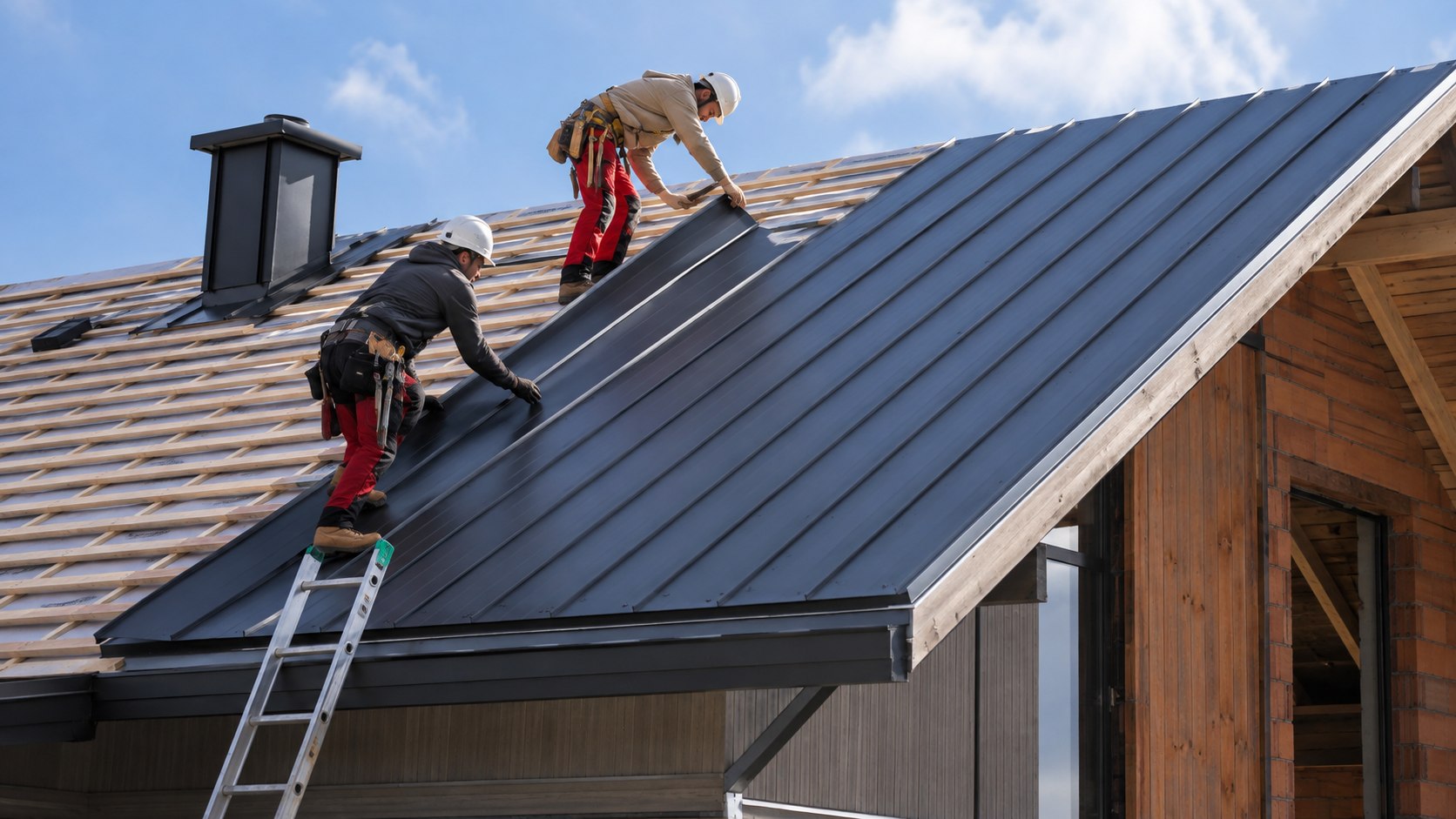
Metal roofing prices USA 2026 typically run from about $6 to $30 per sq ft installed. Screw-down steel often occupies the lower end, while standing seam reaches the upper range. For a 2,000-sq-ft roof surface, that means roughly $12,000 to $60,000 before unusual structural work, as noted by Baltimore Chronicle.
The immediate decision is straightforward. Homeowners focused on the lowest upfront bill should price screw-down panels first. Buyers planning to keep the house longer should compare standing seam carefully. Its concealed fastening system handles metal movement differently and reduces exposed penetration points.
A cheap metal-roof quote is useful only when the panel gauge, coating, underlayment, flashing, tear-off, fasteners, and labor scope are clearly identified.
Key takeaways for metal roof buyers
Before comparing contractors, separate panel type from total project price. Two proposals using “metal roofing” can describe materially different systems.
- Expect screw-down steel to start near $6 per sq ft installed on simple roofs, with complex work costing considerably more.
- Standing seam commonly requires a larger budget because clips, seams, trim details, equipment, and skilled labor raise installation costs.
- Compare complete scopes rather than headline totals, including decking repairs, tear-off, ventilation, flashing, permits, disposal, and warranties.
Roof area also differs from house floor area. Pitch and overhangs increase the number of square feet contractors must cover. Valleys, dormers, chimneys, and skylights create additional cutting and flashing. Waste allowances rise when roof geometry becomes complicated.
A homeowner comparing proposals can use Baltimore Chronicle’s guide to reading a construction estimate before signing.
Metal roofing prices USA 2026 for standing seam and screw down
The biggest pricing divide is between concealed-fastener standing seam and exposed-fastener screw-down roofing. A screw-down panel is attached through its face with gasketed fasteners. Standing seam panels use concealed clips or fastening details beneath raised seams.
For budgeting in 2026, standing seam metal roof cost can reasonably occupy a broad $8 to $30 per sq ft installed range. Standard painted steel is usually cheaper than aluminum, zinc, or copper. Mechanically seamed systems and complicated residential architecture increase labor.
By comparison, screw down metal roof cost commonly starts around $6 per sq ft installed. Complex tear-offs, premium coatings, steep pitches, and difficult access can push it into the low-to-mid teens. The lower initial price comes with more exposed fasteners that remain part of the roof’s weather barrier.
“It is very important to select the correct type of fastener … to ensure a strong and weather-tight attachment.”
Metal Construction Association, technical guidance on profiled metal roof and wall panels. Source.
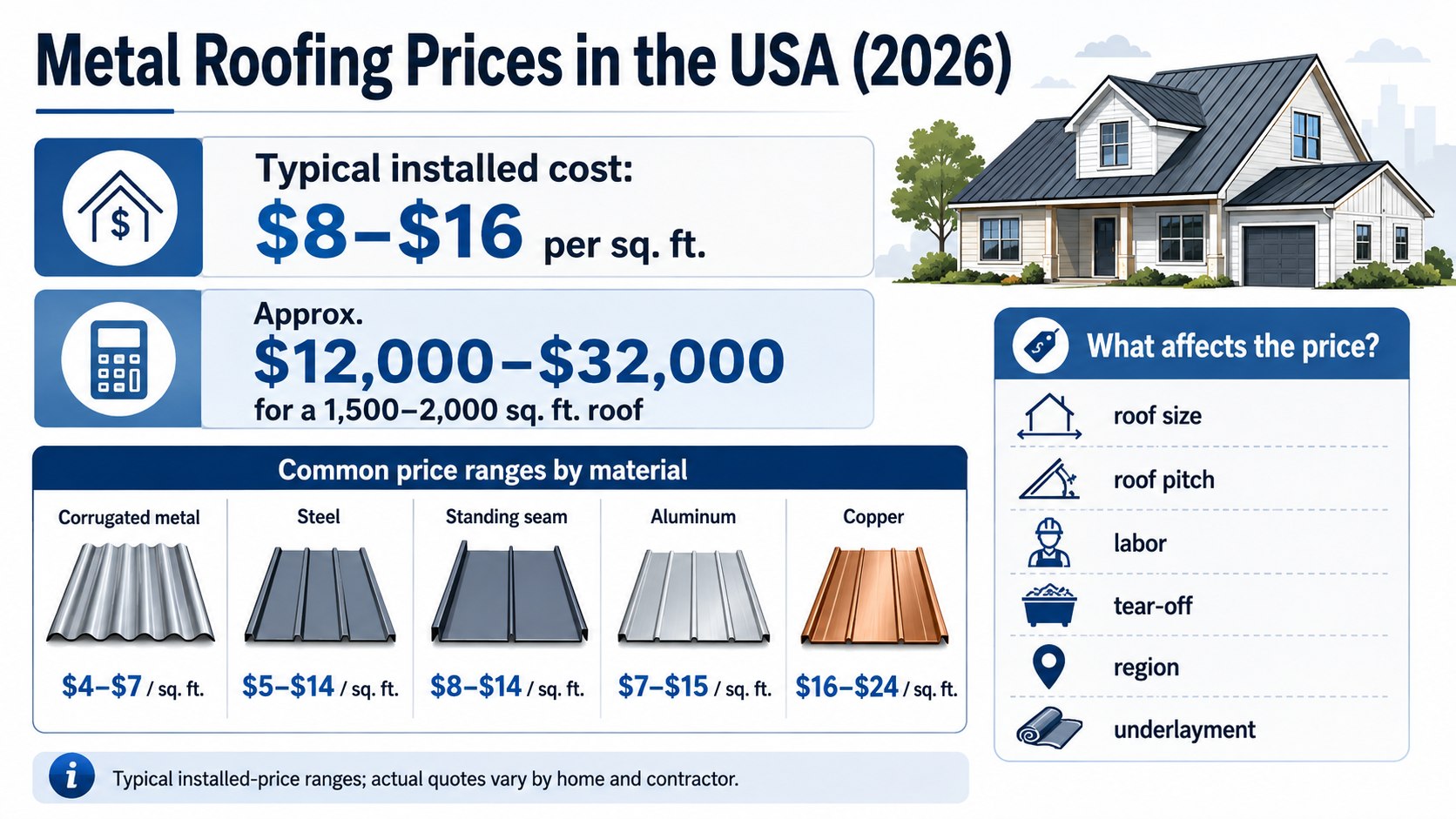
What drives the price
Panel system
Standing seam requires more specialized components and installation skill than exposed-fastener panels. Clips must accommodate panel movement while maintaining attachment. Mechanically seamed profiles also require additional installation work.
Metal and coating
Galvanized steel and Galvalume-style coated steel usually provide the practical entry point for residential projects. Aluminum can make sense near saltwater because corrosion exposure changes material priorities. Copper and zinc occupy premium categories and can multiply material costs.
Brands including MBCI and ABC Metal Roofing offer several panel profiles, gauges, coatings, and fastening systems. A proposal should name the actual product rather than simply state “metal roof.” That detail makes competing bids easier to compare.
Roof geometry
A basic gable roof is cheaper to cover than a roof with several valleys and dormers. Every transition needs cutting, trim, flashing, sealant, or custom fabrication. Steeper pitches also require more fall protection and slower movement.
Removal and decking
Installing over an acceptable existing assembly can reduce demolition costs where code and manufacturer requirements permit it. Removing old shingles creates labor, hauling, and disposal charges. Rotten sheathing discovered afterward becomes an additional line item.
This is why broader renovation budgeting matters. Similar scope-control problems appear in projects such as bathroom remodeling and surface replacement, where hidden substrate damage can alter the final bill.
Location and code requirements
Labor and specifications vary across the United States. Coastal Florida projects may require wind-rated assemblies and corrosion-conscious components. California labor pricing can differ materially from rural Midwest markets. Texas, Maryland, and Colorado contractors also work under different local permit, weather, and design conditions.
Access and timing
A one-story house with open driveway access is easier to stage than a tall urban property. Limited material storage can increase handling time. Contractor workload also affects pricing, particularly during storm-repair periods.
Price breakdown for a 2026 metal roof
The following ranges are planning figures rather than contractor quotes. Actual metal roofing cost per square foot depends on system, location, roof shape, and specifications.
| Line item | Typical 2026 cost |
|---|---|
| Screw-down metal roof, installed | About $6–$15 per sq ft |
| Standing seam steel, installed | About $8–$18+ per sq ft |
| Premium standing seam systems | Up to roughly $30 per sq ft |
| Old roofing removal | Often $1–$3+ per sq ft |
| Underlayment and accessories | Project-specific |
| Decking replacement | Quoted by damaged area and material |
| Permits and inspections | Varies by jurisdiction |
A 2,000-sq-ft roof at $8 per sq ft produces a $16,000 baseline. At $14, the same area reaches $28,000. A $20 rate brings the project to $40,000. Those calculations exclude any roof area omitted from the measurement. They also exclude structural repairs not included in the original scope.
The useful number is not the cheapest bid. It is the price for the same roof system, same preparation, and same installation scope.
Standing seam versus screw down
For homeowners comparing standing seam vs screw down metal roofing, price is only one distinction. Standing seam conceals most fastening points and permits designed thermal movement through clips or concealed attachments. Screw-down roofing places fasteners directly through panel faces.
| Feature | Standing seam | Screw down |
|---|---|---|
| Fasteners | Mostly concealed | Exposed through panel face |
| 2026 installed price | About $8–$30 per sq ft | About $6–$15 per sq ft |
| Thermal movement | Designed into clip or seam system | More dependent on fastener detailing |
| Appearance | Clean raised seams | Visible fastener pattern |
| Typical fit | Primary residences, architectural roofs | Budget projects, garages, barns, simple roofs |
Neither system is automatically appropriate for every structure. A detached workshop may not justify architectural standing seam. A long-term primary residence may justify the additional investment. Coastal exposure can change both material and fastener requirements. Solar plans can also affect attachment decisions. Manufacturer specifications should control installation details rather than generic rules.
Ways to save in 2026
Reducing metal roof installation cost should start with scope control rather than thinner materials or missing accessories. The following steps can reduce avoidable spending without turning the project into a false economy.
- Get at least 3 itemized bids using the same panel specification and roof scope.
- Request separate prices for tear-off, decking replacement, underlayment, ventilation, flashing, and disposal.
- Ask whether stock colors or standard panel profiles cost less than special-order finishes.
- Schedule non-emergency work before storm damage creates heavy regional contractor demand.
- Measure roof area independently or compare the square footage stated on every proposal.
- Resolve gutters, skylights, chimneys, and ventilation before panels are ordered.
- Ask whether replacing only verified damaged decking is possible instead of budgeting full redecking automatically.
Material downgrades are not the safest savings target. Reducing unnecessary scope and change orders is usually more defensible. Stock materials may also reduce delivery complications. Detailed bids reveal whether one contractor omitted work another included.
Baltimore Chronicle’s guide to controlling renovation costs applies the same principle to broader home projects.
When paying more makes sense
Higher metal roof prices in the USA can be justified when the additional money buys a measurable specification. Paying more only for vague claims such as “premium quality” provides little basis for comparison.
- Complex primary residences. Standing seam can reduce exposed penetrations while giving valleys and roof transitions a cleaner architectural finish.
- Coastal properties. Appropriate metals, coatings, fasteners, and tested assemblies may justify higher costs in salt and wind exposure.
- Long panels. Systems designed for thermal expansion become more important as panel length and temperature movement increase.
- Future solar installations. Some standing-seam mounting systems can attach at seams rather than creating new roof penetrations.
Specifications should still be verified before paying the premium. Ask for panel manufacturer, profile, gauge, coating, and fastening method. Obtain the written workmanship warranty as well. Check who is responsible for penetrations added after completion. Keep product and installation documents with other house records.
“Traditional building components that primarily serve a roofing or structural function generally don’t qualify.”
Internal Revenue Service, guidance on residential clean-energy expenditures and roofing. Source.
That IRS language matters in 2026 because homeowners should not assume a conventional metal roof creates a federal energy tax credit. Federal residential energy-credit rules were also changed after 2025. Contractor marketing should never substitute for current IRS guidance or professional tax advice.
What to ask before signing a metal roofing contract
A contractor’s total should be traceable to specific materials and work. The following checklist catches many differences hidden behind similar-looking estimates.
- Exact roof area and waste allowance
- Panel manufacturer, profile, gauge, metal, and coating
- Standing seam or exposed-fastener attachment method
- Underlayment type and ventilation work
- Flashing around walls, valleys, chimneys, and penetrations
- Tear-off, hauling, and disposal responsibilities
- Decking repair prices before additional work begins
- Workmanship and manufacturer warranty terms
A written specification makes later disputes easier to prevent. It also exposes unusually low bids that omit necessary work. Permit responsibility should appear in the contract. Payment milestones should correspond to actual project stages. Final payment should follow the agreed completion and inspection process.
FAQ about metal roofing prices in 2026
How much does a metal roof cost in the USA in 2026?
A practical national planning range is about $6 to $30 per sq ft installed. Screw-down steel usually starts lower than standing seam. Premium metals, difficult roofs, and extensive repairs can exceed ordinary residential budgets.
Is standing seam worth the extra cost?
It can be for a long-term primary residence, complicated architecture, or projects where concealed fasteners matter. Its higher price reflects both components and specialized installation.
What is the cheapest type of metal roofing?
Exposed-fastener steel panels are generally among the lowest-cost residential metal options. The quote should still include correct fasteners, flashing, underlayment, trim, and labor.
How much would a 2,000-sq-ft metal roof cost?
At $8 per sq ft, the project is about $16,000. At $14, it becomes $28,000. At $20, the same roof area costs about $40,000 before additional structural work.
Does a metal roof qualify for a federal tax credit in 2026?
Homeowners should not assume it does. The IRS states that traditional roofing materials serving a roofing or structural function generally do not qualify. Federal residential energy-credit provisions also changed after December 31, 2025.
Should I choose standing seam or screw down?
Choose screw down when initial cost and simple construction dominate the decision. Consider standing seam when concealed fastening, thermal movement, appearance, and long-term ownership justify the premium.
Earlier we wrote about Starting a YouTube Channel in 2026: Equipment, Costs, and 6 Practical Steps