


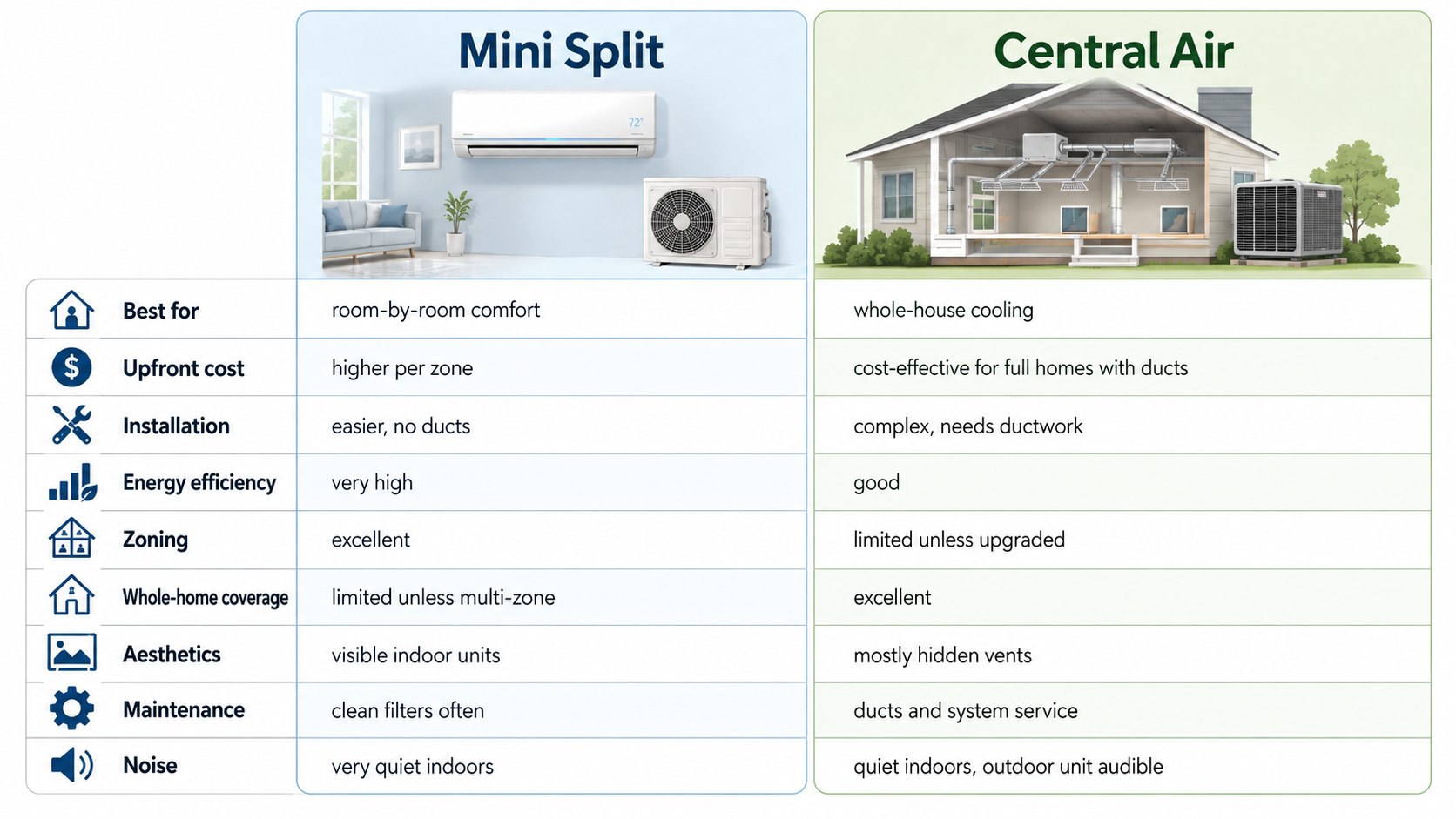
Mini split vs central air for a house 2026 usually favors central air when usable ducts already serve the entire home. A mini split wins when ducts are missing, zoning matters, or only selected rooms need conditioning, as noted by Baltimore Chronicle.
The financial dividing line is often ductwork rather than equipment. In 2026, central AC replacement can stay competitive when existing ducts remain sound. Adding new ducts can erase that advantage quickly. Multi-zone mini splits also become expensive as indoor heads multiply.
Key takeaways
- Existing ducts usually make central air the simpler whole-house choice, especially for homes with many enclosed rooms.
- Mini splits offer stronger room-by-room control and avoid the cost and disruption of installing new ductwork.
- Get a Manual J load calculation before comparing quotes, because oversized equipment can hurt comfort and humidity control.
Neither system should be priced only by outdoor-unit capacity. The house itself determines the required heating and cooling load. Insulation, windows, ceiling height, orientation, and climate all matter. A 2,000 sq ft home in Arizona has different demands from one in Maine. Poor sizing can undermine an otherwise good equipment choice.
Homeowners comparing broader replacement budgets can also review 2026 HVAC replacement costs. That comparison covers furnaces, central AC systems, and heat pumps. It helps separate equipment costs from installation-related expenses.
At a glance
The comparison below assumes professional installation in a typical US single-family home. Actual bids vary by capacity, electrical work, permits, access, and local labor prices.
| Factor | Mini split | Central air |
|---|---|---|
| Typical 2026 installed cost | About $2,000–$5,000 for simpler projects; whole-home multi-zone systems can exceed $12,000 | Often about $4,000–$8,000 for replacement; duct repairs or new ducts add thousands |
| Ductwork required | No | Yes |
| Individual zones | Excellent | Limited unless zoning hardware is added |
| Installation disruption | Usually moderate | Low with existing ducts; high when ducts must be added |
| Visual impact | Indoor heads remain visible | Mostly hidden behind registers and grilles |
| Whole-house airflow | Depends on head placement | Consistent when ducts are well designed |
| Best climate fit | Broad, including cold climates with suitable heat-pump models | Broad; equipment must match regional conditions |
| Repair structure | One failed head may affect only one zone | Major equipment failure can affect the whole house |
| Best retrofit | Homes without ducts | Homes with usable ducts |
These figures are planning ranges, not contractor bids. Many professional mini-split projects in 2026 fall around $2,000–$5,000. Larger multi-zone projects can run much higher. Central AC replacement also rises sharply when ducts require major work. Electrical upgrades can increase either project.
Labor costs differ between Maryland, Texas, California, New York, and other markets. Attic access can also change the bill dramatically. A simple equipment swap is not comparable with a complete retrofit.
The cheapest equipment quote can become the expensive option when sizing, drainage, electrical work, or airflow needs correction later.
Mini split vs central air for a house 2026 by installation cost
For a house without ducts, mini split installation cost 2026 often gives ductless equipment its strongest advantage. Refrigerant lines need only small wall penetrations between indoor and outdoor units. Installers avoid opening long sections of ceilings for supply and return ducts.
A single-zone system can serve an addition, garage apartment, finished attic, or difficult upstairs bedroom. Whole-house installations are different. Each additional zone needs another indoor unit, drainage planning, controls, and refrigerant piping. Five indoor zones can turn a modest project into a five-figure installation.
“No duct work is needed.”
ENERGY STAR, US Environmental Protection Agency, Ductless Heating & Cooling guidance.
Central air has the opposite cost pattern. Existing ducts can make a condenser and air-handler replacement relatively straightforward. Missing or damaged ducts create the expensive scenario. New trunk lines, returns, insulation, drywall repairs, and framing access increase labor.
The Baltimore Chronicle guide to choosing AC capacity by room size explains why square footage alone is insufficient. Contractors should calculate the actual building load before selecting equipment.
Mini splits offer better zoning
The biggest operational difference is not efficiency. It is control. A ductless mini split for a house can maintain different temperatures across bedrooms, offices, basements, and living spaces.
A family might cool the occupied first floor during daytime hours. Upstairs bedrooms can remain warmer until evening. A home office can operate independently from guest rooms. Central air normally treats the house as one large zone unless dampers and multiple thermostats are installed.
Mini splits are especially useful in these situations:
- older homes with radiators and no cooling ducts;
- finished attics, additions, workshops, and converted garages;
- homes with persistent hot or cold rooms;
- households needing different bedroom temperatures;
- properties where new ductwork would damage finished interiors.
Zoning does not automatically guarantee lower bills. Savings depend on how occupants actually use the zones. Conditioning every room to identical temperatures removes part of the benefit. Open floor plans may need fewer indoor heads than compartmentalized houses. Closed bedroom doors also affect air distribution.
One outdoor condenser can support several indoor units on many multi-zone systems. Brands such as Mitsubishi Electric, Daikin, Fujitsu, LG, and Carrier sell multi-zone configurations. Available combinations depend on capacity and model series.
A mini split makes the strongest financial case when homeowners can avoid conditioning unused rooms for long periods.
Central air is cleaner for whole-house integration
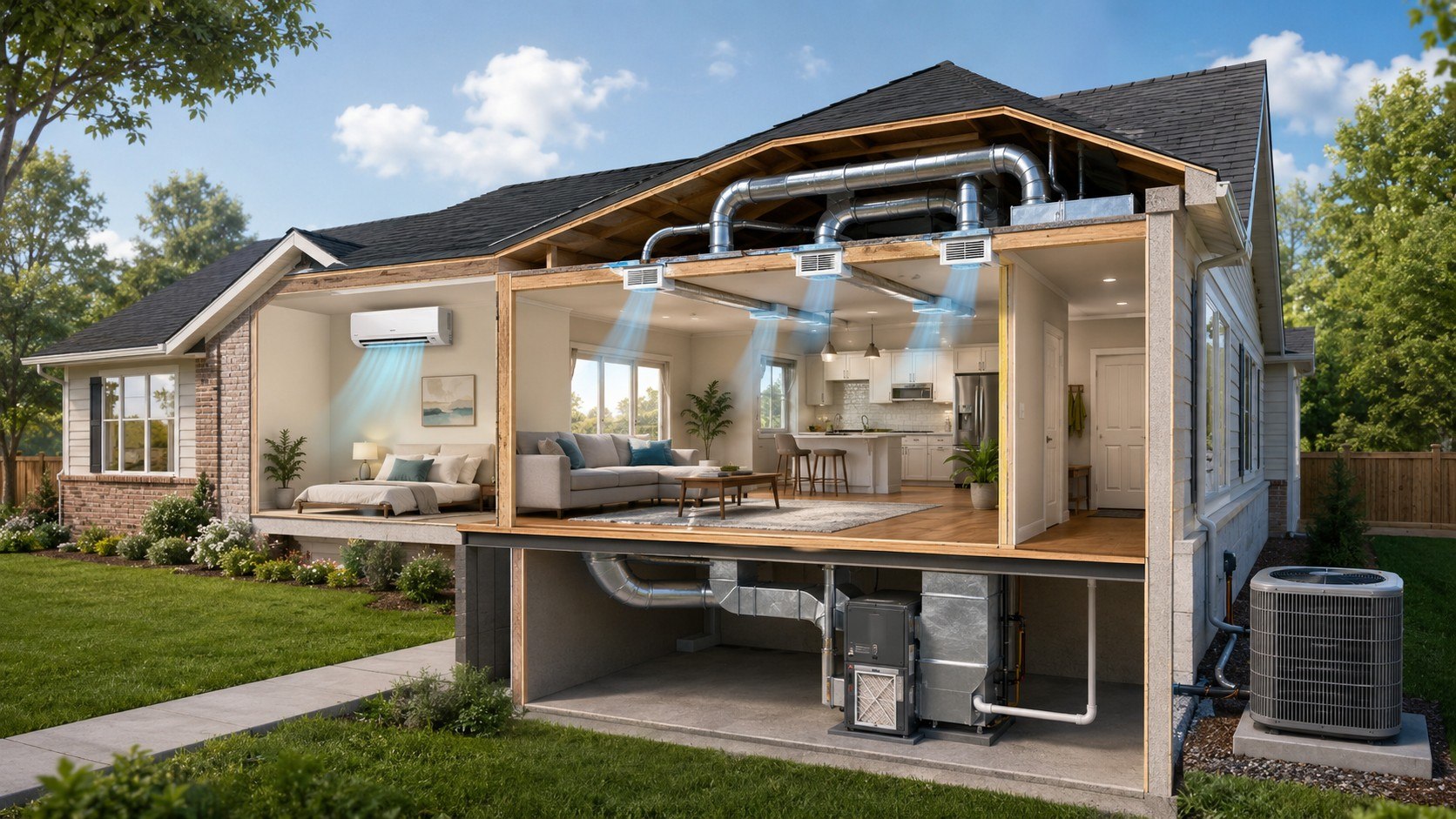
Central air installation for a house remains compelling when ducts already reach every occupied room. The system hides most hardware behind ceilings, walls, or utility spaces. Only registers, return grilles, and thermostats remain visible indoors.
Central systems can also integrate filtration, humidification, and some ventilation equipment more naturally. That matters for owners who want one mechanical system serving the entire house. Good duct design distributes conditioned air without wall-mounted indoor heads.
The weaknesses appear when ductwork is poor. Leaking or undersized ducts can reduce airflow and create uneven temperatures. Ducts running through hot attics or vented crawlspaces also add thermal losses. Repairs may require access through finished surfaces.
“Installing properly sized HVAC equipment for your home is essential.”
ENERGY STAR, sizing guidance for residential heat-pump systems.
Central air also provides less independent room control. Closing registers is not a substitute for engineered zoning. Excessive register restriction can create airflow problems at the equipment.
Pros, cons and the ideal homeowner for each system
Mini split
The strongest mini split vs central AC argument starts with houses lacking usable ducts. Ductless systems can solve individual comfort problems without rebuilding the home’s air-distribution network.
- Ductless HVAC avoids major duct construction.
- Independent zones can reduce unnecessary conditioning.
- Heat-pump models provide both heating and cooling.
- Installation can be easier in historic or finished homes.
- Indoor heads require visible wall, floor, or ceiling space.
- Whole-house multi-zone installations can become costly.
The ideal owner has a house with radiators, baseboard heat, or difficult duct access. It also works well for additions and rooms with unusual schedules. Owners should be comfortable seeing indoor units. Maintenance includes cleaning filters at each head. Drain lines also require correct installation.
Cold-climate buyers should compare low-temperature performance rather than assuming every mini split works identically. ENERGY STAR maintains cold-climate criteria for qualifying heat pumps. That detail matters in Maine, Minnesota, Vermont, and other colder states.
Central air
Central AC fits homes that already have correctly sized ducts. It also appeals to owners who dislike visible wall units. One thermostat can provide simple whole-house control.
- Choose central air when ducts already reach the required rooms.
- Inspect duct leakage and insulation before approving equipment replacement.
- Require load calculations instead of replacing equipment by old nameplate size.
- Price zoning separately when different floors need independent control.
- Compare a central heat pump when heating equipment also needs replacement.
Central air is not automatically cheaper because ducts exist. Old returns may be too small for newer equipment. Flexible ducts can become crushed or disconnected. Older additions sometimes have inadequate supply airflow. Fixing those defects belongs in the project budget.
Owners replacing both heating and cooling should also compare furnaces and heat pumps in 2026. A central heat pump can use existing ducts while providing heating and cooling.
Which should you buy in 2026
The answer becomes clearer after separating equipment preference from the house itself. Use the following decision path before requesting final bids.
- If the house has no ducts, then price a mini split first.
- If usable ducts already serve every room, then price central air first.
- If different rooms need independent temperatures, then favor a multi-zone mini split.
- If hidden indoor equipment matters, then central air has the aesthetic advantage.
- If both heating and cooling need replacement, then compare ducted and ductless heat pumps.
Get at least several itemized contractor quotes for the same project scope. Each proposal should identify equipment capacity, efficiency ratings, labor, electrical work, permits, and warranty terms. Ask whether the contractor completed a Manual J calculation. Request duct testing when central air is involved.
For mini splits, confirm the exact number and placement of indoor heads. Ask how condensate will drain. Confirm line-set routing before work begins. Those details determine whether an attractive estimate stays attractive.
2026 cost checklist before signing a contract
A useful quote should answer more than the equipment price. Check these items before comparing totals:
- Manual J heating and cooling load calculation.
- Exact outdoor and indoor model numbers.
- Number of zones and thermostat locations.
- Electrical panel or dedicated-circuit requirements.
- Permit and inspection fees.
- Duct repairs, replacement, or sealing.
- Condensate drainage and refrigerant-line routing.
- Labor and equipment warranty terms.
A low bid may omit expensive scope items. Electrical work is a common example. Duct repairs can create another large adjustment. Mini-split line covers and pumps may also cost extra. Permit practices vary by municipality.
Brands should be compared through available service support, not logos alone. Mitsubishi Electric, Daikin, Fujitsu, Trane, Lennox, Carrier, Rheem, and Goodman have different dealer networks. Local technician availability can matter more than small efficiency differences.
FAQ
Is a mini split cheaper than central air in 2026?
It can be cheaper when a house has no ductwork. A multi-zone whole-house system may cost more than central AC when usable ducts already exist. Compare equal-capacity professional quotes before deciding.
How many mini splits does a 2,000 sq ft house need?
There is no reliable answer based on square footage alone. Room layout, insulation, windows, climate, and occupancy change the load. A contractor should perform a Manual J calculation.
Can a mini split cool an entire house?
Yes. Multi-zone systems can condition several rooms using multiple indoor units. Larger or compartmentalized homes may require several heads or more than one outdoor unit.
Does central air add more value to a house?
Buyer preferences vary by market and house type. Central air can feel more integrated in homes with existing ducts. Ductless systems can be more attractive in older homes where ducts are impractical.
Which system is better for Maryland, Texas, or California?
Central air works well in all three states when ductwork is already suitable. Mini splits become attractive for additions, older homes, and zoning needs. Equipment capacity must reflect each local climate.
What is the biggest mistake when choosing between them?
Choosing equipment before calculating the home’s actual load is the most consequential mistake. Oversized systems can cycle poorly and reduce humidity control. Undersized systems may struggle during temperature extremes.
Earlier we wrote about Metal Roofing Prices USA 2026: What Standing Seam and Screw Down Really Cost