

How often should you replace your mattress 2026? Most US households should begin a serious condition check after 7 years and expect replacement within 7–10 years. Replace it earlier when deep sagging, recurring morning pain, damaged edges, odors, overheating, or restless sleep become persistent, as noted by Baltimore Chronicle.
The best time to buy is often around Presidents Day, Memorial Day, July 4, Labor Day, or Black Friday. However, a failing mattress should not remain in use for months merely to reach a holiday promotion. Its physical condition matters more than its age or the retail calendar.
Key takeaways
- Inspect a daily-use mattress closely after 7 years, even when the surface still looks clean and undamaged.
- Persistent sagging, weaker edges, poor sleep, and morning stiffness are stronger warning signs than age alone.
- Compare final prices, trial periods, delivery, old-mattress removal, and return fees before choosing a 2026 deal.
How Often Should You Replace Your Mattress 2026 by Type?
Mattress construction provides a useful starting point for estimating service life. Sleeper weight, foundation quality, material density, room humidity, and nightly use can move the replacement date forward or backward.
| Mattress type | Typical replacement range | Common signs of wear | Typical 2026 queen price |
|---|---|---|---|
| Traditional innerspring | 5–8 years | Noisy coils, visible dips, weak edges | $350–$1,200 |
| Memory foam | 7–10 years | Permanent impressions, soft spots, heat retention | $500–$2,000 |
| Hybrid | 6–10 years | Compressed foam, uneven support, edge collapse | $700–$2,500 |
| Latex | 8–12 years or longer | Cracking, reduced resilience, uneven firmness | $1,200–$3,500 |
| Adjustable air chamber | 7–10 years | Leaks, pump problems, changing firmness | $1,500–$5,000+ |
These ranges are inspection guides, not automatic expiration dates. A low-density foam mattress used by 2 adults can soften within several years. A well-supported latex mattress in a guest room may remain comfortable beyond 10 years.
Price also varies considerably by brand and construction. Entry-level queen mattresses can cost below $500, while premium Tempur-Pedic, Saatva, or adjustable-air models may exceed $3,000. Promotional prices, bundles, delivery charges, and size upgrades can change the final total.
A higher price does not guarantee suitable firmness or better sleep. It may buy thicker materials, stronger edges, longer trials, complex cooling layers, or in-home setup. Buyers should compare construction and policies rather than relying on the logo.
A mattress also depends on the surrounding bedroom setup. Slat spacing, center support, bed-frame dimensions, and delivery access can affect comfort and warranty coverage. Households replacing several items can consult Baltimore Chronicle’s guide to the best furniture stores in the USA for 2026.
Calendar at a Glance
A worn mattress should be replaced when it stops providing stable support. Households with several months of flexibility can still plan around common retail periods and avoid rushed decisions.
| Month | Recommended action | Buying outlook |
|---|---|---|
| January | Inspect sagging, stains, odors, and edge support | Clearance varies by retailer |
| February | Compare trial periods and return terms | Presidents Day offers are common |
| March | Measure doors, stairs, frames, and bedroom space | Usually a quieter shopping period |
| April | Check the foundation for broken or widely spaced slats | Spring promotions may begin |
| May | Shortlist 2–3 suitable models | Memorial Day is a major sale period |
| June | Evaluate heat retention during warmer nights | Useful month for testing cooling needs |
| July | Replace a clearly worn mattress without delay | July 4 promotions can be competitive |
| August | Review children’s, dorm, and guest-room beds | Back-to-school offers may cover basic models |
| September | Compare full checkout costs | Labor Day is a strong sale period |
| October | Read warranty exclusions and return charges | Useful research month before November |
| November | Track prices before buying | Black Friday brings broad promotions |
| December | Check comfort after seasonal temperature changes | Year-end clearance depends on inventory |
Holiday advertising can make every discount appear urgent. Record the listed price several weeks before buying and compare the same model, size, and firmness. A large percentage discount means little when the reference price was temporary.
Check delivery, setup, old-bed removal, and return costs. A $999 mattress with a $199 return charge may carry more risk than a $1,099 model with free pickup.
Online prices often change after selecting the exact size. California king, split king, and specialty-height models usually cost more. Financing can also increase the total when a promotional period ends.
Renters should measure stair turns, elevators, doorways, and hallways. A compressed foam mattress may enter easily but cannot usually be compressed again for the next move.
Shoppers comparing national chains and online marketplaces can also review Baltimore Chronicle’s IKEA, Ashley, and Wayfair furniture quality comparison for 2026. The same concerns about delivery, returns, materials, and measurements apply to bedroom purchases.
Why Timing Matters
1. A worn mattress can change how your body feels
A mattress gradually loses its ability to distribute weight. The change can be too slow to notice during a single night. Morning stiffness, shoulder pressure, numbness, and lower-back discomfort may become the first obvious signals.
The mattress is not automatically the cause of every pain. Persistent or severe symptoms require medical evaluation. However, sleeping better in a hotel or guest bed is useful evidence that your home mattress needs inspection.
2. Waiting reduces your replacement options
An emergency purchase often leads to rushed choices. Buyers may accept the wrong firmness, ignore measurements, or overlook return fees because they need a usable bed immediately.
Beginning research around the 6- or 7-year mark creates more control. You can compare materials, test firmness levels, read policies, and monitor prices before the mattress becomes unusable.
3. Your needs may change before the mattress fails
Pregnancy, injury, weight changes, aging, or a new sleeping partner can alter support requirements. A mattress may remain structurally sound while no longer serving the household well.
Parents should reassess children’s beds after major growth changes. Freelancers should also avoid using the mattress as a desk chair. Repeated daytime sitting concentrates pressure along one edge.
Signs Your Mattress Needs Replacing
Age should trigger an inspection rather than an automatic purchase. Use the following checklist to judge whether the mattress still performs its main function.
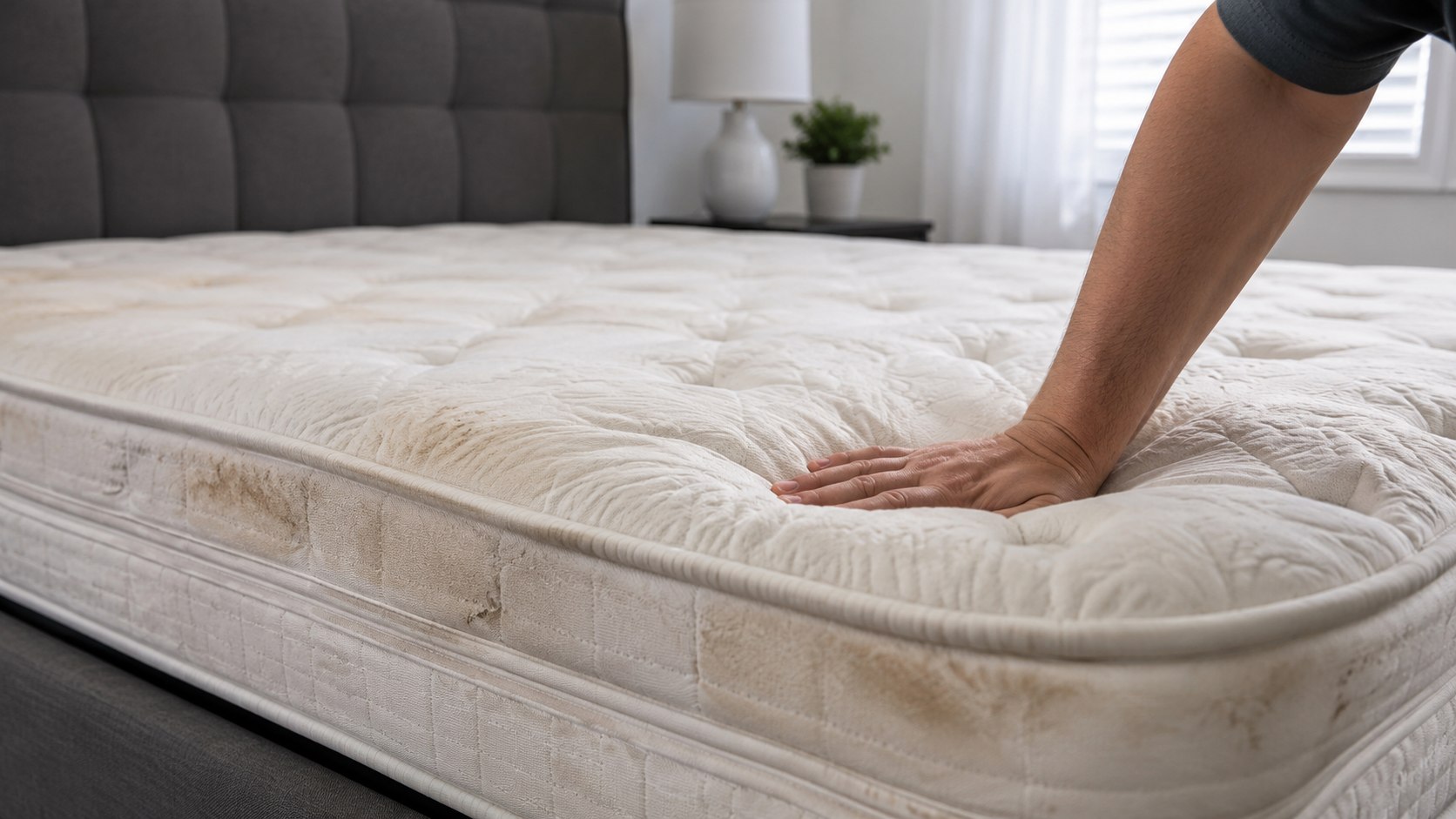
- A visible depression remains after the mattress has been empty for several hours.
- You roll toward the center or feel trapped in a softened area.
- Coils squeak, pop, or can be felt through the comfort layers.
- The edge collapses when sitting or getting out of bed.
- You wake with recurring stiffness that improves on another bed.
- Your partner’s movements cause more disruption than before.
- The mattress smells musty despite cleaning and ventilation.
- You sleep noticeably hotter because foam no longer recovers properly.
- The cover is torn, damp, contaminated, or difficult to sanitize.
One minor symptom may not justify replacement. Several symptoms appearing together usually indicate broader material fatigue.
Measure suspected sagging with a straight board across the mattress. Measure the deepest gap without pressing on the surface. Compare the result with the warranty’s indentation requirement.
A topper cannot repair structural failure. It can change surface firmness, but it follows the shape below. Placing soft foam over a deep depression may make alignment worse.
Inspect the foundation before replacing the mattress. Broken slats, excessive spacing, a bent frame, or a missing center support can create similar symptoms. An unsuitable base may also affect warranty eligibility.
How to Extend Mattress Lifespan Without Hiding Damage
Routine care can reduce uneven wear and prevent avoidable contamination. It cannot reverse broken coils, degraded foam, mold, or deep impressions.
- Rotate the mattress from head to foot according to manufacturer instructions.
- Use a breathable protector against spills, sweat, dust, and pet accidents.
- Keep the mattress on the approved frame or foundation.
- Vacuum the surface and seams during normal bedroom cleaning.
- Dry spills fully before replacing sheets and bedding.
- Avoid sitting or working on the same edge every day.
- Keep pets from scratching or digging into the cover.
Most modern mattresses should not be flipped unless the manufacturer labels them as double-sided. Flipping a one-sided hybrid places the support core above its comfort system.
Rotation schedules differ by manufacturer. Some brands recommend more frequent rotation during the first year. Others suggest occasional rotation only when wear becomes uneven.
Climate also affects care. Humid homes in Florida, Louisiana, Maryland, or coastal Texas need reliable moisture control. Dry conditions in Arizona or Nevada reduce humidity problems but do not prevent material fatigue.
A waterproof protector is useful in children’s rooms, rentals, and homes with pets. Choose a breathable model that does not create excessive noise or heat.
Maintenance should preserve a functional mattress, not postpone an unavoidable replacement. Once structural support has failed, adding pads and plywood usually creates new comfort problems.
Edge Cases in 2026
Replace immediately after serious contamination
Do not wait for a sale after sewage exposure, major flooding, deep mold growth, or failed bedbug treatment. Mattresses are difficult to sanitize internally because moisture and pests can move beyond the visible cover.
Atlantic hurricane season runs from June 1 through November 30. Households in storm-prone states should inspect mattresses after leaks or flooding, even when the surface later feels dry.
Do not confuse warranty length with useful life
A 10-year or lifetime warranty does not promise unchanged comfort for that period. Warranties usually cover defined manufacturing defects rather than ordinary softening or changing preferences.
For a 2026 claim, photograph the mattress, foundation, frame, law tag, and measured indentation. Keep the original receipt and review stain exclusions before contacting support.
Guest beds and children’s beds follow different schedules
A guest-room mattress used only several weeks yearly may age slowly. Inspect it before summer visitors and holiday travel rather than applying the master-bedroom schedule.
Children’s beds require checks after growth spurts, illness, accidents, or moves. Never solve a poor fit by adding loose padding that was not designed for the sleeping surface.
Replacement also creates a disposal problem. Municipal pickup rules differ, and many charities reject used mattresses. Before leaving one near a dumpster, consult Baltimore Chronicle’s guide on how to dispose of old furniture in the USA in 2026.
How to Choose the Replacement
Begin with the problem you want the new mattress to correct. The replacement should solve a defined comfort or support issue, not simply feel impressive during 5 showroom minutes.
Side sleepers often need cushioning around the shoulders and hips. Back sleepers generally need controlled contouring. Stomach sleepers usually require a surface that limits excessive midsection sinking.
Couples should test motion isolation and edge stability. Hot sleepers should examine airflow, foam depth, cover materials, and room temperature. A “cooling” label does not guarantee comfort in a warm Phoenix apartment or humid Miami bedroom.
A practical 2026 budget for a quality queen mattress often falls between $1,000 and $2,000. Lower-priced models may suit guest rooms or temporary housing. Latex, adjustable features, cooling systems, and in-home service can push prices above $3,000.
Review the sleep trial carefully. Confirm the minimum break-in period, return pickup rules, exchange limits, and original delivery fees. Some companies deduct transportation costs from refunds.
Never judge financing only by the monthly payment. Compare the cash price, total financed amount, APR, late fees, and promotional deadline. A low monthly figure can hide a much higher final cost.
FAQ
Can a mattress last 20 years?
Some durable latex or lightly used mattresses may remain physically intact for 20 years. A daily-use mattress rarely provides unchanged comfort and support for that long. Inspect its surface, edges, foundation, smell, and morning comfort.
Should I replace a mattress after 10 years if it still feels comfortable?
Inspect it closely before deciding. Check for hidden sagging, damaged support, moisture, odors, and uneven firmness. A clean and supportive mattress does not require disposal solely because it reached 10 years.
How often should couples replace a mattress?
Couples often create faster compression than a single sleeper. Begin annual checks after 5–6 years, especially when both adults sleep in fixed positions. Rotation and a strong center support can limit uneven wear.
Does a mattress topper extend mattress life?
A topper can protect the surface or adjust firmness. It cannot repair broken coils, deep sagging, mold, unstable edges, or a collapsed support core.
What is the best month to buy a mattress in 2026?
February, May, September, and November commonly bring promotions around Presidents Day, Memorial Day, Labor Day, and Black Friday. July 4 can also produce competitive offers. Replace an unsafe mattress immediately.
Should a mattress be replaced after moving?
Not automatically. Replace it when moving damage, contamination, age, or poor support justifies the cost. Measure the new bedroom and access route because the existing size may no longer fit.
Earrlier we wrote about Concrete Foundation Cost per Square Foot in 2026: Slab, Crawl Space and Basement Prices