

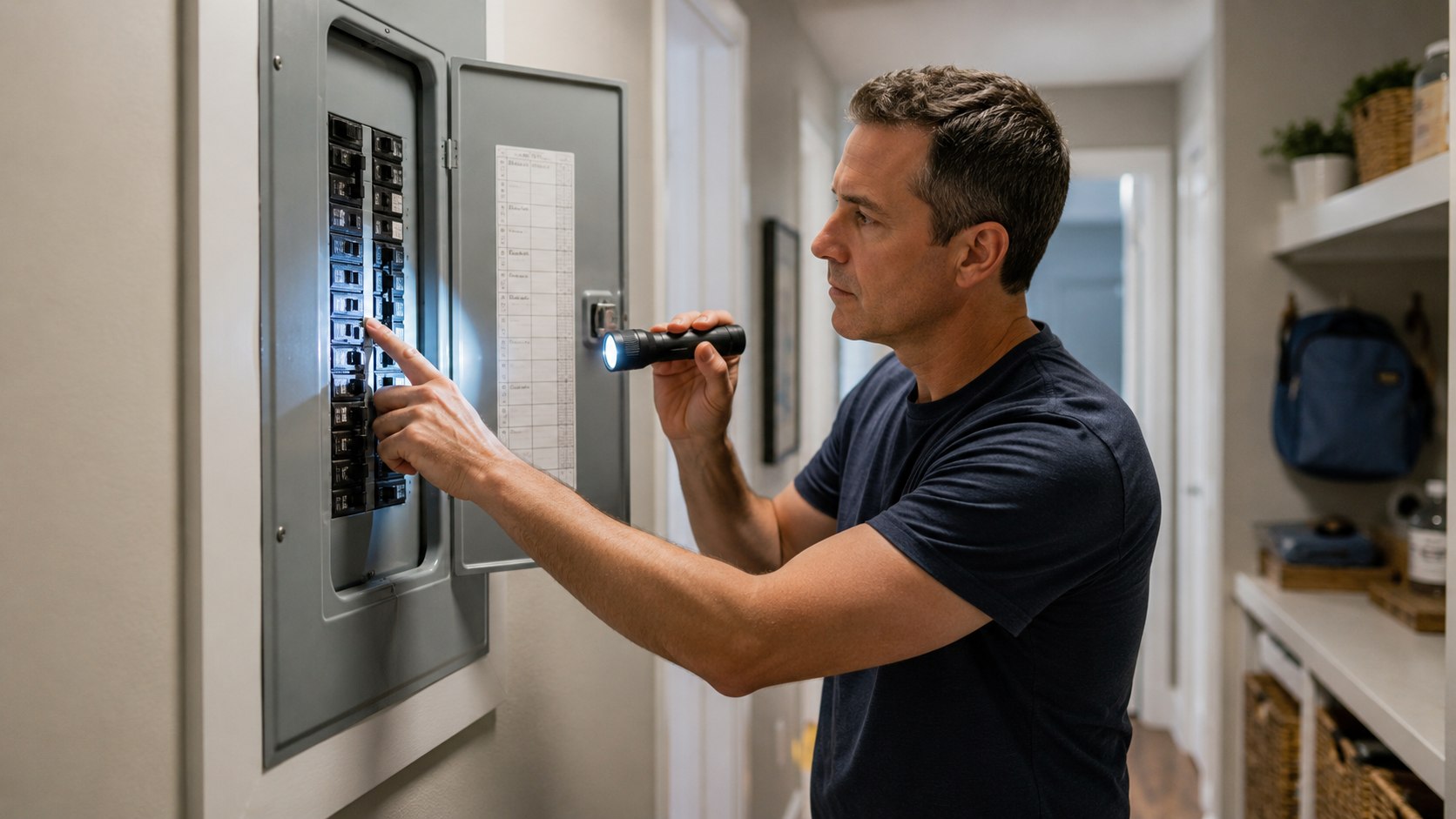
How to reset a tripped breaker safely: unplug or switch off equipment on the affected circuit, find the breaker sitting between ON and OFF, push it firmly to OFF, then move it to ON. The basic reset takes about 5 minutes, but you should stop immediately if the panel feels hot, smells burned, buzzes, sparks, or shows water damage, as noted by Baltimore Chronicle.
A breaker that stays on after the reset probably responded to a temporary overload. A breaker that trips again is reporting an unresolved problem. Do not keep forcing it back on, replace it with a higher-amperage breaker, or remove the panel cover.
Key takeaways
- Move the tripped handle fully to OFF before returning it to ON; pushing directly toward ON may not reset it.
- Disconnect high-draw appliances first, then reconnect them separately to identify an overloaded circuit or defective device.
- Call a licensed electrician when the breaker trips repeatedly, will not reset, feels hot, or accompanies smoke, buzzing, or burning odors.
These distinctions matter because circuit breakers are protective devices, not ordinary switches. They interrupt electricity when current exceeds safe limits or when AFCI and GFCI technology detects certain dangerous fault conditions.
Homeowners planning broader electrical work should include it within the renovation budget. New ranges, microwaves, dishwashers, and receptacles may require dedicated circuits.
A successful reset restores power once. Repeated tripping means the breaker is still detecting a condition that requires investigation.
What you need
You normally do not need specialized tools to reset a residential breaker. Prepare the following before opening the panel door:
- A dry flashlight or phone flashlight
- Dry hands and dry shoes
- Access to the electrical panel
- The circuit directory, when available
- About 5 to 15 minutes
- A phone number for a licensed electrician
- Permission from the landlord or property manager when required
Do not use a screwdriver, pliers, tester, or other metal tool for a basic reset. You should only touch the insulated breaker handle. The panel’s metal cover should remain installed throughout the process.
Stand on a dry floor and keep children away from the area. Use one hand to operate the handle when practical, while keeping your body slightly to one side. Never work at a panel located in standing water or exposed to active leaks.
Renters should document recurring trips and report them to the landlord. A tenant may reset an accessible breaker, but opening the panel or altering wiring usually belongs to qualified maintenance staff.
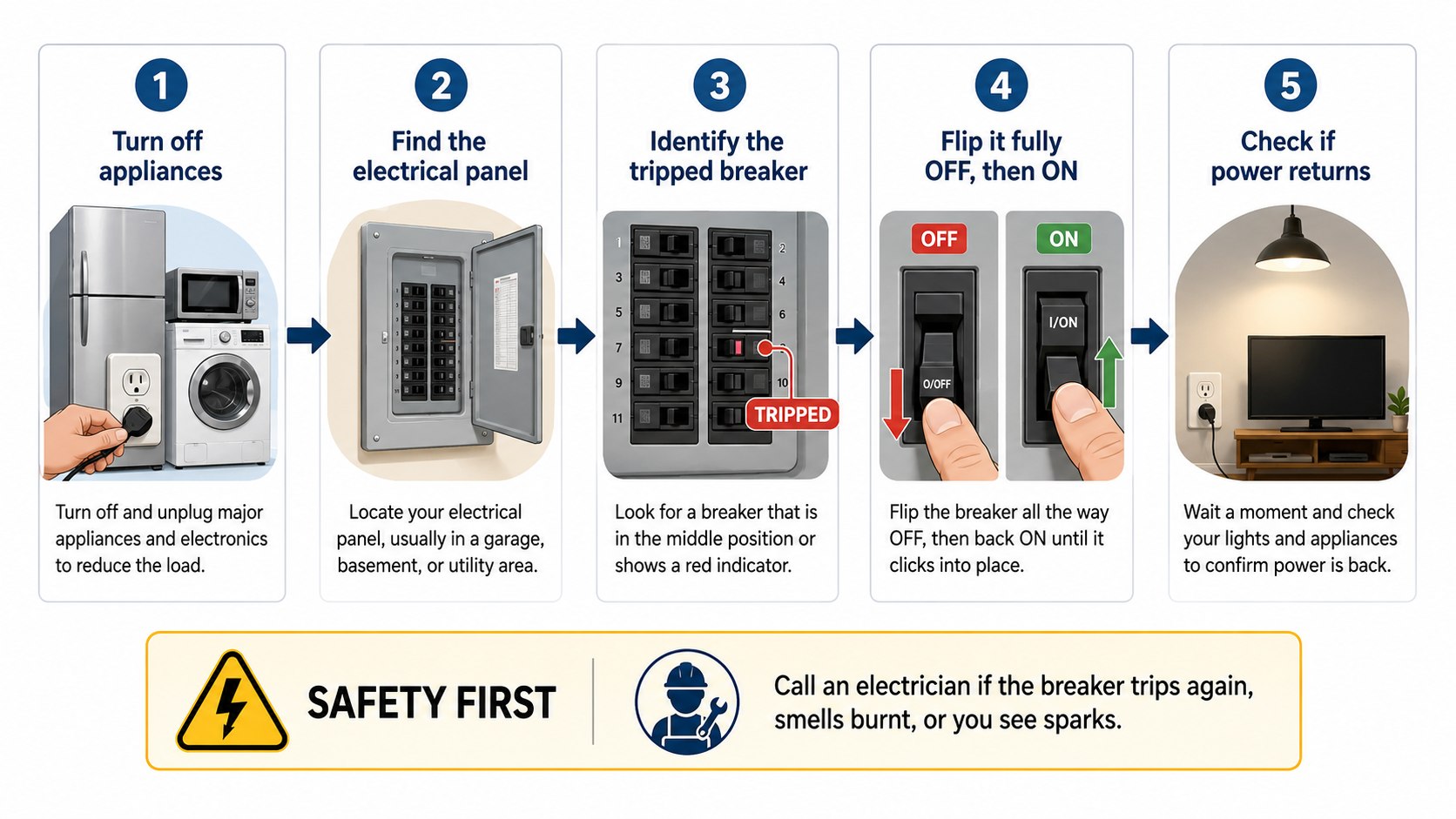
Step 1: Confirm That a Breaker Actually Tripped
Check whether power is missing from one room, several outlets, or one appliance. If the entire neighborhood is dark, the problem may be a utility outage rather than your electrical panel.
Look for a breaker handle positioned between ON and OFF. Some models move only slightly, so compare the handles carefully. Square D, Eaton, Siemens, and GE breakers may use different labels or indicator windows.
The reason matters because resetting the wrong breaker can interrupt equipment unnecessarily. A common mistake is assuming that every dead outlet means a panel breaker has tripped.
Check nearby GFCI receptacles before proceeding. Kitchens, bathrooms, garages, basements, laundry areas, and outdoor locations often have outlets with TEST and RESET buttons. One upstream GFCI can cut power to several downstream receptacles.
Step 2: Turn Off and Unplug Equipment on the Circuit
Switch off lights and unplug portable devices in the affected area. Prioritize space heaters, portable air conditioners, hair dryers, microwaves, countertop ovens, vacuum cleaners, and power tools.
This reduces the electrical load before power returns. It also prevents several motors or heating elements from restarting at the same moment.
Avoid unplugging equipment with wet hands or touching a damaged cord. Do not reconnect an appliance that sparked, smelled burned, delivered a shock, or repeatedly caused the trip.
A standard 15-amp, 120-volt circuit has a theoretical capacity of 1,800 watts. A 20-amp circuit has a theoretical capacity of 2,400 watts. Continuous loads generally require additional capacity under applicable electrical rules, so the breaker rating should not be treated as a daily operating target.
Step 3: Inspect the Panel Without Removing Its Cover
Open only the hinged access door and visually inspect the panel. Keep the fixed cover, sometimes called the dead front, securely installed.
Stop if you notice scorch marks, melted plastic, rust, water, insects, loose components, smoke, or a strong burning odor. Crackling or persistent buzzing also requires professional attention.
This inspection helps distinguish a routine overload from a potentially damaged panel. The common mistake is continuing because the affected breaker still appears physically movable.
“Frequent trips of a breaker indicate a problem and should be inspected by a qualified electrician.”
Electrical Safety Foundation International, homeowner electrical-safety guidance.
The Electrical Safety Foundation International explains that breakers help prevent electrical-system overloads and fires. A tripped breaker should be reset only after the underlying problem has been addressed.
Step 4: How to Reset a Tripped Breaker Correctly
Place your fingers only on the insulated handle. Push the breaker firmly and completely toward OFF, even when it already appears partly off.
Pause briefly, then move the handle decisively to ON. You may feel or hear a clear mechanical click. Power should return to the affected circuit.
The full OFF movement resets the breaker’s internal mechanism. A common mistake is pushing a center-positioned handle directly toward ON. The handle may move without properly resetting the mechanism.
Use the following sequence:
- Stand on a dry surface.
- Face the panel from slightly to one side.
- Touch only the breaker’s insulated handle.
- Move the handle fully to OFF.
- Wait several seconds.
- Move the handle firmly to ON.
- Close the panel door.
- Check whether power returned.
Do not cycle the breaker repeatedly. One controlled reset is sufficient for testing. If it trips immediately, leave it off.
Do not tape the handle in place or physically hold it in the ON position. A breaker must remain free to trip. Preventing that movement defeats its protective function.
Never install a 20-amp breaker where a 15-amp breaker was specified. The breaker must match the conductor size, panel listing, circuit design, and applicable code requirements.
Replacing a breaker is not part of this reset procedure. It requires removing the panel cover and working near energized components, which can remain live even when the main breaker is off.
Step 5: Restore the Load One Device at a Time
After the breaker remains on, reconnect appliances individually. Wait briefly between devices and watch for another trip.
This process can reveal whether one appliance or the combined load caused the shutdown. The common mistake is reconnecting everything simultaneously, which removes the opportunity to isolate the cause.
The following examples show how common household loads can combine. Actual wattage appears on the product label or manufacturer documentation.
| Device | Typical operating range | Possible concern |
|---|---|---|
| Portable space heater | About 1,500 watts | Can consume most of a 15-amp circuit’s practical capacity |
| Hair dryer | About 1,200–1,875 watts | May overload a shared bathroom circuit |
| Countertop microwave | About 900–1,500 watts input | May need a dedicated or lightly loaded circuit |
| Window air conditioner | Varies by capacity | Starting current may trigger a weak or overloaded circuit |
| Vacuum cleaner | About 700–1,400 watts | Can cause a trip when combined with heating equipment |
| Gaming computer and displays | About 300–1,000 watts | Total load rises with printers, heaters, and accessories |
These ranges are examples, not substitutes for equipment labels. Heating appliances usually draw more power than phone chargers, lamps, or networking devices.
A 1,500-watt heater and a 1,200-watt hair dryer should not share a typical 15-amp circuit. Their combined demand can exceed the circuit rating before other loads are counted.
If one appliance causes another trip, unplug it and stop using it. The device may be defective, or the circuit may not support that load.
If several ordinary devices cause the problem only when operated together, redistribute them across different circuits. An extension cord does not create additional circuit capacity and can introduce another hazard.
The safest practical test changes one variable at a time: one breaker reset, followed by one appliance reconnecting at a time.
Step 6: Decide Whether to Monitor the Circuit or Call an Electrician
Monitor the circuit when the breaker stays on and the cause was obvious. A temporary overload from 2 high-draw appliances may not indicate failed wiring.
Call a licensed electrician when the cause is unclear or the trip repeats. Leave the breaker off when there are signs of heat, arcing, moisture, damaged wiring, or equipment failure.
The reason is simple: a breaker may trip because of overload, short circuit, ground fault, arc fault, defective equipment, loose connections, or breaker deterioration. Resetting cannot repair those conditions.
In 2026, a routine US electrician service call often starts around $100 to $200 before added labor or parts. A standard breaker replacement may commonly total roughly $100 to $300, while emergency work and panel repairs cost more. Prices vary across Maryland, California, Texas, New York, Florida, and other states, so verify written local quotes.
The comparison below separates situations suitable for one cautious reset from those requiring professional service.
| Condition | Recommended response | Urgency |
|---|---|---|
| One trip after using several high-wattage appliances | Unplug excess loads and perform one reset | Routine |
| Breaker trips when one specific appliance starts | Unplug the appliance and arrange inspection or repair | Prompt |
| Breaker trips again with all loads disconnected | Leave it off and call a licensed electrician | Prompt |
| Panel is hot, wet, scorched, sparking, or smoking | Do not touch it; contact emergency services or the utility when appropriate | Immediate |
| Breaker handle is loose or will not remain on | Leave it off and request professional diagnosis | Prompt |
| Trips began after drilling, remodeling, or storm damage | Stop using the circuit and arrange inspection | Prompt |
Get at least a clear scope and price before authorizing non-emergency work. Ask whether the quote includes diagnosis, parts, labor, permits, and follow-up testing.
Use an electrician licensed where the home is located. Licensing and permit rules vary by state, county, and municipality. Maryland requirements may differ from those in Texas or California.
Panel brands and breaker families are not universally interchangeable. Eaton, Siemens, GE, and Schneider Electric’s Square D products must be selected according to the panel’s labeling and manufacturer instructions.
Do not buy a replacement solely because its handle and dimensions look similar. An unlisted or incompatible breaker may not seat, connect, or protect the circuit correctly.
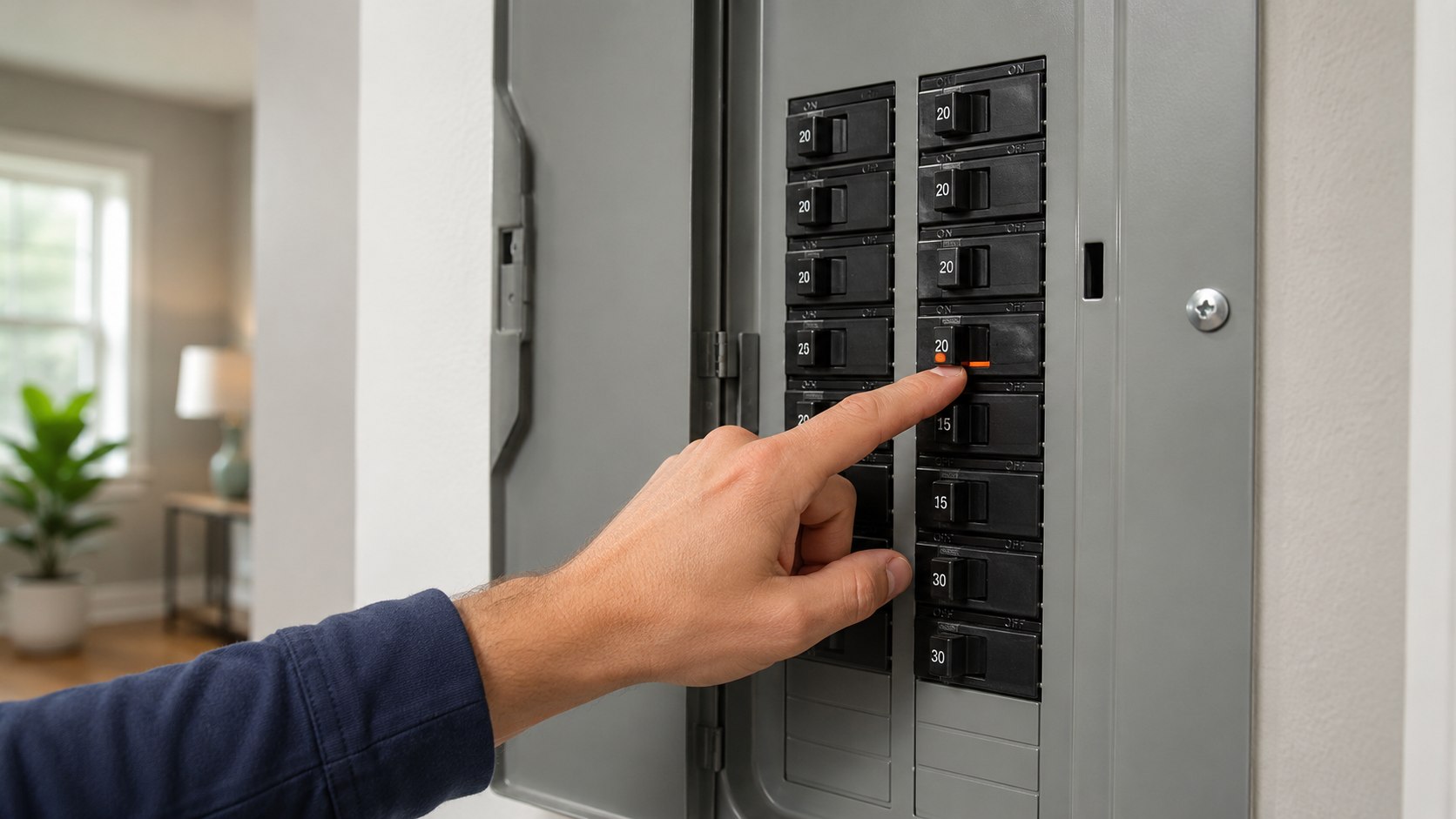
Troubleshooting Common Breaker Problems
Use these scenarios after one safe reset attempt. They help determine whether the problem involves loading, an appliance, a protective device, or the electrical system itself.
- The breaker will not reset: Unplug every device on the circuit. Try once more, then leave it off if it trips.
- The breaker stays on, but outlets remain dead: Check GFCI outlets, wall switches, and another breaker serving the same area.
- The breaker trips after several minutes: Heat-producing equipment, motors, or an overloaded connection may be involved.
- An AFCI breaker trips: Damaged cords, loose connections, motor brushes, or wiring faults may create detectable arcing patterns.
- A GFCI breaker trips: Moisture, damaged equipment, leakage current, or a ground fault may be present.
A breaker that will not stay on with every load disconnected may indicate a wiring fault or failed breaker. Do not continue cycling it.
When outlets remain dead, inspect only accessible GFCI RESET buttons and ordinary switches. Do not remove receptacle covers or probe wiring.
Delayed trips often point toward accumulating heat or sustained overload. Record which appliances were running and how long the circuit operated.
AFCI and GFCI trips should not be dismissed as nuisance events. These devices are designed to detect conditions that a standard overcurrent breaker may not identify.
Provide the electrician with the breaker label, affected rooms, connected appliances, visible warning signs, and timing. A short video of the indicator lights can also help, provided recording is safe.
FAQ About Resetting a Tripped Circuit Breaker
Why does my breaker sit in the middle?
Many breakers move to a center or intermediate position after tripping. Push the handle fully to OFF before moving it to ON.
Is it safe to reset a breaker more than once?
One reset after disconnecting the load is reasonable when no warning signs exist. Repeated resetting is unsafe because the original fault remains unresolved.
What if the breaker trips immediately?
Leave it off. Disconnect all devices, but do not make repeated attempts when the breaker still trips without a connected load.
Can I reset a breaker during rain or flooding?
Not when the panel, floor, wall, or your hands are wet. Avoid the area and contact the utility, emergency services, or an electrician.
Why is only part of my house without power?
A branch breaker, GFCI device, damaged circuit, or lost utility service conductor may affect only certain areas. Check the panel and utility outage information.
When should a tripped breaker be replaced?
Replacement may be appropriate when a licensed electrician finds mechanical failure, heat damage, corrosion, incompatibility, or deterioration. Frequent trips alone do not prove the breaker is defective.
Earlier we wrote about How to Arrange a Small Living Room With a TV, Sofa, and Clear Walkway