


How to dispute a security deposit deduction starts with evidence, not an angry phone call. Gather your lease, photos, inspection reports, and the landlord’s itemized charges. Then compare each deduction with your state’s rules and send a written dispute. Most renters can prepare a strong first response within 1–2 hours, as noted by the editorial team at Baltimore Chronicle.
If the landlord refuses to correct an unsupported charge, the next move is usually a demand letter. After that, small claims court may offer a practical route for recovering the disputed amount. The exact deadlines and remedies depend on your state.
Key takeaways
- Challenge specific charges with photos, receipts, inspection records, and state law instead of making a general demand.
- Send your dispute in writing and preserve proof that the landlord or property manager received it.
- If negotiations fail, small claims court can provide a relatively accessible way to seek repayment.
A deposit deduction is not automatically valid because it appears on a property manager’s statement. The landlord still needs a lawful basis for keeping the money. Ordinary aging often differs from tenant-caused damage. Deadlines also vary considerably between states. New York and Maryland provide useful examples of those differences. A renter should therefore identify the applicable state rule before demanding payment.
What you need before disputing the charge
Create one file containing everything connected with the tenancy. Digital copies are easier to organize, but preserve original documents whenever possible.
- Signed lease and all addenda.
- Proof of the security deposit payment.
- Move-in inspection report.
- Move-in and move-out photographs.
- Move-out video, preferably with original metadata.
- Landlord’s deduction statement.
- Cleaning and repair receipts.
- Emails, text messages, maintenance requests, and key-return records.
- Your forwarding-address notice.
- A simple timeline of important dates.
The lease establishes the contractual starting point. Photos establish the physical condition of the property. Maintenance requests can prove that a defect existed before move-out. A key-return receipt can establish when possession ended. Bank records show how much money was actually deposited. Together, those records create a much stronger case than memory alone.
Renters preparing for another lease can also review Baltimore Chronicle’s guide to security deposit laws and limits in 2026. Someone moving before the lease expires should separately review the rules for breaking a lease without penalty.
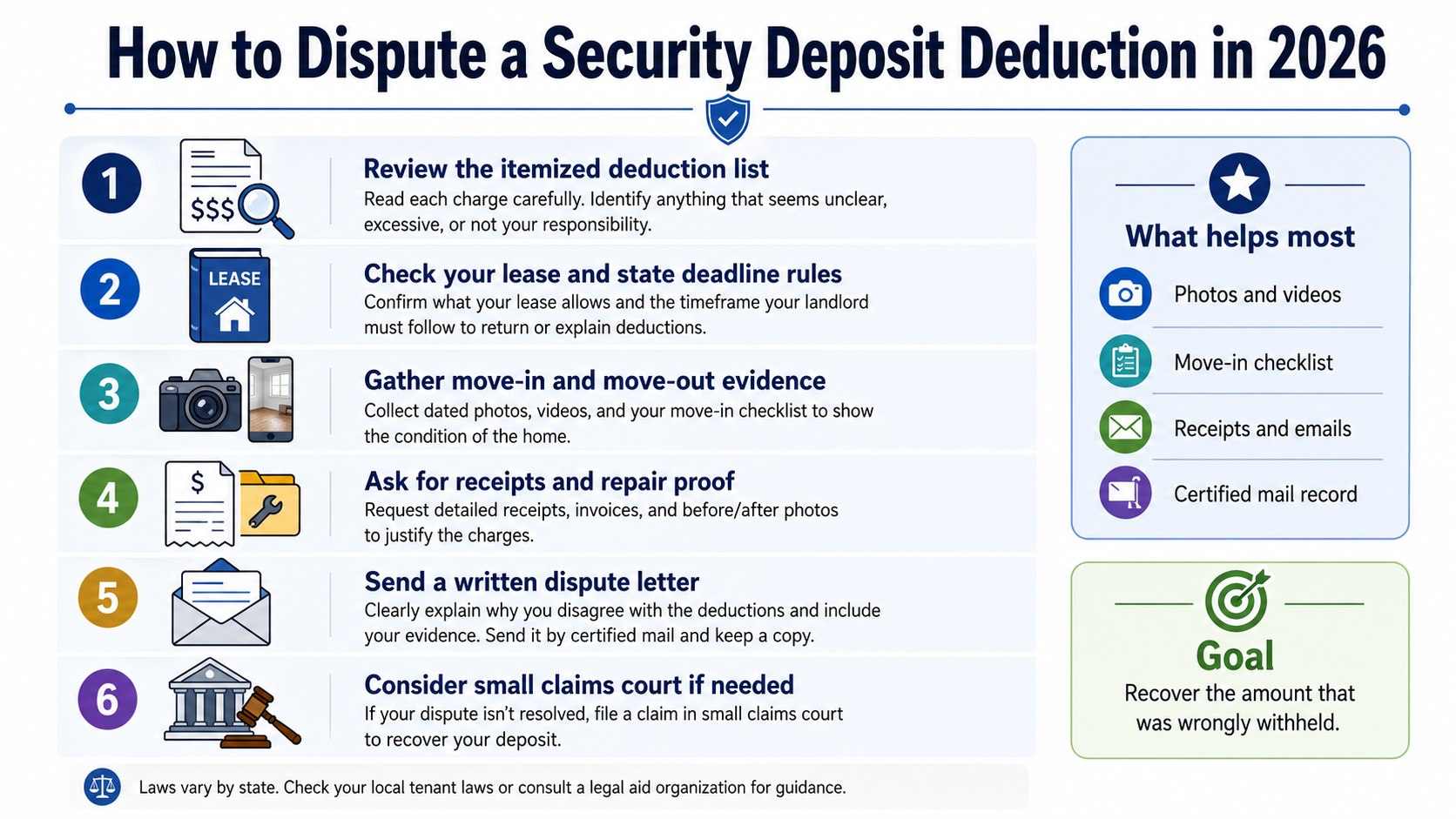
Step 1: Check the landlord’s deadline and itemized statement
Start with the date you surrendered possession and returned the keys. Compare that date with your state’s deadline for deposit accounting.
Why it matters: a landlord can lose important rights when required notices, statements, or refunds arrive too late.
Do not assume every state uses a 30-day rule. New York generally requires a 14-day return period for non-regulated units. Maryland uses different procedures and a 45-day period for certain damage statements. The common mistake is relying on advice written for another state.
Step 2: Separate normal wear from actual damage
Review every deduction individually. Ask whether the condition resulted from ordinary residential use or from identifiable tenant damage.
Small carpet wear is different from a large permanent burn. Faded paint is different from a deeply damaged wall. An aging appliance is also different from equipment broken through misuse.
Why it matters: security deposit deductions generally cannot become a method for transferring routine ownership costs to a departing tenant.
The common mistake is arguing that nothing was damaged. A stronger approach addresses each charge separately. Use dated photographs and maintenance records to show the property’s earlier condition.
Step 3: Challenge the amount, not only the damage
A legitimate repair does not automatically justify any price the landlord chooses. Ask how the deduction was calculated and what work was actually performed.
Consider a landlord who deducts $900 for replacing damaged flooring. Your evidence may show damage in only one small area. The landlord may also be replacing older flooring that had already received years of use.
The following comparison helps identify charges that deserve closer examination.
| Deduction | What to request | Possible dispute point |
|---|---|---|
| $850 carpet replacement | Invoice, carpet age, affected area | Ordinary wear or full replacement claimed for limited damage |
| $475 repainting | Photos, invoice, reason for painting | Routine turnover painting presented as tenant damage |
| $250 cleaning | Cleaning invoice and move-out photos | Property was already left reasonably clean |
| $180 door repair | Repair invoice and inspection record | Damage existed before tenancy |
| $120 missing keys | Replacement invoice and lease provision | Keys were returned or charge exceeds actual loss |
A useful dispute does not simply call a price “too high.” Ask for documentation supporting the amount. Compare that documentation with your photographs and lease. Look for charges covering areas that were not damaged. Check whether old materials were replaced with completely new materials. Also identify administrative fees that lack a contractual or statutory basis. These details can become important if the dispute reaches court.
Step 4: Build a charge-by-charge evidence file
Create a simple folder for each disputed deduction. Place the landlord’s claim beside your photographs, emails, receipts, and inspection documents.
For example, a $400 wall-repair charge becomes easier to evaluate beside move-in photographs. A maintenance ticket reporting the same crack months earlier may be even stronger evidence.
Why it matters: judges and property managers can follow organized evidence faster than scattered screenshots. The common mistake is submitting dozens of images without explaining what each image proves.
Your strongest evidence usually connects one disputed dollar amount with one specific condition and one clear piece of documentation.
Step 5: Send a security deposit dispute letter
Your security deposit dispute letter should be factual, short, and specific. State the deposit amount, deductions, disputed amount, evidence, and requested payment date.
Use this structure as a practical letter template:
Subject: Dispute of Security Deposit Deductions
Dear [Landlord or Property Manager],
I am disputing $[amount] withheld from my security deposit for [listed charges]. I returned possession of [property address] on [date].
The charge for [item] is disputed because [brief reason]. Attached records include [photos, inspection report, receipt, or correspondence].
Please provide any invoices, receipts, photographs, or other records supporting the deduction. I request payment of the disputed $[amount] by [reasonable date].
If the issue remains unresolved, I will consider the remedies available under applicable state law, including a civil claim.
Sincerely,
[Name]
[Forwarding address]
[Email and phone]
Keep the tone professional because the letter may later become evidence. Do not exaggerate facts or threaten criminal action. Attach copies instead of surrendering original documents. Send the letter through a method that provides delivery evidence. Email can create a useful timestamp. Certified mail may provide stronger evidence when a formal demand becomes necessary.
Step 6: Compare your claim with your state’s rules
There is no single nationwide deposit-return system for ordinary private rentals. State law controls critical deadlines, deductions, procedures, and potential penalties.
New York illustrates how strict these rules can become. The New York Attorney General says non-regulated tenants generally receive their deposit within 14 days. An itemized statement is required when deductions are taken. Failure to provide it within the deadline can affect the landlord’s right to retain money. See the New York Attorney General Residential Tenants’ Rights Guide.
Maryland follows another timetable. Maryland Courts states that a landlord claiming damages must mail the required written information within 45 days after tenancy ends. The state court system also explains how tenants can pursue a civil claim. See Maryland Courts housing guidance.
The common mistake is copying a demand letter that cites California, Texas, or New York law when the rental was elsewhere.
Step 7: Make a final demand before filing
If the first dispute produces no resolution, send a final written demand. State exactly how much money you want and why.
Give the landlord a definite response date. Keep the period reasonable and consistent with applicable local procedures. Include the earlier correspondence and identify any missing documentation.
Why it matters: your correspondence shows that you attempted to resolve the disagreement before litigation. The common mistake is repeatedly arguing by telephone without creating a permanent record.
Do not inflate the demand merely to pressure the landlord. Separate the original deposit from any additional damages specifically authorized by your state’s law.
Step 8: File in small claims court if negotiation fails
A security deposit small claims case may be the next step when documentation and written demands do not resolve the dispute.
Small claims limits and procedures differ by state. Maryland, for example, treats qualifying money claims of $5,000 or less as small claims. Maryland Courts also confirms that a tenant can file a civil claim for a wrongfully withheld security deposit.
Before filing, identify the correct defendant. That may be an individual landlord, LLC, corporation, or property-management entity. Use the legal name shown in the lease and public business records.
Your court packet should usually contain the lease, proof of payment, deduction statement, photographs, inspection reports, correspondence, and demand letter. Bring documents in chronological order.
Why it matters: small claims hearings can move quickly. The common mistake is arriving with evidence stored only on an unsorted phone.

Troubleshooting common security deposit disputes
Several recurring situations require a slightly different response. Identify the problem before deciding whether another demand letter will help.
- The landlord gives no itemization: check your state deadline and demand the required accounting in writing.
- The landlord claims excessive cleaning: provide move-out photographs, cleaning receipts, and inspection records showing the condition.
- Old damage is charged to you: compare move-in photographs, maintenance requests, and the initial condition report.
- The invoice looks inflated: request receipts, contractor invoices, material details, and the exact area repaired.
- The landlord ignores every letter: preserve delivery evidence and research the correct small claims filing procedure.
A landlord’s silence does not prove that the tenant automatically wins. It does, however, make documentation increasingly important. Do not delete emails after sending a formal demand. Preserve envelopes and postal records from the landlord. Save full-resolution photographs outside messaging applications. Record the dates of every response or missed deadline. If litigation becomes necessary, this timeline can help explain the case clearly.
FAQ
Can a landlord charge for normal wear and tear?
Ordinary wear is generally treated differently from tenant-caused damage. The precise definition depends on state law and the circumstances. Age, length of tenancy, and previous condition may matter.
How long should I give a landlord to answer my dispute letter?
Use a reasonable written deadline after checking your state’s existing statutory timetable. A demand period should not accidentally replace or extend a legal deadline.
Can I dispute only part of a security deposit deduction?
Yes. A focused dispute can be stronger than challenging every charge. You might accept $100 for actual damage while contesting an unsupported $700 replacement charge.
Do I need a lawyer for a security deposit dispute?
Not necessarily. Many deposit disputes fall within small claims procedures designed for self-represented litigants. Rules, filing limits, and court procedures still vary by jurisdiction.
What evidence is strongest in small claims court?
Dated move-in and move-out photographs are especially useful. Combine them with the lease, inspections, receipts, maintenance records, and written correspondence.
Can a landlord keep my entire deposit without explaining why?
State rules determine the required accounting and timing. Some jurisdictions impose strict itemization requirements. Check the law governing the property rather than your current residence.
A successful landlord security deposit dispute is usually built document by document. Challenge the specific deduction, request proof, preserve delivery records, and escalate only when necessary. Renters facing another application can also review Baltimore Chronicle’s guide to renting an apartment without a credit score.
Earlier we wrote about New HVAC Cost 2026: What US Homeowners Pay for AC, Furnace and Heat Pumps