


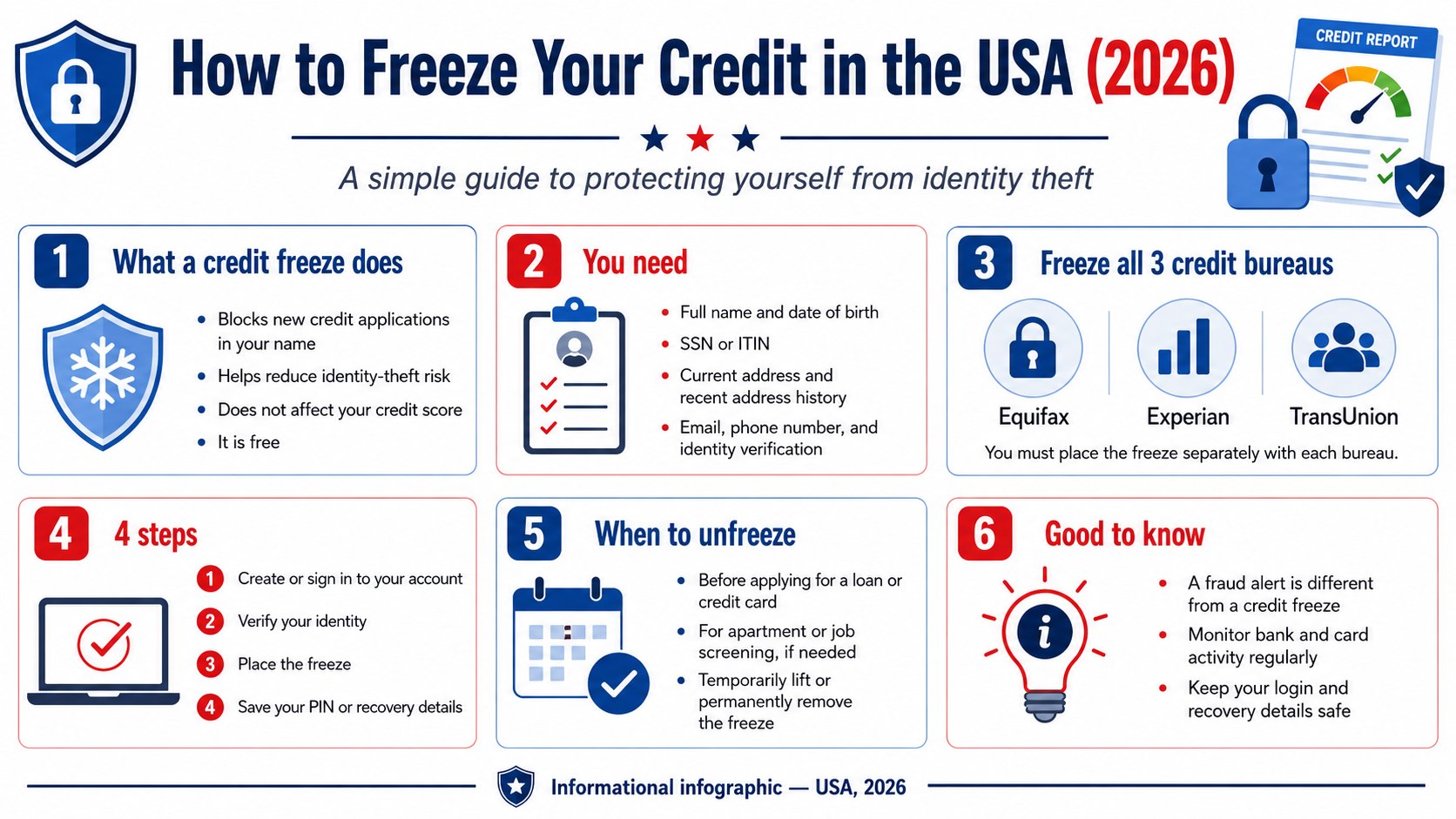
How to freeze your credit 2026 USA starts with one critical rule: you must freeze your file separately at Equifax, Experian, and TransUnion. The process costs $0, usually takes about 15–30 minutes online, and does not lower your credit score. If you suspect identity theft, a stolen Social Security number, or a data breach, freezing all 3 files can immediately make new-account fraud harder, as noted by Baltimore Chronicle.
You do not need to prove fraud before requesting a freeze. Any US consumer can use one, including homeowners, renters, drivers, parents, and freelancers. The freeze remains active until you temporarily lift or permanently remove it.
“Anyone can freeze their credit report, for any reason, even if their identity hasn’t been stolen.”
Federal Trade Commission, Consumer Advice, guidance on credit freezes and fraud alerts.
Key takeaways
- Freeze Equifax, Experian, and TransUnion separately because freezing only one report leaves the other 2 available to potential creditors.
- A credit freeze is free to place, temporarily lift, or remove under federal law in 2026.
- Lift the freeze before certain credit applications, then restore it after the lender completes the required credit check.
A freeze controls access to your credit report rather than changing information inside it. Existing credit cards, mortgages, auto loans, and payment histories continue operating normally. Your lenders can still report account activity.
You can also check your own credit reports while they remain frozen. A freeze therefore works best as an access-control tool, not as a substitute for reviewing your reports. The FTC says a freeze itself does not affect your credit score.
People preparing for a home purchase should coordinate the freeze with lender timing. Baltimore Chronicle explains that mortgage lenders commonly review credit during mortgage pre-approval in the USA.
What you need
Prepare your information before opening the bureau websites. Identity verification can fail when addresses, names, or other records differ from the information already stored in your credit file.
- Full legal name and date of birth.
- Social Security number.
- Current US address and possibly previous addresses.
- Government-issued ID if additional verification is requested.
- Access to your email address and mobile phone.
- Separate online access for Equifax, Experian, and TransUnion.
- About 15–30 minutes if online verification works normally.
- Cost: $0 as of 2026.
You may be asked questions based on your financial history. Keep your information private and start only from official bureau websites.
Avoid paid advertisements that imitate official freeze portals. A federally regulated security freeze itself does not require a subscription.
If you recently moved from Maryland to Florida, Texas, California, or another state, keep your previous address available. Address history can help the bureau match your identity.
Parents can also investigate freezes for minor children. Those requests can require documents proving identity and authority.
Security freeze is not something you should pay a third-party company to “activate” for you. The 3 nationwide credit bureaus provide the freeze directly.
Step 1: Confirm that a credit freeze is the right tool
Choose a freeze when your priority is preventing unauthorized new credit accounts. It restricts access to your credit report for many new-credit decisions.
This matters after a stolen wallet, exposed Social Security number, phishing incident, or major data breach. It can also be used proactively without any known fraud.
Do not confuse a freeze with a fraud alert. A fraud alert tells creditors to verify your identity, while a freeze restricts access more directly. The FTC explains both options in its official credit freeze guidance.
Common mistake to avoid: assuming that a freeze cancels existing cards or blocks charges. It generally addresses new-account access, not ordinary activity on accounts you already hold.
Step 2: Freeze your Equifax credit file
Go to Equifax through its official website and choose its security-freeze service. Complete identity verification and request a freeze for your Equifax credit report.
Why it matters: lenders do not always use the same bureau. Protecting Equifax alone therefore does not protect your Experian or TransUnion reports.
Save any confirmation message and keep your Equifax account credentials secure. Modern bureau systems may use account authentication rather than relying exclusively on an old-style freeze PIN.
Common mistake to avoid: stopping after Equifax confirms the request. You are only one-third finished.
Step 3: Freeze your Experian credit file
Repeat the process directly with Experian. Request a security freeze on your Experian credit report, complete verification, and check its resulting status.
The practical reason is simple. A fraudulent lender could obtain a different bureau report when another file remains accessible.
Experian states that its security freeze limits access to the Experian credit report without your permission. The service is available free of charge.
Common mistake to avoid: buying a credit-lock or monitoring product because its name resembles a security freeze. A freeze and commercial credit-lock products are not necessarily the same service.
Step 4: Freeze your TransUnion credit file
Use TransUnion’s official credit-freeze service for the third request. Verify your identity, activate the freeze, and confirm that your TransUnion file shows the correct status.
This completes the basic freeze all three credit bureaus process. TransUnion describes a freeze as free to add, remove, or temporarily lift.
Common mistake to avoid: assuming your Equifax or Experian request automatically reaches TransUnion. Credit freezes must be requested individually from all 3 bureaus.
Step 5: Record confirmation and verify all 3 freezes
Create a simple record showing Equifax, Experian, and TransUnion as frozen. Store confirmation emails or account information somewhere protected.
This matters because months may pass before you next apply for credit. By then, remembering which bureau was frozen can be surprisingly difficult.
Use this comparison as a final check:
| Credit bureau | Freeze cost in 2026 | Separate request required? | Temporary lift available? |
|---|---|---|---|
| Equifax | $0 | Yes | Yes |
| Experian | $0 | Yes | Yes |
| TransUnion | $0 | Yes | Yes |
All 3 freezes should appear in your records before you consider the process complete. The price should be $0 for the freeze itself.
A paid monitoring service may offer additional features, but that is separate from your federal freeze rights. Never assume a monthly membership is required.
Your existing accounts continue reporting information while frozen. That means payment history and balances can still affect your score.
You can also request your own credit information without removing the freeze. Checking your own report does not require opening the file to a new creditor.
For mortgage planning, Baltimore Chronicle’s guide to credit scores for buying a house in 2026 explains how lenders may use information from all 3 bureaus.
Step 6: Temporarily unfreeze your credit when needed
Do not permanently remove a freeze simply because you need one legitimate credit check. A temporary credit thaw can reopen the necessary file for a defined period.
Ask the lender which bureau it expects to use when possible. You may then need to lift only that specific freeze.
This approach can help with a mortgage, auto loan, credit card, or another transaction requiring report access. If the lender checks multiple bureaus, lift each required file.
Federal rules require a requested electronic or telephone lift no later than 1 hour after receipt. A mailed request can take up to 3 business days.
Common mistake to avoid: applying first and thawing later. A lender can encounter a frozen file and delay the application.
If you expect a mortgage application next week, arrange the temporary lift before the lender performs its credit pull. Restore the freeze after the required checks are finished.
Credit freeze vs fraud alert vs credit lock
These terms are often treated as interchangeable, but they describe different mechanisms. Understanding the distinction prevents consumers from paying for something they can obtain free.
| Option | Main function | Typical cost | Who must you contact? |
|---|---|---|---|
| Credit freeze | Restricts access to a credit report | $0 | All 3 bureaus separately |
| Fraud alert | Asks creditors to verify identity | $0 | One bureau can notify the others |
| Credit lock | May restrict report access through a bureau product | Terms vary | Depends on provider |
A freeze is the stronger default when the goal is limiting new-credit access. A fraud alert works differently because the report can still be available.
The initial fraud-alert process also requires less repetitive work. The bureau receiving the alert generally coordinates with the other 2 nationwide bureaus.
A credit lock can be convenient, but consumers should examine product terms. Some lock features may be packaged with monitoring memberships.
Do not use the words “lock” and “freeze” interchangeably when contacting support. Ask specifically for the federally regulated security freeze.
A freeze also does not repair fraudulent information already present in your file. Disputes and identity-theft reporting may still be necessary.

Troubleshooting common credit-freeze problems
Most online requests are straightforward, but verification problems can interrupt the process. These are the most common situations to check before assuming the system failed.
- Identity verification fails: confirm your legal name, Social Security number, birth date, current address, and prior addresses.
- A lender cannot pull credit: ask which bureau it uses, then temporarily lift the correct freeze before retrying.
- You forgot your login: use the bureau’s official account-recovery process instead of creating unrelated duplicate accounts.
- Only one report is frozen: complete separate requests with the other 2 nationwide credit bureaus.
- Fraud already appears: a freeze cannot erase it, so dispute inaccurate accounts and follow identity-theft reporting procedures.
Do not repeatedly submit conflicting identity information. That can make automated verification more difficult.
If an online request fails, each bureau also provides alternative support methods. Telephone or mail may require additional identity documentation.
Federal timing rules differ for mailed requests. Placement or removal by mail can take up to 3 business days after receipt.
For online or telephone requests, a bureau must place the freeze within 1 business day. A qualifying lift must be completed within 1 hour.
If a stolen Social Security card triggered your concern, Baltimore Chronicle also has a guide to replacing a lost Social Security card in 2026.
FAQ
Does freezing your credit hurt your credit score?
No. The FTC says placing a credit freeze does not affect your credit score. Existing accounts can continue reporting payments and balances normally.
How much does it cost to freeze credit in 2026?
It costs $0 to place, temporarily lift, or remove a security freeze. This applies to Equifax, Experian, and TransUnion.
Do I need to freeze all three credit bureaus?
Yes, if you want comprehensive coverage. A freeze requested from Equifax does not automatically freeze Experian and TransUnion.
How long does a credit freeze last?
A freeze remains in effect until you remove it. You can also temporarily lift it when a legitimate creditor needs access.
Can I apply for a mortgage with frozen credit?
Yes, but the lender needs access to the required credit report. Temporarily thaw the appropriate bureau files before the credit pull.
Should I freeze my credit if my Social Security number was stolen?
A freeze is one practical protection against unauthorized new accounts. You should also inspect your credit reports and respond to any fraudulent accounts you find.
Keep all 3 freezes active when you do not expect legitimate credit applications. Temporarily lift them when necessary, then restore protection after the requested credit check.
Earlier we wrote about Rebar Prices USA 2026: How Much Does a Ton and Linear Foot Cost?