

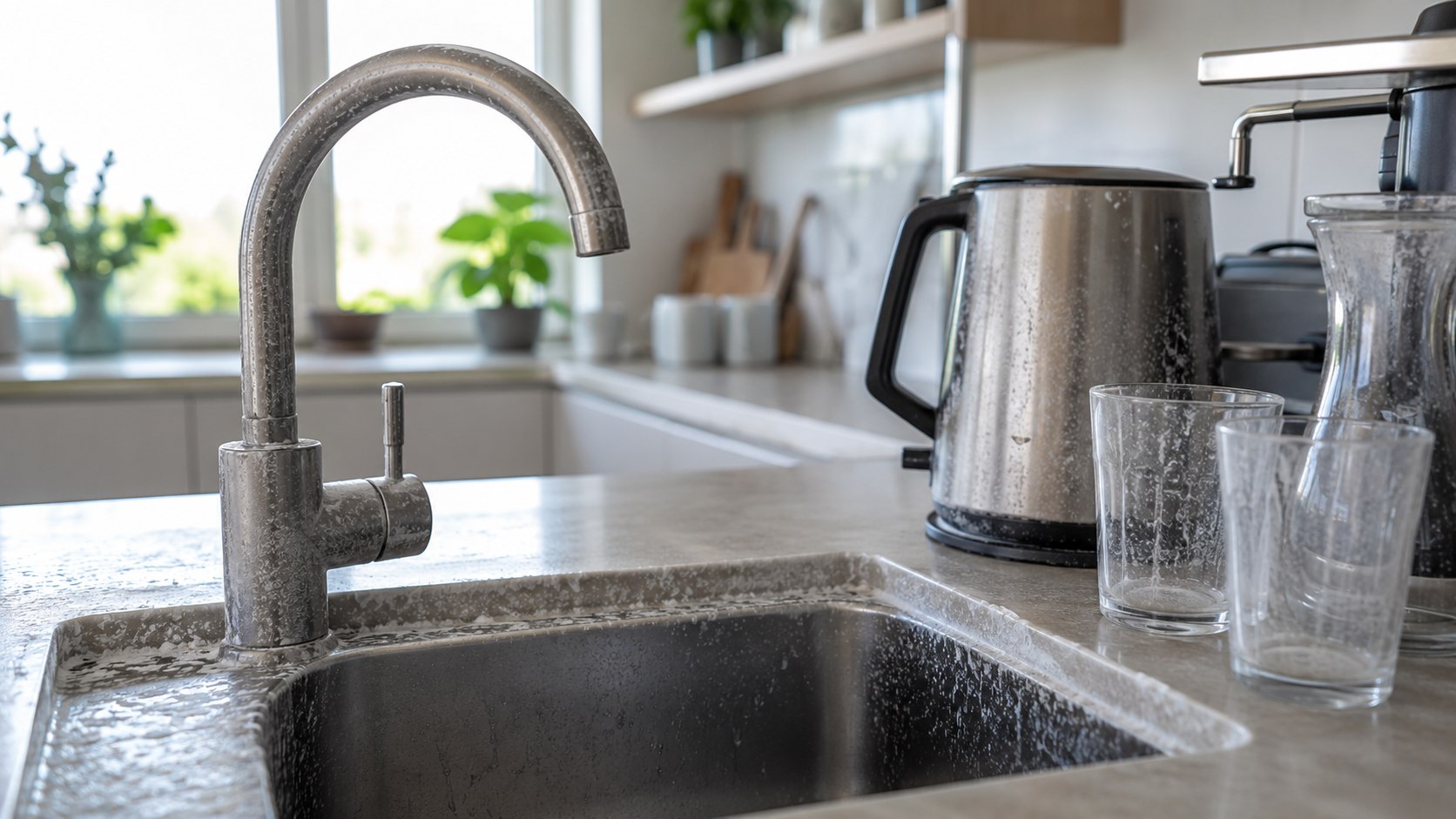
Hard water vs soft water for house decisions usually come down to 2 questions: how severe is the mineral buildup, and will the savings justify a softener? Most homeowners with hardness above 10 grains per gallon should choose a properly sized ion-exchange softener. Hard water remains reasonable for renters, low-hardness homes, and households unwilling to maintain another appliance, as noted by the Baltimore Chronicle.
Do not buy equipment based only on white spots around a faucet. Test the water first. If the result exceeds 10 grains per gallon, fixtures scale quickly, and the water heater shows sediment, whole-house treatment becomes easier to justify.
Key takeaways
- Choose soft water when measured hardness exceeds 10 grains per gallon and scale repeatedly affects plumbing or appliances.
- Expect a professionally installed softener to cost roughly $1,200–$3,800 in 2026, depending on plumbing and capacity.
- Keep hard water when hardness is moderate, maintenance costs matter, or local discharge rules restrict salt-based equipment.
These points provide a starting decision, not a substitute for testing. Local water chemistry can differ between neighboring homes. Well water may also contain iron, manganese, sulfur, or sediment that a standard softener cannot fully correct. Municipal customers should request the latest water-quality report before calling installers.
Home buyers can also review the 2026 home inspection guide before accepting a seller’s claims about plumbing condition.
At a glance
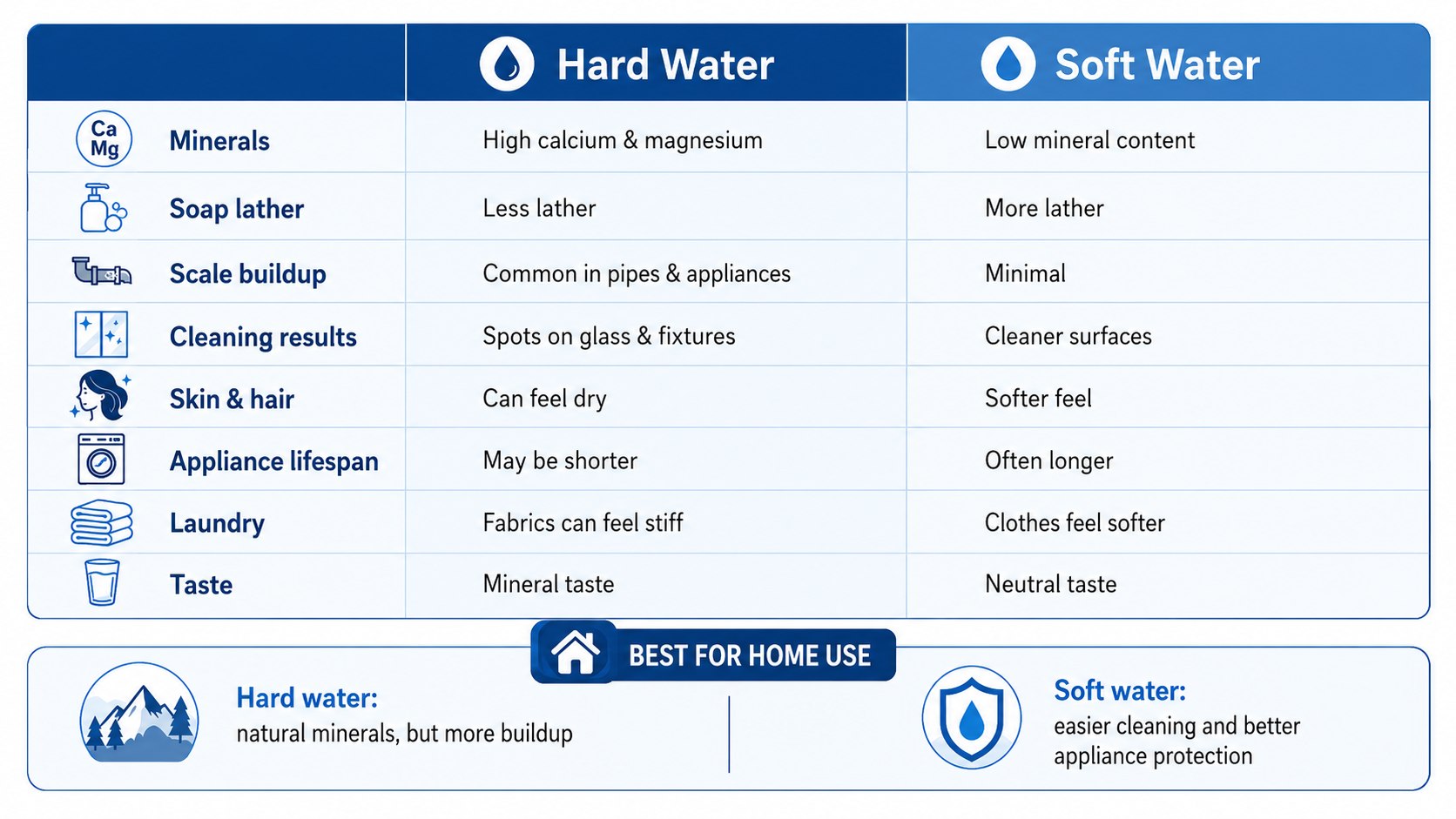
The practical difference is not whether one type of water is universally safer. It is how each affects cleaning, fixtures, appliances, operating costs, and daily maintenance.
| Factor | Hard water | Soft water |
|---|---|---|
| Mineral content | Higher calcium and magnesium | Most hardness minerals removed |
| Upfront cost | No treatment cost | About $1,200–$3,800 installed in 2026 |
| Installation | No equipment required | Plumbing, drain, outlet, and bypass may be required |
| Soap performance | More soap and detergent often needed | Soap lathers more readily |
| Fixtures | Scale and spotting can develop | Less mineral scale |
| Water heater | Greater sediment and scale risk | Reduced hardness-related buildup |
| Maintenance | Frequent descaling and cleaning | Salt refills, inspections, and regeneration |
| Expected equipment life | No treatment appliance | Often 10–15 years with suitable maintenance |
| Best fit | Renters and moderately hard-water homes | Owners with documented hard or very hard water |
The cost row requires context. A basic cabinet-style unit may be relatively affordable, while a dual-tank system can cost substantially more. Installation becomes expensive when the house lacks a nearby drain, electrical receptacle, or suitable plumbing loop. Finished basements and tight utility rooms can increase labor further.
Softener lifespan also depends on chlorine exposure, iron, regeneration frequency, and valve quality. Resin can deteriorate before the tank itself fails. Salt bridging, clogged injectors, or incorrect programming can make a working unit appear defective.
Before approving installation, compare labor assumptions using Baltimore Chronicle’s guide to plumber hourly rates in 2026.
Hard water vs soft water for house: what the test numbers mean
Hardness measures dissolved calcium and magnesium. The U.S. Geological Survey classifies water containing 0–60 milligrams per liter as soft. Water between 61 and 120 milligrams per liter is moderately hard, while 121–180 is hard. Anything above 180 milligrams per liter is very hard.
| Classification | Milligrams per liter | Approximate grains per gallon | Likely household effect |
|---|---|---|---|
| Soft | 0–60 | 0–3.5 | Little hardness scale |
| Moderately hard | 61–120 | 3.6–7.0 | Some spotting and soap residue |
| Hard | 121–180 | 7.1–10.5 | More visible scale and cleaning effort |
| Very hard | Above 180 | Above 10.5 | Frequent scale and stronger treatment case |
One grains-per-gallon reading is not a complete water analysis. Private wells should also be checked for bacteria, nitrates, iron, manganese, pH, and other local concerns. A softener is not a universal purifier. It treats hardness through ion exchange but does not automatically make contaminated water safe.
National maps can show regional patterns, particularly across parts of the Midwest and Southwest. They cannot establish the condition at one address. The USGS directs homeowners toward local utilities, health agencies, or property-level testing for decisions affecting an individual house.
Hard water: lower cost, higher cleaning burden
Hard water is usually safe to drink and does not require a treatment appliance. Its main disadvantage is operational. Calcium carbonate can collect inside faucets, showerheads, coffee makers, dishwashers, and water heaters.
Pros of keeping hard water
- No softener purchase or installation expense
- No salt bags, brine tank, or regeneration cycle
- No added sodium or potassium from ion exchange
- No wastewater discharge from softener regeneration
- Fewer mechanical parts to inspect or repair
Keeping hard water can be financially rational when the measured level is below roughly 7 grains per gallon. Many households can control moderate spotting with periodic descaling. Renters also avoid installing equipment they cannot take easily when moving.
Hard water contains calcium and magnesium rather than an inherently dangerous contaminant. However, those minerals react with soap and contribute to residue. The USGS reports that heated hard water can form deposits that lower water-heater efficiency and restrict plumbing over time.
Maintenance remains the trade-off. Showerheads may need vinegar treatment, dishwasher rinse aid becomes more useful, and glassware can appear cloudy. Scale around valves can also conceal small leaks or make fittings harder to service.
Cons of hard water
- White or chalky deposits around faucets and showerheads
- Spots or cloudy film on dishes and glassware
- More detergent required for laundry and cleaning
- Scale inside tank-style and tankless water heaters
- Reduced water flow through heavily scaled fixtures
- Stiff-feeling laundry and soap residue on surfaces
A single symptom does not prove excessive hardness. Cloudy glassware can result from detergent, etching, or dishwasher settings. Low pressure may come from a failing valve or clogged aerator. Test before spending several thousand dollars.
Hard water is the economical choice when the mineral level is moderate and routine descaling controls the visible effects.
Soft water: stronger scale control with ongoing costs
A traditional whole-house water softener passes water through resin beads. These beads exchange calcium and magnesium for sodium or potassium ions. The system later regenerates using a brine solution.
The U.S. Environmental Protection Agency says cation-exchange units can protect appliances and reduce hardness problems. However, regeneration consumes both water and salt. The agency advises selecting equipment carefully rather than installing a softener automatically.
Pros of soft water
- Less scale on plumbing fixtures and shower surfaces
- Reduced hardness deposits inside water-heating equipment
- Better soap and detergent performance
- Fewer spots on dishes and glassware
- Less frequent descaling of small appliances
- More predictable cleaning results in very hard-water areas
The improvement is most noticeable in homes with very hard water. Families running frequent laundry and dishwasher cycles may also see a larger practical benefit. Softening can reduce nuisance deposits, although it cannot repair plumbing already narrowed by years of scale.
Brand names such as Rheem, Whirlpool, GE, Aquasure, Culligan, and Kinetico appear widely in the U.S. market. Brand alone should not determine the purchase. Valve serviceability, local parts access, certified capacity, resin volume, and installer support matter more.
Cons of soft water
- Installation expense and possible plumbing modifications
- Regular salt or potassium chloride purchases
- Additional water used during regeneration
- Possible local restrictions on brine discharge
- Mechanical failures involving valves, injectors, or controls
- Added sodium in water treated by sodium-based systems
EPA guidance published in May 2026 states that a typical softener uses 20–70 gallons during each regeneration cycle. Larger equipment can use as much as 200 gallons. Actual consumption depends on capacity, household demand, and programming.
Demand-initiated regeneration is preferable to a fixed schedule. It regenerates after measured usage rather than every few days regardless of demand. EPA also recommends considering NSF/ANSI 44 certification and correctly sizing the system.
“Only install a water softener if your area has substantial hardness.”
U.S. Environmental Protection Agency, WaterSense home water-softener fact sheet, May 2026. The agency gives above 180 mg/L, or about 10 grains per gallon, as an example threshold.
Water softener cost in 2026
Most standard U.S. households should budget about $1,200–$3,800 for equipment and professional installation in 2026. A simple replacement using existing connections may cost less. Complex plumbing, dual tanks, premium controls, or well-water pretreatment can push the project beyond $5,000.
| Expense | Typical 2026 range | Main cost driver |
|---|---|---|
| Basic equipment | $500–$1,500 | Capacity, valve, resin volume |
| Professional installation | $500–$1,500 | Plumbing access and local labor |
| Complex installation | $1,500–$3,000+ | Drain, outlet, bypass, wall access |
| Dual-tank or premium system | $2,500–$6,000+ | Continuous supply and proprietary equipment |
| Salt | About $80–$250 yearly | Hardness, usage, and salt efficiency |
| Annual service | About $100–$300 | Local rates and service scope |
These are planning ranges, not guaranteed quotes. Labor differs across California, Texas, Florida, Maryland, Ohio, and other states. Permit requirements can also vary by city or county. Obtain itemized estimates showing equipment, connections, disposal, startup, warranty, and water testing.
A low quote may exclude a bypass valve, drain work, or electrical installation. A high quote may include proprietary service plans that limit future repair options. Compare identical scopes rather than comparing only the final price.
Ask whether the installer will program hardness, household size, and regeneration settings. Incorrect setup wastes salt and water. Before approving a large plumbing proposal, review how to read a construction estimate.
The least expensive unit can become the costliest option when proprietary parts, excessive regeneration, or poor local service increase ownership expenses.
Signs your house may need a water softener
Look for a pattern across several fixtures and appliances. One stained faucet is weak evidence. Repeated scale throughout the house, supported by a test above 10 grains per gallon, creates a much stronger case.
- Test cold water from an untreated tap.
- Confirm the result with the utility report or laboratory analysis.
- Inspect showerheads, aerators, valves, and glass doors for scale.
- Check the water heater for sediment noises or reduced performance.
- Compare detergent use and cleaning effort over several weeks.
- Request 2–3 itemized installation estimates.
- Verify local rules governing softener discharge.
- Choose equipment based on measured demand, not advertised maximum capacity.
Testing should come before sizing because hardness controls how quickly resin capacity is consumed. Household size also matters. A 2-person home does not need the same capacity as a family of 6 with several bathrooms.
Iron can alter the calculation and may require pretreatment. Sediment can clog valves, while chlorine can shorten resin life. Well owners should describe every test result to the installer rather than reporting only hardness.
Do not confuse a salt-free water conditioner with a true ion-exchange softener. Conditioners may reduce the tendency of minerals to form scale, but they usually leave calcium and magnesium in the water. That distinction matters in very hard-water homes.
Which should you buy in 2026?
Use these decision lines after obtaining a property-level hardness result:
- If hardness exceeds 10 grains per gallon, choose a demand-initiated ion-exchange softener sized for actual household use.
- If hardness measures 7–10 grains, compare treatment costs against scale damage, detergent use, and cleaning time.
- If hardness stays below 7 grains, keep the existing water unless a specific appliance or process requires treatment.
- If you rent, use reversible point-of-use measures unless the landlord approves permanent plumbing changes.
- If sodium intake is restricted, discuss an unsoftened kitchen line, potassium chloride, or other options with qualified professionals.
Homeowners with very hard municipal water usually receive the clearest benefit from a conventional softener. Those with moderate hardness may prefer targeted descaling and appliance maintenance. Renters rarely recover the cost of permanent whole-house equipment.
Check state and local rules before installation. Some communities regulate brine discharge because chloride can affect wastewater systems. A licensed local plumber or water-treatment contractor should know the applicable requirements, but homeowners should verify them independently.
The final specification should list tested hardness, daily demand, usable grain capacity, salt efficiency, regeneration water use, warranty terms, and service access. Avoid buying solely from a salesperson’s household-size chart.
FAQ
Is hard water safe to drink?
Hard water is generally a nuisance rather than a health hazard. It contains elevated calcium and magnesium. Testing remains necessary because hardness does not reveal bacteria, lead, nitrates, arsenic, or other contaminants.
How can I tell whether my house has hard water?
Common signs include white scale, spotted dishes, stiff laundry, weak soap lather, and recurring deposits on showerheads. Confirm those signs with a test reported in milligrams per liter or grains per gallon.
Does a water softener remove lead or bacteria?
No standard softener should be treated as a complete purification system. Ion exchange primarily addresses hardness minerals. Contaminants require testing and treatment designed for the specific substance.
How long does a water softener last?
A conventional system often serves for about 10–15 years, although resin or valve components may need earlier work. Chlorine, iron, heavy usage, and poor maintenance can shorten service life.
Can softened water damage plants?
Repeated watering with sodium-softened water can be unsuitable for some plants and soils. Many homes bypass exterior hose connections so irrigation water remains untreated.
Is salt-free treatment better than a conventional softener?
It depends on the goal. Salt-free conditioning may reduce scale attachment with less maintenance. Conventional ion exchange is usually more effective when the homeowner needs actual hardness removal.
Earlier we wrote about How to Cancel Kindle Unlimited on a Phone, Kindle, or Computer in 2026