


Famous quotes by Edgar Allan Poe explained here were chosen from Poe’s poems, stories, and critical essays. Priority went to lines with clear original context and frequent modern misreading, as the Baltimore Chronicle editorial team notes.
If you need a Poe quotation for an essay, memorial, tattoo, caption, or classroom discussion, context matters. Some celebrated “Poe quotes” were spoken by unstable narrators. Others were borrowed from earlier writers. The safest choice is a line whose speaker, work, and meaning match your purpose.
Key takeaways
- Poe’s best-known lines usually concern grief, uncertainty, memory, beauty, obsession, or the inability to escape loss.
- A quotation spoken by Poe’s narrator does not automatically represent Poe’s personal belief or advice.
- Several viral Edgar Allan Poe sayings are misquoted, shortened, or wrongly attributed, so source checking matters.
Poe remains unusually searchable in 2026 because his language survives outside literature courses. His phrases appear in films, tattoos, memorial posts, Halloween features, and discussions of grief. That popularity also creates attribution errors. A polished quotation image can circulate without naming the original work. Some websites then copy it without checking a primary text.
Readers interested in Poe’s Maryland connection can also explore Baltimore history and local facts. Poe lived in Baltimore during the 1830s and died there in 1849.
Famous Quotes by Edgar Allan Poe Explained Through Dreams and Uncertainty
1. “All that we see or seem is but a dream within a dream.”
This line closes the first section of “A Dream Within a Dream.” The speaker questions whether anything can be securely possessed or understood. In the poem, grains of sand slipping through his fingers turn that uncertainty into a physical image.
The line is often treated as a statement that reality is fake. That reading is too simple. Poe is more concerned with loss, perception, and the failure to hold time still.
Edgar Allan Poe quotes about dreams remain popular in 2026 because this one works beyond its 19th-century setting. It fits conversations about memory, grief, aging, and unreliable perception without requiring supernatural beliefs.
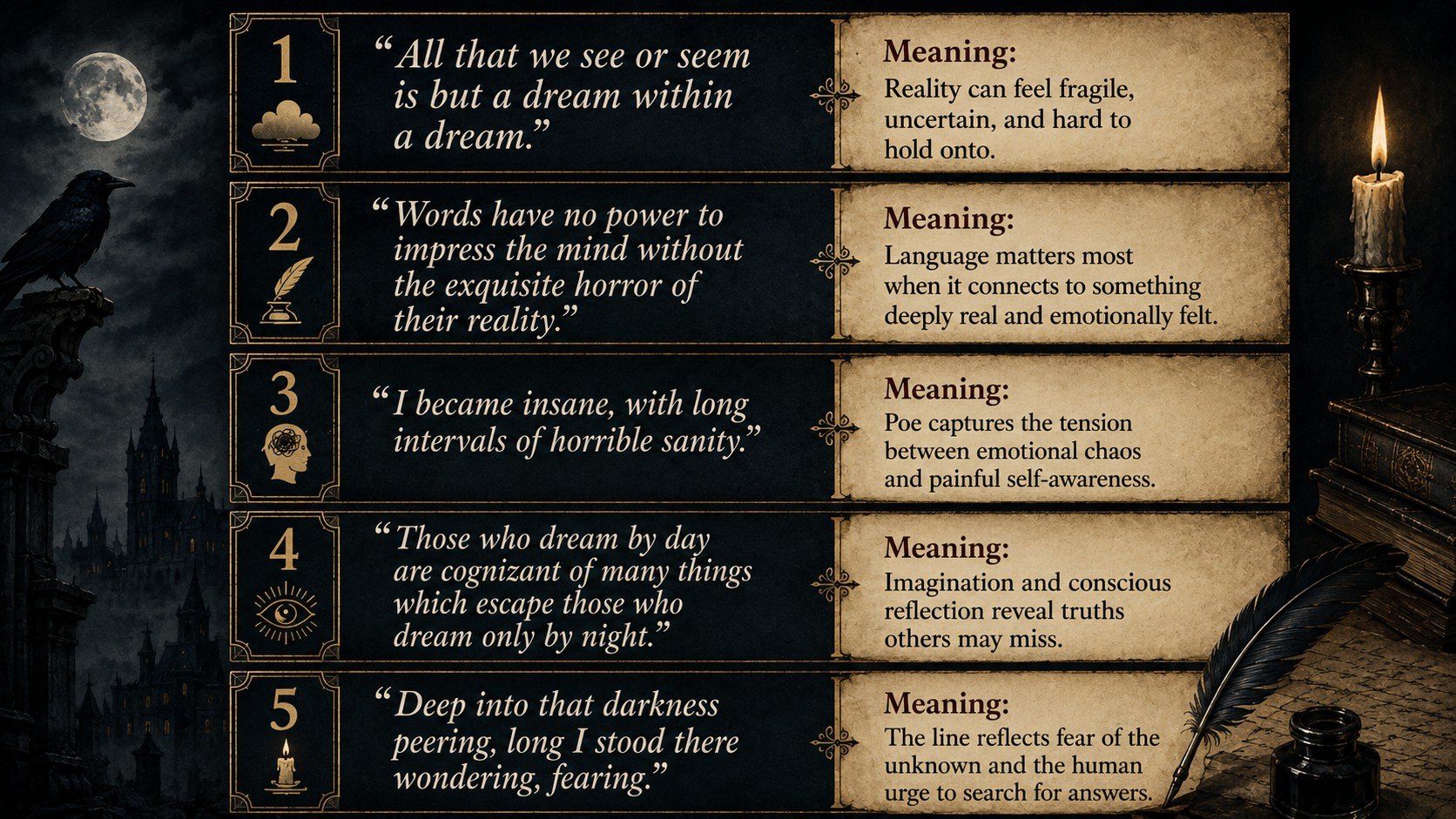
2. “Deep into that darkness peering, long I stood there wondering, fearing”
The phrase comes from “The Raven,” published in 1845. The grieving narrator opens his door after hearing a mysterious tapping, yet finds only darkness.
Its meaning depends on what happens before the line. The narrator already expects something connected with Lenore. Darkness therefore becomes a surface onto which fear and hope are projected.
The power of the line comes from hesitation rather than horror. Poe makes uncertainty itself feel threatening before anything supernatural appears.
3. “Nevermore.”
The raven repeats one word, but its importance changes as the poem progresses. At first, the narrator treats the bird’s answer almost playfully. He later asks questions whose painful answers he can already predict.
“Nevermore” becomes a mechanism for grief. The speaker effectively teaches the bird how to hurt him by asking about reunion, memory, and Lenore.
“Quoth the Raven ‘Nevermore.’”
Edgar Allan Poe, “The Raven,” 1845. Text preserved by the Edgar Allan Poe Society of Baltimore.
The phrase still stands out in 2026 because one word carries several meanings. It can indicate finality, refusal, death, or emotional fixation. That flexibility explains its life in popular culture. It also explains why quoting only “Nevermore” loses much of Poe’s psychological design.
Edgar Allan Poe Quotes About Love, Grief, and Memory
4. “We loved with a love that was more than love.”
This line belongs to “Annabel Lee,” a poem published shortly after Poe’s death. Its speaker describes an idealized relationship that survives the woman’s death.
The wording sounds romantic enough for weddings or anniversary posts. Yet the complete poem is darker. The speaker sleeps beside Annabel Lee’s tomb and insists that supernatural jealousy caused their separation.
That tension makes it one of the most recognizable Edgar Allan Poe love quotes. It expresses devotion, but also shows love becoming inseparable from mourning and obsession.
5. “That years of love have been forgot in the hatred of a minute.”
Poe used this wording in a later manuscript version of “To ——.” Earlier versions used “fever” rather than “hatred,” showing that Poe revised the emotional force.
The line describes how one bitter moment can overwhelm a much longer emotional history. It does not claim love was literally erased. Instead, temporary anger gains enough intensity to make previous affection feel inaccessible.
That idea remains useful in 2026 because digital arguments can preserve a single angry sentence indefinitely. Poe’s line captures emotional disproportion without requiring a modern setting.
6. “The boundaries which divide Life from Death, are at best shadowy and vague.”
This sentence appears in “The Premature Burial.” Poe introduces it while discussing fears surrounding apparent death and burial before modern diagnostic standards.
Today, the line often appears as philosophy. Its original function is more concrete and unsettling. Poe uses uncertainty about bodily signs to build the story’s claustrophobic fear.
For verified biographical background, the Library of Congress records Poe’s 1809 birth in Boston. It also traces his later work as poet, critic, editor, and fiction writer.
What Poe’s Darkest Lines Actually Say About the Mind
7. “Why will you say that I am mad?”
The narrator of “The Tell-Tale Heart” asks this near the opening. It would be a mistake to present the sentence as Poe defending his own sanity.
The entire story depends on dramatic irony. The speaker insists that calm narration proves rationality. His obsessive surveillance, murder, concealment, and imagined heartbeat undermine that claim.
This is a central rule for understanding Edgar Allan Poe famous sayings. Identify the speaker before treating any sentence as the author’s personal philosophy.
8. “Believe nothing you hear, and only one half that you see.”
The sentence appears in “The System of Doctor Tarr and Professor Fether.” Monsieur Maillard gives the advice during a visit to a mental institution.
That context changes everything. Maillard is not a neutral philosopher offering timeless media literacy. The story later reveals that appearances inside the institution are profoundly deceptive.
Poe’s joke works because sensible advice comes from a speaker whose authority should itself be questioned.
This quotation remains unusually relevant in 2026. It resembles advice about misinformation, manipulated images, and viral claims. Its original irony makes it stronger, not weaker, for those discussions.
Poe Quotes About Beauty and Writing Need Extra Context
9. “Beauty is the sole legitimate province of the poem.”
Poe makes this argument in “The Philosophy of Composition.” The essay describes his theory of poetic effect and presents “The Raven” as a carefully constructed work.
“Beauty” does not mean attractive decoration here. Poe defines it as an emotional elevation produced by art. He separates that purpose from factual truth and ordinary passion.
This remains one of the most useful Edgar Allan Poe quotes about writing. It reveals a writer who thought intensely about structure, tone, repetition, and reader response.
10. “There is no exquisite beauty without some strangeness in the proportion.”
This famous sentence requires a correction. Poe used the thought repeatedly, but he explicitly attributed it to Francis Bacon. Bacon’s original wording differs slightly.
Calling this simply an “Edgar Allan Poe quote” therefore hides its history. Poe adapted the idea because it supported his own theory. Unexpectedness, irregularity, and novelty could intensify beauty.
The distinction matters for students, journalists, and anyone publishing Poe quotes with meaning. A line appearing inside Poe’s work is not always a line invented by Poe.
How to Choose the Right Poe Quote Without Misquoting Him
The strongest quotation depends on what the words must communicate. A memorial needs different language from a literary essay. A tattoo requires extra attention because attribution mistakes become permanent.
The following guide separates several common uses without pretending every quotation has one fixed interpretation.
| Purpose | Useful Poe line | Main meaning | Context warning |
|---|---|---|---|
| Grief | “Nevermore” | Finality and unresolved mourning | The narrator becomes increasingly obsessive |
| Love | “Love that was more than love” | Idealized devotion after loss | “Annabel Lee” also contains fixation on death |
| Time | “A dream within a dream” | Impermanence and uncertain perception | Not simply a claim that reality is unreal |
| Writing | “Beauty is the sole legitimate province” | Poe’s theory of poetic effect | It comes from literary criticism, not a poem |
| Skepticism | “Believe nothing you hear…” | Distrust of appearances | The speaker is deliberately unreliable |
No quotation should be selected from the short wording alone. Read at least the surrounding paragraph or stanza first. Check whether Poe speaks directly or uses a fictional narrator. Confirm the title and the historical version when wording varies. Avoid quote websites that provide no source. For permanent uses, compare the text against a scholarly or archival edition.
A practical source-check can follow these steps:
- Search the exact phrase with the work’s title.
- Confirm that the phrase appears in Poe’s actual text.
- Identify whether Poe, a narrator, or another character speaks.
- Check whether the wording changed between published versions.
- Look for an earlier author when the passage is presented as a quotation.
- Save the work title with the quote before reusing it.
This process prevents most common attribution mistakes. It also produces better interpretation. Poe frequently used unstable speakers whose statements should not be trusted literally. His revisions can change individual words and emotional emphasis. Historical spelling may differ between editions. Search snippets often remove precisely the context needed to understand the line.
For more local literary context, Baltimore Chronicle’s guide to unusual Maryland facts and history places Poe’s city within a broader state story. Readers interested in how legends develop can also compare that process with the site’s history of the nine-lives cat myth.

Honorable Mentions and Other Edgar Allan Poe Quotations
Several additional phrases deserve attention, although they are less useful without their complete poems. They show how consistently Poe returned to solitude, sadness, and imagination.
- “Darkness there, and nothing more” from “The Raven,” where expectation meets an empty doorway.
- “While I weep” from “A Dream Within a Dream,” linking lost time with physical helplessness.
- “Melancholy is thus the most legitimate of all the poetical tones” from “The Philosophy of Composition.”
These lines also show why famous Edgar Allan Poe quotations explained work better than isolated quote collections. Poe built effects through repetition and placement. A short phrase can change meaning after several stanzas. His narrators often move from control toward obsession. Reading a few surrounding lines usually reveals more than reading dozens of disconnected quotations.
FAQ About Famous Edgar Allan Poe Quotes
What is Edgar Allan Poe’s most famous quote?
“Nevermore” is probably his most recognizable single-word quotation. “All that we see or seem is but a dream within a dream” is another widely quoted line.
What does “a dream within a dream” mean?
It expresses uncertainty about perception and the inability to preserve what passes. The poem connects that idea directly with loss and time.
What is Poe’s best quote about love?
“We loved with a love that was more than love” is the best-known example. Its original context combines devotion with death and obsession.
Did Poe say there is no exquisite beauty without strangeness?
Poe used that idea, but he credited Francis Bacon. Poe modified the wording and applied it to his own theory of beauty.
Are internet Edgar Allan Poe quotes reliable?
Not automatically. Check the phrase against the named poem, story, essay, letter, or scholarly edition before publishing it.
Why do Edgar Allan Poe quotes still feel modern in 2026?
They compress grief, uncertainty, obsession, memory, and distorted perception into memorable language. Those experiences remain recognizable across different settings.
Earlier we wrote about How to Read a Lease Agreement in USA in 2026: Hidden Fees and Renewal Clauses Renters Should Check