


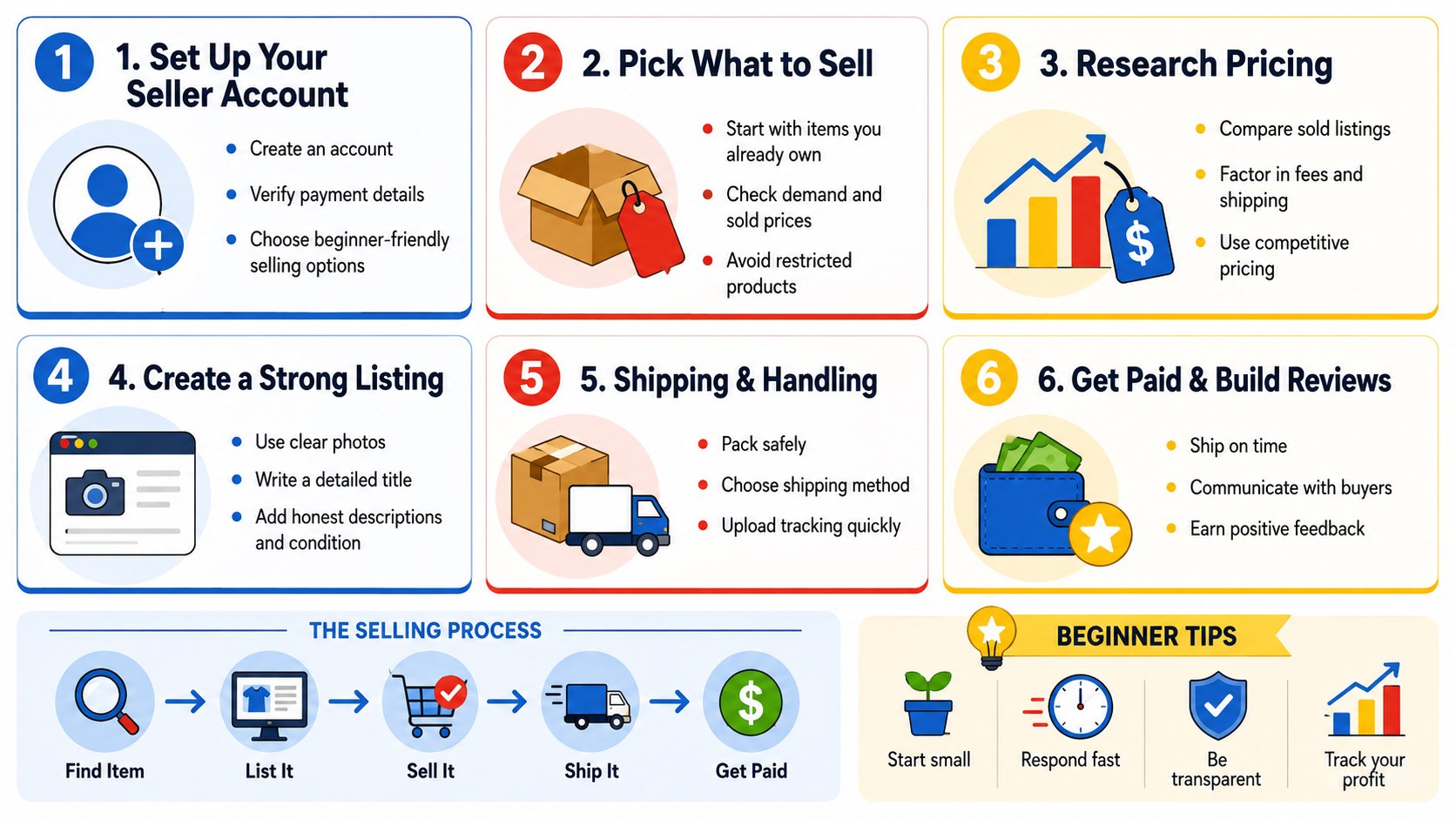
How to sell on eBay for beginners 2026 begins with 3 decisions: what to list, what buyers actually pay, and how much shipping will cost. You can prepare a first listing in 30–60 minutes by researching completed sales, photographing the real item, and measuring the packed parcel before publication, as noted by the Baltimore Chronicle.
You do not need an eBay Store, commercial warehouse, or professional camera. A verified seller account, clear photographs, accurate measurements, packaging supplies, and a reliable shipping plan are enough to begin.
Key takeaways
- Use completed sales to set a realistic price instead of copying expensive listings that have not sold.
- Weigh and measure the finished parcel because box dimensions can materially change UPS, FedEx, or USPS charges.
- Describe every defect, retain shipping records, and calculate fees before accepting an offer from a buyer.
What you need to start selling on eBay
Prepare the basic tools before opening the listing form. This prevents unfinished drafts, incorrect shipping quotes, and descriptions written from memory.
- An eBay account with a verified name, address, phone number, and payout method
- A checking account or another payment method accepted by eBay
- A smartphone with a clean camera lens
- A digital shipping scale with a suitable weight limit
- A tape measure for package dimensions
- Boxes, poly mailers, tape, bubble wrap, and protective filler
- The product’s brand, model, size, condition, and serial information
- A spreadsheet for recording cost, fees, postage, refunds, and profit
A basic postal scale commonly costs about $20–$35 in 2026. Packaging costs depend on the product, although clean boxes from Amazon, Target, or Walmart can often be reused.
Remove every old label and barcode before shipping. Reinforce worn seams and avoid boxes damaged by moisture, oil, or crushing.
Do not order 500 mailers before making your first sale. List several items first, then buy the package sizes you use most frequently.
Step 1: Create and verify your eBay seller account
Sign into an existing eBay account or create a new one. Enter your legal name, residential or business address, phone number, tax information, and payout details.
Verification matters because inconsistent personal or banking information may delay payouts. A common mistake is using a nickname that does not match the name connected to the bank account.
New sellers may receive account-specific limits on active listings or total sales. Review Seller Hub before buying inventory or preparing dozens of products.
eBay can review and adjust limits as the account develops. Do not attempt to bypass a restriction by opening duplicate accounts with conflicting details.
Step 2: Research completed sales and choose an item
Search eBay for the exact product, then filter the results to sold or completed listings. Compare the model, generation, color, size, condition, accessories, and packaging.
An unlocked Apple iPhone usually has a different resale value from a carrier-locked device. Nike Air Jordan shoes may also sell differently when the original box, tags, or receipt are included.
This step reveals what buyers have paid, not what other sellers hope to receive. The most common beginner mistake is copying the highest active price from an item that has remained unsold.
Use this calculation before listing:
Expected sale price − eBay fees − shipping − packaging − purchase cost = estimated profit.
A $50 sale is not automatically a $50 return. Platform charges, postage, promoted listing costs, packaging, and refunds can reduce the payout significantly.
Readers comparing online marketplaces can also review the Baltimore Chronicle guide on how to sell on Amazon as a beginner in 2026. It explains account setup, inventory planning, seller fees, and fulfillment choices.
Step 3: Inspect, clean, and test the product
Clean the product with materials that will not damage its finish. Test every function that a reasonable buyer would expect to work.
For electronics, check charging, speakers, cameras, Wi-Fi, buttons, ports, display condition, and battery behavior. Remove personal accounts, disable activation locks, and perform a factory reset.
Record model numbers, serial numbers, or identifying marks before shipment. This can help when a returned product appears different from the item originally sent.
Document scratches, stains, cracks, missing pieces, odors, repaired areas, and damaged packaging. Hiding a flaw may produce a quick sale, but it also increases the risk of a return or buyer-protection claim.
Never describe an untested product as fully operational. Use “untested,” “for parts,” or another accurate condition when you cannot verify performance.
Step 4: Take photographs that answer buyer questions
Place the product near a window against a plain background. Use indirect daylight, clean the camera lens, and avoid digital zoom.
The first image should show the complete item without unrelated objects. Additional images should document labels, measurements, accessories, packaging, and every visible defect.
Good photographs reduce uncertainty because buyers cannot inspect the item in person. A frequent mistake is using only manufacturer photographs for a used product.
- Photograph the front, back, sides, top, and bottom.
- Capture the model number and identifying labels.
- Show size measurements beside a ruler or tape measure.
- Include every cable, manual, case, or accessory in the sale.
- Photograph scratches and damage under clear light.
- Remove personal documents, addresses, and reflections from the frame.
- Check each image at full size before uploading it.
Use a consistent background when listing several products. A uniform catalog makes the seller profile easier to browse and visually more credible.
Do not apply filters that change the item’s actual color. A buyer ordering a navy jacket should not receive a product that appeared black in edited photographs.
Photograph expensive items immediately before packing. These final images can document condition, included accessories, and the serial number.
Step 5: Write a searchable and accurate listing
Build the title around information buyers type into search. Start with the brand and product, then add the model, size, color, material, or condition.
A useful title could read: “Levi’s 501 Men’s Jeans 34×32 Dark Wash Button Fly Pre-Owned.” It tells the buyer more than “Great Designer Jeans Must See.”
Avoid decorative symbols, repeated words, unsupported claims, and unrelated brand names. Keyword stuffing makes the title harder to read and may attract the wrong audience.
What the description should include
Describe the exact item shown in the photographs. State what works, what is damaged, what is included, and how measurements were taken.
- Exact condition and visible wear
- Product measurements or technical specifications
- Included and missing accessories
- Testing completed before listing
- Compatibility restrictions
- Handling time and return terms
Complete eBay’s item-specific fields whenever the information is known. Buyers often filter results by brand, size, style, storage capacity, compatibility, or color.
Do not guess a technical specification to complete the form. An incorrect model year, storage capacity, or shoe size can create an “item not as described” claim.
Repeat essential details from the photographs in the written description. Some buyers will not study every image before purchasing.
Step 6: Set the price and choose a selling format
Use Buy It Now when completed sales show a stable market value. Consider an auction when the product is scarce, collectible, or likely to attract several motivated bidders.
Most beginners should price near the middle of comparable sold listings. Enable Best Offer only when there is enough margin to negotiate.
The options below suit different products and shipping risks.
| Option | Best use | Main risk |
|---|---|---|
| Buy It Now | Common goods with predictable market prices | An excessive price may prevent a sale |
| Best Offer | Products with room for negotiation | Repeated low offers can waste time |
| Auction | Rare products with active buyer demand | Weak bidding can produce a low final price |
| Free shipping | Small parcels with predictable nationwide costs | Long-distance postage may reduce profit |
| Calculated shipping | Heavy, large, or unusually shaped parcels | Incorrect measurements generate a wrong quote |
eBay charges an insertion fee in some situations and a final value fee after a sale. Many casual sellers receive a monthly allowance of zero-insertion-fee listings.
For many categories, the standard final value fee can be around 13.6% of the total sale amount, plus a fixed per-order charge. However, percentages and thresholds differ by category, subscription, item price, and seller status.
The total sale amount may include the item price, shipping charged to the buyer, sales tax, and certain other amounts. Optional upgrades and promoted listings can add further expenses.
Check the current official eBay selling fee schedule before listing expensive electronics, jewelry, handbags, collectibles, or vehicle parts.
Do not assume every category carries the same percentage. Athletic shoes priced above a threshold, guitars, watches, and trading cards can follow different fee structures.
Step 7: Calculate shipping before publishing
Pack the item exactly as you would after a sale. Weigh the complete parcel and measure its exterior length, width, and height.
This matters because UPS, FedEx, and USPS charges may depend on weight, dimensions, distance, and service. A large lightweight box can cost more than expected because of dimensional pricing.
A common error is weighing only the product. Bubble wrap, cardboard, filler, tape, and accessories can push the parcel into a higher rate.
Use calculated shipping for heavy, oversized, or long-distance products. Flat-rate or free shipping can work for small parcels with predictable costs.
A seller in Maryland may pay less to ship a 2 lb parcel to Pennsylvania than to California. Check several distant ZIP codes before including “free” shipping in the sale price.
Choose a handling period you can meet consistently. A 1-business-day promise only helps when the parcel actually reaches the carrier on time.
Step 8: Pack the order and upload tracking
After payment, compare the order details with the correct product. Inspect the item again before sealing the parcel.
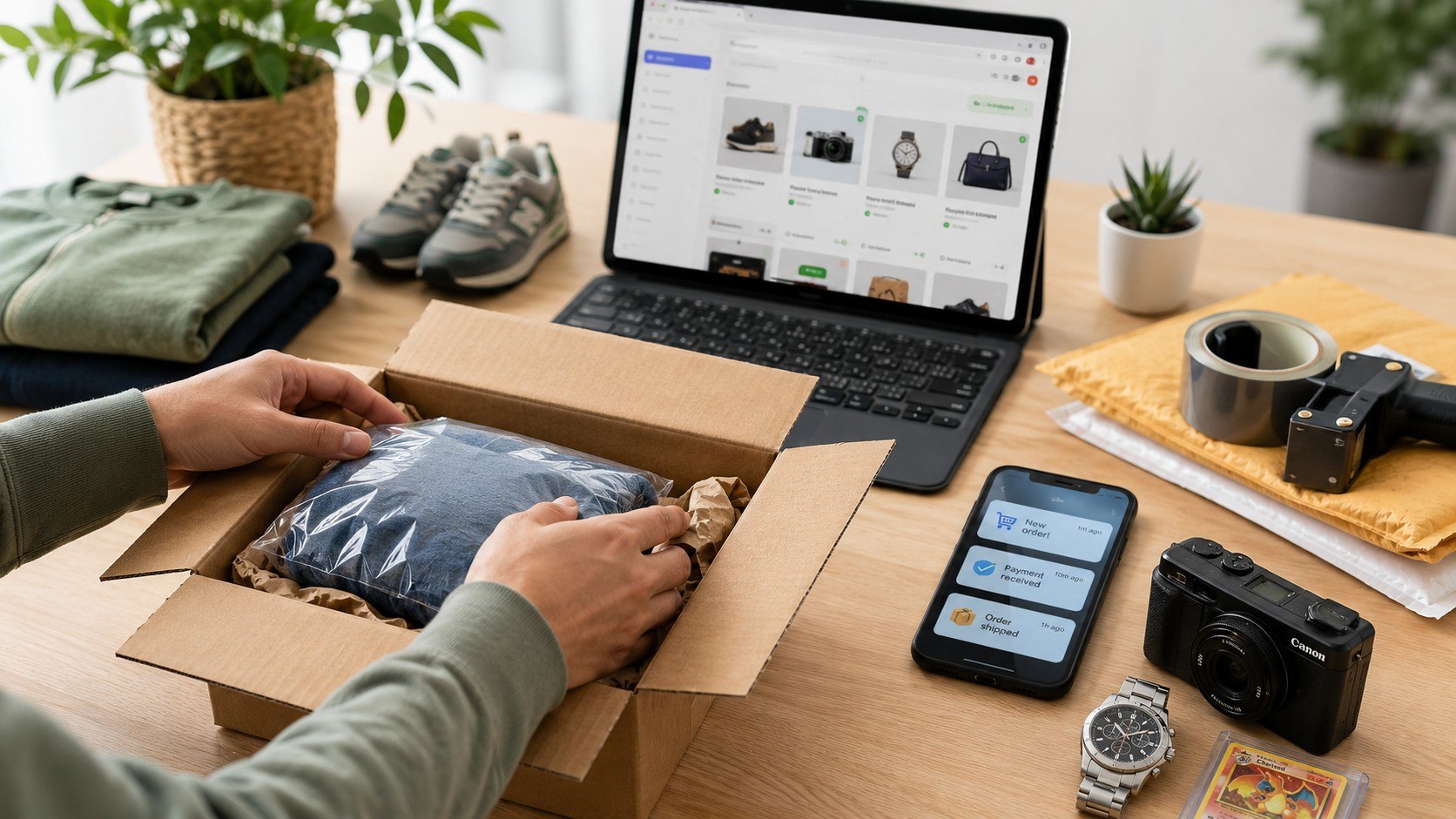
Protect corners, screens, handles, and fragile components. Fill empty space so the product cannot move when the box is shaken gently.
Place the shipping label on a flat, visible surface. Remove or cover every old address label and barcode.
Tracking is essential because it records carrier acceptance, transit, and delivery. Do not mark a parcel shipped while it remains at home for another day.
Retain the carrier receipt until delivery. For expensive products, compare the price of insurance and signature confirmation with the potential loss.
Do not use a thin poly mailer for a rigid or fragile product. A few dollars saved on packaging can lead to a damaged item and a complete refund.
Step 9: Manage messages, returns, payouts, and records
Keep buyer communication inside eBay. Requests to continue by text, email, check, wire transfer, or an outside payment service should be treated cautiously.
Respond to legitimate questions with specific details. Measure the item again when necessary instead of giving an estimate that may later be disputed.
If a return is opened, follow the deadlines shown in the case. Compare the returned item with your photographs, serial numbers, and condition records.
Track purchase cost, postage, platform charges, refunds, packaging, and payout amounts. A seller can generate substantial revenue while earning little actual profit.
Separate revenue from taxable profit
In 2026, an online marketplace generally must issue Form 1099-K when qualifying payments exceed $20,000 and involve more than 200 transactions. A marketplace may still provide the form below that federal threshold.
The form reports gross payments rather than net profit. It may not subtract eBay fees, shipping labels, refunds, packaging, or the original cost of inventory.
Receiving no Form 1099-K does not make taxable profit disappear. Income from business activity and personal property sold at a gain may still require reporting.
The Baltimore Chronicle guide on how to file taxes for free in the USA in 2026 explains IRS Free File, Schedule C, volunteer assistance, and basic record preparation.
Sellers who also receive business payments through mobile platforms can read how to report Cash App payments on taxes in 2026. The guide distinguishes business income from gifts, reimbursements, and shared personal expenses.
Review the current IRS Form 1099-K guidance before filing. Keep receipts and transaction records even when the marketplace does not issue a form.
Troubleshooting common eBay selling problems
Most early problems come from pricing, weak listing data, incorrect parcel measurements, or unrealistic handling promises. Review the likely cause before deleting and rebuilding the listing.
- No impressions or views: check the category, title, item specifics, product demand, and first image.
- Views without a sale: compare the total buyer cost with recently completed listings.
- Unexpected shipping charges: verify packed weight, dimensions, destination, and selected carrier service.
- Listing cannot be published: check account verification, category restrictions, and selling limits.
- Too many returns: improve measurements, testing details, condition descriptions, and defect photographs.
Change one major variable at a time. Replacing the title, price, photographs, and shipping policy together makes it difficult to identify the real problem.
Common products may show results within several days. Rare collectibles often require more time because fewer people search for them.
Do not keep relisting an item indefinitely without checking demand. Storage space, packaging, and attention also carry a cost.
Remove products that generate repeated questions but no serious offers. The item may be overpriced, poorly explained, or listed in the wrong category.
Review seller performance regularly. Late shipment rates, unresolved cases, and inaccurate descriptions can damage account visibility and buyer confidence.
FAQ
How much does it cost to start selling on eBay in 2026?
You can begin without an eBay Store subscription. A basic scale may cost $20–$35, while boxes, tape, labels, and protective packaging create additional expenses.
What are the easiest items to sell on eBay?
Branded clothing, replacement parts, books, collectibles, small electronics, and unused household goods can be manageable. Start with products you can identify, test, price, and pack correctly.
Should a beginner offer free shipping?
Free shipping can work for small, light products with predictable costs. Use calculated shipping for heavy, oversized, or expensive parcels.
Is Buy It Now better than an auction?
Buy It Now is usually safer for products with clear completed-sale prices. Auctions are more suitable for scarce items with several likely bidders.
Can a seller refuse returns?
A seller may select a no-returns policy in eligible categories. However, eBay buyer protection may still apply when an item arrives damaged or differs materially from its listing.
Do eBay sellers have to pay taxes?
Tax treatment depends on whether the seller operates a business or sells personal items at a gain or loss. Keep complete records and consult current IRS and state guidance.
Earlier we wrote about How to Fix a Leaky Faucet Yourself in 2026: Cartridge and Washer Repair