


How to file bankruptcy chapter 7 vs 13 2026 starts with one decision: whether you need debt liquidation or a repayment plan. Chapter 7 often fits people who qualify and have limited nonexempt property, while Chapter 13 can help protect assets and catch up on secured debts, as noted by Baltimore Chronicle.
Chapter 7 usually moves faster and does not require a multi-year repayment plan. Chapter 13 normally lasts 3 to 5 years and requires regular payments through a court-approved plan. Homeowners facing foreclosure, people behind on car payments, and debtors with valuable property often have different priorities than renters with mostly unsecured debt.
Key takeaways
- Chapter 7 focuses on discharging eligible debts, but nonexempt property can potentially be sold by the bankruptcy trustee.
- Chapter 13 lets eligible debtors keep property while making court-supervised payments, usually across 3 to 5 years.
- Both chapters require detailed financial disclosure, credit counseling, court forms, and close attention to federal and state exemption rules.
The choice is not based only on the size of the debt. Income, property equity, mortgage arrears, tax obligations, secured loans, and previous bankruptcy filings can change the analysis.
Someone with $35,000 in credit cards and no valuable nonexempt assets may view Chapter 7 differently from a homeowner who is $18,000 behind on mortgage payments. A freelancer with uneven income may also face a different means-test calculation than a salaried employee.
Bankruptcy is federal law, but exemption rules can depend heavily on the state. California, Texas, Florida, Maryland, New York, and other states can therefore produce different property outcomes.
Consumers still trying to avoid bankruptcy may first compare repayment options in Baltimore Chronicle’s 2026 credit card debt payoff guide. Credit reporting also remains important, especially before major borrowing decisions.
Those reviewing their reports can use the site’s guide to checking a credit score for free in 2026.
At a glance
The practical differences between Chapter 7 vs Chapter 13 bankruptcy become clearer when the filing structure is placed side by side.
| Issue | Chapter 7 | Chapter 13 |
|---|---|---|
| Basic structure | Liquidation bankruptcy | Court-supervised repayment plan |
| Typical duration | Often several months | Usually 3 to 5 years |
| 2026 filing fee | $338 | $313 |
| Means test | Central eligibility issue for many consumer debtors | Used differently when calculating income and plan obligations |
| Property risk | Nonexempt property may be sold | Property can generally be retained if plan requirements are met |
| Mortgage arrears | Does not create a long-term catch-up plan | Can allow arrears to be paid through the plan |
| Regular income | Not required in the same way | Regular income is needed to support plan payments |
| Best-known use | Discharging eligible unsecured debts | Reorganizing debts while keeping property |
The federal court filing fees remain $338 for Chapter 7 and $313 for Chapter 13 in 2026. Filing costs are only part of the total expense. Credit counseling, debtor education, document preparation, and attorney fees can add more.
Attorney pricing varies by location, case complexity, assets, disputes, and local court practice. A straightforward filing in Ohio may cost differently from a contested case in California.
Chapter 13 also creates an ongoing financial commitment. Missing required plan payments can lead to dismissal or other consequences.
The cheaper filing fee does not automatically make Chapter 13 the cheaper case.
The correct comparison is between the complete financial outcomes. That includes property protection, debt treatment, repayment obligations, and the risk of dismissal.
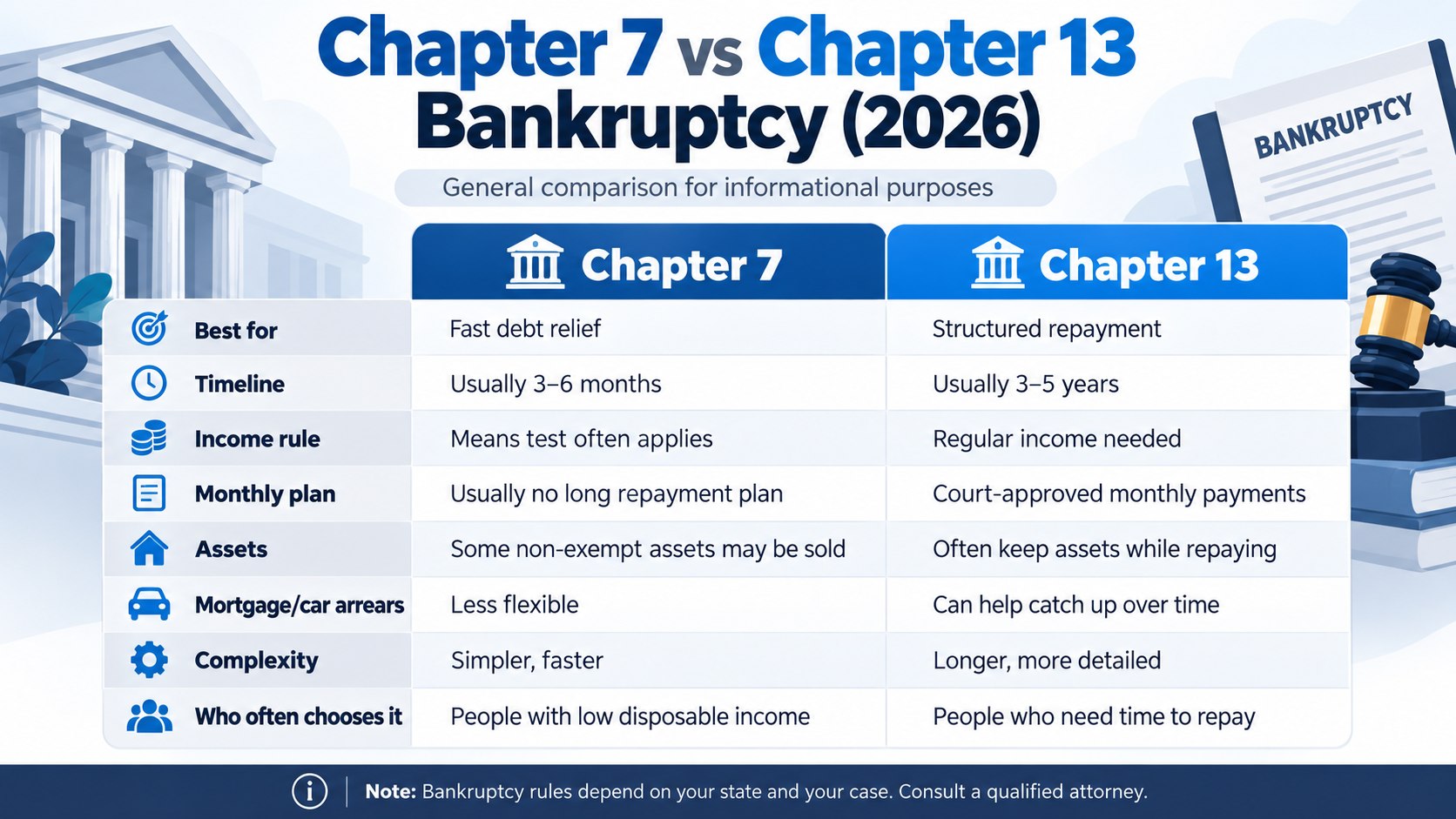
How to file bankruptcy Chapter 7 vs 13 2026
The bankruptcy filing process in 2026 begins before a petition reaches the court. Individual debtors generally must receive approved credit counseling within 180 days before filing, subject to limited exceptions.
A practical filing sequence looks like this:
- List every debt, creditor, asset, bank account, vehicle, property interest, and source of income.
- Complete approved pre-bankruptcy credit counseling and keep the completion certificate.
- Calculate income using the applicable bankruptcy forms and current means-test standards.
- Compare federal and available state exemptions before deciding how property may be treated.
- Select the correct bankruptcy chapter and complete the required schedules and statements.
- File the petition in the correct federal bankruptcy district and pay or address the filing fee.
- Attend the required meeting of creditors and complete the financial management course.
The forms require much more than a current checking balance. Debtors disclose recent income, expenses, property, transfers, debts, leases, contracts, and other financial information.
Leaving out an asset because it seems insignificant can create serious problems. Cryptocurrency, tax refunds, legal claims, inherited interests, business equipment, and jointly owned property may matter.
Bankruptcy courts also expect complete creditor information. A forgotten medical collection or personal loan can complicate notice and discharge questions.
The official forms are standardized nationally, but local filing procedures can differ. Each federal bankruptcy court publishes local rules and filing instructions.
People filing without counsel remain responsible for following those rules. Court clerks can provide procedural information, but they cannot act as personal legal advisers.
For consumers rebuilding after heavy revolving debt, Baltimore Chronicle’s guide to buying a house with damaged credit also illustrates why later financing decisions require careful planning.
Chapter 7 bankruptcy: faster relief with an asset test
Chapter 7 bankruptcy 2026 is commonly associated with unsecured debts such as credit cards, personal loans, and medical bills. A trustee reviews the debtor’s property and can liquidate assets that are not protected by an exemption.
The word “liquidation” can sound more dramatic than the result in every case. Many outcomes depend on exemptions, liens, equity, ownership, and local law.
Chapter 7 does not involve the repayment plan used in Chapter 13.
“Chapter 7 does not involve the filing of a plan of repayment as in chapter 13.”
United States Courts, Bankruptcy Basics, Chapter 7 guidance.
Who usually examines Chapter 7 first
Chapter 7 may warrant close consideration when most debt is unsecured and monthly cash flow cannot support meaningful repayment. It may also fit renters without substantial property equity.
Qualification is not based on debt amount alone. The means test compares income and permitted expenses under rules that depend partly on household size and location.
The U.S. Trustee Program updates allowable expense standards used in bankruptcy calculations. National standards and local housing allowances can affect the result.
A salary that seems modest in one state may interact differently with the means test in another state.
State median income figures also vary considerably. The applicable figures should be checked for the filing date rather than copied from an older calculator.
Chapter 13 bankruptcy: repayment while keeping property
Chapter 13 bankruptcy 2026 is designed for individuals with regular income who can fund a repayment plan. It is often considered by homeowners who need time to cure mortgage arrears.
The U.S. Courts describes Chapter 13 as a process allowing debtors to keep property and repay debts over time. Plans generally last 3 or 5 years, depending on the applicable income rules.
“Chapter 13 allows a debtor to keep property and pay debts over time, usually three to five years.”
United States Courts, Chapter 13 Bankruptcy Basics.
Chapter 13 can also matter when someone owns property that might be exposed in Chapter 7. The debtor must still satisfy the plan rules and make required payments.
Eligibility also depends on applicable debt limits. Secured and unsecured debts are treated separately when determining whether a debtor qualifies for Chapter 13.
A mortgage counts differently from ordinary credit card debt because it is secured by property. Auto loans and other collateral-backed obligations also require separate analysis.
Why regular income matters
A repayment plan cannot work without dependable cash flow. Wages are not the only possible source, but income must support the required payments.
Freelancers, contractors, and small business owners should expect closer attention to variable earnings. Records may include tax returns, bank statements, invoices, and business information.
Chapter 13 can become difficult when monthly income barely covers housing and basic expenses. A plan that fails after repeated missed payments may leave the underlying financial problem unresolved.
Means test, exemptions, and property risk
The Chapter 7 means test is one of the most misunderstood parts of consumer bankruptcy. It does not simply ask whether a person’s salary exceeds one national number.
Median income depends on state and household size. The calculation can then include allowed deductions and other statutory adjustments.
Location matters. Income thresholds differ between California, Arizona, Colorado, Maryland, Texas, and other states. Current filing-date data should always be used.
Property exemptions create another layer. A house with $20,000 of equity can receive different treatment depending on applicable exemption law and existing liens.
The same applies to vehicles, household goods, retirement accounts, jewelry, business equipment, and pending legal claims. Exemption planning should happen before filing documents, not after the trustee raises a question.
Bankruptcy does not erase the distinction between owning an asset and owing money against that asset.

Which should you choose in 2026?
The decision should follow the problem that bankruptcy needs to solve. These simplified lines can help organize the first conversation with a bankruptcy attorney.
- If unsecured debt dominates and the means test is satisfied, examine Chapter 7 eligibility first.
- If foreclosure arrears must be cured over time, Chapter 13 may provide the more relevant structure.
- If valuable nonexempt property is at risk, compare Chapter 13 before assuming Chapter 7 is safer.
- If income cannot support a 3-to-5-year plan, Chapter 13 may be difficult to complete.
- If secured and unsecured debts approach Chapter 13 limits, verify current eligibility before filing.
This framework is not a substitute for reviewing actual schedules and exemptions. Two people with the same $60,000 debt can receive very different answers.
A homeowner in Florida may have different exemption concerns from a renter in Illinois. A married debtor filing alone can also face household-income questions that require careful calculation.
Recent transfers matter as well. Giving away a car or moving money before filing does not necessarily remove it from the bankruptcy analysis.
Taxes, student loans, domestic support obligations, and secured debts can also receive special treatment. A discharge does not automatically eliminate every obligation listed on a petition.
The useful question is therefore not simply whether Chapter 7 or Chapter 13 is “better.” It is which structure matches income, property, arrears, debt type, and the result the debtor needs.
FAQ
Is Chapter 7 better than Chapter 13 in 2026?
Neither chapter is universally better. Chapter 7 can be simpler for eligible debtors seeking discharge without a repayment plan. Chapter 13 can be more useful when property protection or repayment of arrears is central.
How much does it cost to file bankruptcy in 2026?
The federal filing fee is $338 for Chapter 7 and $313 for Chapter 13. Additional costs can include counseling, education, document services, and attorney fees.
Can Chapter 13 stop foreclosure?
Filing can trigger the automatic stay in many cases, while Chapter 13 can provide a structure for curing mortgage arrears. Exceptions and prior filings can affect stay protection.
Do I have to pass a means test for Chapter 7?
Many individual consumer debtors must complete the applicable means-test forms. Income, household size, state median income, and allowed expenses can affect the result.
Can I keep my house in Chapter 7?
Possibly. The answer depends on equity, liens, applicable exemptions, payment status, and the trustee’s analysis.
How long does Chapter 13 last?
Chapter 13 plans usually run 3 to 5 years. A debtor generally must complete required plan payments and other obligations before receiving the applicable discharge.
Earlier we wrote about DHL Lost Package Claim 2026: Who Can File, What Proof You Need and Where to Send It