


How to install an outlet yourself is a manageable 30–60 minute project when you are replacing an existing 120-volt receptacle in a sound electrical box. The job becomes different when you add wiring, relocate a box, or create a new circuit, because permits and licensed-electrician rules may apply, as noted by Baltimore Chronicle.
This guide covers a like-for-like receptacle replacement, including when you need GFCI protection. If the box contains damaged wiring, aluminum conductors, unexplained connections, or no reliable grounding path, stop before disconnecting anything.
Key takeaways
- Replacing an existing outlet can be DIY-friendly, but adding or moving one may require a local electrical permit.
- GFCI protection matters in kitchens, bathrooms, garages, laundry areas, outdoors, and other locations exposed to moisture.
- Never trust the breaker label alone. Switch power off and verify the receptacle is de-energized before touching conductors.
Electrical rules are local. The National Electrical Code provides the technical framework, but states and municipalities decide which edition applies and how it is enforced.
What you need before replacing an electrical outlet
A straightforward DIY outlet installation does not require expensive equipment. A reliable voltage tester matters more than a large collection of tools.
- Non-contact voltage tester
- Phillips and flat-head screwdrivers
- Wire stripper, if conductor ends need correction
- Needle-nose pliers
- Replacement 15-amp or 20-amp receptacle matching the circuit
- GFCI receptacle where required
- New wall plate if the existing plate is cracked
- Flashlight or work light powered separately
- About 30–60 minutes
- Local permit information if you are adding or relocating an outlet
In 2026, an ordinary residential duplex receptacle commonly costs only several dollars. Tamper-resistant models from Leviton, Eaton, Legrand, or GE generally cost more than basic devices.
GFCI pricing is higher. Current major-retailer listings show many 15-amp and 20-amp GFCI devices in roughly the $10–$25-per-unit range, although multipacks can reduce the unit price.
If the existing receptacle is scorched or melted, buying another $5 outlet is not the first task. The damaged connection and circuit need to be identified.
A cheap receptacle is inexpensive to replace. A damaged conductor hidden inside the box is a different problem and should not be treated cosmetically.
Homeowners dealing with broader electrical problems can compare the scope with Baltimore Chronicle’s guide to whole-house rewiring costs in 2026. That distinction helps separate a small device replacement from a wiring-system problem.
Do you need a permit to install an outlet yourself?
There is no single national yes-or-no answer. Permit rules are established by the authority having jurisdiction, often a city, county, or state building department.
A simple replacement in an existing box may be exempt in some jurisdictions. Adding a receptacle, extending wiring, relocating the box, or creating a circuit is more likely to require an electrical permit.
| Project | Typical permit issue | Best first action |
|---|---|---|
| Replace existing receptacle | May be exempt locally | Check local building department rules |
| Replace standard outlet with GFCI | Rules vary | Confirm local requirements and existing wiring |
| Add another outlet | Permit often required | Check before opening walls |
| Move an outlet | Usually involves wiring modification | Confirm permit and inspection rules |
| Add a new branch circuit | Permit commonly required | Use a qualified electrician where required |
| Work inside service panel | Higher-risk regulated work | Use a licensed electrician |
California illustrates how local distinctions matter. Exeter states that moving or adding an electrical outlet requires a permit, while some California jurisdictions exempt individual outlet replacements.
New York City is substantially stricter. The NYC Department of Buildings states that electrical-system installation and modification require a permit and a Licensed Master Electrician.
Maryland homeowners should also check city or county rules rather than assuming a statewide DIY rule. Baltimore City directs electrical permit and inspection questions through its Department of Housing and Community Development.
Renters have another layer to consider. A lease may prohibit electrical alterations even when local code would otherwise permit the work.
Permit requirements can also affect later inspections, insurance documentation, and property sales. Checking before changing wiring is easier than trying to document unpermitted work afterward.
When does an outlet need GFCI protection?
GFCI outlet requirements are especially relevant when electricity and moisture can meet. A ground-fault circuit interrupter disconnects the circuit when it detects a dangerous imbalance in current.
The Electrical Safety Foundation International explains that GFCI protection is used in locations including bathrooms, kitchens, garages, laundry areas, and outdoors. Requirements have expanded through successive NEC editions.
GFCI protection can come from the receptacle itself or from an upstream GFCI device or breaker. Therefore, an ordinary-looking receptacle may already be protected.
Common locations that deserve a GFCI check include:
- Bathrooms
- Kitchens and food-preparation areas
- Garages
- Outdoor receptacles
- Laundry areas
- Basements and crawl spaces covered by applicable code
- Locations near sinks or other wet areas
Exact requirements depend on the code edition adopted locally. See the Electrical Safety Foundation International GFCI guidance for the safety principle and current educational material.
Do not automatically install a GFCI solely because the old outlet has 2 wires. Older ungrounded systems require specific treatment and labeling under applicable electrical rules.
GFCI and AFCI also solve different problems. GFCI primarily addresses shock hazards, while AFCI protection addresses hazardous electrical arcing.
If you are working around finished walls, Baltimore Chronicle’s guide to finding studs without a stud finder explains why outlets can provide framing clues without proving a stud’s exact location.
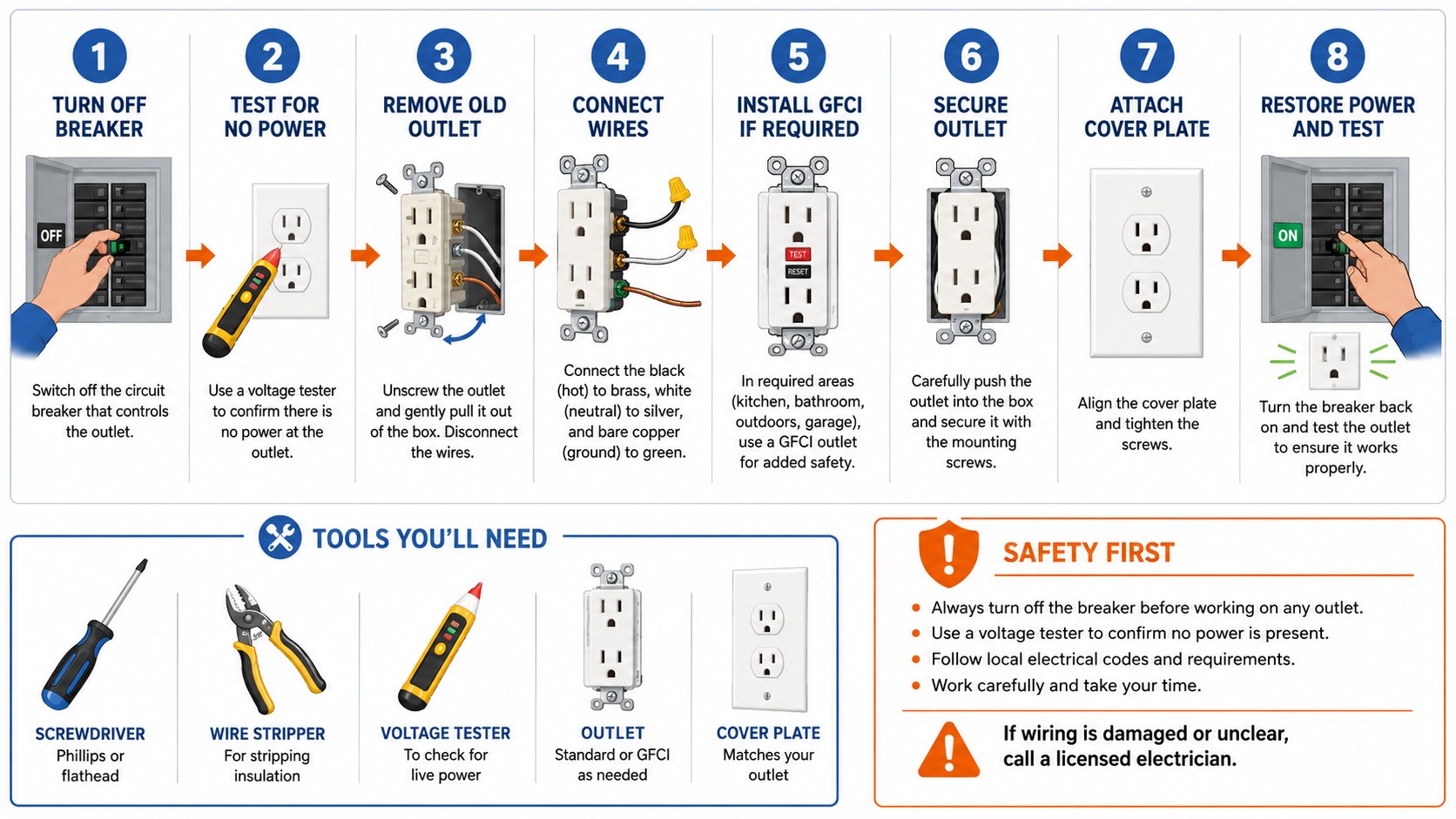
Step 1: Confirm the replacement outlet is compatible
Read the circuit breaker rating and inspect the existing receptacle before buying a replacement. Do not install a device simply because its face fits the wall plate.
Why it matters: receptacle configuration, circuit amperage, grounding, GFCI protection, and tamper-resistance requirements can affect the correct choice. A common mistake is installing a 20-amp-style receptacle without understanding the branch circuit.
Step 2: Shut off the breaker and verify power is off
Turn off the breaker feeding the outlet. Plug in a lamp first if that makes circuit identification easier, then confirm it switches off.
Remove the cover plate only after shutting down the circuit. Verify the outlet and accessible conductors with a suitable voltage tester before touching them.
Why it matters: breaker-panel labels can be wrong after years of remodels. The common mistake is assuming a dead lamp proves every conductor in the box is de-energized.
Treat circuit identification and voltage verification as 2 separate tasks. One tells you what should be off; the other checks what is actually off.
Step 3: Remove the old receptacle without losing the wiring layout
Unscrew the mounting screws and gently pull the receptacle forward. Do not tug on the wires or allow exposed conductors to touch each other.
Before disconnecting anything, take clear photos showing each conductor and terminal. This is especially useful when more than 1 cable enters the box.
Why it matters: a receptacle may also feed downstream devices. The common mistake is disconnecting several wires and assuming their original function will be obvious afterward.
Step 4: Inspect the box, conductors, and grounding
Look for brittle insulation, burn marks, melted plastic, loose splices, corrosion, or damaged conductor ends. Check whether a grounding conductor and approved grounding arrangement are present.
Homes with older wiring require extra attention. Aluminum branch-circuit wiring, cloth-covered conductors, unusual splices, or badly deteriorated insulation are reasons to stop.
Why it matters: replacing the visible receptacle does not repair defective wiring behind it. The common mistake is interpreting discoloration as ordinary aging when it may indicate overheating.
Step 5: Connect the replacement receptacle correctly
Follow the markings and manufacturer instructions supplied with the new device. On conventional receptacles, terminal identification distinguishes grounded, ungrounded, and equipment-grounding connections.
If replacing a GFCI, identify LINE and LOAD correctly. A basic replacement may require only LINE connections, while LOAD terminals can provide downstream GFCI protection when intentionally configured.
Why it matters: reversing or misusing terminals can prevent proper protection. A common mistake is copying wire positions without checking whether the old device was installed correctly.
Do not place multiple conductors under a terminal unless the device is specifically listed for that connection method. Avoid loose loops and exposed copper beyond the terminal area.
Step 6: Reinstall the outlet and test it
Fold the conductors carefully into the box without sharply kinking them. Mount the receptacle straight, reinstall the wall plate, then restore the breaker.
Test both receptacle openings. For a GFCI, use its TEST and RESET controls according to the manufacturer’s procedure.
Why it matters: successful power restoration does not prove the installation is correct. The common mistake is declaring success immediately because a lamp turns on.
If the receptacle is loose in the wall, fix the mounting problem rather than tightening the plate excessively. A wall plate is a cover, not structural support.
For another household electrical-control project, Baltimore Chronicle also covers installing a smart thermostat yourself, including wiring identification and situations where DIY work should stop.

Troubleshooting after replacing an electrical outlet
If the outlet does not behave normally after power returns, switch the circuit off again before investigating. Repeatedly resetting a breaker is not a diagnostic method.
- No power: check the breaker, upstream GFCI, connections, and whether the correct circuit was restored.
- GFCI will not reset: confirm power is present and review LINE versus LOAD connections.
- Breaker trips immediately: switch it off and stop troubleshooting energized wiring.
- Outlet feels warm: unplug loads and investigate the circuit rather than assuming warmth is normal.
- Lights flicker elsewhere: stop and check for a disturbed or loose connection in the box.
A newly installed receptacle should not buzz, smell burned, spark repeatedly, or become hot under ordinary loads. Those symptoms justify shutting off the breaker.
An outlet tester can identify several common wiring conditions, but it cannot prove every installation is safe. It does not replace inspection of connections and conductor condition.
Problems involving several rooms can indicate something beyond the individual receptacle. That may include an upstream splice, failed GFCI, loose neutral, damaged circuit, or breaker problem.
Do not increase breaker size because a circuit trips. The breaker must match the permitted circuit conductors and equipment.
A failed DIY replacement should not become an escalating experiment. If the wiring no longer matches the expected layout, document it and call an electrician.
FAQ about how to install an outlet yourself
Can I legally replace an electrical outlet myself?
In many US jurisdictions, homeowners can perform some work on their own property. The scope and permit exemptions differ substantially. New York City, for example, imposes much stricter licensing requirements than many other jurisdictions.
Do I need a permit just to replace an existing outlet?
Not everywhere. Some jurisdictions exempt a like-for-like receptacle replacement, while adding or relocating outlets requires a permit. Verify the 2026 rules with your local authority having jurisdiction.
Can I replace a normal outlet with a GFCI outlet?
Often yes, provided the installation is compatible and completed correctly. GFCI devices have specific LINE and LOAD terminals, so the manufacturer’s wiring instructions must be followed.
How much does it cost to replace an outlet yourself in 2026?
A standard receptacle can cost only several dollars. A GFCI commonly falls around $10–$25 per unit at major US retailers, with brand, rating, features, and multipacks affecting the price.
How long does it take to replace an electrical outlet?
A straightforward replacement usually takes about 30–60 minutes for someone familiar with basic household electrical work. Damaged wiring, crowded boxes, or unclear circuits can extend the job considerably.
When should I call an electrician instead?
Stop for damaged insulation, aluminum wiring you cannot properly identify, overheating, missing grounding, repeated breaker trips, panel work, or confusing multi-wire connections. Adding circuits also commonly enters permit territory.
Earlier we wrote about Is a Self-Cleaning Oven Safe to Use in 2026? Risks, Heat and Safety Rules