

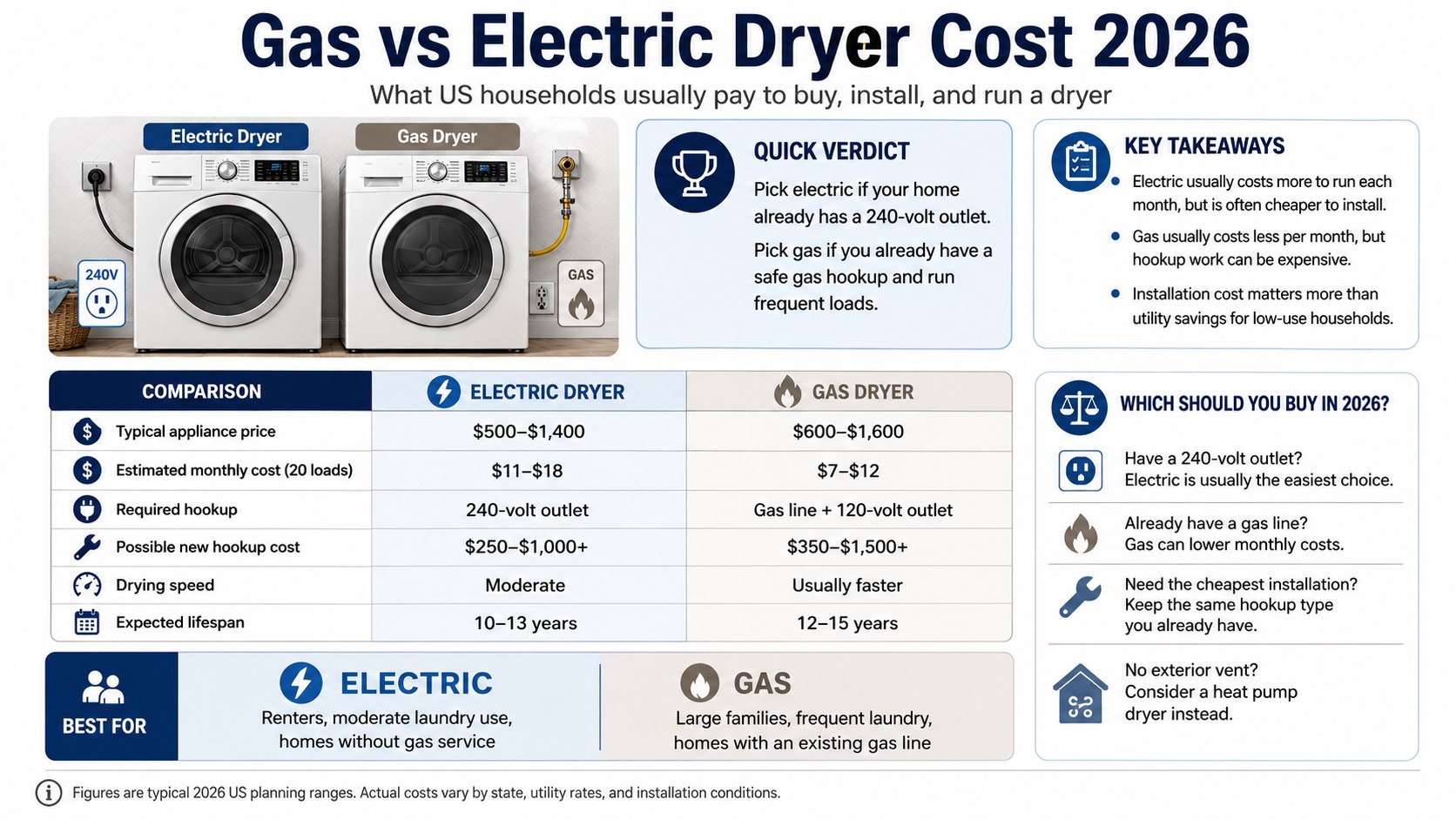
Gas vs electric dryer cost 2026 comparisons favor an electric dryer when a home already has a 240-volt outlet. A gas dryer can cost less each month, but it is usually worthwhile only when an approved gas connection already exists, as the Baltimore Chronicle editorial team notes.
For a household drying about 20 loads monthly, a standard electric model may cost roughly $11–$18 to operate. A gas dryer may cost about $7–$12, including the electricity needed for its motor and controls. Buyers without the correct hookup should focus on installation costs because a new circuit or gas line can erase years of utility savings.
Key takeaways
- Choose electric when a compliant 240-volt outlet exists and the household dries fewer than 20 loads monthly.
- Choose gas when the laundry room has an approved line and the household needs fast, frequent drying.
- Consider a heat pump dryer when electricity is expensive, exterior venting is unavailable, or clothing care matters most.
At a glance
The sticker price does not reveal the full cost of a dryer. Buyers must also consider the hookup, utility rates, maintenance, drying speed, venting, and expected ownership period.
| Cost or feature | Electric dryer | Gas dryer | Heat pump dryer |
|---|---|---|---|
| Typical appliance price | $500–$1,400 | $600–$1,600 | $900–$2,200 |
| Estimated cost for 20 loads monthly | $11–$18 | $7–$12 | $4–$9 |
| Required connection | Usually 240-volt outlet | Gas line and 120-volt outlet | 120- or 240-volt outlet |
| Possible new hookup cost | $250–$1,000 or more | $350–$1,500 or more | Usually limited electrical work |
| Exterior vent required | Yes for standard models | Yes | Usually no |
| Drying speed | Moderate | Usually fastest | Usually slower |
| Expected lifespan | About 10–13 years | About 12–15 years | About 10–15 years |
| Repair complexity | Low to moderate | Moderate | Moderate to high |
| Best fit | Homes with an existing 240-volt outlet | Frequent users with an existing gas line | Ventless spaces and high-rate states |
These figures are planning ranges rather than contractor quotes. Labor prices can differ sharply between Baltimore, Boston, Houston, Seattle, and smaller rural communities.
An older electrical panel may turn a simple dryer installation into a larger upgrade. A gas installation may require permits, pressure testing, a new shutoff valve, and wall access.
Renters should not change fuel types without written approval. Property owners may restrict gas appliances or electrical modifications because of insurance and building rules.
Delivery charges, removal fees, stacking kits, cords, vent kits, and gas connectors may also be sold separately. A low advertised price can therefore produce a much higher final invoice.
The safest comparison uses the complete installed cost. Buyers should request written estimates before ordering a model that requires a different connection.
Gas vs electric dryer cost 2026: monthly running expense
The US Energy Information Administration expects average residential electricity prices to remain near 18 cents per kilowatt-hour in 2026. Actual rates vary by state, utility, season, and time-of-use plan.
A conventional electric dryer commonly uses about 3–5 kilowatt-hours per load. At $0.18 per kilowatt-hour, 20 loads may cost around $11–$18 monthly. Heavy towels, bedding, repeated cycles, and clogged vents can push the bill higher.
A gas dryer may use roughly 0.20–0.30 therm per load. It also draws electricity for the drum, fan, ignition, sensors, and control board. Under representative 2026 rates, the combined monthly expense often falls near $7–$12.
Local utility prices matter more than national averages. Electricity is generally expensive in Hawaii, California, Massachusetts, Connecticut, and parts of New York. It can be substantially cheaper in Washington, North Dakota, Nebraska, and several Southern states.
Use this process to estimate the dryer operating cost for a specific home:
- Find the dryer’s annual consumption on its EnergyGuide label.
- Check the latest electricity or gas rate on the utility bill.
- Count the household’s average loads during a normal month.
- Adjust for large loads, high heat, timed cycles, and repeated drying.
- Add any gas customer charge created by opening a new account.
- Compare annual costs across the expected ownership period.
EnergyGuide estimates use standardized testing conditions. Real households may sort clothing differently, select hotter cycles, or open the door before a cycle finishes.
A gas customer charge deserves special attention. It should not be assigned entirely to the dryer when gas also serves the furnace, water heater, or stove.
However, opening gas service only for one appliance may add a fixed monthly fee. That expense can eliminate the apparent fuel savings.
Time-of-use electricity plans can change the calculation. An electric dryer may cost less when it runs during overnight or off-peak hours.
Always use the household’s latest bill rather than an online national average. Utility rates can change during 2026.
Electric dryers: simpler for most existing laundry rooms
An electric dryer is usually the practical choice when the laundry room already has a compliant 240-volt receptacle. Full-size models from Whirlpool, GE, Maytag, LG, Samsung, Electrolux, and Frigidaire commonly use this connection.
Advantages of an electric dryer
- Lower starting prices across many entry-level product lines.
- No combustion process or gas connector inside the appliance.
- More choices among full-size, compact, smart, and stackable models.
- Wider repair availability in many US communities.
- No separate gas account or monthly gas service charge.
Electric models are easy to compare across retailers. Their basic heating system also makes common repairs more predictable.
Typical failures include heating elements, belts, rollers, thermal fuses, sensors, and thermostats. Parts availability depends on the brand and model age.
The main disadvantage is energy use. Resistance heating requires substantial electricity, especially when drying towels, jeans, comforters, and oversized loads.
An electric dryer also becomes expensive when the correct circuit is missing. A licensed electrician may need to install wiring, a double-pole breaker, and a 4-prong receptacle.
Older homes may still have 3-prong dryer outlets. Buyers should not assume that a new machine includes the correct cord because retailers often sell cords separately.
The washer can reduce dryer costs by removing more water during its final spin. Buyers replacing both appliances can compare capacity, water use, cleaning performance, and stackable layouts in Baltimore Chronicle’s top load vs front load washer comparison for 2026.
Who should buy an electric dryer?
Electric is ideal for renters, moderate-use households, and homes without natural gas. It also suits buyers who want a lower purchase price and simpler repair access.
Gas dryers: lower monthly bills with higher hookup stakes
A gas dryer produces heat by burning natural gas or propane. Electricity still powers its motor, controls, fan, ignition system, sensors, and interior light.
Advantages of a gas dryer
- Lower operating costs in many natural-gas markets.
- Fast heating and shorter cycles for dense fabrics.
- Less demand on the home’s electrical panel.
- Strong value for families completing frequent loads.
- Good performance when drying towels, bedding, and work clothing.
Gas heat reaches operating temperature quickly. Shorter cycles may help a large household complete several loads during one evening.
The financial advantage is strongest when the laundry room already has a compliant gas connection. In that case, the appliance’s price premium may be recovered through lower monthly bills.
Installation becomes the central problem when no line exists. The work may require a licensed plumber, permit fees, pressure testing, wall access, and a new shutoff valve.
Gas dryers also need an approved metal exhaust path. The vent carries moisture and combustion gases outside, so a damaged or restricted duct creates serious safety concerns.
A $5 monthly saving does not justify a $1,000 conversion for most households. Recovering that expense would take about 200 months before considering maintenance or financing.
Propane users must verify whether a conversion kit is available. Installation and burner adjustment should follow the manufacturer’s instructions.
Who should buy a gas dryer?
Gas works best for owner-occupied homes with an existing line and frequent laundry use. It also suits properties where adding a large electrical load would require panel work.
Heat pump dryers: the efficient third option
A heat pump dryer recirculates heated air instead of continuously exhausting it. ENERGY STAR states that certified heat pump models can use far less energy than conventional dryers.
These appliances deserve attention in California, Hawaii, New England, and other high-electricity-cost markets. They are also useful in condos or interior laundry closets without an exterior vent.
A heat pump dryer works at lower temperatures. That treatment can reduce stress on elastic, synthetic fabrics, printed shirts, and delicate clothing.
The tradeoffs are purchase price and cycle length. Some loads take longer, while filters and heat-exchanger surfaces require regular cleaning.
Compact capacity can also be a limitation. Buyers should compare drum volume with their washer and confirm that bedding will fit comfortably.
Some state or utility programs may offer rebates for qualifying equipment in 2026. Eligibility, funding, income limits, and covered models vary, so buyers should verify terms before ordering.
Hookup costs can reverse the result
The cheapest energy source does not always produce the lowest ownership cost. Existing infrastructure should lead the buying decision.
Replacing a dryer with the same fuel type is usually straightforward. The installer must still inspect the outlet, shutoff valve, vent route, clearances, and connection condition.
Switching from electric to gas may require plumbing work and permits. Switching from gas to electric may require a dedicated 240-volt circuit and electrical panel capacity.
Check these items before purchasing:
- Measure doors, hallways, stairs, appliance depth, width, and height.
- Confirm whether the dryer outlet has 3 prongs or 4 prongs.
- Find the gas shutoff valve and check whether it remains accessible.
- Measure the exhaust route and count every elbow.
- Ask whether the quoted price includes a cord or gas connector.
- Confirm whether removal, stacking, permits, and delivery cost extra.
- Check the manufacturer’s required rear and side clearances.
- Request written electrical or plumbing estimates before ordering.
A long vent route can slow drying and collect lint. Each elbow increases resistance, so the manufacturer’s maximum duct length should guide installation.
Flexible plastic ducting should not replace an approved metal dryer vent. The duct should also remain accessible for inspection and cleaning.
Stacked appliances require a compatible stacking kit. Similar width does not guarantee that 2 models can be safely combined.
Compact ventless dryers may need a drain connection or condensate container. Buyers should confirm that routine maintenance remains practical after installation.
A written quote should separate labor, materials, permits, disposal, and appliance accessories. This makes competing offers easier to compare.
How washer habits change dryer costs
The dryer is only one part of the laundry system. A washer with a strong final spin can remove more water before each load enters the dryer.
Overloading the washer can produce the opposite result. Clothing may remain wetter because water cannot leave the fabric efficiently.
Detergent residue also matters. Excess soap can trap moisture, create odors, and make fabrics harder to rinse and dry.
Sensor drying usually costs less than fixed timed drying. The machine stops when clothing reaches the selected moisture level instead of running for an arbitrary period.
Households can reduce total laundry costs by using correct load sizes, maintaining the washer, and selecting suitable cycles. Baltimore Chronicle explains these steps in its guide on how to use a washing machine properly and save energy.
Clean the dryer’s lint screen after every load. A blocked screen restricts airflow and forces the appliance to run longer.
The full exhaust duct should also be inspected regularly. Slow drying, excessive heat, or a burning smell requires immediate attention.
Which should you buy in 2026?
The best dryer follows the property’s existing connections, expected usage, and local utility prices. No fuel type wins in every home.
- If a 240-volt outlet already exists, choose electric for the lowest installation risk.
- If an approved gas line already exists, choose gas for frequent loads and faster drying.
- If neither connection exists, compare full contractor quotes before selecting a fuel.
- If exterior venting is impossible, price a ventless heat pump dryer.
- If electricity is expensive, compare 10-year heat pump savings with the higher purchase price.
A household running 8–12 loads monthly will usually save little by converting fuel types. Installation cost will dominate the decision.
A family completing 30–40 loads may recover a modest gas price premium faster. A heat pump model may produce greater savings where electricity rates are high.
Renters should normally match the existing connection. Owners planning a renovation have more freedom because wiring, plumbing, and venting can be addressed before walls close.
EnergyGuide labels should only be compared across products with similar size and features. The same ownership-cost principle applies to other major appliances. Baltimore Chronicle’s guide to the best refrigerator brands in the USA for 2026 explains how reliability, repair access, efficiency, and purchase price affect long-term value.
Repair availability should be checked before buying a specialized model. High efficiency provides limited value when parts are scarce or technicians must travel several hours.
FAQ
Is a gas dryer cheaper to run than an electric dryer in 2026?
Usually, yes. A gas dryer may save roughly $4–$9 monthly under common rates and usage. Local prices and fixed gas charges can reverse the result.
How much does an electric dryer cost per month?
A conventional electric dryer may cost about $11–$18 monthly for 20 loads. Electricity rates, load weight, vent condition, and cycle settings affect the total.
Does a gas dryer work during a power outage?
No. A gas dryer still needs electricity for ignition, controls, airflow, and drum movement. A normal power outage stops both dryer types.
Can a gas dryer use a regular electrical outlet?
Most gas dryers use a standard 120-volt outlet. They also require an approved gas line, shutoff valve, connector, and exterior exhaust duct.
Is converting from electric to gas worthwhile?
Usually not for light laundry use. An expensive new gas line can take many years to recover through lower operating costs.
Which dryer type lasts longest?
Gas models sometimes remain in service longer, but maintenance matters more than fuel. Clean venting, correct loading, and timely repairs extend every dryer’s life.
Earlier we wrote about Venmo Tax Rules 2026: Form 1099-K, Schedule C and Personal Transfers