


How to report Venmo income on taxes 2026 starts with one question: why did you receive the payment? Money from clients, customers, tenants, or profitable sales may be taxable. Gifts, reimbursements, and transfers between your accounts usually are not, as the Baltimore Chronicle editorial team notes.
You can organize a simple Venmo account in about 30–60 minutes. Download the transaction history, separate personal and business payments, then compare the totals with every tax form received. Report taxable income once, deduct eligible expenses separately, and keep evidence for excluded payments.
Key takeaways
- Venmo does not determine whether money is taxable. The payment’s purpose determines its federal tax treatment.
- Business income remains reportable even when Venmo does not send you Form 1099-K.
- Form 1099-K shows gross payments before fees, refunds, chargebacks, and most business expenses.
What you need before reviewing your Venmo income
Collect your documents before opening tax software. Complete records help prevent duplicate reporting and unsupported deductions.
- Your full Venmo transaction history for the relevant calendar year
- Every Form 1099-K, 1099-NEC, and 1099-MISC you received
- Client invoices, contracts, receipts, and payment confirmations
- Bank statements connected to your Venmo account
- Refund, chargeback, and disputed-payment records
- Purchase receipts for personal property sold through Venmo
- Receipts for platform fees and other business expenses
- Tax software or contact details for a qualified tax professional
Download the complete history instead of using recent app activity. Save an untouched copy before categorizing anything. Create another working copy for notes and calculations.
For every incoming payment, record the sender, amount, date, purpose, and supporting document. Mark unclear transactions for follow-up. Do not classify them from memory alone.
A separate business profile can simplify future recordkeeping. However, account labels do not override the facts. The IRS considers why you received the money, not how Venmo displayed it.
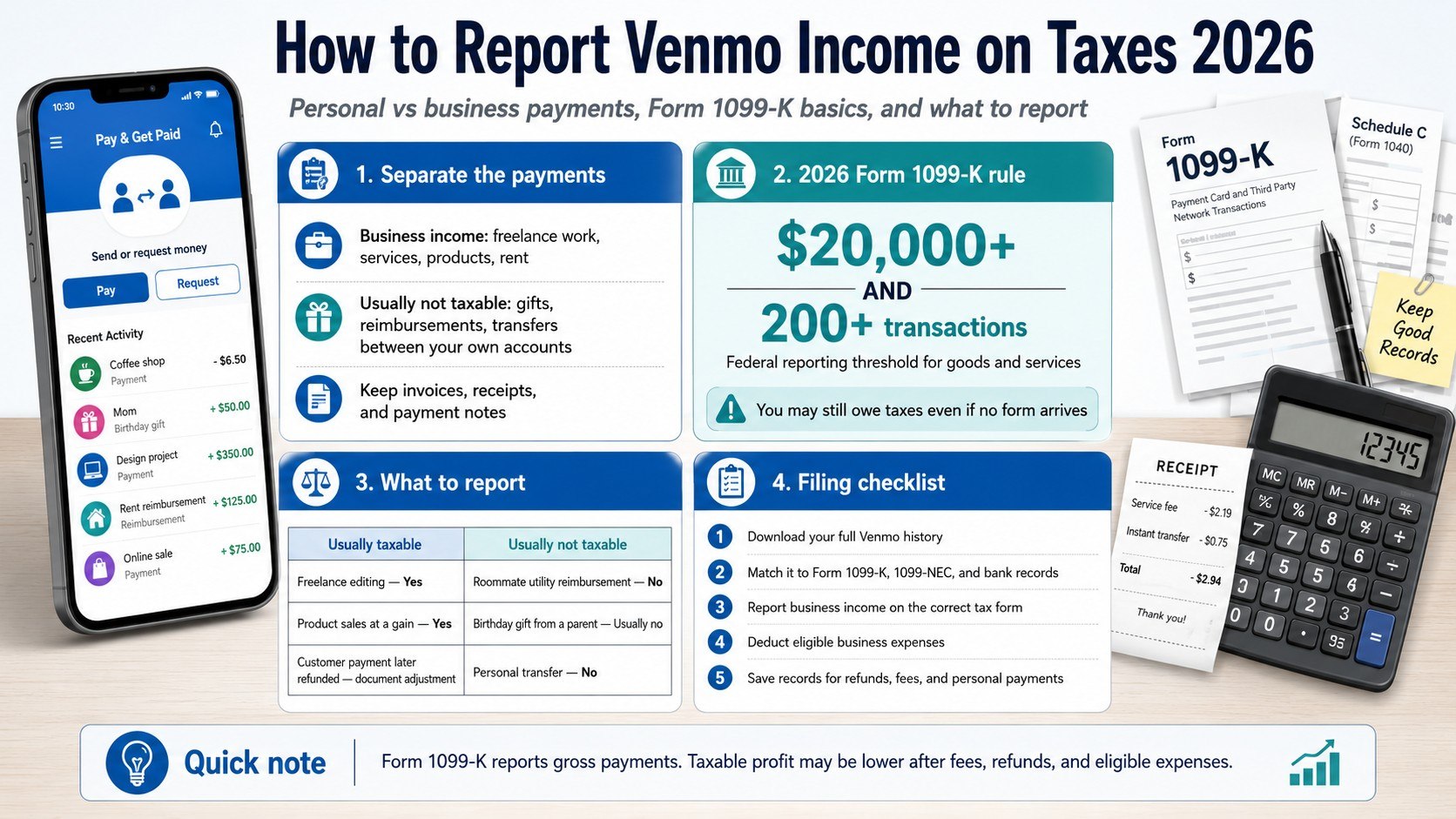
Step 1: Separate personal Venmo payments from business income
Review each incoming transaction and identify its real purpose. Payments for freelance work, repairs, consulting, childcare, rent, products, or professional services are generally business income.
Personal transactions usually include birthday gifts, family support, roommate reimbursements, and a friend’s share of dinner. These transfers normally do not become taxable merely because they entered Venmo.
Classification depends on the underlying transaction. A payment description can help, but it is not decisive. Someone may label a legitimate invoice as “thanks” or mark a reimbursement as “work.”
Keep messages, bills, invoices, and receipts that explain the payment. A common mistake is treating every deposit as taxable revenue. The opposite mistake is calling customer payments “personal” without supporting evidence.
Step 2: Check whether Venmo issued Form 1099-K
For payments made during 2026, a payment platform generally must issue Form 1099-K when both federal conditions apply. Payments for goods or services must exceed $20,000, and the account must exceed 200 transactions.
Venmo may still issue a form below those limits. Some states also apply separate information-reporting requirements. Therefore, review your Venmo tax documents even when you expect no federal form.
The reporting threshold applies to Venmo, not to your personal tax obligation. A designer who receives $7,000 from clients generally reports that income despite receiving no Form 1099-K.
The same principle applies to other payment platforms. Baltimore Chronicle’s guide to reporting Cash App income on taxes in 2026 explains how business receipts remain taxable without a platform form.
Do not divide payments between Venmo, Cash App, PayPal, and cash to avoid reporting. Your return must reflect qualifying income from every payment method.
Step 3: Reconcile Form 1099-K with invoices and bank records
Compare Box 1a of Form 1099-K with your transaction history. The form reports gross qualifying payments. It does not automatically subtract fees, refunds, discounts, shipping costs, or chargebacks.
Next, compare the total with your invoices and client records. Differences may result from payment timing, returned funds, or transactions processed near year-end.
You must also review Forms 1099-NEC and 1099-MISC. A client might report a payment already included in your Venmo total. Do not report the same income twice.
The examples below show the usual treatment of common transactions. Facts and business structures can change the correct form.
| Venmo transaction | Usually taxable? | Likely treatment |
|---|---|---|
| $1,500 for freelance editing | Yes | Business revenue, commonly on Schedule C |
| $95 roommate utility reimbursement | No | Keep the utility bill and payment record |
| $400 birthday gift from a parent | Usually no | Retain the message or payment note |
| Used phone bought for $900 and sold for $500 | Usually no gain | Personal loss is generally not deductible |
| Collectible bought for $600 and sold for $1,000 | Gain may be taxable | Calculate the $400 gain using cost records |
| $750 customer payment later refunded | Not retained as income | Document the original payment and refund |
Create a reconciliation showing gross payments, personal transfers, refunds, fees, and taxable receipts. Keep the calculation with your return.
Do not change figures simply to match a tax form. Instead, explain each difference with supporting documents. Your accounting records should show how gross payments became taxable income.
Form 1099-K is an information document. It does not replace invoices or business records. Those documents remain necessary when calculating profit and deductions.
For personal property, preserve the original purchase price. Without cost records, proving that an item was sold at a loss becomes harder.
Step 4: Choose the correct tax form for Venmo payments
Most freelancers, contractors, and sole proprietors report Venmo business income on Schedule C with Form 1040. Schedule C records gross receipts and qualifying business expenses.
Net profit can affect both federal income tax and self-employment tax. However, not every Venmo payment belongs on Schedule C. The correct form depends on the underlying activity.
Rental income may belong on Schedule E. Partnerships generally use Form 1065. S corporations usually file Form 1120-S, while C corporations use Form 1120.
Hobby income and investment sales can require different treatment. Do not select a form only because Venmo issued Form 1099-K.
Taxpayers preparing their own returns can review Baltimore Chronicle’s guide on how to file taxes for free in the USA in 2026. It covers IRS Free File, Fillable Forms, VITA, TCE, and common state-filing charges.
Step 5: Calculate taxable profit and eligible expenses
Self-employed people generally pay tax on net business profit rather than every dollar received. Start with gross business receipts, including qualifying Venmo payments.
Then subtract ordinary and necessary business expenses supported by records. Potential deductions may include processing fees, advertising, software, supplies, shipping, insurance, and professional services.
Vehicle costs may qualify when travel had a legitimate business purpose. A home office may qualify when the space meets federal requirements. Personal spending remains nondeductible.
Consider a photographer who receives $15,000 through Venmo. The photographer pays $450 in processing fees, $1,200 for advertising, and $800 for business insurance.
Those documented costs may reduce Schedule C profit. Equipment purchases may follow separate depreciation or expensing rules. The taxpayer should not subtract undocumented estimates.
The common mistake is reporting only the net amount deposited into a bank account. Record gross business receipts first. Enter eligible expenses in their correct categories afterward.
Step 6: Report personal items sold through Venmo correctly
Selling a used couch, phone, bicycle, or concert ticket differs from operating a resale business. Compare the amount received with the item’s documented cost.
A personal item sold for more than its adjusted basis can produce a taxable gain. An item sold below its cost usually creates no taxable gain. The personal loss generally cannot offset wages or business profit.
Suppose you bought a laptop for $1,800 and later sold it for $700. The $700 Venmo payment is not automatically $700 of taxable income. Your records show that the item was sold below cost.
Now suppose you bought a rare watch for $2,000 and sold it for $3,200. The $1,200 difference may be taxable, depending on the facts and applicable rules.
Keep receipts, retailer confirmations, credit card statements, photographs, and marketplace listings. Do not invent a cost basis when the original receipt is missing.
Step 7: Correct personal payments included on Form 1099-K
Contact Venmo when a Form 1099-K incorrectly includes personal transfers. Request a corrected form and save copies of all correspondence.
Collect evidence showing why the transactions were not taxable. Useful records include shared bills, refund confirmations, personal messages, and transfers between your own accounts.
Do not ignore the form. Venmo usually sends the same information to the IRS. An unexplained mismatch can lead to a notice requesting clarification.
Also, do not delay filing indefinitely while waiting for a correction. Follow current IRS instructions for reporting gross amounts and offsetting nontaxable transactions.
Keep both the original and corrected forms. The documents establish the reporting history and show how the error was resolved.
Step 8: Estimate your tax and keep supporting records
Net self-employment earnings of at least $400 can trigger self-employment tax and a federal filing obligation. Estimated tax payments may also be required during the year.
Your actual tax depends on total income, deductions, credits, filing status, and state residence. California, Maryland, and New York impose state income taxes. Florida and Texas do not impose individual state income taxes.
Review business profit every quarter. Move part of each payment into a separate savings account. Avoid using one fixed percentage without considering your complete tax position.
If your records remain incomplete near the deadline, read Baltimore Chronicle’s instructions on how to file a tax extension in 2026. Form 4868 extends filing time, but it does not postpone payment.
Keep transaction histories, invoices, expense receipts, and reconciliation worksheets for the appropriate retention period. Preserve asset records longer when they establish cost basis.
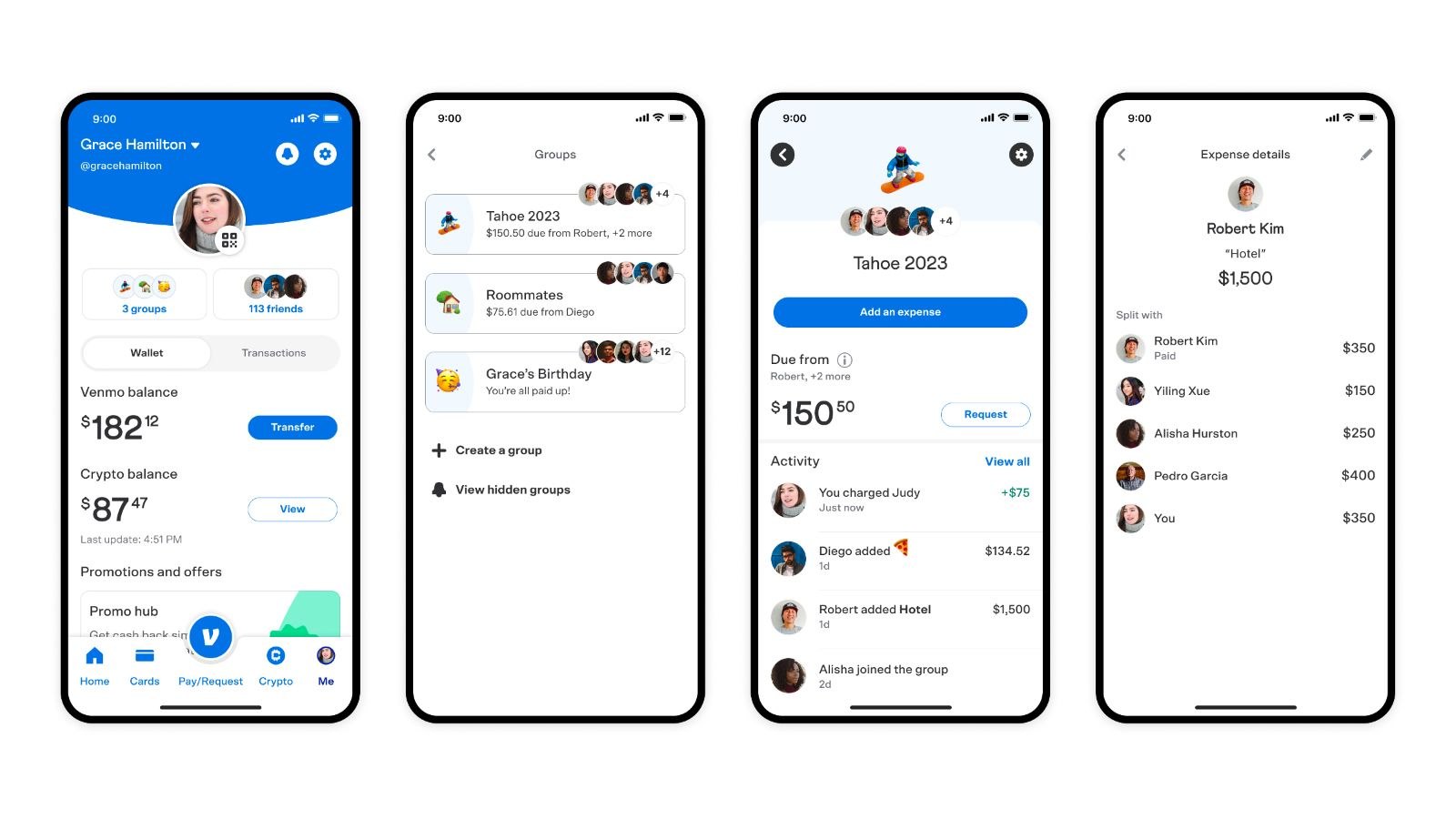
Troubleshooting common Venmo tax problems
These situations often create filing errors. Resolve each issue before submitting the return.
- No Form 1099-K arrived: Report taxable business income using your own invoices, statements, and transaction history.
- Personal transfers appear on the form: Request a correction and retain evidence showing the payment’s purpose.
- The same payment appears on 2 forms: Reconcile the forms but report the underlying income only once.
- Venmo shows more than your bank deposits: Check fees, refunds, chargebacks, holds, and year-end timing.
- Business and personal activity were mixed: Classify each transaction separately and improve account separation next year.
Start with the full transaction history rather than the year-end Venmo balance. The balance excludes withdrawn money and may include personal funds.
Do not rely only on payment descriptions. Match descriptions with invoices, receipts, contracts, and bank records. Strong documentation matters when the wording is unclear.
Reconcile each platform separately before combining income totals. This method makes duplicate forms and missing payments easier to identify.
Consider professional help when several businesses, rental properties, corporations, cryptocurrency, or major asset sales are involved. Give the preparer complete records, not only tax forms.
After filing, keep your working spreadsheet with the return. It should explain every adjustment from gross Venmo payments to taxable income.
FAQ about Venmo income and taxes
Do I report Venmo payments from friends and family?
Usually not when they are genuine gifts or shared-expense reimbursements. Keep records proving the payment’s personal purpose. Compensation for work remains taxable even when paid by a relative.
Will Venmo send Form 1099-K below $20,000 in 2026?
It may issue one below the federal threshold. State rules can also differ. Receiving the form does not mean every listed dollar represents taxable profit.
Do I owe tax if I received less than $600 through Venmo?
Possibly. A general $600 exemption does not erase legitimate business income. Tax treatment depends on the transaction and your overall filing circumstances.
Where should freelancers report Venmo income?
Sole proprietors usually report gross receipts and expenses on Schedule C. Net profit then flows to Form 1040 and may create self-employment tax.
Can I deduct Venmo processing fees?
Fees tied to legitimate business payments are generally deductible when documented. Personal transfer fees are not business expenses. Record gross revenue before claiming fees.
Is a Venmo reimbursement taxable?
A genuine reimbursement usually is not income when it only repays your share of an expense. Keep the original receipt and evidence showing how the cost was divided.
Meta description: How to report Venmo income on taxes 2026: separate personal payments, reconcile Form 1099-K, report business profit, deduct fees, and correct errors.
Earlier we wrote about How Much Do Uber Drivers Make in 2026? US Pay Before and After Expenses