

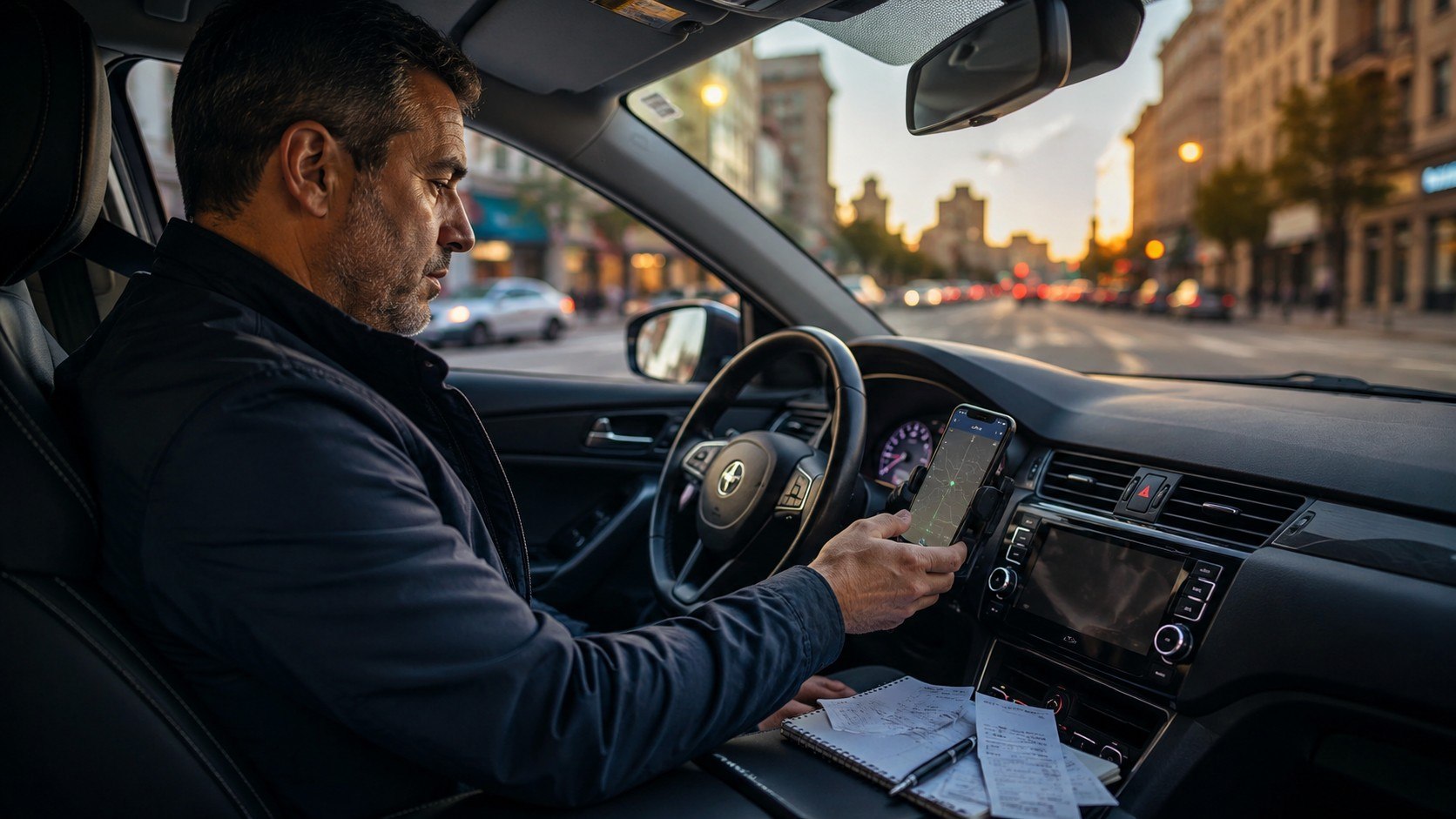
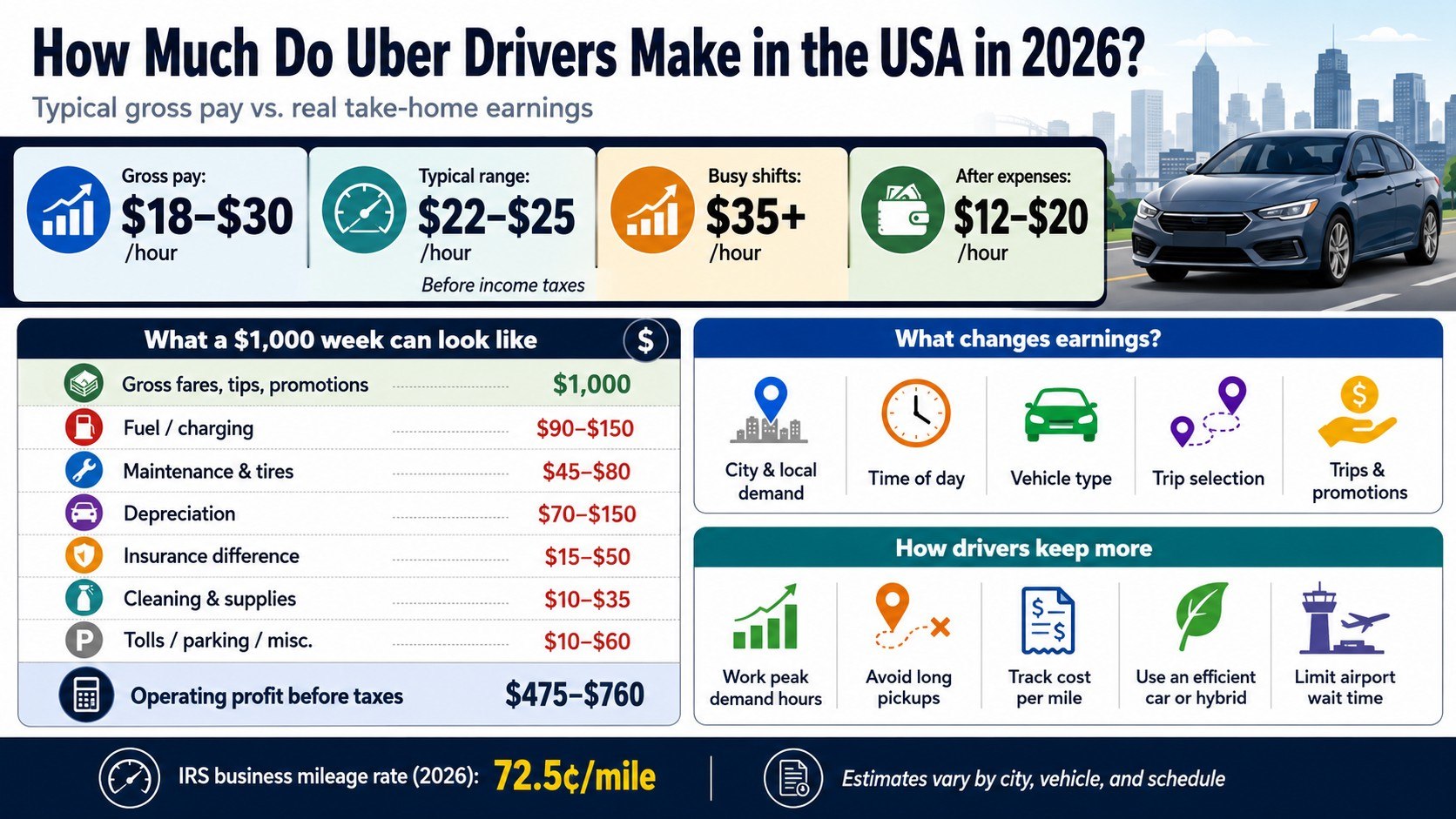
How much do Uber drivers make 2026 USA? A practical national range is about $18 to $30 per online hour before expenses. Many drivers land near $22 to $25, while busy airport, event, and late-night shifts may exceed $35. After fuel, maintenance, depreciation, insurance, and unpaid mileage, take-home earnings often fall near $12 to $20 per hour before taxes, as Baltimore Chronicle reports.
The number shown in the Uber Driver app is gross revenue, not personal profit. A driver receiving $1,000 in weekly payouts may keep only $500 to $750 after operating costs. The final result depends on the vehicle, market, schedule, total mileage, tips, and trip selection.
Key takeaways
- Typical Uber gross earnings in 2026 are about $18 to $30 per online hour across US markets.
- Vehicle costs can reduce apparent earnings by $5 to $12 per hour, especially with financed SUVs.
- Profit should be calculated using total online time and all business miles, including empty pickup miles.
A driver working 25 hours could gross roughly $450 to $750 per week. After operating expenses, that amount may decline to $300 to $525 before federal and state taxes. Efficient drivers improve the result by limiting idle time, avoiding weak pickups, and using economical vehicles.
How Much Do Uber Drivers Make 2026 USA Before and After Expenses?
There is no single national Uber salary because drivers work as independent contractors. Earnings change by city, vehicle category, demand, promotions, and working hours. Uber also adjusts trip pricing according to local conditions.
A realistic 2026 estimate places gross Uber driver pay between $18 and $30 per online hour. Drivers in New York City, Seattle, Los Angeles, Chicago, Miami, Boston, and Washington may see higher peak-period revenue. Their insurance, fuel, parking, and vehicle costs can also be higher.
Consider a driver grossing $24 per online hour. Fuel may consume $3 to $5 per hour. Maintenance and tires can add $1 to $2, while depreciation may cost another $2 to $4.
Insurance, cleaning, tolls, phone service, and unpaid return mileage can remove $1 to $3 more. The driver may therefore keep $13 to $17 per hour before income taxes. An efficient Toyota Prius will usually produce a stronger margin than a financed Chevrolet Tahoe.
Drivers should also distinguish active time from online time. Active time begins after accepting a request and includes pickup and passenger time. Online time also covers waiting between requests, which makes it the more accurate measure of Uber driver take-home pay.
New applicants should calculate these costs before submitting their documents. Baltimore Chronicle’s guide on how to become an Uber driver in the USA in 2026 explains vehicle eligibility, insurance, background checks, required documents, and signup steps.
What Drives the Price
Location and local demand
Driver revenue varies sharply between cities and even neighboring ZIP codes. Dense business districts, airports, hospitals, universities, stadiums, and nightlife areas usually generate more ride requests. Suburban and rural drivers may wait longer between passengers.
High-demand markets are not automatically more profitable. California fuel costs, New York insurance premiums, and downtown parking can consume much of the additional revenue. Local wage rules can also change how drivers are paid.
Time of day
Weekday demand often rises between 6 a.m. and 9 a.m. Another strong period usually appears between 4 p.m. and 8 p.m. Friday and Saturday nights can generate higher fares, although they also bring additional cleaning and safety risks.
Surge pricing may increase the fare when passenger demand exceeds available driver supply. However, driving several miles toward a surge zone can waste fuel. The higher rate may disappear before the driver arrives.
The Baltimore Chronicle explainer on how Uber surge pricing works in 2026 examines demand zones, airport spikes, event traffic, changing upfront fares, and peak travel periods.
Vehicle category
UberX usually offers the greatest trip volume. Uber Comfort, UberXL, and premium categories can produce higher fares but require eligible vehicles. Larger vehicles also consume more fuel and use more expensive tires.
A Honda Accord, Toyota Camry, Hyundai Sonata, or qualifying hybrid may offer a useful balance between passenger comfort and operating cost. Drivers should verify local vehicle requirements before buying a car specifically for rideshare work.
Trip selection
Upfront trip information can show estimated pay, pickup distance, trip length, and destination. A 9-mile pickup for a 2-mile passenger ride often produces weak earnings. Airport offers may also include waiting and an empty return trip.
Many experienced drivers evaluate expected revenue per total mile. A target between $1.25 and $2 per mile can protect margins in some markets. The correct threshold depends on local demand, vehicle efficiency, and average waiting time.
Promotions and tips
Uber may offer quests, boosts, or other incentives in selected markets. These programs change regularly and may not appear for every driver. Temporary bonuses should never support a long-term income estimate.
Tips can materially improve earnings because they do not add mileage. A clean interior, safe driving, accurate pickup location, and respectful service can help. Drivers should never pressure passengers to leave a tip.
Price Breakdown
The following example shows how a $1,000 weekly app total can shrink after operating costs. It assumes approximately 700 business miles in an efficient sedan. Actual spending will vary by market, driving style, financing, and fuel economy.
| Line item | Typical 2026 amount |
|---|---|
| Gross fares, tips, and promotions | $1,000 |
| Fuel or charging | $90–$150 |
| Maintenance and tires | $45–$80 |
| Vehicle depreciation | $70–$150 |
| Rideshare insurance difference | $15–$50 |
| Cleaning and supplies | $10–$35 |
| Tolls, parking, and miscellaneous costs | $10–$60 |
| Operating profit before taxes | $475–$760 |
Not every cost produces a bill during the same week. Tire replacement, brake service, and repairs appear irregularly. That delay can make an ordinary week look unusually profitable.
Depreciation is another hidden expense. Heavy rideshare mileage reduces resale value and shortens the period before replacement. A driver may appear profitable until a major repair or vehicle purchase becomes necessary.
The IRS business standard mileage rate for 2026 is 72.5 cents per mile. This rate provides an optional method for calculating deductible vehicle costs. It does not mean that every vehicle actually costs 72.5 cents for each mile driven.
A driver recording 700 eligible business miles could calculate a $507.50 mileage deduction. The deduction lowers taxable business income but does not provide a dollar-for-dollar reimbursement. Drivers must maintain accurate mileage records and follow the IRS mileage rules for 2026.
Drivers should track both mileage and direct spending. Comparing those figures reveals whether the vehicle remains economical. It also prevents weekly app deposits from being mistaken for actual earnings.
How to Calculate Real Uber Hourly Pay
Begin with the total Uber payout for the selected week. Add any cash tips, then subtract every business expense connected with those shifts. Use online hours rather than active hours for the final calculation.
- Record total online hours, including time spent waiting between requests.
- Record active hours displayed inside the Uber Driver app.
- Track pickup, passenger, repositioning, and return mileage.
- Subtract fuel, tolls, parking, charging, cleaning, and rental charges.
- Reserve money for maintenance, tires, repairs, and depreciation.
- Divide operating profit by total online hours.
- Calculate federal, state, and self-employment taxes separately.
Suppose a driver grosses $720 during 30 online hours. The apparent gross rate is $24 per hour. Fuel costs $95, while tolls and parking add $25.
The driver reserves another $90 for maintenance and depreciation. Rideshare insurance adds $20 for the week. Operating profit falls to $490, or $16.33 per online hour before taxes.
The calculation must include empty miles. Driving 12 miles toward an airport without a passenger still consumes fuel and vehicle life. Excluding these miles produces an inflated profit estimate.
A weekly earnings review helps identify weak periods and locations. Drivers can compare airport shifts, weekday commuting hours, event traffic, and weekend nights. Unprofitable hours can then be removed from the schedule.
Rideshare income may create federal filing obligations because drivers generally operate as independent contractors. Baltimore Chronicle’s guide on how to file taxes for free in the USA in 2026 explains IRS Free File, VITA, TCE, and other filing options. Drivers with complex business deductions may still require professional assistance.
Ways to Save in 2026
Higher profit does not always require longer shifts. Reducing unpaid mileage and fixed vehicle costs can produce a larger improvement. These tactics work across most US rideshare markets.
- Work focused demand periods instead of remaining online through slow afternoon hours.
- Compare each offer using estimated pay, total mileage, and expected completion time.
- Avoid distant pickups unless a strong fare or promotion justifies the mileage.
- Use destination filters when traveling toward home or another active district.
- Choose an efficient sedan or hybrid with affordable tires and available replacement parts.
- Track maintenance by mileage and repair small problems before they cause extended downtime.
- Compare insurance policies that include an appropriate rideshare endorsement.
- Limit airport waiting when queue length and incoming flight volume are unfavorable.
Fuel rewards can reduce spending, but they cannot repair an inefficient schedule. Saving 10 cents per gallon matters less than eliminating 50 empty miles. Mileage control should remain the first priority.
Drivers may also compare Uber demand with Lyft or delivery platforms. Using more than one app can reduce idle periods. The unused apps should be paused immediately after accepting a trip.
Rental programs require close examination. Weekly rental fees can exceed the ownership cost of a reliable used vehicle. Drivers should review deposits, insurance, charging fees, mileage limits, and maintenance coverage.
A rental can still make sense for a short trial or for someone without an eligible car. It reduces the risk of buying a vehicle before confirming local demand. The entire weekly fee must be included when calculating hourly profit.
Maintenance planning also affects earnings. Oil changes, tire rotations, brake inspections, and fluid checks reduce unexpected downtime. A missed weekend shift can cost more than the preventive service that would have avoided the breakdown.
When Paying More Makes Sense
Better rideshare insurance
A rideshare endorsement may cost more than standard personal insurance. It can address coverage gaps between personal use and platform coverage. Drivers should compare deductibles, collision protection, and coverage during each app period.
A reliable fuel-efficient vehicle
Replacing a working car only to drive for Uber is usually risky. However, an unreliable vehicle can produce repeated repair bills and missed shifts. A carefully selected hybrid may reduce fuel use during urban driving.
Professional tax assistance
A tax professional may help drivers using several platforms or claiming complex deductions. The fee can be reasonable when business records, estimated payments, and state filings require additional work. Drivers should choose someone familiar with independent contractors.
Preventive maintenance
Quality tires, timely brake repairs, and regular servicing protect safety and income. The cheapest repair may create repeat failures. A trusted local shop can offer stronger long-term value than emergency service.
FAQ About Uber Driver Earnings in 2026
How much does an Uber driver make per hour in 2026?
Many US drivers gross about $18 to $30 per online hour. A typical range is near $22 to $25. After vehicle expenses, take-home operating income may fall near $12 to $20 before taxes.
Can an Uber driver make $1,000 per week?
Yes, especially in a major city or during strong demand periods. Reaching $1,000 gross may require 35 to 50 online hours. The result depends on promotions, tips, local demand, and vehicle category.
How much do full-time Uber drivers make annually?
A driver grossing $22 per hour across 40 weekly hours would produce about $45,760 annually. Expenses can reduce that amount significantly. Net operating income might fall near $30,000 to $40,000 before personal taxes.
Does Uber pay for gas?
No. Independent drivers generally pay their own fuel, charging, maintenance, insurance, cleaning, and vehicle costs. Some partner programs may provide discounts rather than direct reimbursement.
Is driving for Uber worth it in 2026?
It can work for drivers with an efficient vehicle, strong demand, and disciplined scheduling. It becomes less attractive with expensive financing, excessive empty mileage, weak insurance, or long unpaid waiting periods.
Which Uber trips are usually most profitable?
Strong trips combine a short pickup, useful destination, limited waiting, and competitive pay per mile. Airport, event, and premium trips can perform well. Empty return mileage must still be included.
Earlier we wrote about How to Buy a House with Bad Credit in USA 2026: FHA, Co-Signer and Credit Repair