

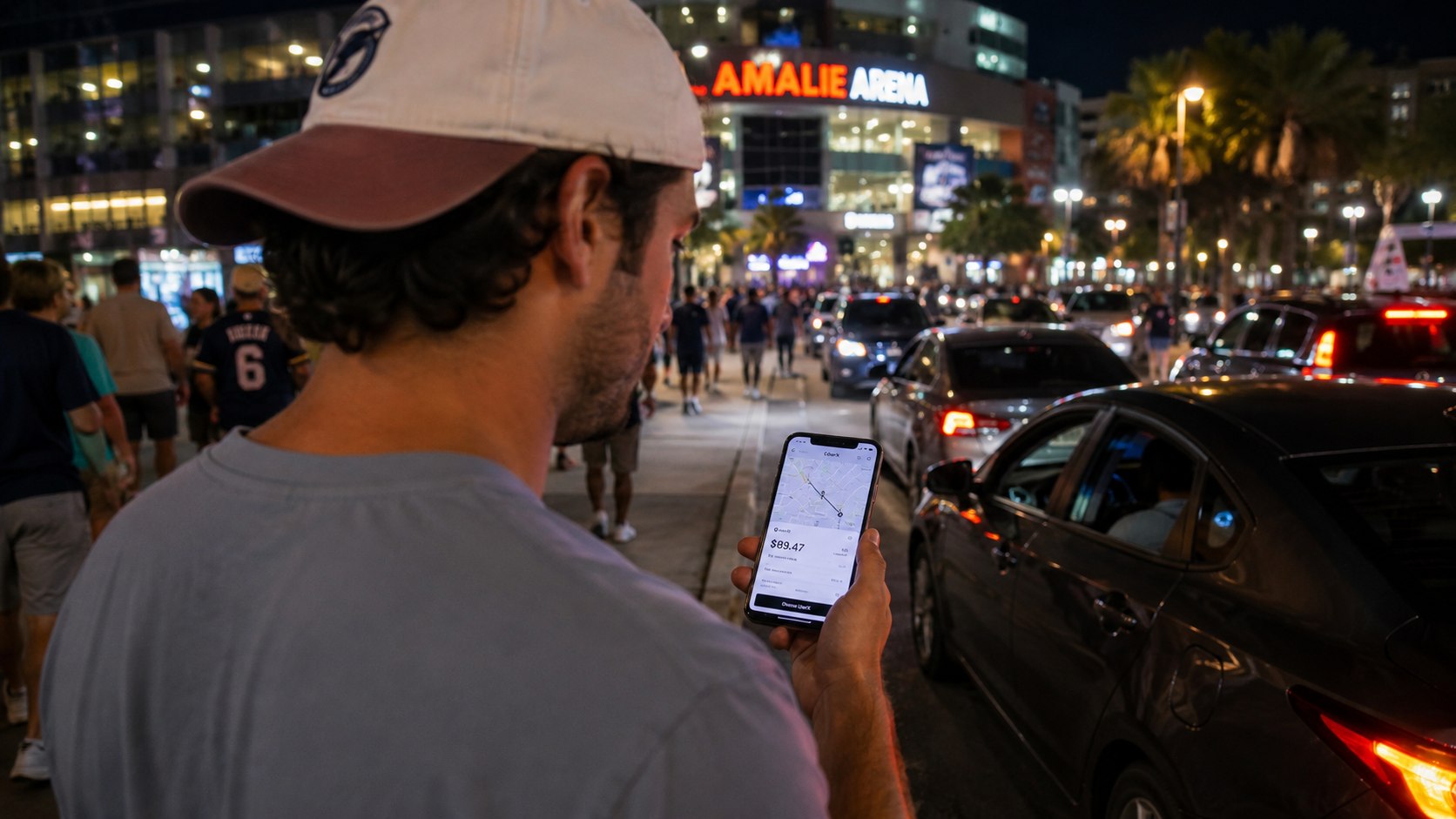
Uber surge pricing is Uber’s way of raising ride prices when more riders are requesting trips than nearby drivers can handle, аs noted by Baltimore Chronicle.
If the question is how does uber surge pricing work 2026, the practical answer is this: open Uber, compare the upfront price with Lyft or a taxi estimate, wait 5–15 minutes if the fare looks inflated, walk a few blocks away from a packed venue, or switch to UberX Share when available. Surge is not a penalty fee. It is a live price adjustment tied to local demand, driver supply, route, pickup point, trip type, and timing.
Key takeaways
- Uber surge usually appears when rider demand exceeds nearby driver supply in a specific pickup area.
- The upfront price can include surge, tolls, airport fees, booking fees, and route-based time estimates.
- The fastest ways to avoid surge are waiting, changing pickup location, comparing Lyft, or using public transit.
Uber explains that surge pricing automatically goes into effect when more riders are requesting trips than available drivers in a given area, and that higher prices are reflected in the upfront fare shown before booking. Uber’s marketplace page on surge pricing describes the goal as rebalancing rider demand and driver availability.
For riders, the key number is not the old-school multiplier. In most US markets in 2026, the useful number is the full upfront fare shown before tapping “Confirm.”
In plain English
Think of Uber like a small elevator at a busy hotel after a concert. When 200 people want to go down at once and only two elevators are running, the wait gets ugly. Surge pricing is Uber’s way of making the “elevator ride” more expensive so some riders wait, some drivers move toward the crowd, and the system clears faster.
The analogy is not perfect because Uber is not selling a fixed seat on a train. It is matching private cars, moving drivers, rider pickup points, traffic, app demand, and estimated travel time across a city block by block.
That is why two people standing half a mile apart in Chicago, Dallas, Miami, or Baltimore can see different prices for the same destination. One pickup point may be inside a hot zone near an arena. The other may be outside it.
For local readers comparing airport pickups, taxi lines, and rideshare zones, the Baltimore Chronicle guide to BWI to Downtown Baltimore by train, bus, rideshare, and taxi gives useful context for when Uber is only one of several realistic options.
How does uber surge pricing work 2026? The math behind the fare
Uber does not publish a single national formula that riders can use to calculate every surged fare. The visible price is an upfront fare, not a simple “base fare × surge multiplier” in many US cities.
A realistic 2026 way to think about Uber dynamic pricing is this:
- Uber estimates the normal price for the trip using route, distance, time, product type, pickup location, and local fees.
- The system checks rider demand and available drivers around the pickup area.
- If demand is higher than supply, the app adds a surge effect to the price.
- The rider sees one upfront fare before booking.
- The fare may change if the route, destination, stops, or trip conditions change materially.
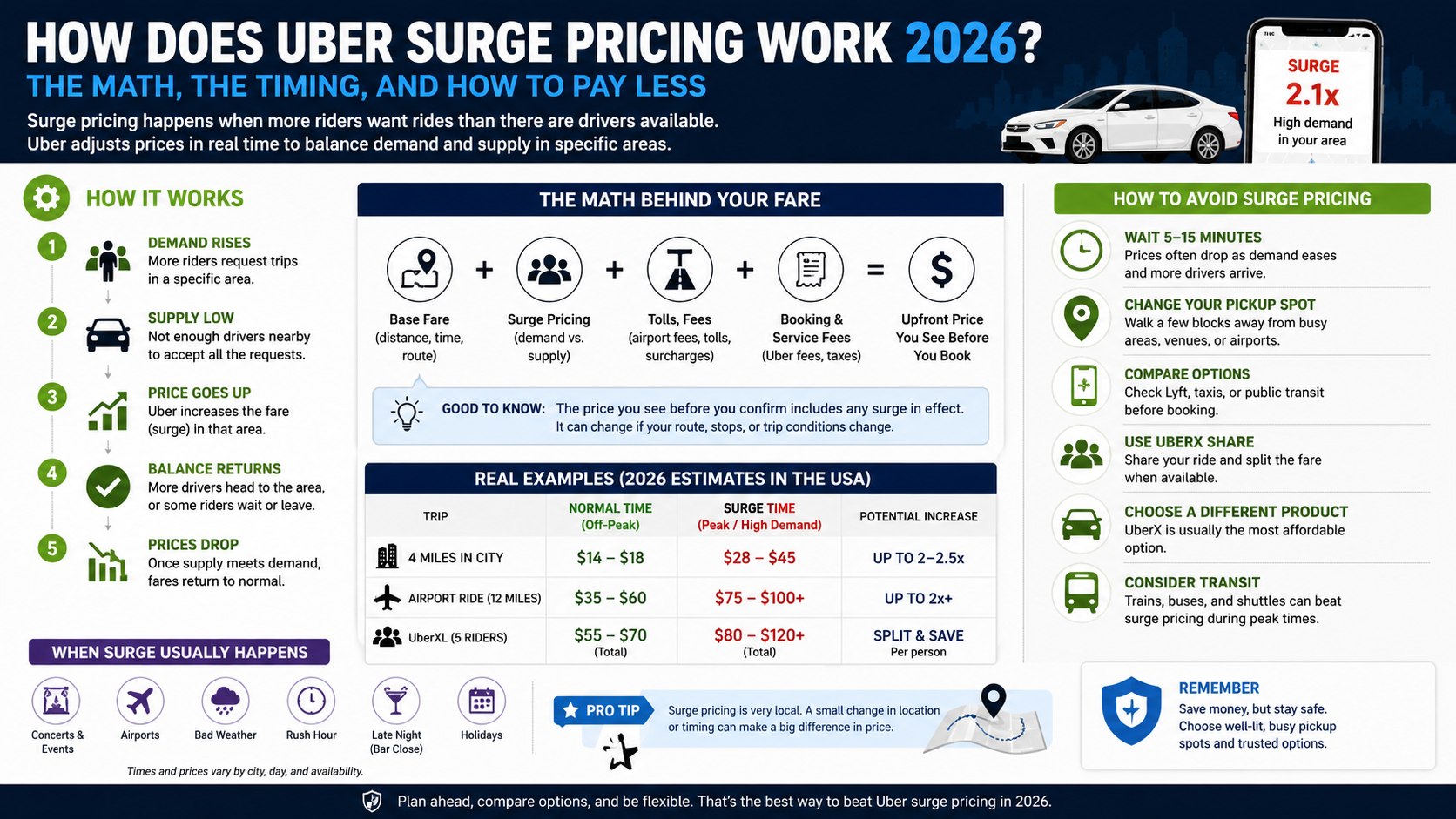
For example, a normal 4-mile UberX ride that might show as $14–$18 during a quiet afternoon could show as $28–$45 after an NFL game, a New Year’s Eve party, a thunderstorm, or a mass airport arrival. Those are realistic US consumer ranges as of 2026, not guaranteed rates.
Uber says upfront pricing can include estimated trip length and duration, pickup distance, tolls, taxes, surcharges, and surge pricing. Uber’s upfront pricing explanation is the most relevant official rider-facing source for what appears before booking.
| Fare component | What it means in 2026 | What riders can control |
|---|---|---|
| Base trip estimate | Expected cost tied to distance, time, route, and ride type. | Choose UberX instead of Comfort, Black, or XL. |
| Surge effect | Demand-based increase when riders outnumber nearby drivers. | Wait, move pickup point, or compare Lyft. |
| Airport and local fees | Charges tied to airports, cities, states, or regulated pickup zones. | Use legal off-airport transit or pickup areas when practical. |
| Tolls | Route-related toll charges, common near bridges, tunnels, and airports. | Compare alternate pickup or destination points. |
| Booking and marketplace fees | Platform charges included in the displayed price. | Limited control except comparing providers. |
The rider does not need the exact algorithm to make a better decision. The useful move is to treat the upfront fare like an airline ticket search: check timing, location, product type, and alternatives before paying.
How it actually works
Surge starts with a local imbalance. If hundreds of riders open Uber near Madison Square Garden, LAX, Austin-Bergstrom International Airport, or a downtown bar district at the same time, the system sees too many ride requests and too few available cars.
The app then raises prices in that area. Higher fares can reduce rider demand because some people wait, walk, take transit, call a friend, or choose Lyft. Higher earnings opportunities can also pull drivers toward the busy zone.
The surge area is narrow. It may cover a few blocks, an airport queue, a stadium exit, or a neighborhood. Crossing a street, walking to a hotel entrance, or moving away from the venue can sometimes change the fare.
The price is product-specific. UberX, Uber Comfort, UberXL, Uber Black, Uber Green, and UberX Share may not move in the same way at the same moment. A family needing a car seat or XL vehicle has fewer substitutes, so the practical surge pain can be higher.
The final decision happens before booking. Riders should read the upfront price, pickup point, estimated arrival, and ride type before confirming. That screen is the best protection against surprise.
Who it matters to in 2026
Airport riders
Airport riders face the most visible Uber surge pricing USA problem because demand spikes in waves. A delayed flight bank at JFK, SFO, ATL, or DFW can push hundreds of people into the rideshare zone at once.
The best move is to compare the rideshare price against the taxi line, airport rail, hotel shuttle, rental car shuttle, or pickup at a legal off-airport location. A $75 airport Uber that falls to $42 after 12 minutes is common enough that waiting can pay.
Parents and caregivers
Parents often use Uber when timing matters: daycare pickup, doctor visits, school events, late-night rides for teens, or a backup when the family car is unavailable. Surge hurts more when the ride cannot be delayed.
For predictable trips, checking Uber Reserve can be useful, but it is not a magic anti-surge tool. Reserve rides show an upfront price at booking and may include applicable surge, fees, and tolls.
Freelancers and workers without a car
Freelancers, service workers, and renters in car-light households often care less about the algorithm and more about whether a job remains profitable. A $19 ride to a client site is one thing. A $48 ride for the same job can erase the margin.
For recurring trips, it helps to track the normal fare range by time of day. A simple note in a phone can show whether a Monday 8 a.m. ride in Phoenix, Philadelphia, or Seattle usually costs $18, $24, or $35.
Common myths
- Myth: Uber always uses a visible multiplier. Correction: many riders now see an upfront fare, not a clean 1.5x or 2.0x label.
- Myth: Closing and reopening the app removes surge. Correction: the local price may update, but the demand imbalance usually remains.
- Myth: Drivers personally set surge prices. Correction: surge is handled by Uber’s marketplace system, not by individual drivers.
- Myth: Airports are always cheaper by Uber. Correction: taxis, rail, shuttles, and hotel vans can beat Uber during peak periods.
- Myth: A short ride cannot surge. Correction: short trips can still become expensive if pickup demand is concentrated.
How to avoid Uber surge pricing without wasting time
The best avoidance strategy is not one trick. It is a quick sequence that takes less than two minutes.
- Check the Uber upfront fare and estimated pickup time.
- Check Lyft for the same trip.
- Change the pickup point by 2–4 blocks if safe and practical.
- Switch from Comfort, XL, or Black to UberX when possible.
- Try UberX Share if the route and timing work.
- Wait 5–15 minutes after stadium exits, bar close, flight banks, and bad-weather spikes.
- Compare taxi, rail, bus, hotel shuttle, or walking for the first mile.
- Split the fare with another rider when the trip and safety situation allow it.
The strongest tactic is moving the pickup point. A stadium gate, airport rideshare pen, convention center exit, or concert venue entrance can sit inside the most expensive demand pocket. A nearby hotel, restaurant, office lobby, or transit stop may price differently.
Safety comes first. Do not walk into poorly lit areas, freeway ramps, closed lots, or unfamiliar side streets just to save a few dollars. For late-night rides, a staffed hotel entrance or busy business frontage is usually better than an empty corner.
The price to beat is not yesterday’s fare. The price to beat is the next-best safe option available right now.
Uber vs Lyft surge pricing
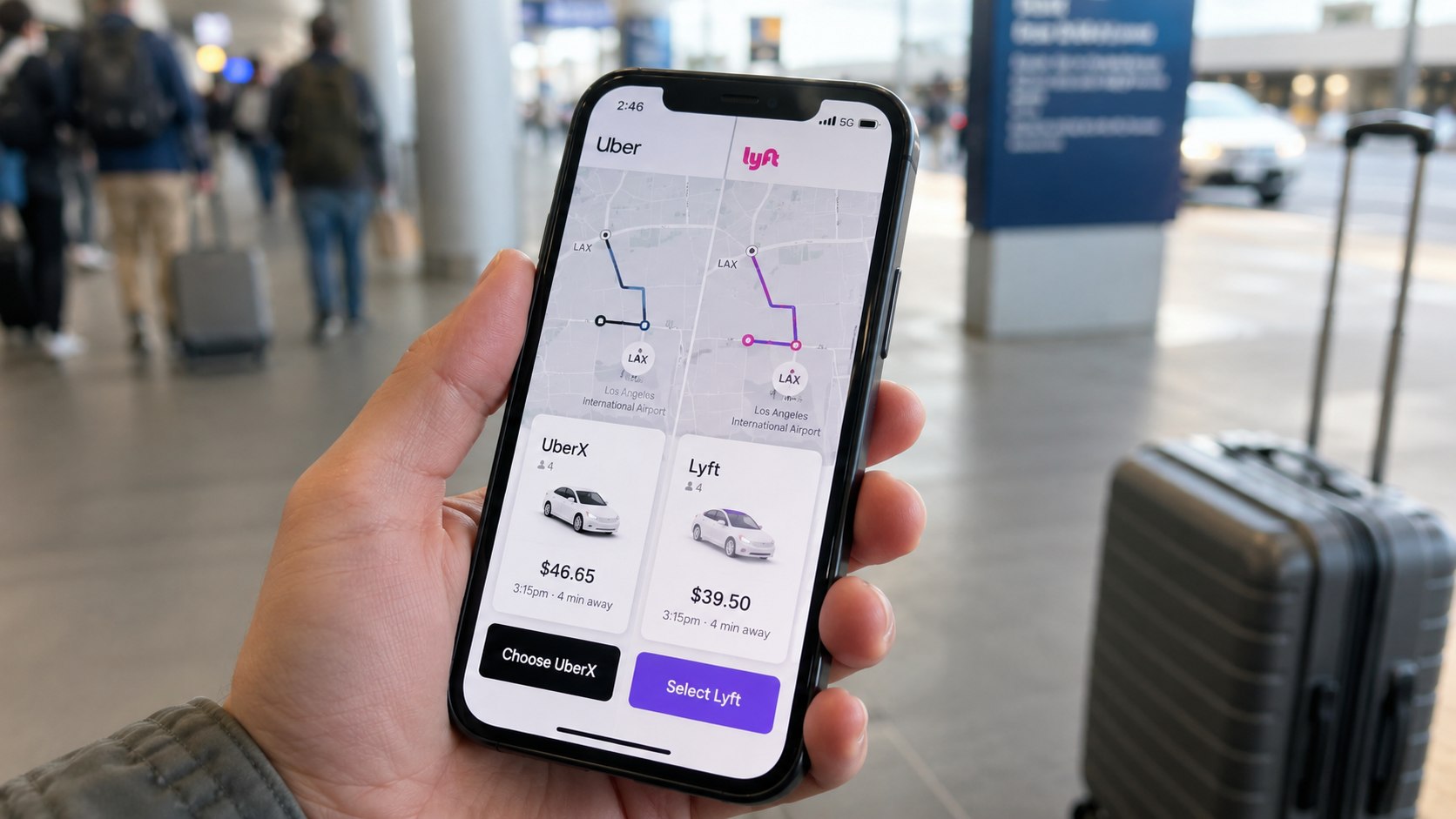
Uber and Lyft both use demand-based pricing, but they do not always surge at the same time or by the same amount. Different driver supply, rider demand, airport rules, promotions, and pickup coverage can create a price gap.
In practice, the best answer to why is Uber so expensive right now is often visible in 30 seconds: Lyft may be cheaper, or both apps may be expensive because the whole area is overloaded.
Readers comparing both apps before a regular commute or airport ride can use the Baltimore Chronicle breakdown of Uber vs Lyft prices in 2026 as a companion guide before deciding which app to open first.
| Situation | What usually happens | Best move |
|---|---|---|
| Concert or stadium exit | Both Uber and Lyft may jump at once. | Walk away from the gate, wait, or use transit for one stop. |
| Airport arrival wave | Airport pickup zones can surge quickly. | Compare taxi, rail, shuttle, and both rideshare apps. |
| Rain or snow | Demand rises while traffic slows. | Wait indoors and recheck every few minutes. |
| Weekday commute | Surge may hit business districts and commuter corridors. | Shift departure by 10–20 minutes when possible. |
| Late-night bar close | Demand compresses into a short window. | Leave earlier, wait later, or meet at a calmer pickup point. |
Real-price examples riders can use
Exact Uber prices change by city, time, driver supply, route, and product. The following examples are practical 2026 ranges for thinking about Uber fare increase during peak hours, not published national rates.
A quiet 3-mile UberX ride in a midsize city might show $11–$16. The same ride after a major downtown event might show $22–$38.
A 12-mile airport ride in Los Angeles, New York, Boston, or Atlanta might normally show $35–$60 depending on tolls and airport fees. During a storm, holiday return wave, or convention surge, the same trip can move above $75 or $100.
An UberXL for five people can look expensive, but the per-person math may still beat two separate UberX rides. A $72 XL split among five riders is $14.40 per person before tip. Two $43 UberX rides cost $86 total before tip.
The practical rule is simple: calculate the total trip cost, not the emotional price shock. A surged Uber may still be the best option for four adults with luggage at 11 p.m.; it may be a bad choice for one person traveling near a train line at 6 p.m.
For Baltimore trips that combine rideshare with driving or transit, the guide to parking in Baltimore for visitors can help compare the real cost of an Uber, a garage, street parking, or a mixed trip.
When surge is worth paying
Surge avoidance has a limit. Paying the higher fare can make sense when the alternative is unsafe, unreliable, or more expensive in time.
It may be worth accepting upfront Uber pricing during medical appointments, late-night airport arrivals with children, severe weather, or trips where missing a train, shift, court date, or flight would cost more than the fare increase.
Drivers also matter in this equation. Higher prices can attract more drivers to busy areas, but drivers still decide whether a trip is worth accepting based on distance, pickup effort, traffic, and earnings. A rider who moves to an easier pickup point may get a faster match even if the price does not drop much.
For household budgeting, frequent riders should treat Uber like a variable utility, not a fixed transit pass. A monthly transportation budget can include a normal rideshare line and a separate emergency ride line, especially for renters, parents, and gig workers who do not own a car.
FAQ
Does Uber still have surge pricing in 2026?
Yes. Uber still uses surge pricing in 2026 when rider demand is higher than nearby driver availability. In many US markets, the rider sees it as part of the upfront fare rather than a simple visible multiplier.
How can I tell if my Uber fare includes surge?
The app may show language that the fare is higher because of increased demand. The most reliable signal is a price that is much higher than the same route usually costs at that time and place.
What time is Uber surge pricing worst?
Common surge periods include weekday commute peaks, Friday and Saturday late nights, airport arrival waves, major sports and concert exits, holidays, storms, and bar closing times. The pattern varies by city and neighborhood.
Is Lyft cheaper when Uber is surging?
Sometimes. Lyft can be cheaper if it has better driver supply or lower rider demand nearby. During major events or bad weather, both apps may be expensive at the same time.
Can walking a few blocks really lower an Uber fare?
Yes, in some cases. Surge can be highly local, especially near stadiums, airports, campuses, hotels, and nightlife districts. Moving to a safer, less crowded pickup point can reduce price and improve pickup speed.
Should I tip on a surged Uber ride?
Tip decisions are separate from surge. Surge affects the fare shown in the app, while tipping is optional and based on service, safety, luggage help, cleanliness, and the rider’s budget.
Earlier we wrote about Walk-In Shower vs Bathtub Resale Value 2026: Which Bathroom Upgrade Pays Off?