


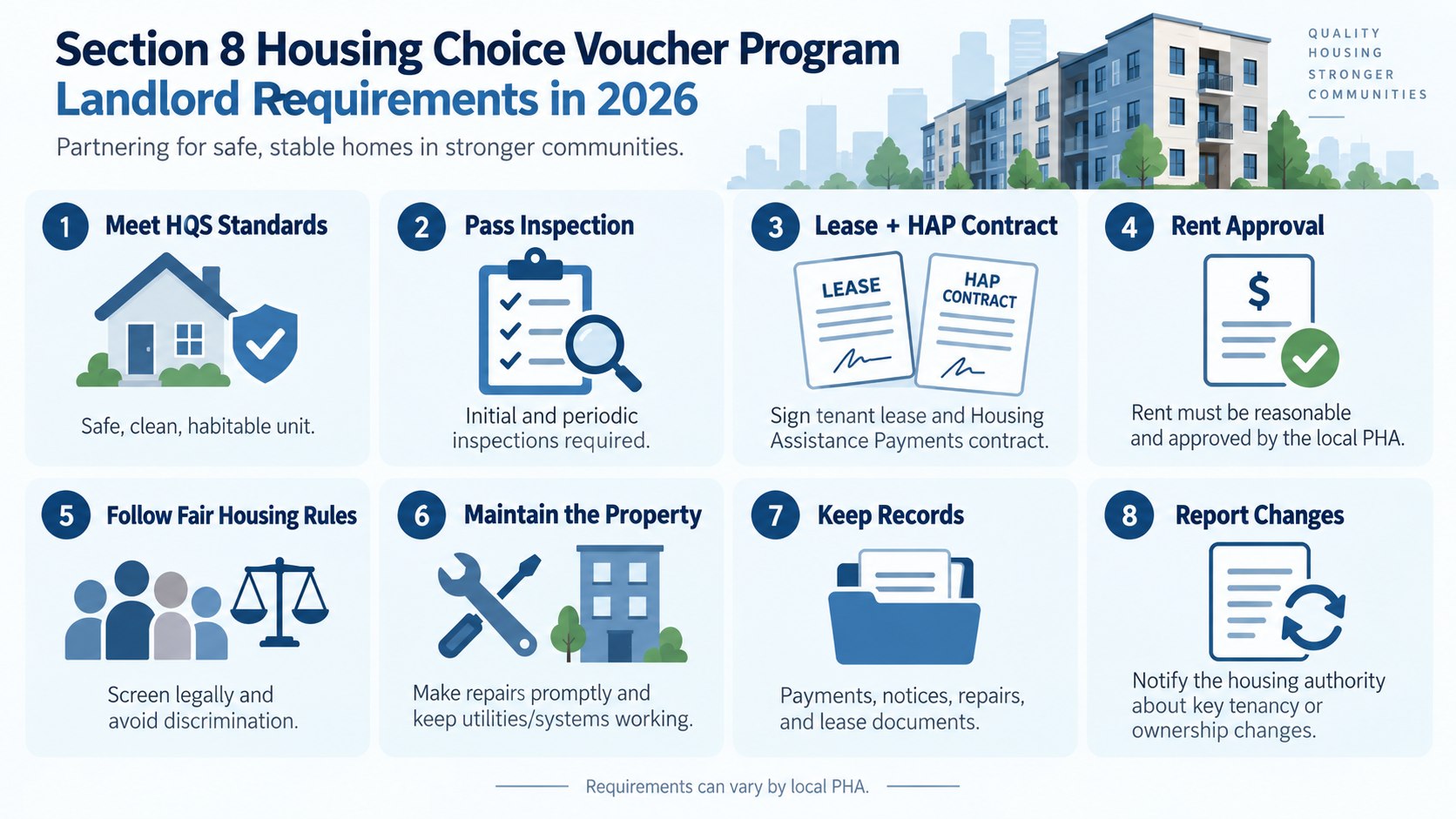
Section 8 landlord requirements 2026 are the federal and local rules a property owner must meet before receiving Housing Choice Voucher payments for an approved tenant. The practical sequence is straightforward: submit the tenancy paperwork, clear the housing agency’s rent review, pass the required inspection, sign the lease and Housing Assistance Payments contract, then keep the property compliant. The details depend on the local Public Housing Agency, or PHA, as the editorial team at Baltimore Chronicle notes.
For landlords facing an actual leasing decision, the biggest mistake is treating a voucher tenant like an ordinary lease-up with an extra payment method. The PHA becomes a third party in the transaction. It approves the unit, reviews rent reasonableness and controls the subsidy payment under a separate federal contract.
Key takeaways
- A landlord generally needs PHA approval, an acceptable rent and a qualifying property before housing assistance payments begin.
- The owner signs both a tenant lease and a Housing Assistance Payments contract, creating separate contractual obligations.
- Inspection rules remain especially important in 2026 because HUD’s broader NSPIRE transition for voucher programs continues toward 2027.
Landlords preparing a first rental should also review the broader 2026 landlord licensing and tenant-screening requirements. Section 8 participation does not replace state licensing, insurance, tax or lease rules.
In plain English
Think of the Housing Choice Voucher program as a 3-party rental instead of a 2-party rental. The tenant still rents the home from the landlord. A local housing agency separately promises to pay an approved portion of the rent under federal program rules.
The voucher itself does not guarantee that a particular property will qualify. A tenant may choose a home, yet the PHA can reject the proposed tenancy if the rent fails its reasonableness review. The unit can also be delayed when inspection problems remain unresolved.
The useful distinction is simple: HUD sets the federal framework, the local PHA administers the voucher, and the landlord remains responsible for managing the property.
Owners still screen applicants under lawful, consistently applied standards. HUD’s HAP guidance places tenant suitability decisions with the owner rather than the housing agency. Screening must still comply with federal, state and local housing laws.
That matters in places with additional source-of-income protections. A landlord in California, Maryland, Texas or another state should not assume the federal voucher program answers every local legal question. Owners comparing ordinary rental rules can also review how tenant rights continue when rental property changes ownership.
How it actually works
A Section 8 lease-up usually begins after a voucher holder identifies a property. The prospective tenant and owner then provide information needed for the PHA’s Request for Tenancy Approval process. Agency-specific forms and procedures can differ.
HUD explains that the housing agency reviews the proposed tenancy and schedules an inspection. It also decides whether the requested rent is reasonable compared with comparable unassisted housing. A high asking rent is therefore not automatically approved simply because the tenant holds a voucher.
The practical order normally looks like this:
- Confirm the owner and property can participate with the local PHA.
- Complete the required tenancy approval documents with the voucher holder.
- Allow the PHA to review proposed rent and property information.
- Complete the required inspection and repair failed items when necessary.
- Execute the lease, tenancy addendum and HAP contract after approval.
The owner should not assume that subsidy payments begin when the tenant receives keys. HUD guidance states that a PHA cannot make Housing Assistance Payments before the HAP contract is executed. The contract identifies the approved rent and initial assistance amount.
The tenant remains responsible for the tenant share of rent. The housing agency generally sends the approved subsidy directly to the owner. Changes in household income or composition can later alter the assistance amount without necessarily changing the underlying contract rent.
Landlords should also keep separate records for the tenant payment and agency payment. If a $1,800 contract rent were split between a $500 tenant obligation and a $1,300 HAP payment, each source should be tracked independently. Those figures are only an example, not a national Section 8 payment standard.
Section 8 landlord requirements 2026 for inspections
Inspection is one of the most consequential parts of the approval process. The property must meet applicable federal housing quality requirements and any additional requirements imposed by the administering PHA. Cosmetic perfection is not the objective; safety, sanitation and proper operation matter.
For 2026, landlords need to understand an unusual transition. HUD extended the mandatory compliance date for NSPIRE implementation in Housing Choice Voucher, Project-Based Voucher and Section 8 Moderate Rehabilitation programs through January 31, 2027. PHAs must transition by February 1, 2027, although specific requirements and agency practices can differ during the transition.
“The property must meet health and safety standards.”
U.S. Department of Housing and Urban Development, Housing Choice Voucher tenant guidance.
Before an inspection, owners should check the items most likely to cause a preventable delay:
- working smoke and carbon monoxide alarms where required;
- safe electrical outlets, wiring and permanent fixtures;
- operable plumbing without serious leaks or sanitation hazards;
- functional heating and essential utilities;
- secure exterior doors, windows and required locks;
- safe stairs, railings, floors and walking surfaces;
- working cooking facilities and required appliances;
- absence of serious health hazards inside the dwelling.
A failed inspection does not necessarily end the proposed tenancy. The agency can identify deficiencies and require repairs within the applicable timeframe. The owner should document each repair with invoices, dated photographs and contractor records where relevant.
Some problems carry greater urgency than ordinary maintenance. Smoke alarms, carbon monoxide protection, exposed electrical hazards and conditions affecting essential utilities can trigger accelerated corrective requirements. Local procedures should be confirmed before the scheduled visit.
HUD describes NSPIRE as focusing more heavily on health, safety and functional defects than appearance. Its official NSPIRE notices track implementation dates and program changes. Owners should still ask the local PHA which inspection protocol it is using during 2026.
- A landlord preparing only for what an inspector can see risks missing the larger obligation: the property must remain compliant after the tenant moves in.*
Contract and payment rules landlords cannot ignore
The lease with the tenant and the HAP contract with the PHA are not the same document. That distinction explains many payment disputes. The lease governs the landlord-tenant relationship, while the HAP contract controls the housing agency’s subsidy payments.
HUD identifies Form HUD-52641 as the standard Housing Assistance Payments contract used in the voucher program. Its landlord resources also explain that the tenancy addendum becomes part of the lease. The federal provisions take precedence where the addendum conflicts with a lease term.
| Document or step | Main purpose | Landlord issue to verify |
|---|---|---|
| Request for Tenancy Approval | Starts review of the proposed unit | Rent, utilities and property information |
| PHA inspection | Checks applicable housing standards | Repairs must meet required deadlines |
| Tenant lease | Creates landlord-tenant obligations | Must comply with state and local law |
| Tenancy addendum | Adds mandatory federal voucher terms | Overrides conflicting lease provisions |
| HAP contract | Controls subsidy payments | No HAP before contract execution |
| W-9 and payment information | Supports tax reporting and payment setup | Name and taxpayer information must match records |
A landlord should read the HAP contract as carefully as the lease. It is not merely a payment enrollment form. It is a binding agreement between the owner and PHA.
The owner must maintain the property and provide services required under the lease. HUD guidance allows a PHA to act when an owner fails those obligations. Possible consequences can include payment abatement, reduction, recovery of overpayments or termination of the HAP contract.
Rent increases also require planning. HUD guidance states that proposed rent changes generally must be reported to the PHA before they become effective and remain subject to rent-reasonableness requirements. Owners should confirm their PHA’s current notice process rather than relying on the tenant’s lease alone.
The same caution applies to late fees and other charges. State rules differ substantially, and a voucher does not erase those limits. Baltimore Chronicle’s guide to 2026 landlord late-fee rules illustrates why owners must separate federal assistance rules from state landlord-tenant law.
Who it matters to in 2026
Owners considering their first voucher tenant
New participants need to budget for approval time rather than assuming an immediate move-in. The property may need repairs, paperwork corrections or a rent adjustment before approval. A landlord carrying a mortgage should keep enough cash available for that gap.
The benefit is a structured payment relationship with a PHA once the tenancy is approved. The tradeoff is additional paperwork and continuing program compliance. This makes preparation more valuable than rushing a voucher lease-up.
Existing Section 8 landlords
Current owners should pay particular attention to inspections, rent-change notices and the upcoming NSPIRE transition. HUD’s 2026 guidance confirms February 1, 2027 as the extended compliance date for voucher-program implementation.
Owners should therefore avoid using an old inspection checklist as their only maintenance standard. Local PHAs may update forms, training and inspection procedures as the federal deadline approaches.
Tenants comparing voucher properties
A voucher holder benefits from knowing which delays belong to the tenant and which belong to the property. A landlord asking for rent outside PHA approval cannot simply treat the difference as an informal side payment.
Tenants should also distinguish the PHA-paid share from their own lease obligations. The voucher subsidy does not eliminate responsibilities involving tenant rent, property care and authorized household members.
Documents and records worth preparing
Housing Choice Voucher landlord rules involve more paperwork than a conventional cash-rent tenancy. Creating one property file before accepting an applicant can prevent repeated requests and contradictory information.
A practical owner file can include:
- proof of ownership and current owner contact information;
- completed W-9 with correct taxpayer identification information;
- local rental license or registration when required;
- proposed lease and required disclosures;
- utility responsibility information;
- banking or direct-deposit information requested by the PHA;
- repair invoices and inspection documentation;
- current insurance and property-management information.
HUD’s landlord forms page confirms that PHAs use standard federal documents alongside forms created under local agency policies. That is why an owner’s paperwork from one city may not exactly match paperwork requested elsewhere.
Property managers should also confirm who is authorized to sign documents. Ownership changes can require reassignment paperwork, a new W-9 and supporting evidence. A management change may create similar administrative requirements.
Keep payment records for both subsidy and tenant portions. Maintain inspection notices, repair receipts and written PHA communications with the lease file. These records become important when payment, maintenance or ownership questions arise months later.
Section 8 landlord inspection requirements are ultimately part of ongoing property management, not a single pre-move-in hurdle. A unit that passes initially still needs ordinary repairs and compliance throughout the assisted tenancy.

Common myths
Several assumptions repeatedly create problems for owners entering the voucher program. The most useful corrections are practical rather than technical.
- Section 8 landlord payment requirements do not mean HUD sends every landlord a fixed national rent. The local PHA approves assistance and reviews rent reasonableness.
- “Passing once means the property is permanently approved.” Inspections and continuing maintenance obligations remain part of the tenancy.
- “The housing agency screens the tenant for the landlord.” Owners remain responsible for lawful tenant suitability screening.
- “The voucher pays the entire rent.” Many households pay a tenant portion while the PHA pays the approved subsidy.
- “Any lease clause is valid if the tenant signs it.” The required tenancy addendum can supersede conflicting lease provisions.
The program also does not create one nationwide rule requiring every private landlord to participate. Source-of-income protections and participation requirements depend partly on state and local law. Owners should check the jurisdiction where the property is located.
Nor does the voucher create a national rent price. Payment standards vary by PHA, bedroom size and local market conditions. Rent reasonableness is evaluated against comparable unassisted units rather than the owner’s mortgage payment.
The safest working rule for 2026 is to treat PHA approval, inspection approval and contract execution as separate gates rather than one administrative step.
That approach also makes delays easier to diagnose. A property can be physically acceptable but still await rent approval. Another unit can have acceptable proposed rent but remain ineligible for payments until required repairs and contracts are completed.
FAQ
What are the main Section 8 landlord requirements in 2026?
Landlords generally need an eligible property, PHA approval, an acceptable inspection, reasonable approved rent and completed program documents. The owner must then maintain the unit and comply with the HAP contract, lease and applicable laws.
Does a landlord receive the Section 8 payment directly?
Generally, the PHA sends the Housing Assistance Payment directly to the approved owner. The tenant separately pays the tenant share required under the tenancy. Payment procedures can differ by housing agency.
Can a landlord charge more than the PHA approves?
The owner cannot secretly collect extra rent outside the approved arrangement. Contract rent and tenant obligations must follow the HAP contract, lease and PHA approval. Proposed rent changes are also subject to program requirements.
What happens if a Section 8 property fails inspection?
The PHA can require correction of identified deficiencies. The consequences depend on the problem and timing. Uncorrected owner-caused deficiencies can eventually affect or stop housing assistance payments.
Is Section 8 using NSPIRE inspections in 2026?
HUD has extended the mandatory NSPIRE compliance date for HCV, PBV and Section 8 Moderate Rehabilitation programs to February 1, 2027. PHAs may be at different transition stages, so landlords should confirm the current local protocol.
Can a Section 8 landlord choose which applicant to rent to?
Owners generally remain responsible for lawful tenant screening and suitability decisions. Screening standards must still comply with federal, state and local fair-housing and source-of-income rules that apply to the property.
Earlier we wrote about How Much Does an ADU Cost in 2026? State-by-State Prices Show a Wide Gap for 600 Sq Ft Units