

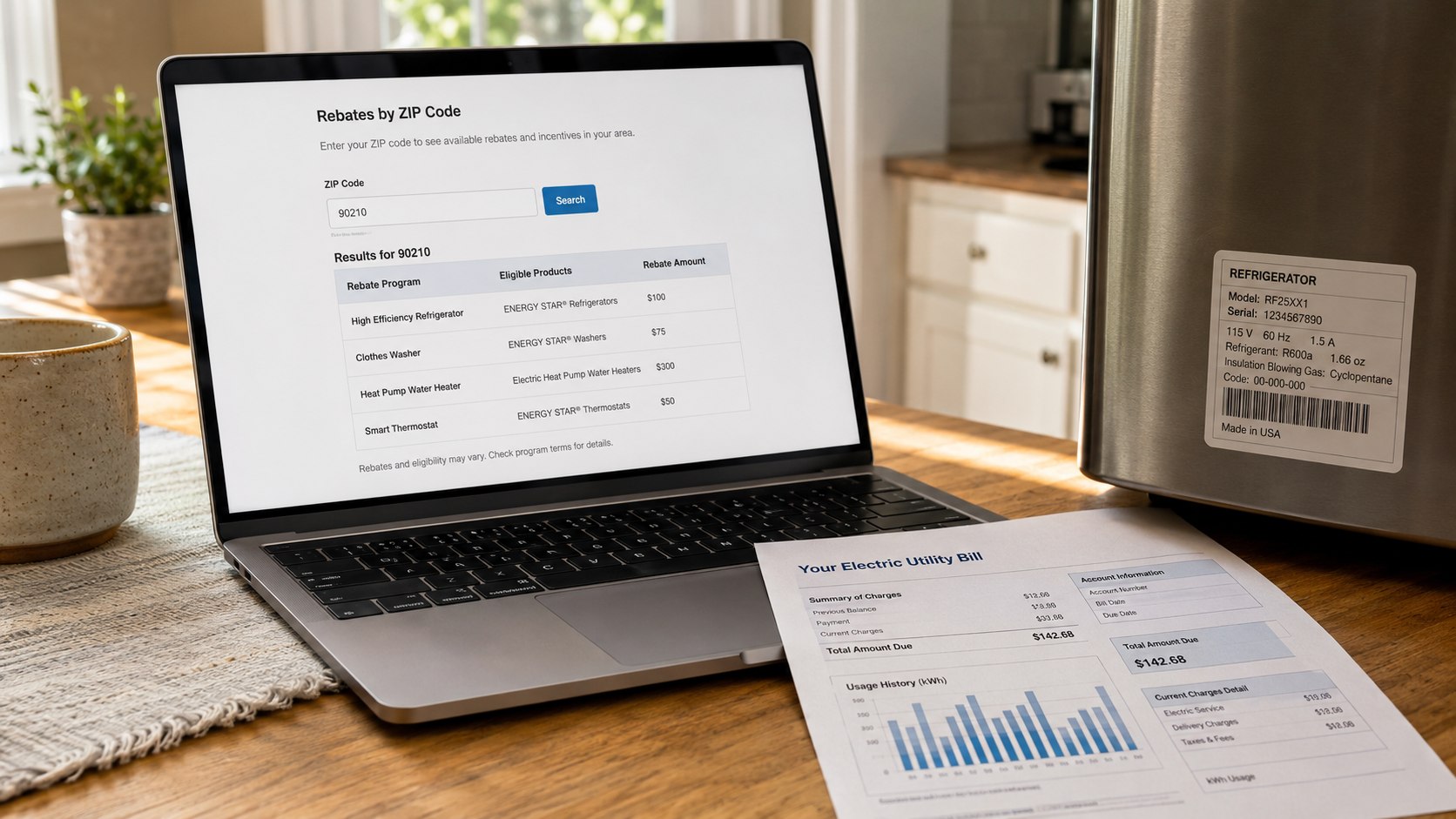
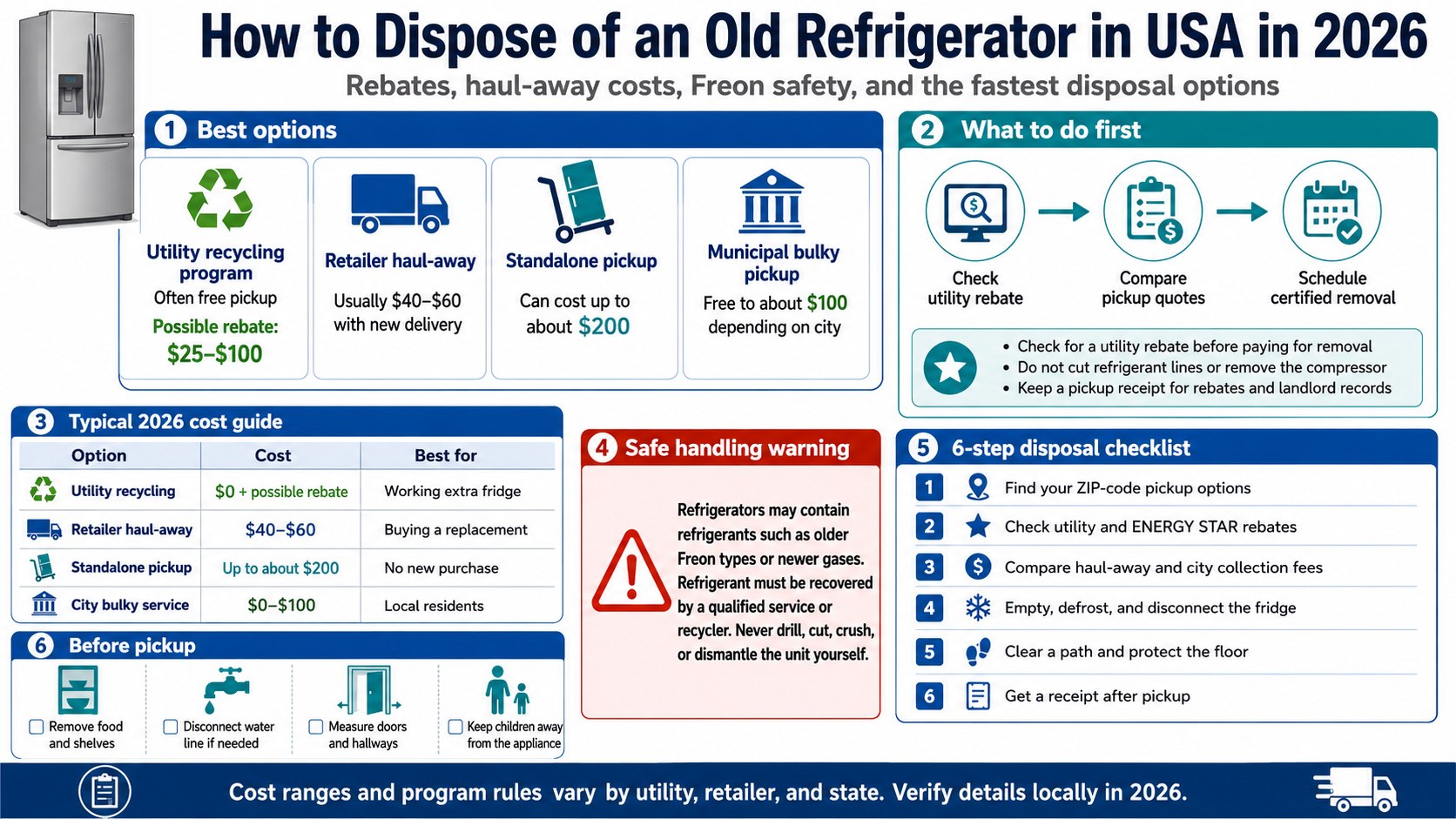
Learning how to dispose of an old refrigerator in USA usually takes 15 to 30 minutes of research and one scheduled pickup or drop-off. The fastest solution is to check for a utility rebate first, then compare retailer haul-away, municipal collection, and certified appliance recycling, аs noted by Baltimore Chronicle.
Do not cut refrigerant lines, remove the compressor, or leave the refrigerator at the curb without confirming local rules. Refrigerant must be recovered before the appliance is dismantled or sent for final disposal.
Key takeaways
- Check utility recycling rebates before paying for removal; qualifying households may receive an incentive and free pickup.
- Retailer haul-away commonly costs about $40 to $60 with delivery, while standalone pickup can approach $200.
- Use a recycler that properly handles refrigerant, compressor oil, insulation foam, metal, glass, and electronic controls.
What you need
- Your ZIP code and utility account number
- The refrigerator brand, approximate age, and dimensions
- A phone or computer for checking pickup programs
- A cooler or insulated bags for remaining food
- Towels and a shallow pan for water
- A screwdriver or wrench if a water line must be disconnected
- About 30 minutes for preparation, plus the scheduled pickup window
- A removal budget of $0 to about $200 in 2026
Step 1: Choose how to dispose of an old refrigerator in USA
Start by comparing four routes: a utility recycling program, retailer haul-away, municipal bulky-item collection, or direct delivery to an appliance recycler. Search by ZIP code because prices, accepted appliances, and pickup conditions vary among states, counties, cities, and electric utilities.
This comparison matters because the most convenient option is not always the cheapest. A utility may pay a recycling incentive, while a retailer may charge a separate fee even when delivering a new Whirlpool, GE, LG, Samsung, Frigidaire, or Maytag refrigerator.
Before replacing a unit that has stopped cooling, check whether the problem can be repaired at a reasonable cost. The Baltimore Chronicle guide to fixing a refrigerator that is not cooling explains how to check condenser coils, airflow, door seals, fans, and temperature controls before paying for disposal.
Avoid calling a general junk hauler before asking where the refrigerator will go and how the refrigerant will be recovered. A low pickup quote does not confirm compliant refrigerator disposal near me.
| Disposal option | Typical 2026 cost or benefit | Best for | What to confirm |
|---|---|---|---|
| Utility recycling program | Free pickup; some programs offer about $25 to $100 | Working secondary refrigerators | Age, size, operating condition, and account eligibility |
| Retailer haul-away with delivery | Often about $40 to $60 per appliance | Households buying a replacement | Stairs, built-in units, water-line disconnection, and local availability |
| Standalone retailer pickup | About $200 for a limited number of large items | Households without a new purchase | Item limits and excluded installations |
| Municipal bulky-item service | Free to about $100, depending on location | Residents with city collection access | Appointment rules, tags, fees, and curb placement |
| Certified appliance recycler | Free to about $100, plus transportation | Owners who can arrange delivery | Refrigerant acceptance and proof of evacuation requirements |
These ranges are planning figures rather than national fixed prices. Verify the final charge with the utility, retailer, sanitation department, or recycler serving the property.
Step 2: Check for a refrigerator recycling rebate
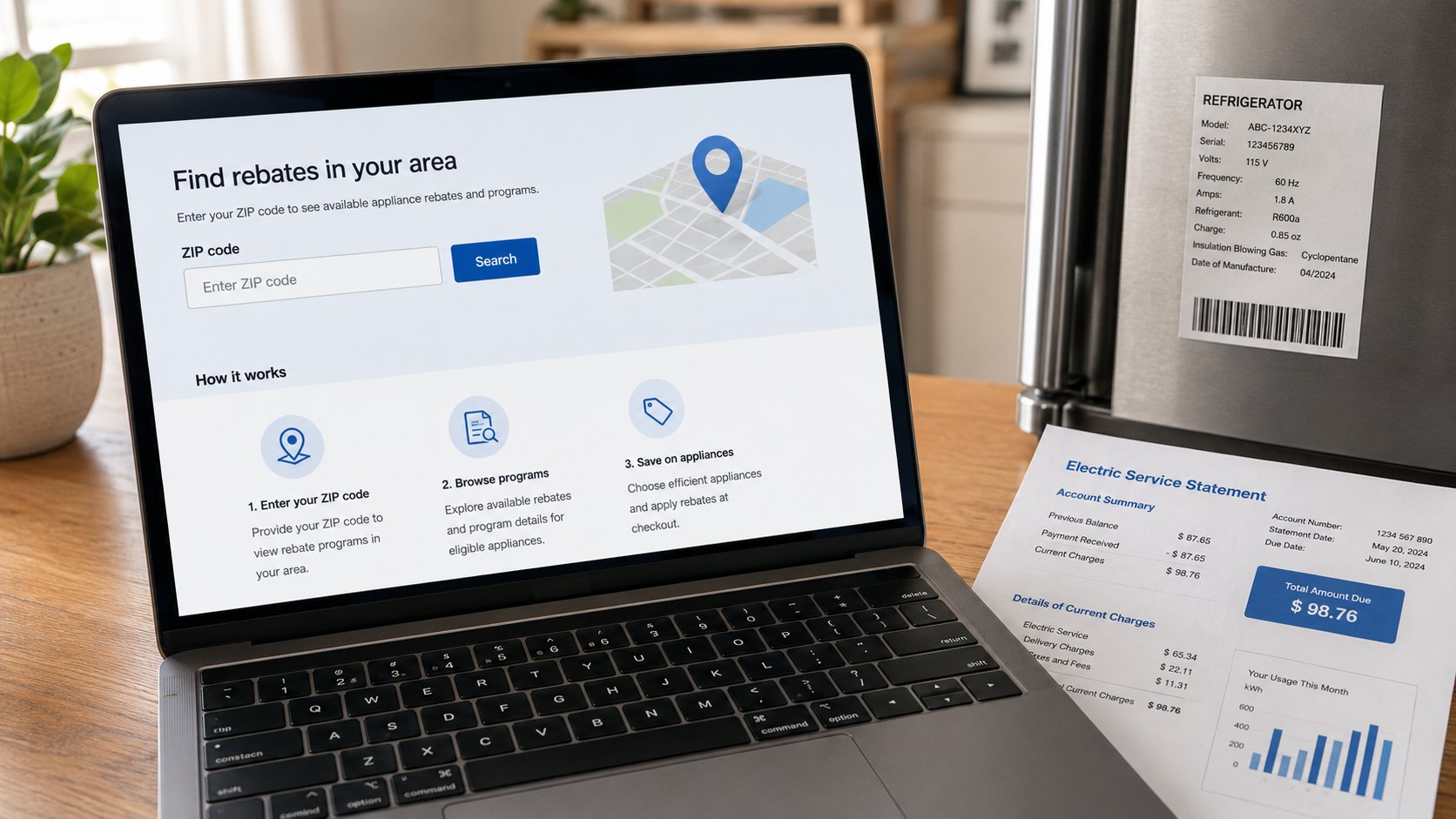
Enter the property ZIP code in the ENERGY STAR Rebate Finder, then check the electric utility’s website. In 2026, refrigerator offers can include free pickup, a cash incentive, or a rebate toward a qualifying ENERGY STAR replacement.
This step matters because some programs pay residents to remove inefficient refrigerators from service. Programs may require the unit to be plugged in and cooling when the crew arrives, so do not unplug it days before pickup unless the written instructions allow it.
A common mistake is assuming that every old refrigerator qualifies. Utilities may restrict incentives by appliance age, internal capacity, customer type, service address, or whether the refrigerator is the household’s primary or secondary unit.
Residents of Maryland should check offers from local providers such as BGE, Delmarva Power, Pepco, or Potomac Edison. Programs in California, New York, Texas, Florida, Ohio, and other states operate under different terms and may change incentive amounts during 2026.
A rebate for disposal does not automatically mean the replacement model is economical. Compare purchase price, warranty coverage, energy use, repair access, and expected ownership costs using the Baltimore Chronicle overview of the best refrigerator brands in the USA for 2026.
Step 3: Compare haul-away and local pickup prices
Ask the new-appliance seller for the complete delivered price, including old-unit removal. As of 2026, major retailers commonly price refrigerator haul-away at about $40 to $60 when a replacement is purchased and delivered, while a standalone large-appliance pickup can cost about $200.
Home Depot, Lowe’s, Best Buy, Costco, local appliance stores, and manufacturer-authorized dealers may offer old refrigerator haul-away. Fees can depend on the ZIP code, product, promotion, membership, delivery contractor, and whether the refrigerator is freestanding or built in.
This comparison matters because a quoted “free delivery” price may exclude removal. The checkout page should identify haul-away as a separate line item or state that it is included.
Avoid assuming the crew will remove doors, railings, cabinets, water lines, or a built-in refrigerator. Ask whether the unit must be disconnected, empty, defrosted, and positioned on the same floor as the exit.
- Get the retailer’s haul-away price in writing.
- Ask the city or county sanitation department about bulky-appliance pickup.
- Call the electric utility about rebates and operating-condition rules.
- Request a quote from a local appliance recycler or licensed junk hauler.
- Compare the net cost after rebates, transportation fees, and preparation requirements.
A retailer’s removal fee may still be the best option when delivery and pickup happen during the same appointment. Municipal collection can cost less, but it may require curb placement on a specific day.
Step 4: Confirm safe Freon and refrigerant handling
“Freon” is commonly used as a general name for refrigerator refrigerant, although different models may contain CFCs, HCFCs, HFCs, or newer refrigerants such as R-600a isobutane. The model label may identify the refrigerant type, but homeowners should not attempt to recover it themselves.
The recycler or final disposal facility must ensure that refrigerant is recovered before the refrigerator is dismantled or discarded. The US Environmental Protection Agency’s appliance-disposal guidance also addresses compressor oil and other appliance components that require responsible handling.
This requirement matters because releasing refrigerant can damage the environment and violate federal law. Some modern refrigerators use flammable refrigerants, creating an additional risk when tubing is cut, punctured, heated, or crushed.
Never drill the cabinet, saw through refrigerant lines, remove the compressor, or attempt homemade Freon removal from refrigerator. Do not accept a hauler’s suggestion that the unit can be left for informal scrap processing without refrigerant recovery.
A responsible pickup provider should identify the recycling facility or explain how refrigerant-containing appliances enter a compliant recovery process.
If a technician has already removed the refrigerant, keep the service invoice or signed recovery statement. A recycler may request documentation before accepting an appliance that appears to have been evacuated.
Step 5: Prepare the refrigerator for removal
Empty the refrigerator and freezer, discard unsafe food, and move usable items to a cooler or replacement appliance. Remove loose shelves, drawers, bins, and glass panels if the pickup company instructs customers to secure them separately.
This preparation matters because loose parts can shift while the refrigerator is tilted through a doorway or loaded onto a truck. Water from melting ice can also damage hardwood, laminate, carpet, stairs, and elevator floors.
A common mistake is unplugging the refrigerator without protecting the floor or checking rebate instructions. A utility program may require the appliance to remain operational until inspection, while a retailer may require it to be unplugged and defrosted before arrival.
Preparation checklist
- Confirm the pickup date and arrival window.
- Photograph the refrigerator’s condition and model label.
- Remove food, ice, shelves, magnets, and personal items.
- Turn off and disconnect the water supply when required.
- Drain the ice maker and water dispenser line.
- Tape or secure the power cord without damaging it.
- Measure doorways, halls, stairs, gates, and elevator openings.
- Protect floors and clear a route to the exterior door.
- Keep children and pets away from the work area.
Never place an unwanted refrigerator outdoors with the doors attached where children could enter it. If local rules require curb placement, follow municipal instructions for securing or removing doors without puncturing refrigerant tubing.
Renters should obtain the landlord’s approval before removing an appliance supplied with the unit. A refrigerator that belongs to the property owner should not be sold, recycled, or discarded by the tenant.
Step 6: Complete the pickup and keep proof
On pickup day, verify that the crew is removing the correct refrigerator and that the quoted charge matches the order. Ask for a receipt showing haul-away, recycling, or appliance removal rather than accepting an undocumented cash-only pickup.
This record matters if a utility rebate requires proof, a landlord requests documentation, or the appliance is later found abandoned. It also helps resolve disputes when a retailer charges for removal but the delivery crew cannot complete it.
Avoid signing a completed-service form before checking the walls, doors, floors, stairs, and water connection. Photograph any damage immediately and report it through the retailer’s or contractor’s service channel.
Keep rebate confirmations until payment arrives. Utility incentives may be issued as a check, account credit, digital payment, or prepaid card, depending on the program.
When the refrigerator still works and no rebate is available, donation or resale may be possible. Confirm that a charity accepts large appliances and provides pickup before listing the unit. Many organizations reject older, inefficient, damaged, or nonworking models.
Households exposed to frequent outages should also consider whether the refrigerator failed because of unstable power rather than age alone. The Baltimore Chronicle guide to choosing a backup generator for a home explains how to calculate the wattage needed for essential appliances, including refrigerators.
Troubleshooting
- No utility program serves the address: Contact the municipal solid-waste department, county transfer station, or a local recycler that accepts refrigerant-containing appliances.
- The refrigerator does not work: Tell the pickup provider before booking. Some rebate programs accept only working units, but recyclers and retailer haul-away services may still take it.
- The crew refuses the appliance: Check whether it was empty, disconnected, accessible, and listed on the order. Built-in models and units with unsafe access may require a specialist.
- The city will not collect it with regular trash: Schedule a separate bulky-item or white-goods appointment. Do not leave the refrigerator at the curb without authorization.
- A scrap collector offers free pickup: Ask how refrigerant recovery will be documented and which facility will process the appliance. Choose another provider when the answers are vague.
Frequently asked questions
Can a refrigerator be placed in a dumpster?
Usually not without approval from the dumpster company and proper refrigerant recovery. Many landfills, transfer stations, and rental agreements prohibit intact refrigerators because they contain refrigerant, compressor oil, insulation foam, and other regulated components.
Who will pick up an old refrigerator for free?
Electric utilities, municipal programs, retailers running promotions, charities, and local recyclers may offer free refrigerator pickup. Eligibility often depends on the ZIP code, operating condition, appliance size, customer account, and whether a replacement is being delivered.
Can a homeowner remove Freon from a refrigerator?
No. Refrigerant recovery requires appropriate equipment and trained handling. Cutting a line can release refrigerant, oil, or flammable gas and expose the homeowner to injury and legal liability.
How much does refrigerator disposal cost in 2026?
The practical range is $0 to about $200. Utility rebates may make disposal free and provide an incentive, municipal services may charge a bulky-item fee, retailer add-on haul-away often costs about $40 to $60, and standalone pickup can cost about $200.
Should refrigerator doors be removed before disposal?
Follow the receiving program’s instructions. Door removal can reduce entrapment risk, but it must be done without damaging refrigerant lines, electrical wiring, hinges under tension, or electronic components.
What happens to a recycled refrigerator?
A qualified facility recovers the refrigerant, removes compressor oil and hazardous components, and separates recyclable materials such as steel, aluminum, copper, and some glass or plastic. Processing methods for insulation foam and electronic controls vary by facility and program.
Earlier we wrote about DIY Kitchen Cabinet Installation Guide: Tools, Layout, and Mounting