


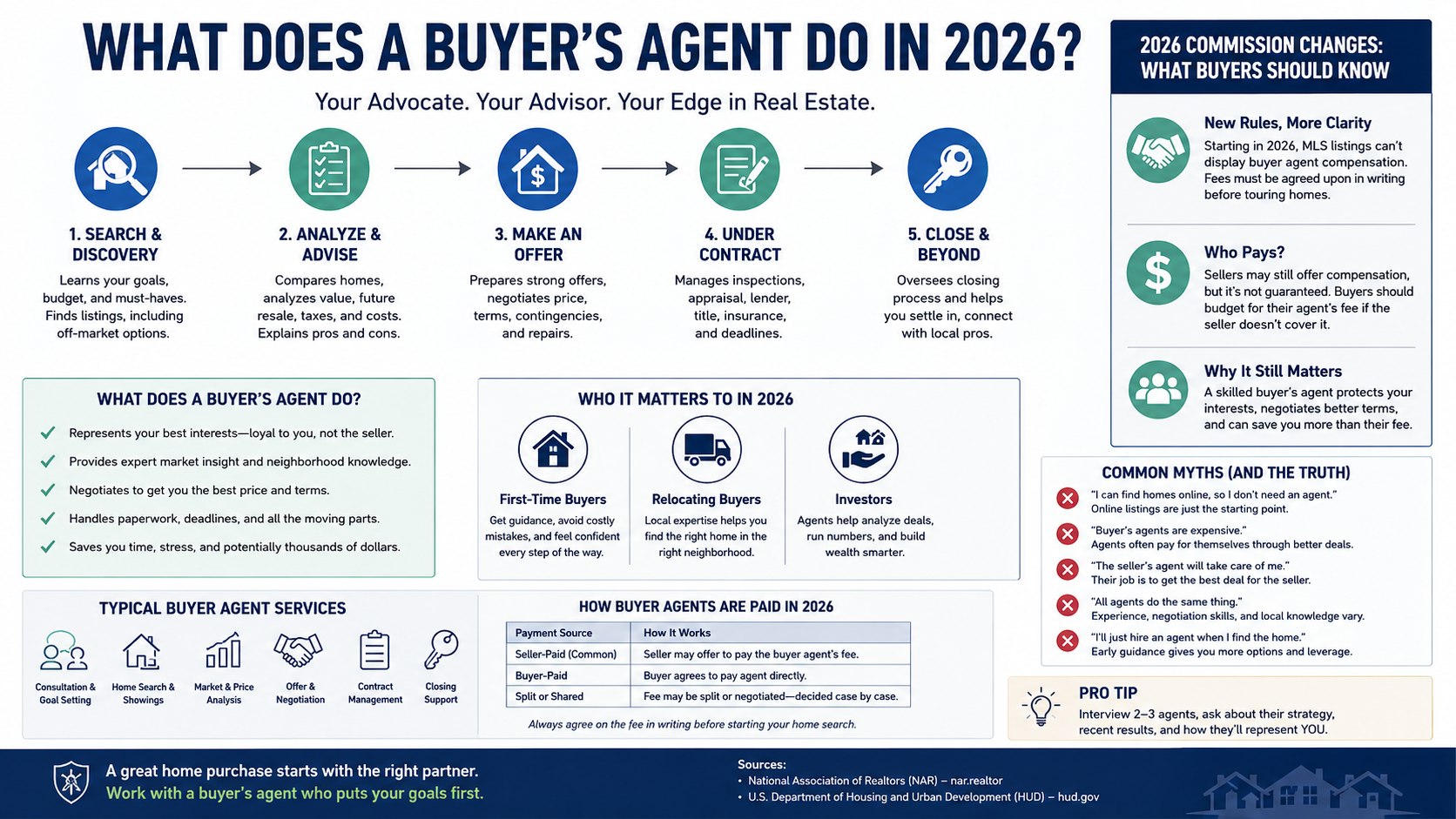
A buyer’s agent is a licensed real estate professional who represents the interests of homebuyers, guiding them through property searches, offer negotiations, inspections, financing, and closing transactions. In 2026, with evolving commission models and tighter market conditions across the USA, understanding what does a buyer’s agent do is critical for anyone planning to buy a home, investment property, or second residence—especially when decisions made early can affect costs and outcomes later, аs noted by Baltimore Chronicle.
Key takeaways:
- Buyer’s agents act as advocates for buyers, not sellers.
- Commission structures in 2026 are shifting, making agent choice more important.
- A good agent can reduce risks, reveal off‑market opportunities, and streamline closing.
In plain English
Imagine you’re shopping for a car in a huge lot with thousands of options, scattered pricing, and no clear checklist of what’s included. A buyer’s agent is like a trusted mechanic with deep local market knowledge. They not only point you to the best options but also spot issues you might miss, negotiate price and terms, and help finalize paperwork. In real estate, that expertise can save thousands of dollars and reduce stress.
How it actually works
Buyer representation agreement
When you first engage an agent, you typically sign a buyer representation agreement. This document defines the scope of work, how the agent is paid, and the duration of the relationship. It legally obligates the agent to work for you, not the seller or listing agent.
Property search and MLS access
Agents use the Multiple Listing Service (MLS)—the primary industry database for active properties—to find homes that match your criteria. They also tap into off‑market listings that don’t appear on public sites like Zillow or Redfin. This can be especially valuable in competitive markets such as Los Angeles, Seattle, or Boston, where desirable homes are snapped up quickly.
Agents perform comparative market analysis (CMA) using real prices from recent sales to help you assess fair value and avoid overpaying, a topic closely linked to understanding home equity trends and local neighborhood performance.
Showings and inspections
A buyer’s agent schedules showings, tours properties with you, and highlights potential red flags. They coordinate with licensed home inspectors to evaluate structural, electrical, and mechanical conditions. A thorough inspection can uncover issues that affect safety and future costs.
Offers and negotiation
Once you choose a property, the agent figures out a strategic offer price and terms. They write and submit the paperwork, respond to counteroffers, and advocate for your interests when negotiating contingencies, closing dates, and seller concessions.
Skilled negotiation in 2026 is especially important given tighter inventory and rising borrowing costs. Agents often draw on past experience and data to strengthen your position.
Closing coordination
Closing a real estate transaction involves many documents and deadlines. Agents coordinate with lenders, title companies, and your attorney (if applicable) to ensure:
- All disclosures are reviewed.
- Financing deadlines are met.
- Title and escrow issues are resolved.
They help you understand closing statements and confirm that agreements are honored.
Who it matters to in 2026
First‑time homebuyers
First‑timers benefit the most from an agent’s guidance. Contracts, inspections, and financing are unfamiliar territories for many buyers. An agent helps avoid pitfalls that could cost thousands.
For tips on preparing financially, see our article on how to budget for a first home purchase.
Investors and second‑home buyers
Buyers looking at rental properties or vacation homes rely on agents for market trend insights, rent estimates, cap rate considerations, and off‑market deals. These factors affect investment performance and future resale.
Relocating or out‑of‑state buyers
If you’re moving from one state to another, like from Texas to Florida or New York to Illinois, a buyer’s agent familiar with local markets helps bridge gaps in knowledge about schools, zoning, taxes, and neighborhood values.
Commission and fees in 2026
Traditionally, buyer’s agents were compensated via a percentage of the home’s sale price—often 2–3%—paid by the seller through the listing agent’s agreement. As of 2026, some trends include:
| Commission Type | Typical Range | Notes |
|---|---|---|
| Percentage | 2%–3% | Standard in many US markets |
| Flat fee | $3,000–$8,000 | Common for higher‑value homes |
| Hybrid | 1% + flat fee | Emerging in competitive urban markets |
These evolving models affect how agents are compensated and how buyers negotiate representation contracts. Always clarify payment terms before signing.
Common myths
- Buyer’s agents are free: Not exactly. Sellers may pay commission, but that cost is often embedded in the sale price.
- They only show homes: Agents manage negotiations, paperwork, timelines, and risk mitigation.
- Online tools replace agents: Tools help research, but they can’t negotiate or access every listing.
- All agents are the same: Experience, local knowledge, and negotiation skills differ significantly.
Understanding these myths ties into knowing how real estate market cycles work and what drives home values.
Checklist: Choosing a buyer’s agent
- Verify state licensing and credentials.
- Review recent sales in your target neighborhoods.
- Ask about experience with 2026 commission structures.
- Get references from past clients.
- Confirm communication style and availability.
- Understand the representation agreement fully.
- Ensure MLS and off‑market access.
- Learn negotiation philosophy.
- Discuss how they handle inspections and contingencies.
How to maximize value from a buyer’s agent
Provide clear criteria for your ideal property, including budget, location, and must‑have features. Pre‑approval from a lender strengthens your offer and helps agents act quickly in hot markets like Phoenix or Denver.
Let agents schedule inspections and review reports with you. Their experience can highlight issues you might otherwise overlook. If relocating, consider speaking with agents in both your current and destination markets for broader insights.
Maintaining a collaborative relationship, with transparent expectations on both sides, leads to smoother transactions and better outcomes.
Related services and tools
Here are tools and services that often work alongside a buyer’s agent:
| Service | Purpose | Notes |
|---|---|---|
| MLS Access | Central listing database | Core source for available properties |
| Zillow/Redfin | Trends & estimates | Useful data but not definitive pricing |
| Home inspectors | Property condition assessment | Agents usually help schedule and review |
| Mortgage lenders | Loan pre‑approval & financing | Rates vary; verify current 2026 terms |
| Title & escrow | Legal and ownership transfer | Essential for closing accuracy |
These tools complement agent services but do not replace the personalized support an agent provides.
Who regulates buyer’s agents?
In the USA, each state regulates agent licensing and conduct. National groups like the National Association of Realtors (NAR) set ethical standards and codes of practice. Federal laws, including those enforced by the U.S. Department of Housing and Urban Development (HUD), ensure compliance with fair housing regulations.

What to expect in 2026 markets
Interest rates and housing supply dynamics in 2026 may slow overall transaction volumes in some states but make other regions highly competitive. In such environments, agents with deep local knowledge help buyers:
- Identify emerging neighborhoods.
- Evaluate realistic offer prices.
- Time their entry into the market.
In markets like San Francisco or Washington, D.C., where competition remains strong, agents can source listings before they’re widely marketed and craft offers that stand out.
Frequently Asked Questions
Do I need a buyer’s agent if I use online listings?
Yes. Listing portals show available homes, but agents add negotiation strategy, access to off‑market opportunities, and help manage legal documents and deadlines.
How are buyer’s agents compensated in 2026?
Compensation varies. Many agents work on commission from the seller, but flat fees and hybrid agreements are increasingly common. Always confirm terms before engagement.
Can a buyer’s agent help with investment properties?
Yes. Agents knowledgeable about investment criteria help evaluate cash flow potential, rental demand, and resale value.
Are buyer’s agents available in all US states?
Yes, but licensing requirements and regulations differ. Verify credentials for the state where you’re buying.
Can I change my buyer’s agent during the process?
Typically yes, but review your representation agreement for any obligations or notice requirements.
Do buyer’s agents handle closing paperwork?
Yes. They coordinate with lenders, title companies, and attorneys to ensure documents are complete and deadlines met.
Earlier we wrote about How to Legally Remove Activation Lock on iPhone 2026 Without Losing Data