


AI robots in 2026 are moving from staged demonstrations toward measurable deployment tests. The field is still early, but the center of gravity has shifted. Companies now have to show not only motion, but endurance, safety, cost, fleet learning and repeatable work.
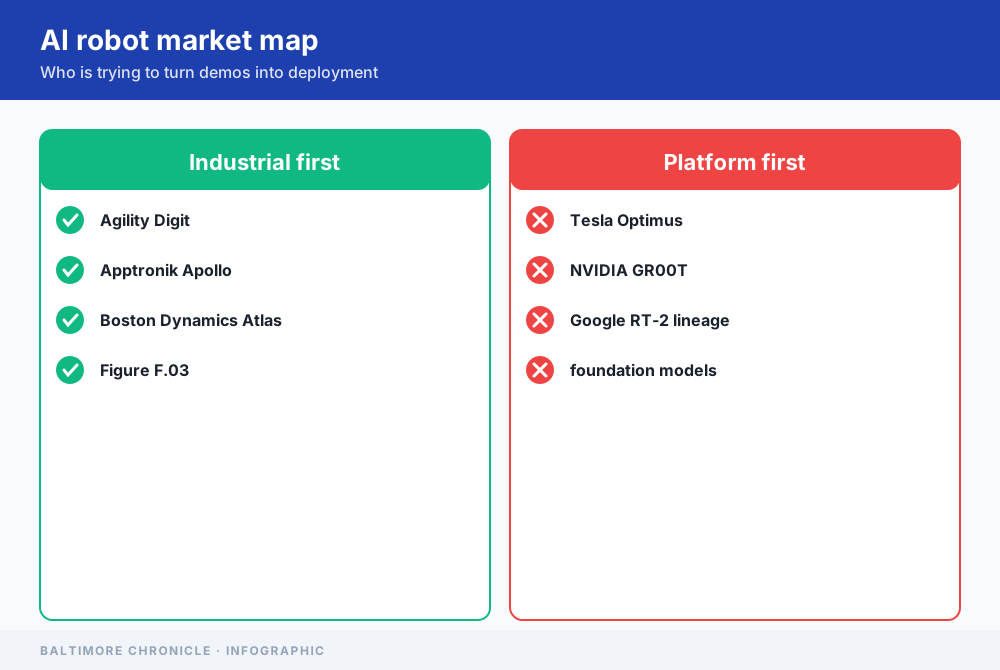
The most important names are not all doing the same thing. Figure is pushing Helix and Figure 03. Tesla is developing Optimus. Agility Robotics is focused on Digit in industrial settings. Apptronik is positioning Apollo for commercial work. Boston Dynamics is bringing Atlas toward enterprise applications. NVIDIA and Google DeepMind are building model and data layers that could power many robots. This is the landscape behind Figure’s F.03 live work-shift stream.
Figure: the public endurance test
Figure’s strongest 2026 signal is the push to show humanoid work in public, especially through Figure 03 and Helix. The company’s official materials emphasize a redesigned sensory suite, palm cameras, tactile sensors and a body-control architecture meant to connect perception to movement.
That gives Figure a clear story: dexterity plus autonomy. The risk is scale. Building a few impressive robots is not the same as producing, servicing and updating many robots in real customer environments. The next proof point is fleet reliability.
Tesla: the scale argument
Tesla Optimus remains the most visible scale bet in humanoid robotics. Tesla describes Optimus as a general-purpose bipedal autonomous humanoid robot for unsafe, repetitive or boring tasks. Tesla’s advantage is not only software; it is manufacturing culture, battery experience, actuator development and a large engineering base.
The challenge is proving dexterity and reliability. Cars operate in a difficult world, but humanoid robots must physically touch objects, work around people and handle unstructured spaces. Tesla’s market credibility will depend on long-duration work demonstrations, safety progress and actual deployment data.
Agility Robotics: the warehouse-first approach
Agility Robotics presents Digit as a humanoid already in production deployment. The company’s public materials focus heavily on logistics and facility floors, which is a practical starting point. Warehouses have repetitive tasks, measurable workflows and labor gaps that can make robotics economically attractive.
This approach may look less spectacular than a general-purpose home robot, but it is commercially sensible. A narrow task that saves money is more valuable than a broad promise that cannot be deployed. That is why our article on humanoid robots in warehouses focuses on mixed human-robot workflows rather than total replacement.
Apptronik and Boston Dynamics: industrial credibility
Apptronik’s Apollo is designed around commercial humanoid deployment, with specifications such as a 5-foot-8 body, 160-pound weight, hot-swappable battery concept and payload positioning for work environments. Boston Dynamics’ Atlas brings decades of dynamic robotics experience into a newer enterprise humanoid push.
These companies show that the humanoid race is not only an AI-model race. Mechanical design, serviceability, safety engineering and customer integration matter. A robot that is slightly less “general” but more reliable may win early contracts.
NVIDIA and Google DeepMind: the model layer
NVIDIA’s Isaac GR00T initiative and Google DeepMind’s RT-2 work point to the software foundation beneath the hardware race. RT-2 helped define the idea of vision-language-action models for robot control. GR00T focuses on humanoid robot foundation models, synthetic data and simulation tooling.
The model layer could become the Android of robotics, or it could stay fragmented. If common model architectures and datasets spread, smaller robotics companies may move faster. If every robot needs a custom stack, progress may remain uneven and expensive.
What risks could slow the market?
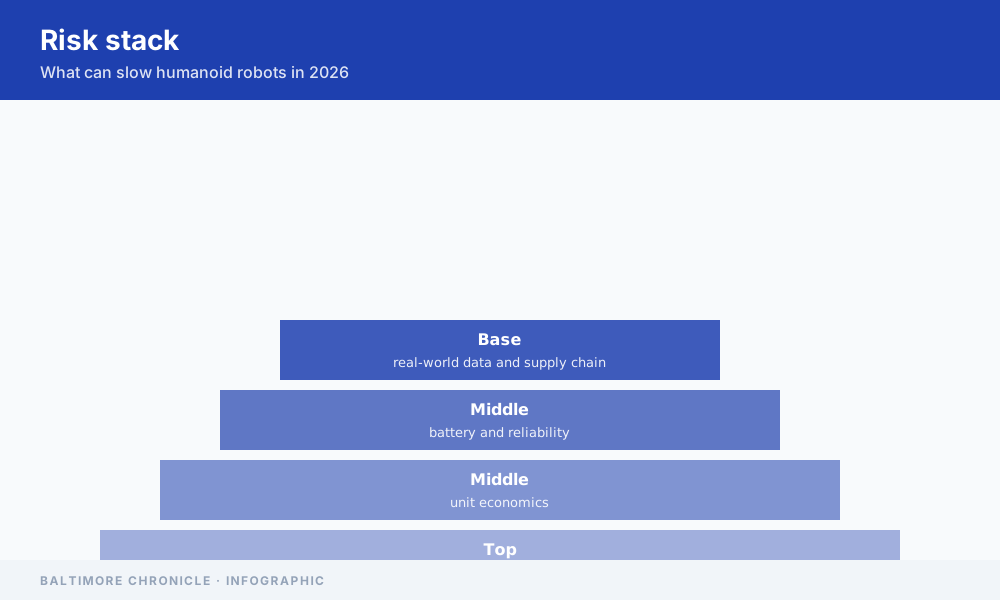
The first risk is safety. A humanoid robot is heavy, powered and mobile. It may work near people, fragile objects and expensive equipment. Buyers will demand evidence that the robot can fail safely, stop reliably and be supervised.
The second risk is economics. A robot has to beat the total cost of the alternative, not just the hourly wage of a worker. That includes purchase or leasing cost, maintenance, charging, downtime, software, integration, insurance and support.
| Risk | Why it matters | What would reduce it |
|---|---|---|
| Safety incidents | one failure can slow adoption | certification and transparent testing |
| High unit cost | buyers need ROI | manufacturing scale and leasing |
| Poor uptime | robots must work shifts | service networks and diagnostics |
| Weak generalization | demos do not equal deployment | broader real-world datasets |
| Public backlash | jobs and safety are political | honest communication and worker training |
What to expect in 2026
Expect more long videos, more factory and warehouse pilots, more claims about foundation models and more partnerships between robot makers and logistics or manufacturing companies. Also expect many demos to look better than the underlying business case. The market will reward evidence, not adjectives.
The most convincing announcements will include task duration, number of robots, customer name, operating environment, safety constraints and whether humans are supervising. The least convincing will show a single robot doing one polished action with no measurable context.
- Watch for multi-hour autonomous runs, not only short clips.
- Look for customer deployments with named partners.
- Check whether robots are solving a paid workflow.
- Separate hardware specs from AI-control capability.
- Ask how failures are handled and logged.
Bottom line
AI robots are becoming a real industrial category, but the hype cycle is ahead of deployment. The companies that matter in 2026 will be the ones that can turn demos into repeatable, safe, economically useful work. That means bodies, models, data and operations must mature together.
The humanoid race is no longer about who can make a robot look alive; it is about who can make one useful. To understand the software behind the shift, read our guide to VLA models. To understand the hardware challenge, read why tactile sensors matter. Related Baltimore Chronicle coverage includes AI model development and Honor’s humanoid robot investment.