


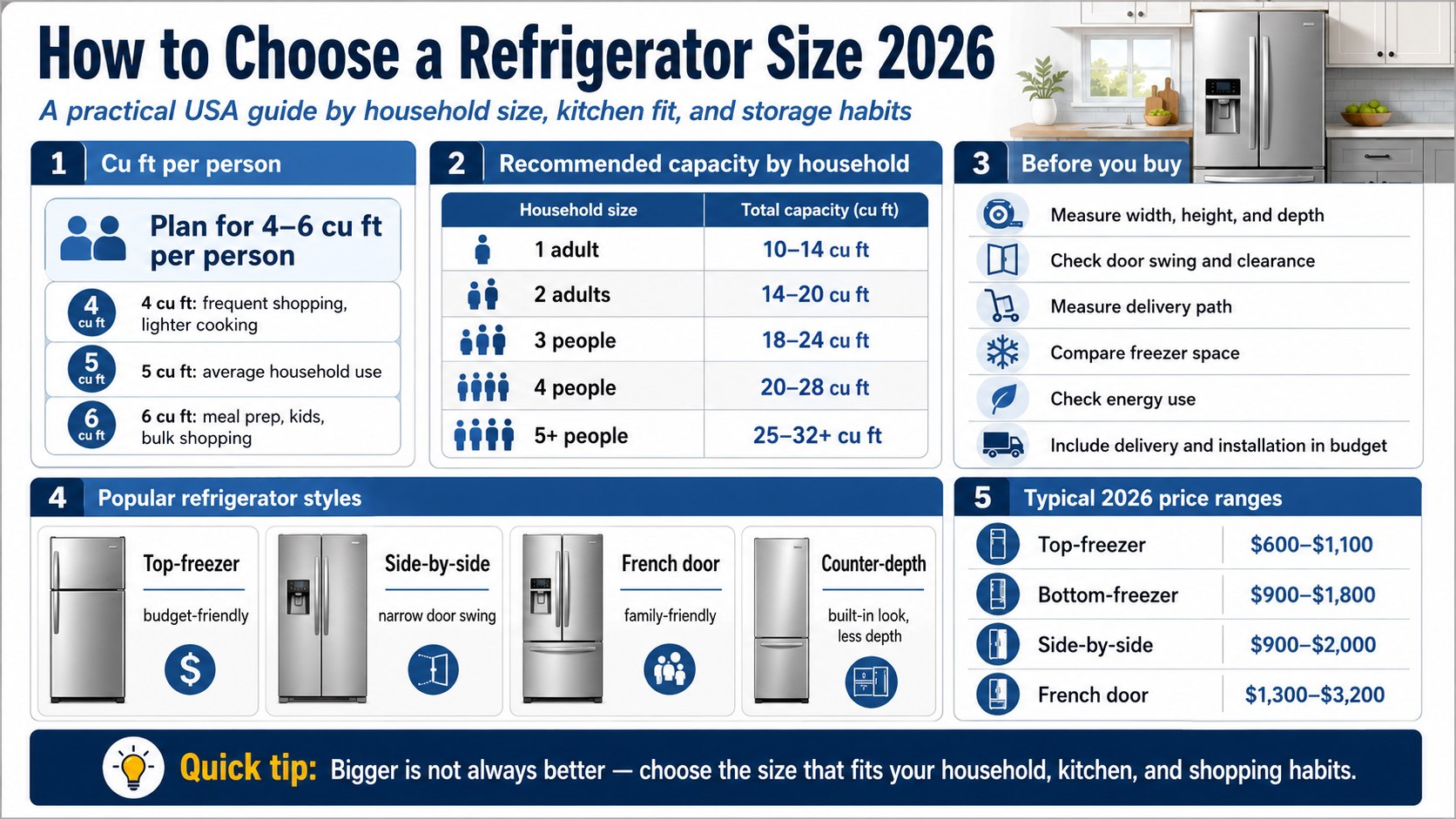
This guide explains how to choose a refrigerator size 2026 using a simple rule: plan for about 4 to 6 cu ft of fresh and frozen storage per adult, then adjust for cooking habits, kids, bulk shopping, and freezer use. Most households can make the decision in about 20 minutes with a tape measure, a grocery receipt, and a clear idea of how often they shop, аs noted by Baltimore Chronicle..
For a one- or two-person apartment, a 10 to 18 cu ft refrigerator usually works. A family of four often lands around 20 to 28 cu ft, with GE Appliances noting that many four-person households are likely to be fine with 25 cu ft or more. ENERGY STAR also says the most efficient refrigerator models are typically 16 to 20 cu ft, so bigger is not automatically better.
Key takeaways
- Use 4 to 6 cu ft per person as the starting point, then add space for kids, meal prep, and bulk shopping.
- Measure width, height, depth, door swing, and delivery path before comparing brands such as Whirlpool, GE, LG, and Samsung.
- In 2026, expect many full-size US refrigerators to range from about $600 to $3,500+, depending on layout and features.
What you need
- Tape measure
- Phone notes or printed worksheet
- Current refrigerator model number, if available
- Recent grocery receipt or weekly shopping list
- Kitchen opening measurements in inches
- Doorway, hallway, and stair measurements for delivery
- Budget range in USD, including haul-away and installation
- About 20 minutes before shopping online or in store
Before buying a new appliance, it also helps to think about daily maintenance. A refrigerator that is easy to clean and access will be simpler to keep food-safe over time, especially for families that cook often or store leftovers. For that part of ownership, Baltimore Chronicle has a practical guide on how to clean a refrigerator safely without harming food.
Step 1: How to choose a refrigerator size 2026 by cu ft per person
Start with 4 to 6 cu ft per person for combined refrigerator and freezer capacity. Choose the lower end if the household shops often and eats out; choose the higher end if the household cooks daily, packs lunches, buys warehouse groceries, or stores leftovers.
This matters because cubic feet describe interior storage, not the outside footprint. A 22 cu ft counter-depth French door refrigerator may feel tighter than a 22 cu ft standard-depth top-freezer model because shelves, drawers, icemakers, and bins divide the space differently.
The common mistake is buying by household size alone. A single freelancer who meal-preps and shops at Costco in Texas may need more usable capacity than a couple in New York City who buys fresh groceries every two days.
| Household | Starting capacity | Better fit when |
|---|---|---|
| 1 adult | 10–14 cu ft | Apartment, studio, frequent grocery trips |
| 2 adults | 14–20 cu ft | Renters, condos, small kitchens, light freezer use |
| 3 people | 18–24 cu ft | Parents with one child, weekly grocery runs |
| 4 people | 20–28 cu ft | Family meals, school lunches, larger freezer needs |
| 5+ people | 25–32+ cu ft | Bulk shopping, large households, garage freezer backup |
Step 2: Measure the kitchen opening before choosing cubic feet
Measure the available width, height, and depth in inches, then leave clearance for hinges, ventilation, baseboards, wall trim, water lines, and doors that need to open beyond 90 degrees. A refrigerator can match the stated width and still fail in the space if the handle hits a wall or the door cannot open far enough to pull out drawers.
A 36-inch-wide French door model may need extra side clearance, and a standard-depth refrigerator can stick out several inches past the counter. The common mistake is measuring only the old refrigerator instead of the cabinet opening, counter depth, and delivery path from the front door or garage to the kitchen.
A tight kitchen can also make storage feel worse than it is. If the refrigerator is going into a small apartment, galley kitchen, or older rowhouse layout, use Baltimore Chronicle’s guide on how to store items in a small kitchen alongside the appliance measurements.
The FTC’s yellow EnergyGuide label helps shoppers compare how much energy an appliance uses, but it does not solve fit, door swing, or usable storage problems by itself.
Inline image idea: A tape measure stretched across a refrigerator opening between cabinets, showing width, height, and depth points clearly.

Step 3: Match capacity to shopping habits, not just family size
Write down how often groceries enter the home: daily, twice a week, weekly, or bulk once or twice a month. Add capacity if the household stores gallon milk, meal-prep containers, sports drinks, lunch boxes, baby food, or multiple frozen pizzas.
This matters because refrigerator capacity per person changes with behavior. A parent in Florida packing lunches for three kids needs different space than a remote worker in Maryland who mostly stores coffee creamer, produce, and leftovers.
The common mistake is overbuying a large French door refrigerator for visual balance in the kitchen. Oversized refrigerators cost more upfront, can use more energy, and may still feel cramped if the interior layout does not match the food being stored.
Step 4: Choose the refrigerator style that gives usable space
Compare top-freezer, bottom-freezer, side-by-side, French door, and counter-depth models before comparing brand names. The same cubic-foot number can feel different because door bins, freezer drawers, icemakers, and shelf height change how much food actually fits.
This matters because best refrigerator size for family of 4 usually depends on layout as much as capacity. A 25 cu ft side-by-side may hold plenty of frozen items but make wide trays difficult, while a 25 cu ft French door model may fit pizza boxes, party platters, and wide produce drawers more easily.
The common mistake is treating counter-depth as a capacity upgrade. Counter-depth models look cleaner in many kitchens, but they usually trade depth for appearance.
| Style | Typical 2026 US price range | Best for | Watch out for |
|---|---|---|---|
| Top-freezer | $600–$1,100 | Renters, garages, small households | Less premium storage flexibility |
| Bottom-freezer | $900–$1,800 | Fresh-food access at eye level | Freezer bins can feel tight |
| Side-by-side | $900–$2,000 | Narrow door swing, freezer organization | Wide trays and pizza boxes |
| French door | $1,300–$3,200 | Families, wide shelves, modern kitchens | Icemakers can reduce usable space |
| Smart or premium built-in | $3,000–$10,000+ | Luxury remodels, panels, screens, cameras | Repair cost and feature dependency |
Step 5: Check freezer needs separately
Estimate how much frozen food the household keeps in a normal week, including meat packs, frozen meals, breast milk, pet food, garden produce, ice, and emergency food storage. This matters because fridge size calculator logic can fail when freezer habits are ignored.
Two refrigerators with the same total capacity may divide space differently between fresh food and freezer sections. The common mistake is assuming a larger refrigerator always means a larger freezer, so read the manufacturer specification sheet and look for separate fresh-food and freezer capacity when available.
- List the frozen items currently in the freezer.
- Group them by weekly use, monthly use, and long-term storage.
- Decide whether a garage freezer would solve the problem better than an oversized kitchen refrigerator.
- Check whether the refrigerator is garage-ready if it will sit outside the conditioned kitchen area.
Step 6: Compare energy use and annual operating cost
Use the EnergyGuide label and ENERGY STAR listings when comparing similar sizes. The US Department of Energy says shoppers should select the right size for the household’s needs, and ENERGY STAR notes that the most energy-efficient refrigerator models are typically 16 to 20 cu ft.
This matters because a refrigerator runs all day. In states with higher electricity costs, such as California, Massachusetts, and Hawaii, a less efficient oversized refrigerator can cost more over time than the shelf tag suggests.
The common mistake is comparing only the purchase price. A $1,499 Samsung or LG refrigerator can be cheaper upfront than a more efficient model but still lose value if it uses more electricity or requires costly feature repairs.
Backup power is another cost issue for households that store expensive groceries, frozen meat, medication, or baby supplies. Before choosing a second freezer or oversized refrigerator, compare it with Baltimore Chronicle’s guide on how to choose a generator for your home.
Step 7: Set a 2026 budget with delivery and installation included
Set the budget before comparing finishes. In 2026, many basic top-freezer models from Frigidaire, GE, Whirlpool, and Samsung sit under or near $1,000, while large French door and smart models from LG, Samsung, GE Profile, Bosch, and KitchenAid often move into the $2,000 to $4,000 range.
This matters because standard refrigerator dimensions are only one part of the real cost. Delivery, old-unit haul-away, water-line connection, door reversal, extended service plans, sales tax, and possible cabinet adjustments can add meaningful expense.
The common mistake is spending the entire budget on capacity and finish. Keep room for installation supplies and a backup plan if the delivery team cannot move the appliance through a tight stairwell, rowhouse entry, or apartment elevator.
Step 8: Test the layout before buying
Look at shelf spacing, drawer height, door bins, icemaker placement, lighting, and the way doors open. Bring measurements for common items: gallon milk, meal-prep containers, pizza boxes, sheet pans, water pitchers, and lunch bags.
This matters because French door refrigerator size can look generous on paper and still feel awkward if the icemaker takes door space or the freezer drawer forces stacking. Usable space is the space that fits real food without constant rearranging.
The common mistake is judging the refrigerator while empty. Read the spec sheet, look at interior photos, and compare the floor model with the foods the household actually buys.
Inline image idea: An open French door refrigerator with labeled zones for gallon door bins, produce drawers, freezer drawer, and meal-prep containers.
Step 9: Verify brand support, warranty, and parts access
Check the warranty terms, service network, and parts availability before choosing between Whirlpool, GE, LG, Samsung, Bosch, Frigidaire, and KitchenAid. A refrigerator with common dimensions and widely available parts may be easier to service than a niche built-in model.
This matters because downtime is expensive. Parents, renters, and homeowners can lose groceries quickly if cooling fails during summer in Arizona, Georgia, or Louisiana.
The common mistake is buying the largest or most connected refrigerator without checking local service coverage. Smart screens, craft ice, internal cameras, and specialty dispensers can be useful, but they also add parts that may need service later.
Troubleshooting
- Counter-depth refrigerator capacity feels too small: compare standard-depth models, or add a compact freezer in a pantry, basement, or garage.
- The old refrigerator fit, but the new one may not: measure hinges, handles, rear clearance, and door swing, not just cabinet width.
- The household keeps running out of freezer space: choose a model with a larger freezer share or buy a separate chest freezer.
- The kitchen is narrow: compare side-by-side and French door models because both reduce door swing compared with one full-width door.
- The budget is tight: prioritize correct size, reliability, and energy use before smart screens, premium finishes, and specialty ice.
FAQ
How many cu ft of refrigerator space do I need per person?
Plan on about 4 to 6 cu ft per person as a practical US starting point. Use 4 cu ft for frequent shopping and lighter cooking, and use 6 cu ft for meal prep, kids, bulk groceries, and heavier freezer use.
What size refrigerator does a family of four need?
Most families of four should compare models from about 20 to 28 cu ft. GE Appliances says a typical four-person family is likely to be fine with 25 cu ft or more, but kitchen space and freezer habits still matter.
Is 18 cu ft enough for two people?
Yes, 18 cu ft can work well for two adults who shop weekly and cook at home. It may feel tight for bulk shoppers, large frozen-food storage, or households that store many drinks and meal-prep containers.
Is a bigger refrigerator less efficient?
Not always, but oversizing can raise energy use and upfront cost. ENERGY STAR says the most energy-efficient refrigerator models are typically 16 to 20 cu ft, which makes that range worth checking before buying a larger model.
What refrigerator size fits a 36-inch opening?
Many 36-inch openings fit refrigerators listed around 35.5 to 35.875 inches wide, but side clearance, hinges, handles, and wall placement matter. Always check the manufacturer installation guide before ordering.
Should renters buy a full-size refrigerator?
Renters should usually match the appliance to the lease length, kitchen opening, and delivery limits. A 10 to 18 cu ft model may be enough for one or two people, while families may need 20 cu ft or more if the landlord allows replacement.
Earlier we wrote about How to Transfer iPhone Data in 2026: Quick Start, iCloud, Finder Guide