

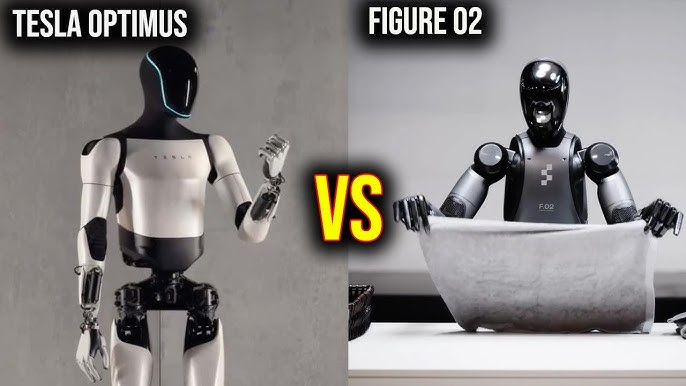
Figure 03 and Tesla Optimus are chasing the same prize with very different advantages. Figure is trying to prove real robot labor through public demonstrations, sensor-rich hands and a Helix control stack. Tesla is trying to turn its AI, manufacturing culture and capital scale into a general-purpose humanoid that can handle unsafe, repetitive or boring tasks.
The comparison matters because humanoid robotics is entering a new phase. A few years ago, the key question was whether these robots could walk convincingly. Now the better question is which company can make a robot useful enough to justify deployment. That connects directly to Figure’s F.03 live work-shift test, where the most valuable signal is not style but repeatable work.
What Figure 03 is trying to prove
Figure 03 is built around a clear thesis: a humanoid needs better perception at the point of contact. The official Figure 03 announcement emphasizes a redesigned sensory suite, palm cameras and tactile sensing. The company’s Helix 02 post goes further, describing how those inputs feed the robot’s whole-body autonomy system.
That makes Figure’s public demonstrations unusually focused on manipulation. The robot must reach into spaces, see objects even when its head camera is blocked, sense light forces and adjust its grip. In a warehouse or home, that is more valuable than perfect choreography. The world is full of soft bags, loose clothes, uneven packages and objects that slip.
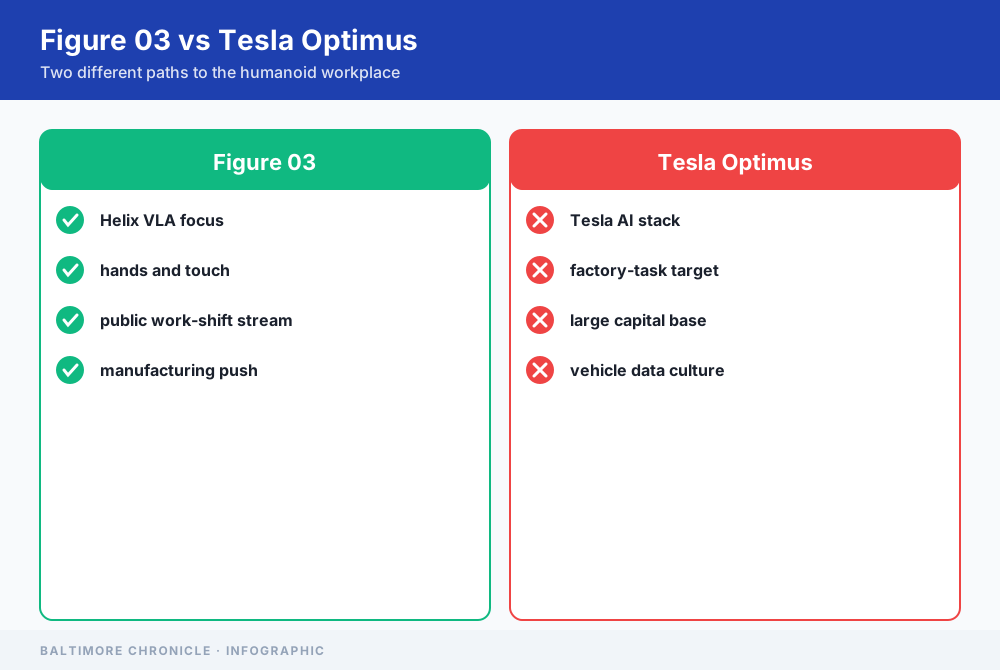
- Figure’s advantage is a tight link between hardware and the Helix autonomy stack.
- The palm-camera design directly targets occlusion during grasping.
- The tactile sensors target a common failure mode: gripping with too little or too much force.
- The public work-shift stream creates a stronger endurance signal than edited clips.
What Tesla Optimus is trying to prove
Tesla Optimus is positioned as a general-purpose, bipedal autonomous robot. Tesla’s AI & Robotics page says the goal is to create a robot capable of tasks that are unsafe, repetitive or boring. That framing fits Tesla’s broader culture: build a platform, scale hardware production and improve autonomy over time.
Tesla has strengths that few robotics startups can match. It understands high-volume manufacturing, batteries, motors, real-world AI infrastructure and global supply chains. It also knows how to sell a long-range vision to investors and customers. But humanoids are not cars on legs. Hands, balance, contact-rich manipulation and workplace safety introduce different engineering and certification problems.
Which company looks closer to real deployment?
“Closer” depends on the definition. Figure currently looks more focused on visible humanoid work demonstrations. Tesla looks better positioned for eventual manufacturing scale if the robot reaches a reliable design. The hard part is that robotics rewards both: a useful robot must work in the real world and be affordable enough to deploy.
The live-stream style of demonstration gives Figure a near-term credibility advantage. It exposes the robot to a longer observation window and lets viewers judge pauses, resets and recovery. Tesla’s advantage is different: if Optimus becomes reliable, Tesla has the industrial muscle to produce and iterate quickly.
| Category | Figure 03 | Tesla Optimus |
|---|---|---|
| Core message | Helix-powered humanoid for practical tasks | General-purpose robot for repetitive or unsafe work |
| Visible strength | Hands, sensing, live demos | Scale, manufacturing, AI infrastructure |
| Open question | Can it scale economically? | Can it master dexterous real-world work? |
| Best early market | warehouses, factories, controlled homes | Tesla factories, logistics, later consumer use |
Why hands may decide the race
Walking is necessary, but hands create value. A humanoid that walks beautifully but cannot handle ordinary objects is a mobile statue. In many jobs, the robot must pick, orient, sort, carry, fold, wipe, open, close or place objects. That is why tactile sensing and in-hand vision are so important, as explained in our separate guide to robot touch sensors.
Figure has made hand perception a public part of its story. Tesla has shown Optimus performing tasks in videos, but buyers will want to know how robustly it handles object variation. The winner may be the robot that makes fewer dramatic motions but completes more boring tasks without help.
Where VLA models fit into the comparison
Both companies are part of a wider shift toward embodied AI: systems that do not just answer questions, but control bodies. VLA models connect vision, language and action. Google DeepMind’s RT-2 helped popularize this model category by showing how web-scale vision-language knowledge could be adapted for robot control. NVIDIA’s GR00T work points in a similar direction for humanoid foundation models.
The software race is about generalization. A scripted robot can work well in a fixed station. A useful humanoid has to understand a new scene, relate a command to objects and adjust motion when reality differs from training data. That is why our explainer on VLA models in robotics is essential background for this comparison.
What investors and buyers should watch
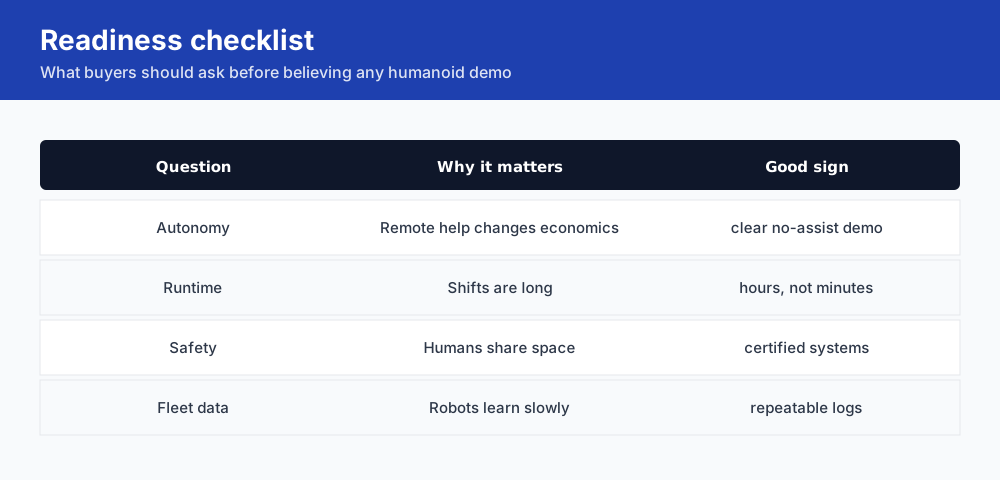
For investors, the key signals are not social-media views. They are manufacturing cost, component reliability, serviceability, fleet-learning speed and customer willingness to pay. For buyers, the question is narrower: can the robot handle a real workflow cheaper or more flexibly than existing automation?
- Demand long, unedited task videos, not only highlight reels.
- Ask how often a robot needs reset, cleaning, charging or remote support.
- Compare throughput against a person and against conventional automation.
- Check whether the robot can be integrated into existing warehouse or factory systems.
- Separate a robot’s body design from the AI model that controls it.
“The first successful humanoid market may not look like science fiction. It may look like a warehouse task nobody wanted to automate with a custom machine.”
— Automation consultant, logistics-sector note
Bottom line
Figure currently has the more concrete public argument around dexterous work: show the robot, show the task, keep the camera on. Tesla has the stronger long-term scaling argument if Optimus reaches product maturity. Neither path is easy, and neither company has yet proved the full equation of cost, safety, uptime and broad usefulness.
The practical winner will be the robot that turns autonomy into a boring, measurable workday. That is why the next phase of the race will be judged less by viral clips and more by hours worked, errors avoided and tasks completed. For more context, see our market overview of AI robots in 2026 and Baltimore Chronicle’s related coverage of Honor’s humanoid investment.