


For humanoid robots, touch can be more important than vision once the hand reaches the object. Cameras can tell a robot where something is, but tactile sensors help it understand what is happening during contact: pressure, slip, grip force and whether the object is moving unexpectedly.
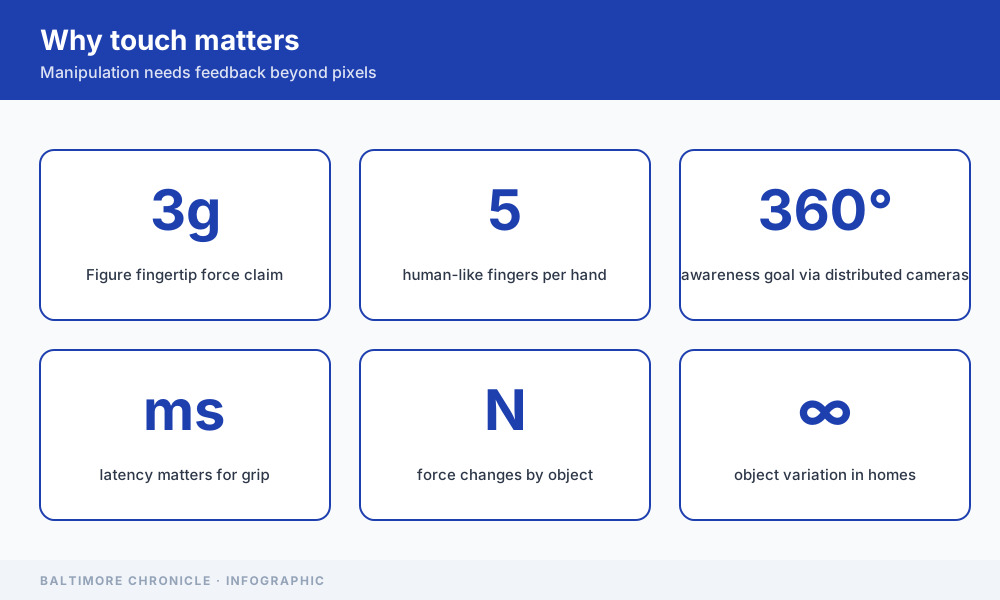
This is why Figure’s palm cameras and fingertip sensors matter. The company says Figure 03’s tactile sensors can detect forces as small as three grams. That is the kind of detail that separates a robot hand from a mechanical clamp. It also explains why the F.03 live work-shift stream is interesting: long-duration manipulation exposes whether the robot can correct small contact errors.
Why cameras are not enough
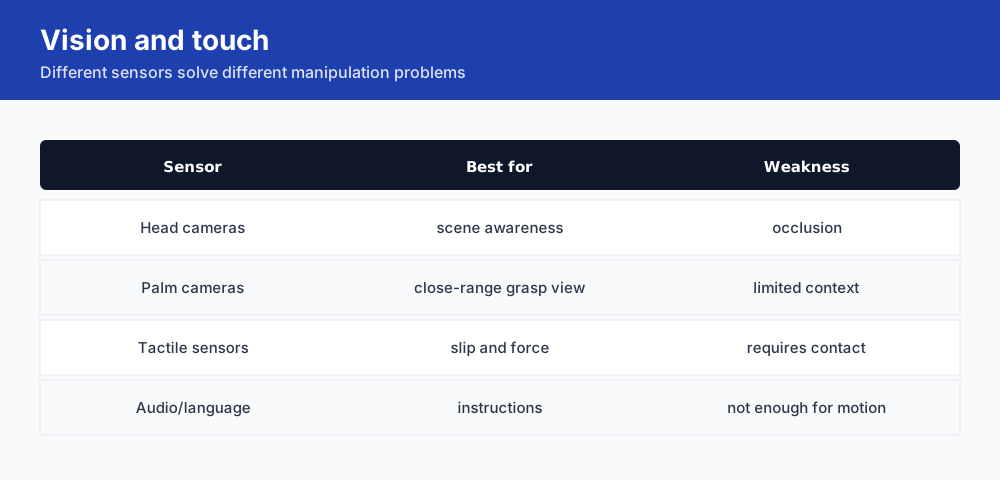
Cameras are powerful, but they have a basic weakness: they need line of sight. When a robot hand wraps around an object, the hand itself can block the view. When a robot reaches into a bin, cabinet or tight shelf, the head camera may see only the outside of the scene. Lighting, reflections and clutter make the problem harder.
Palm cameras help by moving some vision closer to the action. They can see from the hand’s perspective during grasping. But even palm cameras do not fully solve contact. A camera can show that fingers are near a cup; it cannot directly feel whether the cup is slipping.
What tactile sensors measure
Tactile sensors can measure force, pressure distribution, slip, vibration or contact location, depending on the design. In a humanoid hand, the most important use is force-modulated grasping: closing the fingers enough to hold an object, but not so hard that the object is crushed, bent or pushed away.
Tactile feedback turns grasping from a guess into a control loop. The robot touches, senses, adjusts and continues. Humans do this constantly without thinking. Pick up a paper cup, a glass jar and a soft towel, and your fingers automatically change force. Robots need sensors and models to approximate that behavior.
Why Figure’s three-gram claim is meaningful
Figure says its fingertip tactile sensors can detect forces as small as three grams, sensitive enough to feel a paperclip. The exact commercial impact depends on durability, calibration and software, but the direction is important. Light-force sensing helps with delicate objects and early contact detection.
In warehouses, this can reduce drops and crushed packaging. In homes, it matters for dishes, clothing, food containers and objects with irregular shapes. In factories, it may help robots handle parts without damaging them. The sensor alone is not enough, but it gives the AI a better signal.
| Sensor | What it tells the robot | Why it matters |
|---|---|---|
| Head camera | where objects and people are | navigation and scene context |
| Palm camera | what the hand sees up close | grasping when the head view is blocked |
| Tactile fingertip | force and contact at the fingers | slip correction and delicate handling |
| Joint sensors | body position and load | balance and motion control |
How touch changes robot behavior
A robot without tactile feedback may behave cautiously and slowly because it cannot trust its grasp. It may over-grip to avoid dropping objects, or stop when vision becomes uncertain. A robot with good touch sensing can make smaller corrections during the motion.
This is especially important for tasks that look simple to people: folding a towel, picking up a bag, putting a dish away, moving a flexible package or sorting mixed objects. The object changes shape, or the contact surface is unpredictable. Vision gives the plan; touch keeps the plan from failing.
Why tactile sensing is hard to scale
The difficult part is making touch sensors durable, cheap and useful in software. Fingertips are exposed to impacts, dust, oils, repeated contact and accidental overload. If a sensor is too fragile or too expensive, it becomes a maintenance problem. If the software cannot interpret the data quickly, the sensor becomes a fancy decoration.
Robotics companies also need calibration. A force reading that is useful in a clean lab may drift in a warehouse. A real fleet needs diagnostics, replacement procedures and data pipelines that detect when a hand is no longer sensing correctly.
How this connects to VLA models
VLA models are often discussed as if vision and language are the whole story. For real robots, action depends on feedback. A model can understand the phrase “pick up the mug,” but the final centimeters require contact-rich control. That is why our explainer on VLA models in robotics should be read alongside hardware discussions.
In the long run, tactile data may become part of the training loop. A robot that knows when it slipped, pressed too hard or made weak contact can learn better manipulation strategies. That is a different kind of intelligence from writing text. It is intelligence through the body.
What to watch in future demos
Viewers should look for tasks that expose touch. A robot picking up identical rigid blocks is useful, but limited. More revealing demos involve soft items, transparent objects, cluttered bins, object handoffs and recovery after a partial slip. Those situations show whether touch sensing is actually helping.
- Does the robot regrip without human help?
- Can it handle soft, flexible or light objects?
- Does it adjust force depending on the item?
- Can it continue when the head camera is blocked?
- Does performance remain stable across long sessions?
“Dexterity is not only a hand design problem. It is a sensing, control and learning problem wrapped around the hand.”
— Robotics hardware engineer, conference discussion
Bottom line
Another useful signal is how the robot behaves with partial information. A human can often feel that an object is sliding before seeing it move. A robot with useful tactile sensing can make the same kind of early correction, which is exactly what long work demos should reveal.
Touch will not replace vision. The two sensors solve different problems. Cameras help the robot find the world; tactile sensors help it survive contact with the world. The best humanoids will combine head cameras, palm cameras, fingertip sensing and fast control loops.
The robot that feels better may work better. That is why Figure’s tactile claims deserve attention, and why future humanoid demos should be judged by manipulation, not only walking. For the bigger market picture, read AI robots in 2026 and our guide to warehouse jobs likely to change first. Related Baltimore Chronicle coverage includes Honor’s investment in humanoid robots.