


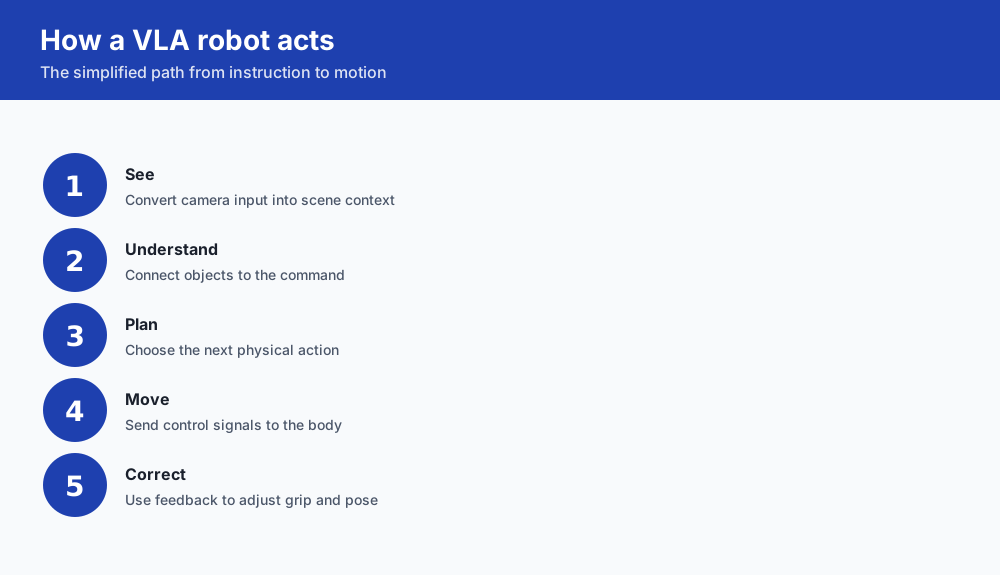
A VLA model is the bridge between seeing the world, understanding a command and moving a robot body. The letters stand for vision-language-action. In robotics, that means a system takes visual input, interprets a language instruction and produces actions the robot can execute.
This matters because humanoid robots are leaving the era of simple remote control and scripted motions. The most ambitious systems now try to generalize from data. That is the software layer behind Figure’s Helix-powered F.03 livestream, Tesla Optimus, NVIDIA’s GR00T research and Google DeepMind’s RT-2 lineage.
What does “vision-language-action” actually mean?
Vision is the robot’s sensor view of the scene: cameras, depth information and sometimes in-hand views. Language is the instruction or goal: “pick up the package,” “put the cup in the sink,” or “sort this item.” Action is the output: the robot’s next physical motion, such as moving an arm, closing fingers, stepping or adjusting posture.
Traditional robot programming often separates these steps into rigid modules. A VLA model tries to connect them more directly. The attraction is clear: if a model has learned broad visual and language concepts, it may adapt better when an object is new or a scene is not perfectly arranged.
Why Google DeepMind’s RT-2 was important
Google DeepMind described RT-2 as a vision-language-action model that learns from both web and robotics data. The key idea was that knowledge from large-scale vision-language models could help a robot generalize beyond the exact objects and instructions seen in robot training.
RT-2 helped make VLA models a mainstream robotics concept. It showed that the model could treat actions in a way that fits the language-model training pattern, while still controlling a physical robot. The practical question since then has been how to make that idea fast, reliable and safe enough for robots with full bodies.
The jump from a tabletop robot arm to a humanoid is significant. A humanoid has balance, gait, torso pose, head motion and two hands. If the software hesitates or misjudges contact, the cost is higher than a simple failed pick.
How Helix fits into the VLA trend
Figure describes Helix as the intelligence behind Figure 03 and Helix 02 as a full-body autonomy system. The important phrase is “whole-body.” A humanoid’s AI cannot treat the hand, head and legs as independent machines. It has to coordinate them through the task.
In Figure’s case, palm cameras and tactile sensors give the model more information during manipulation. That is useful because the main camera can lose sight of an object when the hand closes around it. A VLA-style system becomes more useful when it receives richer feedback.
What NVIDIA GR00T adds to the picture
NVIDIA’s Isaac GR00T initiative points to another important direction: foundation models and data pipelines for humanoid robots. NVIDIA announced GR00T N1 as an open humanoid robot foundation model and a set of simulation/data tools meant to speed robot development.
The reason this matters is data. Robots are expensive to train in the real world. They break, move slowly and need supervision. Simulation, synthetic data and shared model architectures can reduce the cost of learning, though they do not eliminate the reality gap. A robot that performs well in simulation still has to survive dust, lighting, friction, battery limits and people.
How VLA differs from a scripted robot
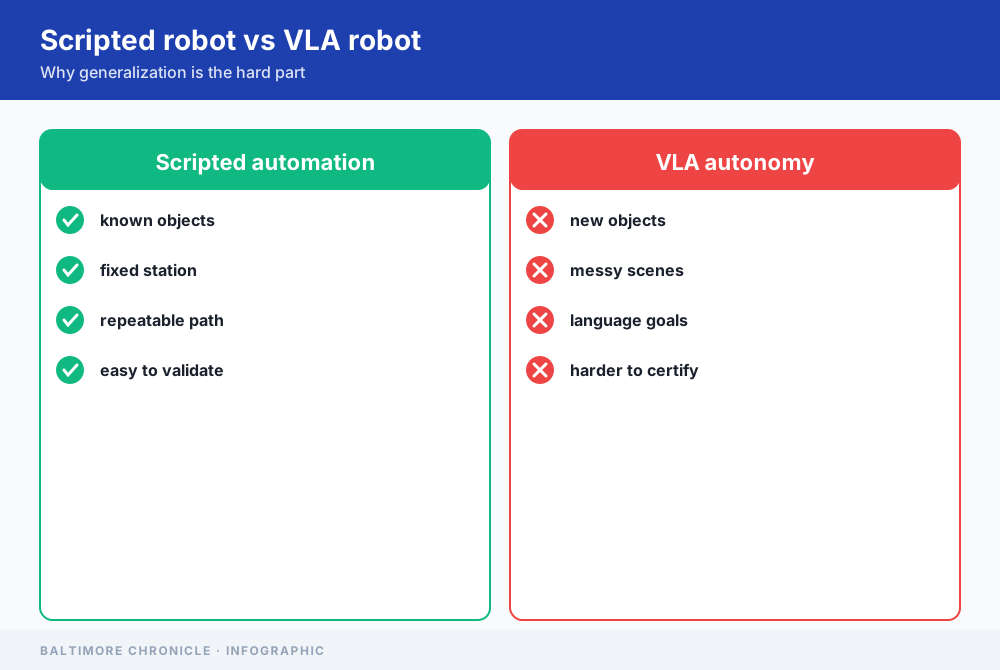
A scripted robot is easier to validate. It performs a known action in a known place. That is why industrial robots have been successful for decades in factories. The tradeoff is flexibility: when the environment changes, the script may fail.
A VLA robot aims to handle more variation, but this makes verification harder. If the model can produce many possible actions, engineers must prove that those actions remain safe. The more general the robot becomes, the more important guardrails, monitoring and fallback behavior become.
Where VLA models still struggle
The unsolved problem is reliable generalization under physical pressure. A model may understand a command but still fail to grip the object. It may recognize a cup but misjudge whether it is empty. It may plan a correct action but execute it too slowly for a production environment.
Latency is also critical. A conversational AI can take seconds to answer. A robot hand sometimes has milliseconds to adjust grip before an object slips. That is why many systems combine a slower reasoning layer with a faster control layer.
| Challenge | Why it is hard | What improves it |
|---|---|---|
| Object variation | real items differ from training examples | more data, better sensing |
| Latency | physical control needs fast feedback | on-device inference, control layers |
| Safety | bad actions can cause damage | constraints, monitoring, certification |
| Data cost | real robot training is expensive | simulation and shared datasets |
| Evaluation | demos can hide failures | long tests and public benchmarks |
Why this matters to non-engineers
VLA models will shape what robots can do around people. A robot that only follows scripts belongs in a fixed cell. A robot that can interpret scenes may work in a warehouse, hospital, store or home. That does not mean instant replacement of human labor. It means automation becomes more adaptable.
For readers, the key is to separate intelligence claims from physical performance. A model may be impressive in language tasks and still weak at manipulation. Embodied AI requires both cognition and contact.
Bottom line
VLA models are the software reason humanoid robots suddenly look more plausible. They connect the AI boom to physical automation. But the path from a model paper to a safe work robot is long, and it runs through sensors, batteries, actuators, safety cases and boring reliability tests.
To see why the physical side is just as hard, read our guide to tactile sensors in robots. To understand where these models may first affect jobs, read how humanoid robots could change warehouses. Related Baltimore Chronicle coverage includes new AI model development and AI hardware alliances.