

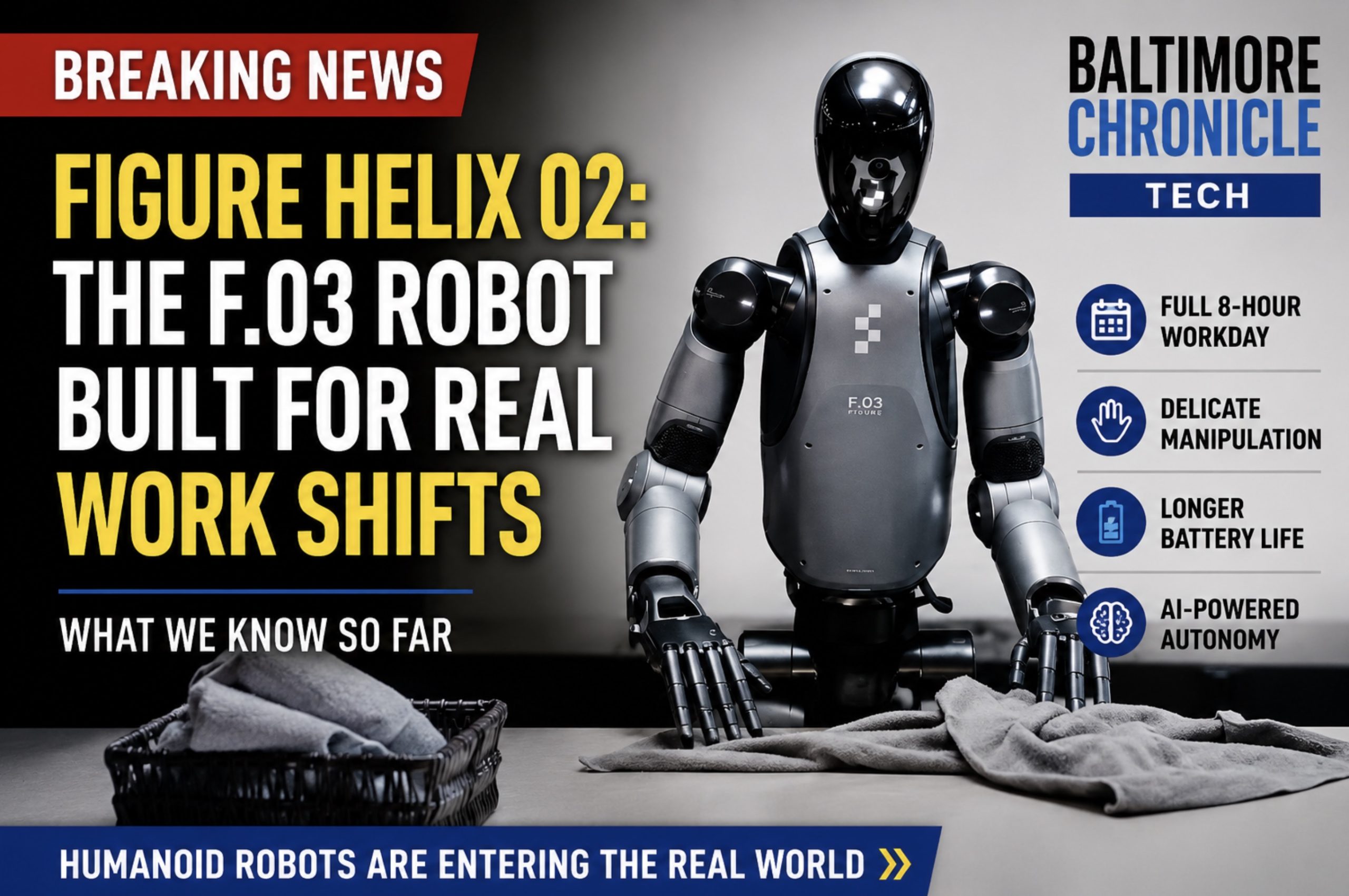
Figure’s F.03 livestream matters because it turns a humanoid robot demo into an endurance test. A short edited clip can hide resets, human help and cherry-picked success. A live work shift is harder to fake, especially when the task is repetitive enough to reveal fatigue, perception errors and manipulation failures.
The post from Figure points viewers to the company’s public stream, where F.03 robots are shown attempting a fully autonomous workday. The most useful way to watch it is not as entertainment, but as a checklist: What is the robot actually doing, how often does it hesitate, and does the task stay stable as the hours pass? This is closely connected to the larger race covered in our comparison of Figure 03 and Tesla Optimus, because the winner will not be the company with the flashiest clip. It will be the one that can repeat useful work at scale.
What is Figure F.03?
F.03 is the working name commonly used for Figure 03, the third-generation humanoid robot from Figure AI. Figure describes Figure 03 as a general-purpose humanoid designed for Helix, home use and scaled manufacturing. That wording is important: the company is not presenting it only as a lab prototype, but as a platform that should eventually work in ordinary human spaces.
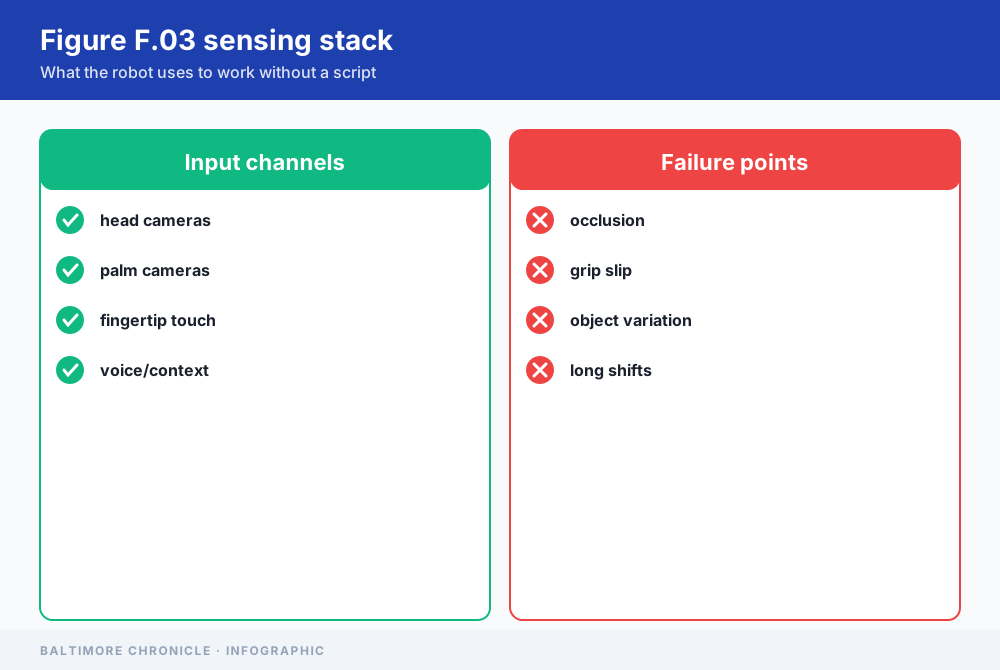
The robot’s most important change is not its outer shell. Figure 03 is built around a redesigned sensory suite and a hand system meant to feed the company’s Helix model. Instead of treating the hand as a simple gripper, Figure is trying to give the robot local perception near the object, force feedback at the fingertips and a body-control model that can translate perception into motion.
- Figure 03 is presented as the company’s third-generation humanoid platform.
- Helix is the AI system intended to connect visual input, language and body movement.
- The hand system includes palm cameras and tactile sensing, which matters for manipulation.
- The company frames the robot for both home environments and commercial use cases.
What does Helix 02 add?
Helix 02 is Figure’s newer full-body autonomy system. According to Figure’s technical description, it uses a pixels-to-whole-body architecture: the system reasons over visual information and sensor data, then produces coordinated movements for the robot’s body. In plain terms, the robot is not supposed to follow one hard-coded arm path while the legs do something separate. The body must act as one system.
That distinction is critical for humanoids. A warehouse arm bolted to the floor can use a fixed coordinate system. A humanoid has to keep balance, place its feet, align its torso, move its head and adjust the hands at the same time. If the object moves, if a hand blocks the head camera, or if the robot grips too hard, the model needs fresh feedback.
Figure says the palm cameras and tactile sensors are new Figure 03 hardware capabilities. The palm cameras provide in-hand visual feedback when the head camera is blocked. The tactile sensors in the fingertips can detect forces as small as three grams, which the company says is sensitive enough to feel a paperclip. That claim is not just a spec-sheet detail. It points to the real problem in home and warehouse robotics: most everyday objects are not shaped like factory parts.
What is the robot doing on the livestream?
The livestream is best understood as a practical sorting and handling test. Viewers are watching a humanoid robot perform a repetitive work task over time, rather than one isolated trick. The task itself may look simple: observe the workspace, identify items, reach, grasp, move and place them. For robotics, that sequence is loaded with failure points.
Small changes matter. A box can be rotated. A surface can reflect light. A hand can block the main camera. A package can be lighter than expected. The robot may have to recover from a slightly bad grasp without dropping the object or forcing a reset. Those small events are why an eight-hour stream is more informative than a one-minute montage.
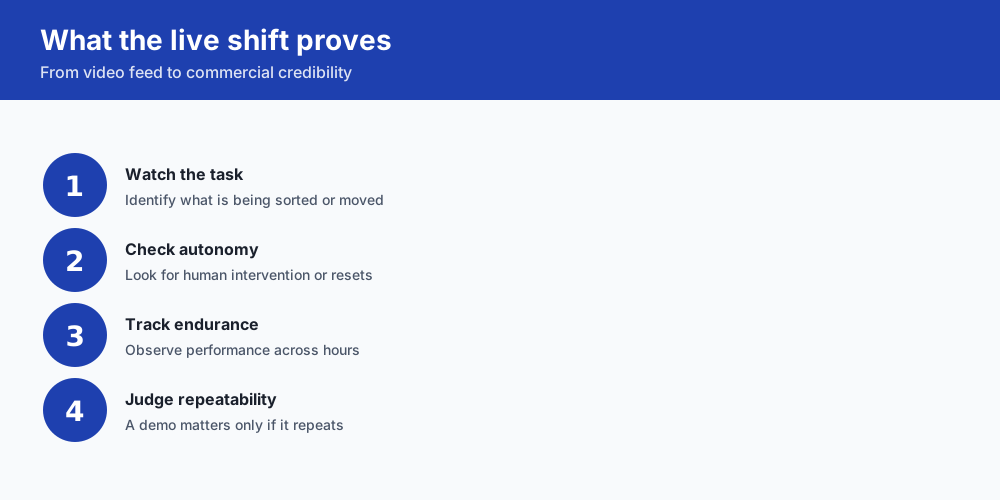
- Look for whether the robot repeats the same motion or adapts to variation.
- Watch whether the hands regrip objects when the first contact is imperfect.
- Check whether people enter the scene to reset items or correct the robot.
- Notice pauses: brief pauses are normal, repeated dead time changes the economics.
- Compare early and late performance to see whether reliability degrades.
Where can you watch the stream and official videos?
The direct place to watch is Figure’s YouTube channel and the YouTube video titled “F.03 Livestream.” Figure also posts robotics updates on X, where the original stream post appeared. For the broader product background, the best official reading is Figure’s “Introducing Figure 03” page and the Helix 02 technical note.
These sources answer different questions. The livestream shows behavior under time pressure. The Figure 03 page explains the hardware goals. The Helix 02 page explains the AI-control architecture. Together, they give a better picture than reposted clips alone.
- Watch the F.03 livestream on YouTube.
- Open Figure’s official YouTube channel.
- Read Figure’s official Figure 03 announcement.
- Read Figure’s official Helix 02 technical post.
Why this test matters for warehouses and factories
The real test is not whether a humanoid can move; it is whether it can work reliably around ordinary objects. That is why warehouses are becoming the first serious proving ground. They contain repetitive tasks, measurable productivity and enough variation to expose weak autonomy. A robot that can sort or move packages for hours is closer to value than a robot that can only dance on stage.
This is also why the stream connects to the broader labor question in our guide to humanoid robots in warehouses. The likely first wave is not “robots replacing every job.” It is robots taking narrow, physically repetitive tasks that are hard to staff or expensive to automate with fixed machinery.
“A useful humanoid is not the one that looks most human. It is the one that can recover from small physical mistakes without making the entire workflow stop.”
— Robotics analyst, industry briefing
What should viewers be skeptical about?
There are still reasons to be careful. A livestream can show endurance, but it does not automatically prove cost, safety certification, maintenance burden, fleet management or general usefulness. A robot may perform well on one prepared task and still fail in a messy loading dock, a home kitchen or a crowded retail aisle.
There is also a difference between autonomy and independence. A robot might run without a person touching it during the stream, while still depending on a carefully prepared scene, limited object types and extensive pre-training. That does not make the demo fake. It means the right question is: how wide is the operating envelope?
| Claim to check | Why it matters | What would be convincing |
|---|---|---|
| Fully autonomous | Human teleoperation changes labor economics | clear logs, no resets, no remote correction |
| Human-level work | Speed alone is not enough | throughput, error rate and consistency |
| General-purpose | One task can be narrow | new tasks with little retraining |
| Ready for deployment | Workplace use requires safety and support | service contracts, certifications and uptime data |
What comes next?
If Figure can repeat this kind of workday across different tasks, the company will have a stronger argument that humanoids are moving beyond theatrical demos. But the next milestone is less glamorous: many robots, many days, measured failure rates and real operating costs. That is the level at which warehouse managers, manufacturers and insurers begin to care.
For readers, the useful takeaway is simple: watch the robot’s recovery, not just its success. Smooth movement is impressive, but recovery from imperfect grasps, blocked cameras and long-duration repetition is the sign that a humanoid is becoming a tool. For the wider context, read next about VLA models in robotics and why tactile sensors may matter more than cameras. Related Baltimore Chronicle coverage includes Honor’s humanoid robot investment and new AI model development.