


Warehouses are the most likely first workplace for humanoid robots because they combine repetitive labor with real-world variation. They are structured enough for automation, but messy enough to make fixed machinery expensive. That is exactly the gap humanoid companies are trying to fill.
The promise is not that every warehouse worker disappears. The more realistic scenario is task reshaping: robots handle some repetitive movement, people handle supervision, exceptions, maintenance and judgment. This is the labor-market context behind Figure’s live work-shift demonstration and the wider competition between Figure 03 and Tesla Optimus.
Why warehouses are the first serious test bed
A warehouse is full of tasks that are measurable. A package is moved or it is not. A tote reaches a station or it does not. A robot works for a certain number of hours, completes a certain number of cycles and causes a certain number of errors. That makes warehouses attractive for robotics companies because performance can be counted.
At the same time, warehouses are not simple. Package size changes, aisles become crowded, labels are imperfect, workers move through the environment and items are not always where software expects them to be. A humanoid has to deal with this variation while staying safe around people.
- Logistics tasks often involve repetitive physical movement.
- Labor shortages and turnover can make automation attractive.
- Existing buildings are designed for human bodies, carts, shelves and stairs.
- Humanoid robots may fit into these spaces without rebuilding the facility.
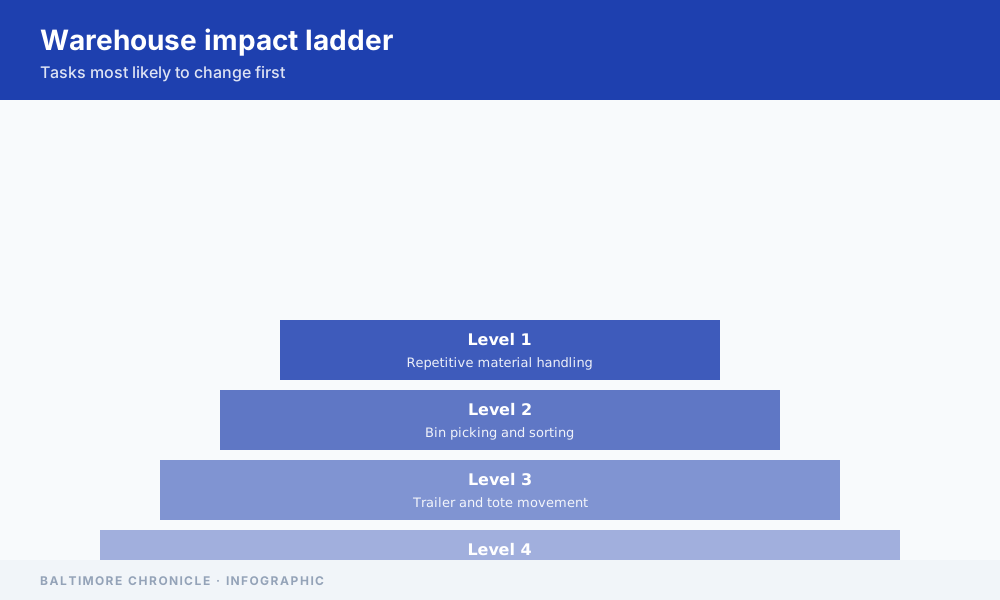
Which jobs change first?
The first warehouse tasks to change are likely the physically repetitive, low-discretion tasks. Think tote movement, package sorting, line replenishment, trailer unloading assistance and moving objects between fixed points. These tasks are boring, tiring and measurable, which makes them good candidates for early humanoid deployment.
More complex work will change later. Exception handling, damaged goods, customer-specific decisions and safety coordination require context that robots still struggle to handle. In many facilities, the near-term pattern may be one worker supervising several robots rather than robots replacing a full team.
| Task type | Automation likelihood | Why |
|---|---|---|
| Tote and bin movement | High | repetitive routes and measurable output |
| Package sorting | High to medium | object variation is real but manageable |
| Trailer unloading | Medium | harder environment and safety constraints |
| Inventory exception handling | Low to medium | requires judgment and system context |
| Team leadership | Low | human coordination and accountability remain central |
What Agility Robotics and GXO show
Agility Robotics says its Digit robot is already in production deployment, and the company has described deployments with GXO. GXO has also discussed work with humanoid technology, including Digit, in supply-chain settings. These examples matter because they shift the conversation from “can a robot walk?” to “can a robot be integrated into a warehouse workflow?”
Digit is not a direct copy of a human. Its legs and arms are designed around material-handling practicality, not human imitation for its own sake. That is a useful reminder: the best warehouse robot may be humanoid enough to use human spaces, but not necessarily human-like in every detail.
How humanoids connect to existing automation
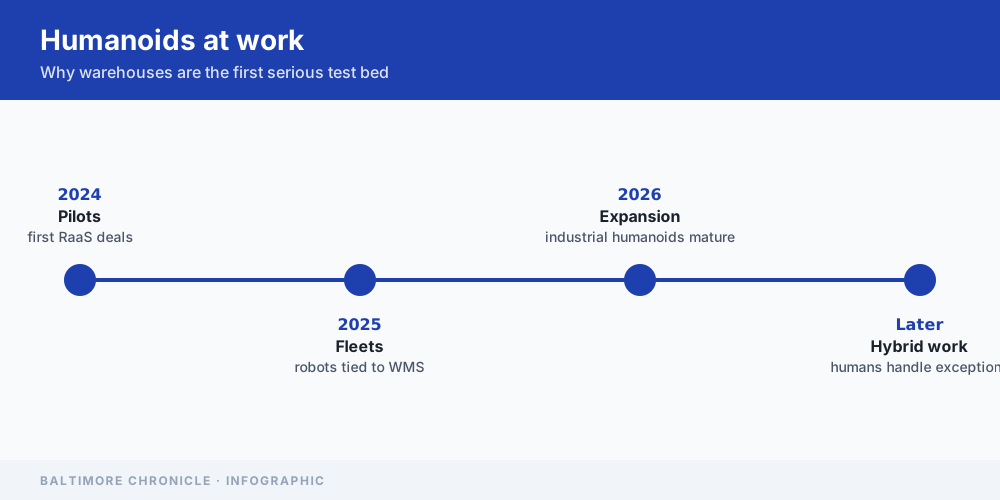
A modern warehouse already contains automation: conveyors, scanners, warehouse management software, autonomous mobile robots and robotic arms. Humanoids will not replace all of that. They will be valuable if they can connect the islands that fixed automation does not easily cover.
This is why fleet software matters as much as the robot body. A humanoid must know what task to do, where to go, when to wait, how to report failure and when to hand off to a person. The robot is only one part of the automation system.
What jobs are safer from near-term automation?
Jobs that require judgment, customer communication, repair knowledge or unusual physical reasoning are harder to automate. A person can see that a shipment is mislabeled, decide that a spill creates a safety hazard, or understand why a damaged package needs escalation. Robots can be trained for some of this, but not all of it at once.
The most durable human role is exception handling. As robots take more routine movement, people may spend more time managing edge cases, quality checks and coordination. That is not automatically a better job, but it is different from the old image of a person doing the same lift hundreds of times per shift.
What workers should learn now
Workers do not need to become roboticists overnight. The useful skills are more practical: understanding workflow software, reading robot status dashboards, knowing how to pause a machine safely, documenting failures and coordinating with maintenance. The person who understands both the floor and the automation system becomes more valuable.
- Learn the warehouse management system instead of only the physical task.
- Understand safety procedures for machines operating near people.
- Track failure patterns: what the robot cannot handle becomes a human workflow.
- Build maintenance literacy: batteries, sensors and grippers will need care.
- Develop coordination skills, because mixed human-robot floors need clear communication.
What companies should measure before buying
Companies should avoid buying humanoids for publicity. The practical business case needs baseline data: current labor cost, injury risk, throughput, overtime, turnover, error rates and the cost of existing automation. A robot that looks futuristic but slows the operation is not progress.
The best early deployments will be narrow. Choose a task with clear boundaries, repeat it, measure it, then expand. This also helps workers understand what the robot is for and where human judgment remains essential.
“A warehouse robot should be judged like any other operational tool: uptime, safety, throughput, error rate and total cost.”
— Supply-chain operations manager, automation workshop
Bottom line
Humanoid robots are most likely to change warehouses in layers. First they will take narrow material-handling tasks. Then they will become part of managed fleets. Later, if VLA models and tactile sensors improve, they may handle more flexible manipulation.
The near-term future is not a lights-out warehouse; it is a mixed floor. People, fixed automation and humanoid robots will work around one another. To understand the AI layer behind that shift, read our explainer on VLA models in robotics. For the hardware side, read why tactile sensors can matter more than cameras. Related Baltimore Chronicle coverage includes how AI is being applied to service workflows.