

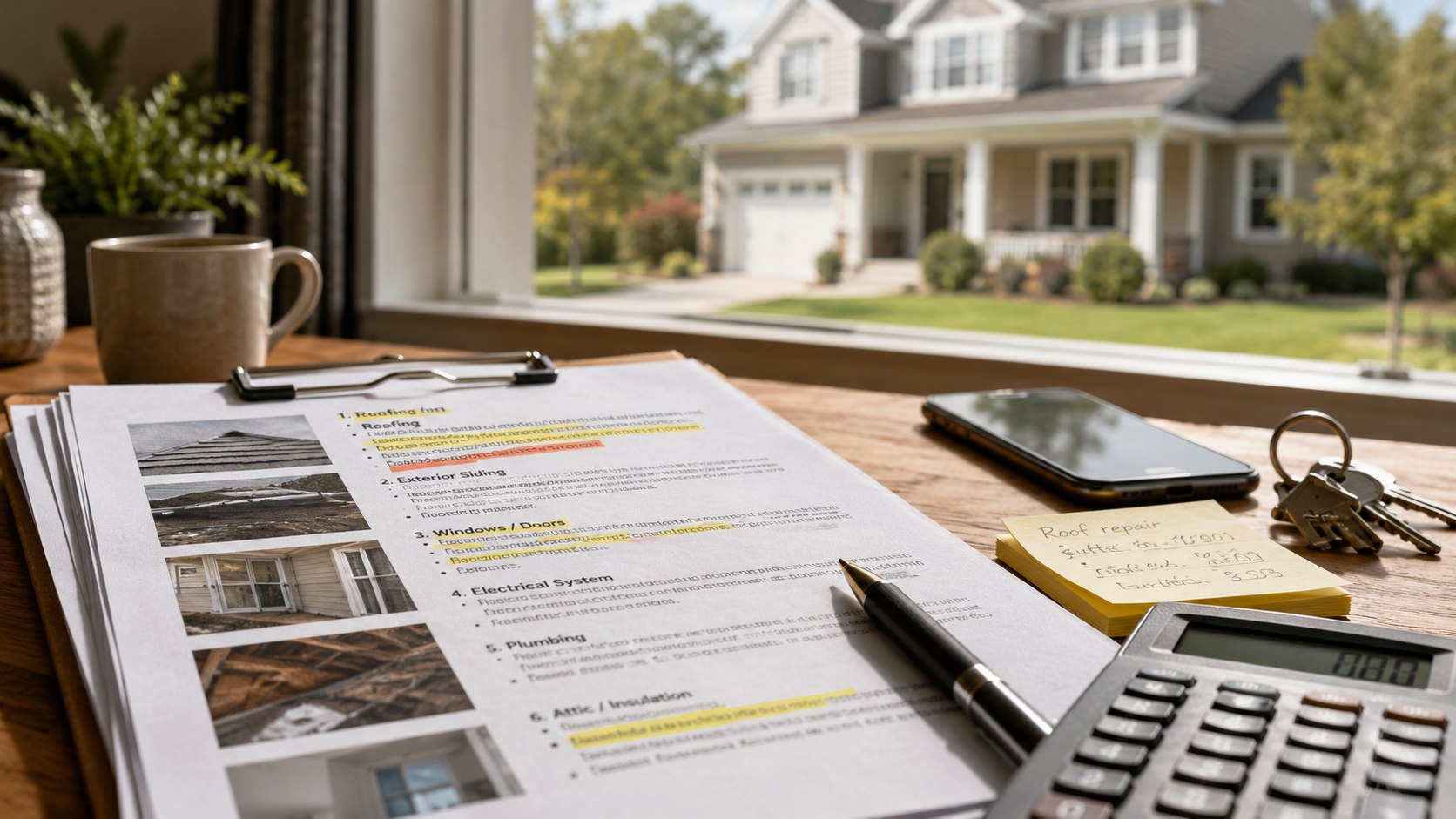
How to negotiate house price after inspection means turning the inspection report into a priced, evidence-based request instead of a long complaint list. In 1–2 hours, you can identify the defects that matter, estimate repair costs, choose the right concession, and send a clean counteroffer, as noted by Baltimore Chronicle.
Your goal is not to win every small issue. Your goal is to protect your cash, avoid hidden risk, and keep the deal alive if the home is still worth buying. Focus first on safety, structure, water, roof, electrical, HVAC, plumbing, termites, sewer lines, mold, and insurance problems.
“A strong inspection negotiation is not emotional. It is a pricing conversation backed by documents, photos, contractor estimates, and contract deadlines.”
Key takeaways
- Ask for money first when repairs are complex, urgent, or better handled by your own contractor.
- Use real repair estimates for roofs, HVAC, foundations, sewer lines, mold, and electrical defects.
- Do not over-negotiate cosmetic flaws; sellers concede faster on defects affecting value, safety, financing, or insurance.
Most sellers expect some inspection pushback, but they also reject vague demands. A request that says “fix everything” usually fails. A request that says “$8,500 credit for roof flashing, GFCI protection, and water heater replacement” is harder to dismiss. Buyers still mapping the full purchase timeline can compare the inspection stage with Baltimore Chronicle’s 2026 guide to buying a house in the USA.
The stronger your evidence, the less the negotiation feels like a second bite at the apple. That matters in markets such as Maryland, Florida, Texas, California, and Ohio, where inventory, insurance, and local buyer demand change leverage fast.
What you need before you negotiate
Before asking for a discount, organize your documents. A seller is more likely to respond when your request looks complete, calm, and tied to actual costs.
- Full inspection report with photos and page numbers.
- Signed purchase agreement and inspection contingency deadline.
- Your buyer’s agent’s advice on local contract forms.
- Repair estimates from licensed contractors where possible.
- Seller disclosure, if your state requires one.
- Loan type: conventional, FHA, VA, USDA, or cash.
- Budget for immediate repairs after closing.
- Time: usually 60–120 minutes to prepare the request.
HUD treats home inspection as a standard step in the homebuying process. That matters because the report is often your last major chance to renegotiate before closing. If you need a deeper inspection baseline, read what a home inspection includes in the USA in 2026 before deciding what to ask from the seller.
You should also check your lender’s rules. FHA, VA, and USDA loans can treat safety and habitability problems differently from conventional loans. In 2026, many buyers also need to consider insurance issues, especially in coastal Florida, wildfire-prone California, and hail-heavy parts of Texas. A house can look affordable until the roof, panel, or plumbing makes coverage expensive.
Step 1: Read the inspection report like a pricing document
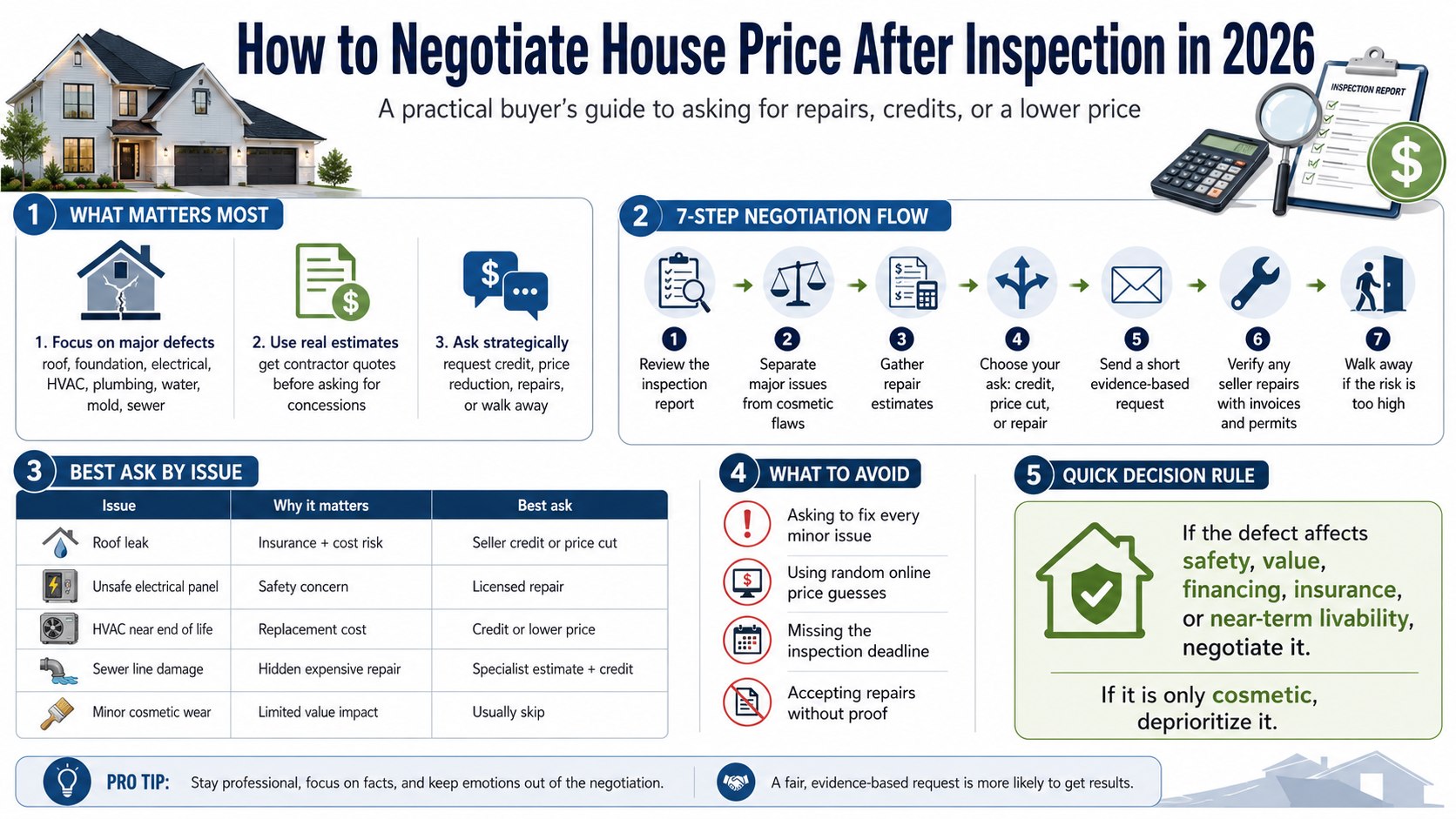
What to do: Start with the summary page, then mark every defect as major, moderate, minor, or cosmetic. Put price-sensitive items first: roof, foundation, electrical panel, HVAC, plumbing leaks, drainage, sewer scope, termites, mold, and water intrusion.
Why it matters: Sellers respond better when your request is organized by financial risk, not by the order in which the inspector found problems.
Common mistake to avoid: Do not treat loose cabinet hinges, peeling paint, and a cracked foundation as equal issues. That weakens your case and makes the seller question the whole request.
A good rule is simple: if the defect affects safety, value, financing, insurance, or near-term livability, keep it on the list. If it is only cosmetic, save it for later or remove it. The best inspection negotiations are short enough for the seller to understand in 5 minutes.
Step 2: How to Negotiate House Price After Inspection With Evidence
What to do: Convert the report into a short repair-cost request. Ask your agent for local contractor names, then get quick written estimates for expensive items before the contingency deadline.
Why it matters: A seller may ignore “the roof looks bad,” but a $12,000–$18,000 roof estimate changes the conversation.
Common mistake to avoid: Do not use inflated numbers from random online forums. Use real local prices, even if the estimate is a range.
Here is how buyers can frame common inspection findings in 2026:
| Inspection issue | Typical 2026 negotiation angle | Better ask |
|---|---|---|
| Old roof with active leaks | High cost, insurance risk | Seller credit or price reduction |
| Unsafe electrical panel | Safety and financing concern | Licensed electrician repair before closing |
| HVAC near end of life | Comfort and replacement cost | Credit, warranty, or lower price |
| Sewer line damage | Hidden repair can exceed normal budgets | Specialist estimate and seller credit |
| Minor drywall cracks | Often cosmetic unless structural | Usually skip or bundle lightly |
The strongest ask usually combines 2–4 serious issues. Too many demands can make the seller defensive. A clean request also helps your lender, title team, and agent keep the file moving. If the defect affects loan approval, say that clearly and attach the relevant inspection page. Keep the tone factual, because the seller may still be your closing partner for several weeks.
Step 3: Choose the right ask: credit, price cut, repair, or walk-away
What to do: Decide whether you want a seller credit, lower purchase price, repairs before closing, or cancellation under the inspection contingency. In many deals, a credit is cleaner than asking the seller to manage repairs.
Why it matters: Sellers often choose the cheapest contractor. Buyers usually prefer controlling the repair quality after they own the home.
Common mistake to avoid: Do not assume the lender will allow every credit. Ask your loan officer before you request a large concession.
- Seller credit: useful for closing costs, prepaid expenses, or allowed concessions.
- Price reduction: lowers the contract price, but may not solve immediate cash needs.
- Seller repair: useful for safety, lender-required, or insurance-required fixes.
- Home warranty: sometimes useful for appliances, but weak for major known defects.
- Cancel and recover deposit: depends on your contract, deadline, and state rules.
A seller credit can be powerful, but it is not always the same as cash in your pocket. Lender limits can affect how much credit you can use, and some concessions work only when they fit your closing-cost structure. For the financial side of this decision, see Baltimore Chronicle’s explainer on closing costs on a house in 2026.
A price reduction may save money over the loan term, but it does not pay the plumber the week after closing. A repair request can work when the fix is simple, licensed, and easy to verify. If the issue is complex, ask for money or renegotiate the price instead.
Step 4: Write a tight repair addendum your seller can accept
What to do: Ask for specific concessions, attach report pages, and use calm language. Your agent should put the request into the correct state contract form or repair addendum.
Why it matters: A precise addendum reduces confusion and gives the seller fewer reasons to reject the request.
Common mistake to avoid: Do not send a long emotional email about disappointment. Send documents, numbers, and a clear remedy.
Here is a practical structure: “Based on the inspection dated March 2026, buyer requests a $9,750 seller credit toward closing costs for roof flashing failure, active plumbing leak under kitchen sink, missing GFCI protection, and HVAC service deficiencies.” Then list the report pages and attach estimates.
The wording should match your state’s contract practice. In Maryland and Pennsylvania, your agent may use different forms than in Texas or Florida. Your agent’s skill matters because inspection negotiations are partly legal timing, partly pricing, and partly psychology. Baltimore Chronicle explains this role in detail in what a buyer’s agent does in 2026.
Step 5: Use market leverage without pretending the market is yours
What to do: Ask your agent for comparable sales, days on market, price reductions, and backup-offer risk. A seller with 3 backup offers has different leverage than a seller listed for 72 days.
Why it matters: The same $10,000 repair ask can be reasonable in one market and unrealistic in another.
Common mistake to avoid: Do not copy negotiation tactics from another state or city without checking your local inventory.
In 2026, inspection leverage is local. A buyer in Baltimore County may have more room on an older rowhouse with wiring concerns than a buyer competing for a move-in-ready home near strong schools. In Texas, foundation and drainage findings can change value fast. In Florida, roof age can affect insurance. In California, wildfire mitigation, sewer laterals, and seismic issues may matter more than cosmetic defects.
Step 6: Ask for the right proof if the seller agrees to repairs
What to do: Require licensed contractors, paid invoices, permits where needed, and reinspection access before closing. Your addendum should say who completes the work and what documentation is required.
Why it matters: A repair that is “done” without proof can become your problem the day after closing.
Common mistake to avoid: Do not accept blurry photos or a verbal promise as proof for electrical, roof, plumbing, gas, or structural work.
For example, a water heater replacement should show the installer, model, permit if required, and date of completion. Electrical repairs should come from a licensed electrician, not a handyman. Roof repairs should specify the area repaired, not just “roof fixed.” If the seller resists documentation, ask for a credit instead.

Step 7: Know when to stop negotiating and when to walk
What to do: Set a walk-away number before you send the request. Add the repair cost, urgency, insurance impact, and your cash reserve after closing.
Why it matters: Buyers often become attached to a house and ignore problems that would have killed the deal earlier.
Common mistake to avoid: Do not use your emergency fund for defects the seller should price into the deal.
A $1,200 gutter repair is not the same as a $35,000 foundation problem. If the home has multiple high-cost defects, the seller must either share the cost or accept that the contract may fail. A beautiful kitchen does not offset unsafe wiring, water intrusion, or an uninsurable roof. If the seller refuses every serious request, your best negotiation may be leaving before the deadline expires.
Troubleshooting common inspection negotiation problems
Inspection talks can stall even when your request is fair. Use the problem below to decide your next move before the deadline gets too close.
- Seller says the house is “as-is”: You can still ask, but your leverage depends on the contract and contingency.
- Lender will not allow the credit: Ask about a price reduction or seller-paid eligible closing costs.
- Seller offers a cheap home warranty: Compare it with the actual repair estimate before accepting.
- Contractor cannot inspect before deadline: Request an extension or use a documented estimate range.
- Repair affects insurance: Ask your insurance agent before removing the contingency.
Troubleshooting is about preserving options. A seller’s first “no” is not always final. Your agent can narrow the request, shift from repairs to credits, or trade timing for money. The worst move is missing the inspection deadline while waiting for perfect information. If you need more time, request it in writing before the deadline passes.
FAQ
Can you negotiate house price after inspection in 2026?
Yes, if your purchase agreement gives you an inspection contingency or another valid contractual path. You can ask for a price cut, seller credit, repairs, or cancellation. The seller does not have to agree unless the contract requires a specific remedy.
What are reasonable requests after a home inspection?
Reasonable requests usually involve safety, structure, water, roof, HVAC, plumbing, electrical, pests, sewer, mold, or insurance-related defects. Cosmetic items are weaker unless they reveal a bigger problem. A damaged foundation beats scratched flooring every time.
Should I ask for repairs or seller credit?
Ask for credit when you want to control the work after closing. Ask for repairs when the lender, insurer, or safety issue requires completion before closing. Always check credit limits with your lender first.
How much can I ask off after inspection?
There is no universal number. In 2026, a small request might be $1,500–$3,000, while roof, sewer, HVAC, or foundation issues can justify much larger negotiations. Use contractor estimates, not guesses.
Can a seller walk away after inspection negotiations?
It depends on your contract and state law. Many sellers can reject your requested repairs or credits, but they may not be able to cancel just because you asked. Your agent or real estate attorney should review the exact contract language.
Earlier we wrote about How to Clean a Front Load Washer When Towels Smell Sour and the Rubber Seal Turns Black