


How to register to vote in USA 2026 usually comes down to 3 actions: open your state’s official portal, submit accurate personal details, and verify that election officials activated your record. The online form often takes 5–15 minutes, costs $0, and can be completed from a phone or computer, as the Baltimore Chronicle editorial team notes.
Your deadline is the first detail to check. The United States has no single national voter registration cutoff. Some states close online registration several weeks before an election, while others permit same-day or conditional registration.
Key takeaways
- Start with Vote.gov, then continue only through the official election website for your state or territory.
- Use your legal name, current home address, and identification details exactly as they appear in official records.
- Check your registration status after applying because a submission receipt does not always confirm final approval.
What You Need Before You Register
Prepare your information before opening the application. State portals can time out, and an unfinished form may not be saved.
- A smartphone, tablet, or computer with internet access
- Your full legal name and date of birth
- Your current residential and mailing addresses
- A state driver’s license or state ID, when required
- Your Social Security number or requested digits
- An email address or access to postal mail
- About 5–15 minutes to complete the application
Official voter registration is free. A private website should not charge you to file a standard application.
Some state systems verify applicants through motor vehicle databases. A driver’s license number, legal name, and address may need to match the information held by the DMV.
Applicants without state identification may still have other routes. Depending on the state, they may register by mail, visit an election office, or provide alternative information.
A passport is not universally required. New citizens, overseas voters, military personnel, and applicants with prior felony convictions should review the rules applying to their situation.
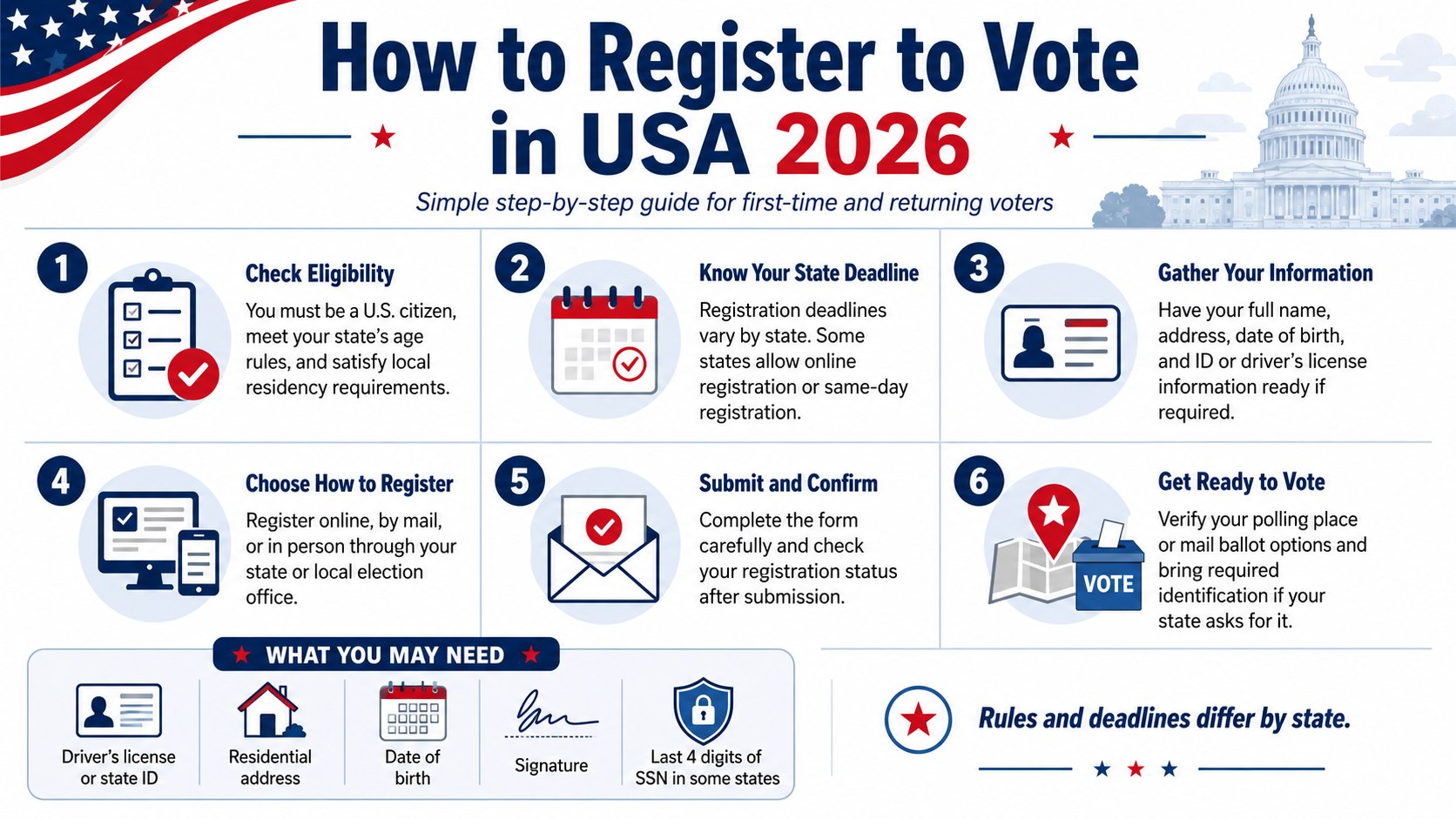
Step 1: Find How to Register to Vote in USA 2026 in Your State
Open Vote.gov’s official voter registration page and select your state or territory. The federal website will direct you to the correct state portal and available registration methods.
This matters because voter registration is administered by individual states. Online systems, deadlines, accepted identification, and party registration rules are not identical nationwide.
Check the web address before entering personal information. The destination should normally belong to a state election agency or another official government office.
A common mistake is opening a sponsored search result and entering data before confirming who operates the website. Use Vote.gov as the starting point instead.
Step 2: Confirm That You Are Eligible
You must be a U.S. citizen to register for federal elections. Lawful permanent residents and other noncitizens cannot register to vote in federal contests.
You must also satisfy your state’s age and residency rules. Many states allow preregistration for teenagers who will become eligible by a future election, but the qualifying age varies.
Residency normally relates to the place you consider your home. College students, people without permanent housing, military families, and recently relocated residents may face additional address questions.
Felony-related voting rules differ sharply by state. Some jurisdictions restore voting rights automatically after release, while others require further steps.
Do not rely on advice written for another state. A voter in California may follow a different process from someone in Texas, Maryland, Ohio, or Florida.
Step 3: Check the Correct 2026 Deadline
Find the deadline for the exact election you plan to vote in. A state may hold primaries, municipal elections, special elections, runoffs, and a general election during 2026.
Deadlines can also vary by application method. An online form may have one cutoff, while a mailed application must be postmarked or received by another date.
The following examples show the range of state approaches. Always confirm the current calendar through your state election agency before filing.
| State | Typical online deadline | What to verify |
|---|---|---|
| California | 15 days before Election Day | Conditional registration after the standard cutoff |
| Florida | 29 days before Election Day | The deadline for the specific primary or general election |
| Maryland | 21 days before Election Day | Same-day options and proof-of-residence rules |
| Michigan | 15 days before Election Day | In-person registration after the online cutoff |
| North Carolina | 25 days before Election Day | Early-voting same-day registration availability |
| Ohio | 30 days before Election Day | The exact calendar date and mail postmark rule |
| North Dakota | No standard advance registration | Identification requirements at the polling location |
These examples are planning guides, not a substitute for an official lookup. Election dates and local procedures can change.
Save the deadline to your calendar and submit early. Waiting until the final evening leaves little time to resolve an address, identification, or website problem.
Keep a screenshot or digital copy of your confirmation. Mailed applicants should retain proof of postage or delivery.
Maryland voters can also review the Baltimore Chronicle’s Maryland Election Guide 2026. It explains polling hours, same-day registration, mail-in ballot deadlines, and voter identification rules.
Missing the regular cutoff does not always end the process. Several states permit registration during early voting or on Election Day, although documents and locations differ.
Step 4: Complete the Online Application Carefully
Enter your full legal name, date of birth, current residential address, and requested identification number. Review every field before submitting.
Election officials may compare your application with state motor vehicle or government records. Even a missing apartment number or outdated surname can cause a mismatch.
If your identification records need updating, see the Baltimore Chronicle guide on how to get a REAL ID in USA 2026. It explains common proof-of-identity, Social Security, residency, and legal-name requirements used by state motor vehicle agencies.
The form may ask whether you want to affiliate with a political party. Your choice can affect participation in closed or partially closed primary elections.
Party registration does not require you to vote for that party’s candidate during a general election. General-election ballots allow voters to choose among all eligible candidates.
Read the citizenship and eligibility certifications before signing. Never select an answer simply to advance to the next screen.
Step 5: Use a Paper or In-Person Method if Needed
If online registration is unavailable or cannot verify your details, follow your state’s instructions for registering by mail or in person.
The National Mail Voter Registration Form can be used in most states. It is not accepted for the standard registration process in New Hampshire, North Dakota, Wisconsin, or Wyoming.
Print the form clearly, complete every required field, and add a handwritten signature. An unsigned application may be treated as incomplete.
Mail the form to the state or local address listed in its instructions. Check whether the deadline depends on the postmark date or the date officials receive it.
Registration services may also be available through election offices, motor vehicle agencies, and certain public assistance offices.
Military members and U.S. citizens living abroad should use the Federal Post Card Application. That process can combine registration with an absentee ballot request.
Step 6: Update Your Registration After Moving
A move can change your precinct, local contests, polling place, and election district. Update your voter record even when you remain within the same city or county.
Do not assume a USPS forwarding request automatically updates election records. Voter registration and postal forwarding are separate government processes.
The Baltimore Chronicle’s Moving Address Checklist 2026 covers voter registration, DMV records, banks, insurers, utilities, tax agencies, and other accounts connected to your home address.
Use your actual residence when registering. A mailing address can be different, but state officials may still require the physical location where you live.
Update your name after marriage, divorce, or another legal change. The name on your registration should match the identification you expect to use.
Make these changes before the deadline. A last-minute mismatch can create unnecessary delays at the polling place.
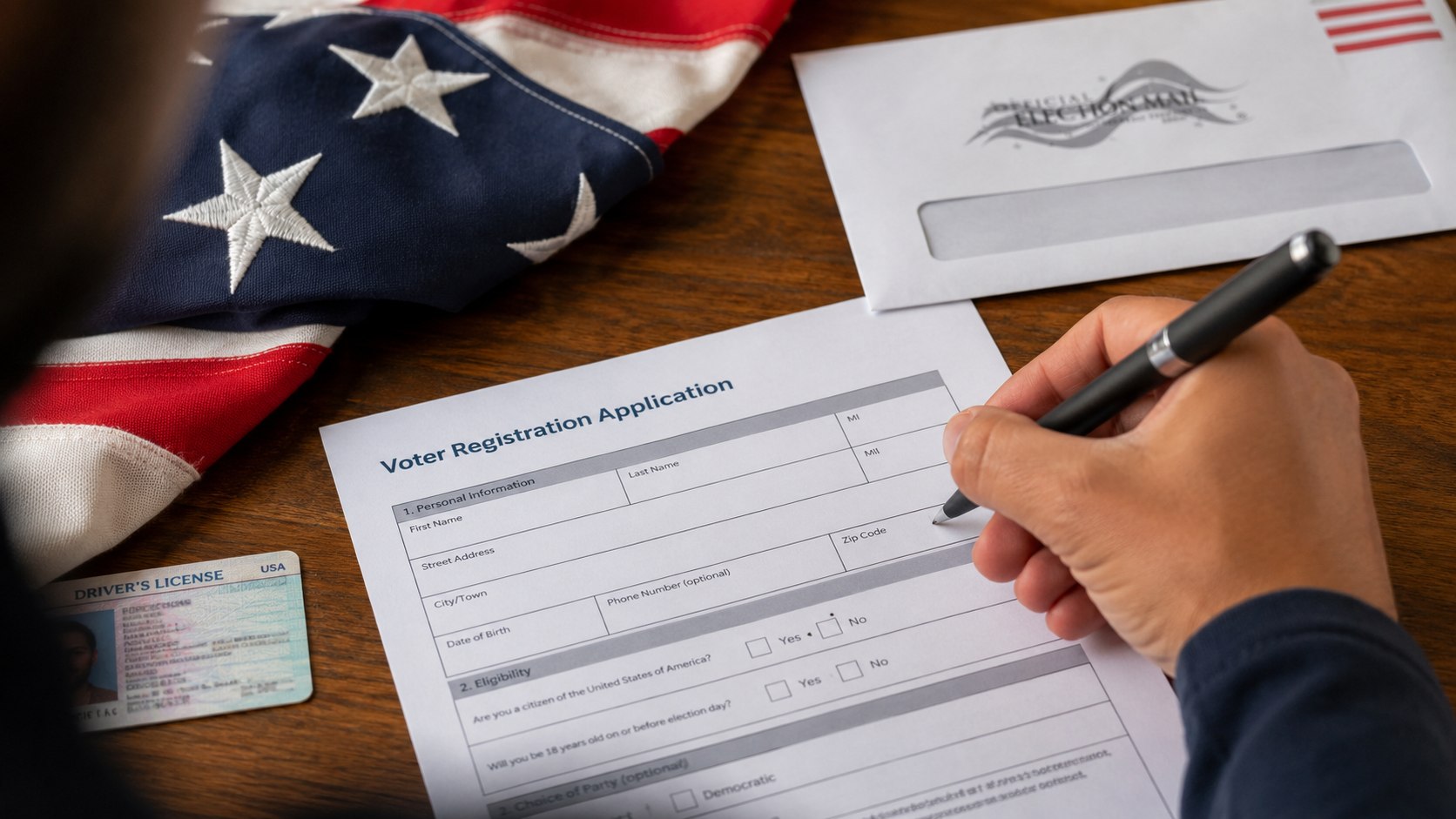
Step 7: Verify That Your Registration Is Active
Return to Vote.gov or your state election website and open the voter status tool. Search using the same name, date of birth, and address entered on your application.
Verification matters because an automated receipt usually confirms submission, not final acceptance. Election officials may still need to review or correct the record.
Before voting, confirm the following details:
- Your registration status is active or otherwise eligible.
- Your legal name is spelled correctly.
- Your residential address is current.
- Your party affiliation is correct for the primary.
- Your polling place matches your current precinct.
- Your state’s voter identification rules are clear.
- Your mail ballot request was completed separately, when required.
- Your early-voting location and operating hours are current.
Registration does not automatically produce a mail ballot in every state. Many jurisdictions require voters to submit a separate absentee or vote-by-mail request.
Your polling place can also change between elections. Do not assume the school or community center used last time remains assigned to you.
First-time voters who registered by mail may face additional identification requirements. Review those instructions before Election Day.
If your status remains pending, contact the local election office. Ask whether officials need identification, an address correction, or a new signature.
Troubleshooting Common Voter Registration Problems
Most registration problems can be corrected, but acting early gives election officials more time to process the change.
- The portal cannot verify your ID: use the state paper form or request an alternative method from the election office.
- Your old address appears: submit a formal voter registration update rather than relying on postal forwarding.
- Your name does not match: compare the spelling with your driver’s license, state ID, and Social Security records.
- No confirmation arrived: use the official status checker and contact the local election office.
- The deadline passed: check for same-day, conditional, or early-voting registration in your state.
Do not submit repeated applications every few hours. Duplicate forms will not necessarily accelerate processing.
Write down the date and time when you contact an election office. Record the employee’s instructions and any reference number provided.
If the website produces an error, take a screenshot. Then try another browser or device before switching to a paper application.
Never send a Social Security number, driver’s license image, or birth certificate through an unverified email address. Ask officials which secure submission method they accept.
Continue checking your status until the record shows the expected information. Correct registration is the foundation for receiving the correct local ballot.
FAQ About Voter Registration in 2026
Can I register to vote entirely online in 2026?
Most states provide online registration, although available methods and identification requirements vary. Vote.gov will direct you to the official system for your state.
How much does voter registration cost?
Official voter registration costs $0. Paper applicants may need to pay only for printing and postage.
Do I need to register before every election?
Usually not. However, you should update your record after moving, changing your name, or changing party affiliation.
Can I register after moving to another state?
Yes, once you meet the new state’s residency and eligibility rules. Submit a new application using your current residential address.
Does party registration control my general election vote?
No. Party affiliation may determine primary participation, but voters can choose any eligible candidate in a general election.
What should I do if I miss the deadline?
Check whether your state offers same-day or conditional registration. Otherwise, contact the state or local election office for the next available election.
Earlier we wrote about Can You Replace a Kitchen Faucet Yourself? Tools, Supply Lines, and Costs Explained