


How to buy a house with no money down 2026 depends on whether you qualify for a VA loan, USDA financing, gift funds, or local homebuyer assistance. You can usually identify the strongest route within 1–3 days, while a financed purchase commonly takes 30–45 days to close, as the Baltimore Chronicle editorial team notes.
A zero-down mortgage does not always mean arriving at closing with $0. Buyers may still face inspection fees, earnest money, prepaid insurance, property taxes, lender charges, and appraisal gaps. The practical goal is to combine an eligible loan with documented credits or gifts while keeping enough savings for repairs and moving costs.
Key takeaways
- VA financing can provide 100% financing for eligible military borrowers without monthly private mortgage insurance.
- USDA loans can cover the full purchase price in eligible rural and outer-suburban areas.
- Gift funds must be traceable, properly documented, and provided without any private repayment agreement.
What You Need Before Applying
Collect your documents before contacting lenders. A complete file produces more reliable estimates and exposes potential underwriting problems before you make an offer.
- Government-issued identification and Social Security number
- Pay stubs covering the most recent 30 days
- W-2 forms or federal tax returns, usually covering 2 years
- Complete bank and investment account statements
- Current credit card, auto loan, and student loan statements
- Employment history and employer contact information
- VA Certificate of Eligibility, when applicable
- Gift letter and donor records, when using gift funds
- Money for inspections, earnest money, moving, and emergency repairs
Keep every page of each statement, including pages without transactions. Mortgage underwriters may question large deposits, unexplained transfers, new accounts, or money that cannot be traced to an acceptable source.
Do not deposit physical cash during the application process. Cash lacks a reliable paper trail. Ask the lender before moving savings, selling investments, or accepting money from relatives.
Set aside at least 1–2 hours for applications and document uploads. Respond quickly to lender requests, but confirm every number before submitting it.
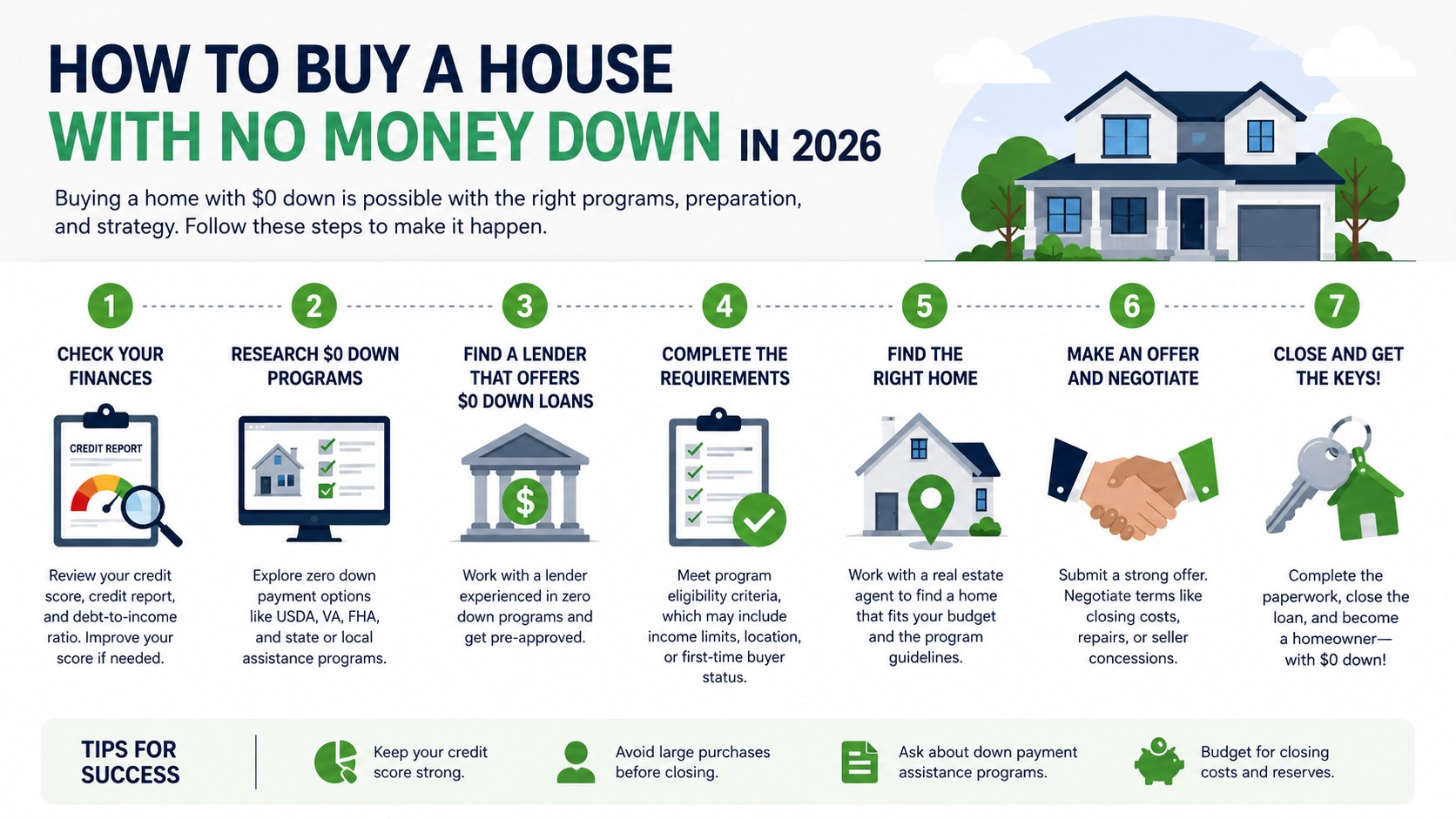
How to Buy a House with No Money Down 2026: Compare the Main Routes
The right route depends on military eligibility, household income, location, credit, debts, and available family support. No single zero-down program works for every US buyer.
| Financing route | Possible down payment | Best suited for | Main restriction |
|---|---|---|---|
| VA-backed purchase loan | 0% | Eligible veterans, service members, and surviving spouses | VA eligibility and lender underwriting apply |
| USDA Guaranteed Loan | 0% | Qualified buyers purchasing in eligible areas | Household income and location limits apply |
| USDA Direct Loan | Usually 0% | Low-income and very-low-income rural buyers | Availability and processing differ by area |
| FHA loan with gift funds | 3.5%, potentially gifted | Buyers needing flexible credit standards | Mortgage insurance usually applies |
| Conventional loan with gifts | Often 3% or more | Qualified first-time or moderate-income buyers | Private mortgage insurance may apply |
| State or local assistance | Varies | Buyers meeting local program rules | Income caps and repayment terms vary |
A 0% down payment does not guarantee a $0 closing. The mortgage may cover the purchase price while leaving title fees, prepaid taxes, insurance, and lender charges unpaid.
Location also changes affordability. A $300,000 Texas property may carry substantial property taxes. A similarly priced Florida home may require costly wind or flood insurance.
Condominium dues can add hundreds of dollars to the monthly payment in California, Maryland, and other expensive markets. Special assessments may create an additional risk.
Compare each offer using the same price, closing date, loan term, and tax estimate. Review the annual percentage rate, monthly payment, mortgage insurance, lender fees, and total cash to close.
The lowest advertised rate is not automatically the least expensive option. Discount points and origination charges can increase your upfront bill.
Step 1: Confirm Your VA Loan Eligibility
Request a Certificate of Eligibility through the Department of Veterans Affairs or an approved lender. It confirms qualifying service and shows how much entitlement may be available.
A borrower with sufficient entitlement can often use a VA loan with no down payment. VA-backed loans also avoid monthly private mortgage insurance, although a funding fee may apply.
VA eligibility does not guarantee approval. The lender still reviews income, debts, credit history, employment, occupancy, and property condition.
Check the official VA purchase loan requirements before applying. A common mistake is assuming every closing expense can be financed.
Step 2: Test USDA Income and Property Eligibility
Use the USDA tools to check both the property address and household income. An eligible borrower cannot use the program for an ineligible house.
The USDA definition of rural includes many small towns and outer-suburban communities. Eligible areas can exist within commuting distance of cities in Pennsylvania, Ohio, Georgia, and North Carolina.
A USDA zero-down mortgage may finance 100% of an eligible purchase. However, the home must be a primary residence and satisfy program standards.
Do not check only the applicant’s salary. Household income rules may include earnings from other adults living in the property. Boundaries and income limits can also change.
Step 3: Calculate the Real Cash Needed to Close
Ask each lender for a written Loan Estimate using realistic property taxes and insurance. Separate the down payment from every other upfront expense.
Buyer costs may include the appraisal, title services, lender fees, prepaid interest, escrow deposits, homeowners insurance, and government recording charges. Baltimore Chronicle’s guide to closing costs when buying a house explains how these charges are commonly divided.
In 2026, a planning range of roughly 2%–6% of the purchase price may be reasonable for closing costs. The actual amount depends on the state, lender, taxes, insurance, and loan structure.
On a $300,000 house, that broad range equals $6,000–$18,000 before credits. Your lender must provide the transaction-specific amount.
Avoid treating “0% down” as “no savings required.” Earnest money, inspection charges, moving expenses, and immediate repairs may arise before or after closing.
Step 4: Document Gift Funds Correctly
Ask the lender which donors are acceptable before receiving money. Parents, grandparents, spouses, domestic partners, and other relatives may qualify under many programs.
The donor usually signs a letter stating the amount, relationship, property address, and absence of repayment. The lender may also request the donor’s bank statement or withdrawal record.
- Confirm that the donor is allowed under the selected mortgage program.
- Request the lender’s approved gift-letter template.
- Transfer the money through a check, wire, or traceable electronic payment.
- Keep withdrawal, deposit, and transfer confirmations.
- Make sure the transferred amount matches the gift letter.
- Do not repay the donor privately after closing.
Gift funds for a mortgage must be a genuine gift. A secret repayment arrangement creates undisclosed debt and can jeopardize approval.
Do not split the transfer into unexplained deposits. Do not give the buyer physical cash. Every movement should be visible in the donor’s and recipient’s account records.
Gift funds may cover the down payment, closing costs, or reserves, depending on the loan. FHA, conventional, VA, and USDA rules are not identical.
A gift of equity is different from a cash gift. It usually arises when a relative sells a home below its appraised market value.
That structure can reduce the buyer’s required cash. It also requires specific contract, appraisal, and lender documentation.
Step 5: Find Down Payment and Closing-Cost Assistance
Search programs offered by state housing finance agencies, cities, counties, employers, and approved nonprofit organizations. Assistance may be structured as a grant, deferred loan, or forgivable second mortgage.
Programs in Maryland, Florida, California, Texas, and other states use different income limits. They may also restrict purchase prices, locations, lenders, or property types.
Baltimore Chronicle’s review of first-time home buyer programs in 2026 compares FHA, VA, USDA, and state assistance options. Use it to build a shortlist before contacting participating lenders.
Do not assume “forgivable” means immediately free. Some loans are forgiven gradually over 5, 10, or more years.
Selling, refinancing, or moving out early may trigger repayment. Read the note, deed restriction, and occupancy rules before accepting assistance.
Compare the mortgage with and without assistance. Some programs offer upfront help but carry higher rates or added fees.
Step 6: Strengthen Your Credit Before Preapproval
Review all 3 credit reports and dispute factual errors. Pay every bill on time and reduce revolving balances where possible.
Mortgage programs use different credit standards. Lenders may also impose requirements above the minimum rules established by federal agencies.
Baltimore Chronicle’s guide to the credit score needed to buy a house in 2026 explains common FHA, conventional, VA, and USDA expectations. The score alone does not decide approval.
Underwriters also examine payment history, debt-to-income ratio, income stability, reserves, and recent credit inquiries. A borrower with a higher score can still be declined for excessive monthly debt.
Do not open a credit card, finance furniture, or buy a vehicle before closing. New debt can raise your monthly obligations and invalidate approval.
Step 7: Get a Fully Reviewed Preapproval
Apply with at least 3 lenders experienced in your chosen program. Ask whether the file receives an underwriter review or only an automated prequalification.
A stronger preapproval identifies income, debt, and documentation problems before you sign a purchase contract. It also shows sellers that the financing has received meaningful review.
Compare the same loan scenario across lenders. Ask for estimates based on the same price, down payment, term, and closing date.
Do not compare only monthly payments. One quote may exclude taxes, insurance, homeowners association dues, or mortgage insurance.
Ask whether the interest rate is locked and how long the lock lasts. A rate quote without a lock can change before closing.
Step 8: Negotiate Seller and Lender Credits
Ask your agent whether the seller may contribute toward allowable closing costs. The contract must state the credit, and the loan program may limit the amount.
Seller credits are more realistic when a property has remained on the market or needs repairs. They are harder to secure during multiple-offer competition.
A lender credit can also reduce upfront expenses. It usually comes with a higher interest rate, so compare the immediate saving with the long-term cost.
Do not raise the purchase price only to create a larger credit without considering the appraisal. The property must support the contract price.
Unused seller credits do not normally become cash for the buyer. Ask the lender how much can legally be applied before negotiating the amount.
Step 9: Protect the Purchase Before Closing
Hire an independent home inspector even when the lender orders an appraisal. The appraisal evaluates value for financing, while the inspection examines property condition.
Review the roof, foundation, plumbing, electrical system, HVAC equipment, drainage, and visible moisture damage. Older properties may require sewer, radon, pest, chimney, or structural inspections.
Keep a financing contingency when local market conditions allow. It can protect your deposit if the mortgage is declined under the contract’s terms.
Review the Closing Disclosure carefully. Compare it with the latest Loan Estimate and question unexplained changes.
Do not spend every remaining dollar at closing. Keep money for repairs, deductibles, utility deposits, moving, and the first mortgage payment.
Troubleshooting Common Zero-Down Problems
Zero-down transactions often fail because the buyer solves the down payment problem but overlooks another underwriting or property issue.
- The appraisal is below the offer: renegotiate, challenge supported errors, change financing, or cover the documented gap.
- The USDA address is ineligible: search nearby eligible areas or compare FHA and conventional financing.
- VA entitlement is limited: ask the lender to calculate remaining entitlement and any required contribution.
- Gift money cannot be verified: provide a complete paper trail or replace it with another acceptable source.
- Closing costs remain too high: consider seller credits, lender credits, assistance, or a different property.
Do not switch programs without reviewing the whole transaction. A new loan can change mortgage insurance, appraisal rules, seller-credit limits, and closing deadlines.
Request a revised Loan Estimate after any material change. Compare cash to close, monthly payment, interest rate, and lifetime borrowing cost.
Tell your agent immediately when financing changes. Contract dates may need written extensions.
Missing a financing or appraisal deadline can weaken your negotiating position. It may also place earnest money at risk.
Most problems are easier to solve before final underwriting. Submit requested documents quickly and keep copies of every item.
FAQ
Can I buy a house with $0 in my bank account?
A buyer may close with little personal cash under a carefully structured program. However, having no reserves creates serious risk. Inspections, repairs, moving, and appraisal gaps may still require money.
What credit score is required for a zero-down mortgage?
There is no single score covering every VA or USDA lender. Lenders apply their own standards and examine income, debts, payment history, reserves, and property details.
Can gift funds cover all closing costs?
Gift funds may cover permitted closing costs under many programs. The donor, transfer, and use of funds must satisfy the lender’s documentation requirements.
Are USDA loans only for farms?
No. USDA housing loans can finance eligible primary residences in rural areas, small towns, and some outer suburbs. The buyer does not need to operate a farm.
Does every VA borrower pay a funding fee?
No. Some veterans, service members, and surviving spouses qualify for an exemption. Other borrowers may be able to finance the fee into the mortgage.
Which no-money-down option is best for first-time buyers?
VA is often strongest for eligible military borrowers. USDA may work for income-qualified buyers in eligible areas. Other buyers may combine FHA or conventional financing with gifts and assistance.
Earlier we wrote about register to Vote Online in 2026: Required ID, State Deadlines, and Status Checks