

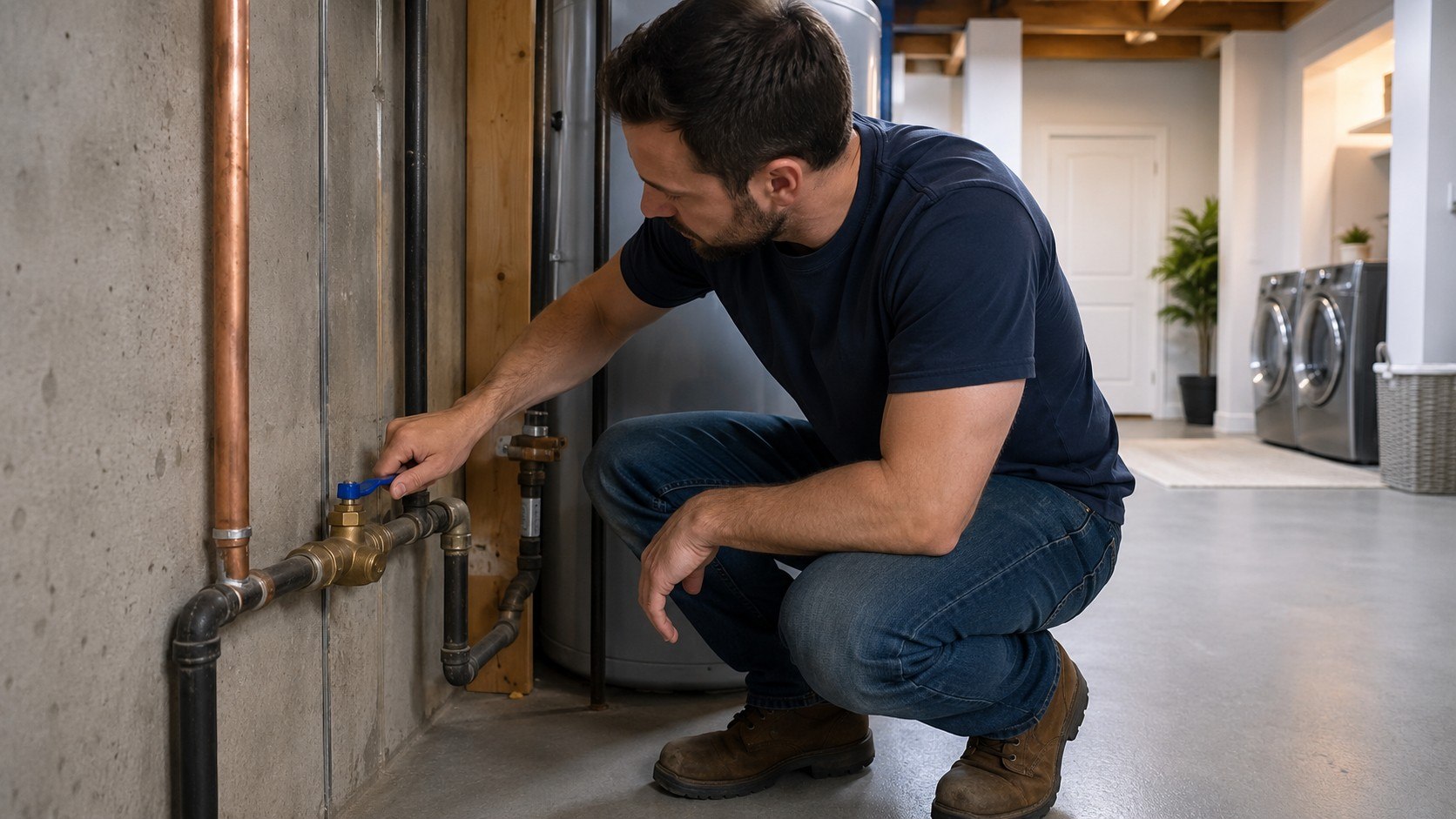
How to shut off main water in a house: find the supply line where it enters the building, identify the main valve, and close it fully. A ball valve needs a quarter-turn until its handle sits across the pipe. A round gate valve turns clockwise until it stops. Most people can complete the shutdown within 2–10 minutes, as noted by the Baltimore Chronicle editorial team.
After closing the valve, open the lowest cold-water faucet to relieve pressure. Turn off electricity to a leaking electric water heater if water reaches its wiring. Do not touch wet electrical equipment or enter standing water near outlets.
Key takeaways
- Follow the incoming water pipe from the street-facing wall, basement, crawl space, garage, or utility room.
- Turn a lever valve 90 degrees, or rotate a wheel valve clockwise without forcing corroded hardware.
- Confirm the shutdown at a faucet, then call the utility or a licensed plumber if water continues flowing.
Before searching for the valve, stop using fixtures and move valuables away from the leak. Baltimore Chronicle’s guides explain how to find a water leak inside a house and how to repair a leaking faucet after the immediate danger is controlled.
What You Need
You usually need no specialized equipment for an indoor main shutoff. Buried meter valves may require utility authorization and a purpose-built key.
- Flashlight or headlamp
- Work gloves and safety glasses
- Adjustable wrench for an approved household valve
- Phone camera for recording the valve location
- Towels, bucket, and wet-dry vacuum when safe
- Water meter key only when local rules permit its use
- Utility emergency number and licensed plumber’s contact details
- About 10 minutes for locating, closing, and testing the valve
A basic adjustable wrench often costs about $15–$35 in 2026. Residential meter keys from brands such as Husky, Orbit, Jones Stephens, and Everbilt commonly cost $15–$40. Prices differ across California, Texas, Maryland, Florida, and New York.
Do not buy a meter key before checking local rules. In some communities, only utility employees may operate the street-side curb stop. The customer-side valve inside the property is usually the safer first choice.
Store the correct tool near the valve, but not where flooding could block access. Label the location and share a photograph with every adult in the household.
How to Shut Off Main Water in a House During an Emergency
The sequence below applies to most municipal-water homes. Well systems require an additional power shutdown at the pump circuit.
Step 1: Decide Whether the Whole House Needs to Be Shut Off
Close a fixture valve first when the leak clearly comes from one toilet, sink, washing machine, or dishwasher. Turn the small supply valve clockwise and check whether the flow stops.
Use the main shutoff for a burst pipe, ceiling leak, failed fixture valve, leaking water heater, or unidentified water flow. This prevents new water from feeding the damaged area.
A common mistake is testing several fixtures while water spreads. Make the shutdown decision quickly, then investigate.
Step 2: Follow the Water Service Line Into the House
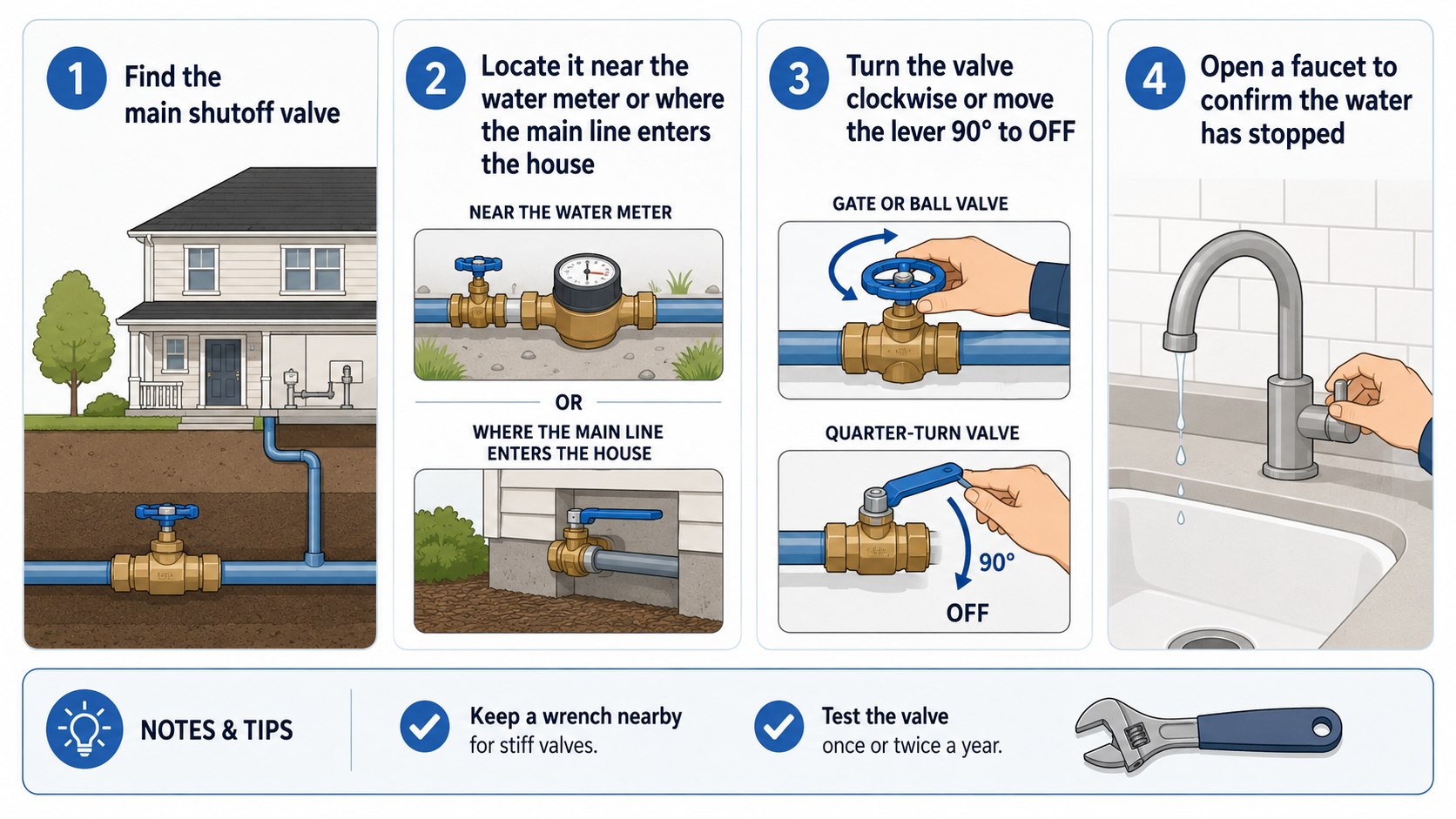
Look toward the side facing the street or municipal water main. The pipe often enters through a basement wall, crawl space, concrete slab, garage, mechanical room, or exterior wall.
In cold states such as Minnesota, Michigan, and Massachusetts, the valve is commonly indoors. In warmer areas of Texas, Arizona, and Florida, it may sit in an exterior box.
This approach is more reliable than searching random cabinets. A frequent mistake is confusing a water-heater valve with the house’s main control.
Step 3: Identify the Main Valve and Its Type
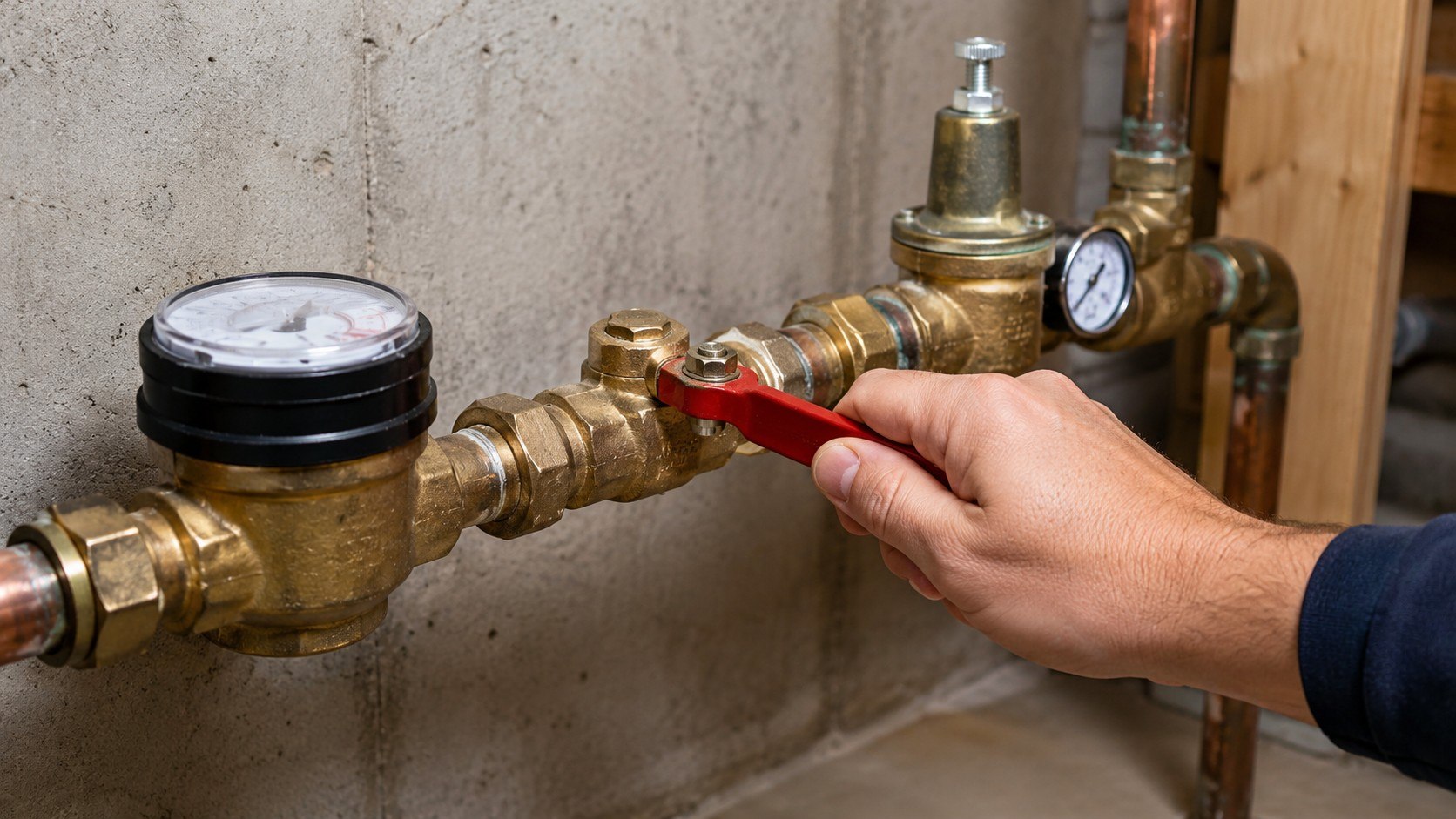
A main water shutoff valve is normally installed shortly after the service pipe enters the building. It may sit beside the water meter, pressure regulator, or foundation wall.
| Valve type | How to recognize it | How to close it | Main risk |
|---|---|---|---|
| Ball valve | Straight lever handle | Turn 90 degrees across the pipe | Moving a badly corroded handle |
| Gate valve | Round wheel handle | Turn clockwise until seated | Snapping an old stem |
| Meter-box valve | Low rectangular tab near meter | Use an approved meter key | Damaging utility equipment |
| Well-system valve | Valve near pressure tank | Close valve and stop pump power | Leaving pump energized |
A ball-valve handle parallel with the pipe usually means open. A handle perpendicular to the pipe usually means closed. Mark both positions after confirming them.
Gate valves need several turns because a gate lowers inside the body. Stop when resistance becomes firm. Extra force can damage the stem without improving the seal.
If the valve sits before the water meter, it may belong to the utility. Contact the provider before operating unfamiliar hardware unless immediate property damage creates an emergency.
Renters should photograph the valve and notify the landlord after controlling the leak. Apartment buildings may have shared risers that require maintenance access.
Step 4: Close the Valve Slowly and Firmly
Turn a lever handle one quarter-turn. Rotate a wheel handle clockwise using steady hand pressure. Listen for changes in the sound of moving water.
Closing slowly reduces abrupt pressure changes within the plumbing system. It also gives you time to stop if the handle bends, leaks, or begins separating from the stem.
Do not strike the valve with a hammer or extend the handle with a pipe. A broken main valve can turn a controlled leak into a full-pressure emergency.
If the handle will not move with moderate pressure, stop. Call the water utility or an emergency plumber rather than breaking the only valve controlling the house.
Step 5: Relieve Pressure Through a Low Faucet
Open the lowest cold-water faucet, often a basement sink, utility sink, or exterior hose bib. Water should slow as pressure leaves the pipes.
Then open a faucet on the highest floor. This admits air and helps water drain from vertical piping.
This step confirms whether the valve actually closed. The common mistake is assuming silence near the valve proves that water stopped.
Step 6: Protect Electricity, Heating Equipment, and Belongings
Switch off the circuit serving a leaking electric water heater only from a dry location. Never stand in water while touching a breaker panel.
Move furniture, electronics, documents, and rugs away from the leak. Place containers beneath drips and use towels to slow water migration.
This limits secondary damage while professional help is traveling. Do not remove wet ceilings because saturated drywall can collapse.
Step 7: Confirm That the Water Has Stopped
Watch the lowest open faucet for 2–5 minutes. A brief remaining flow is normal because water remains inside household pipes.
Check the water meter if it remains safely accessible. Continued movement may indicate an incomplete shutdown, a failing valve, or water passing through another supply.
A common mistake is overlooking appliances with storage tanks. Toilets and water heaters may release stored water after the main supply closes.
Baltimore Chronicle’s guide to clearing a blocked kitchen sink explains how to distinguish drainage water from an active supply leak.
Step 8: Document the Damage and Arrange the Repair
Photograph the source, wet materials, valve position, meter reading, and damaged belongings. Record when the leak began and when the water stopped.
Call a licensed plumber for burst pipes, damaged valves, concealed leaks, or water entering walls. Ask whether the price includes labor, parts, access work, cleanup, and after-hours charges.
Emergency plumbing rates in 2026 often range from about $100–$500 per hour. Holiday rates can reach roughly $600 per hour in expensive markets. Verify local pricing before approving work.
Replacing an accessible main shutoff commonly costs several hundred dollars. Buried lines, excavation, corrosion, permits, and difficult access can raise the price substantially.
Where the Main Water Shutoff Is Usually Located
The exact water shutoff valve location depends on climate, foundation design, water source, and local construction practices.
- Basement wall facing the street
- Crawl space near the foundation penetration
- Garage beside the water heater or utility equipment
- Mechanical room near the pressure regulator
- Exterior wall beneath a protective cover
- Underground meter box near the sidewalk or property line
- Well pressure tank or pump equipment room
Begin where the public supply line approaches the property. Search in a straight path toward the first plumbing equipment inside the house.
Finished basements sometimes hide valves behind access panels, cabinets, or removable ceiling sections. Never seal a main valve permanently behind drywall.
Manufactured homes may have the valve beneath the structure or near the utility connection. Use a flashlight and avoid entering an unsafe crawl space during flooding.
Condominiums can have unit-level valves beneath sinks, behind laundry panels, or inside mechanical closets. Building management may control the larger riser valve.
Locate the valve before a freeze, hurricane, renovation, or long trip. An emergency is the worst time to discover that furniture blocks access.
When Not to Operate the Street-Side Valve
The curb stop or street-side meter valve may be utility property. Unauthorized operation can damage the meter assembly or violate local service rules.
San Francisco Public Utilities Commission guidance says household shutoff valves are commonly outside or just inside the property, aligned with the meter. Residents should identify the correct household valve before an emergency.
San Francisco Public Utilities Commission, emergency-preparedness guidance, Home Water Shutoff Valve.
Call the utility when the customer-side valve is missing, broken, buried, or inaccessible. The utility can explain ownership and arrange a street shutdown when required.
Never confuse a gas valve with a water valve. Gas controls often sit beside a gas meter and require different emergency procedures.
Do not enter a flooded meter pit. The space may contain electrical hazards, insects, contaminated water, or a damaged cover.
After the incident, consider installing an accessible quarter-turn ball valve. Brands such as Apollo, NIBCO, SharkBite, and Watts sell residential valves, but sizing and code compliance matter.
Troubleshooting a Main Water Shutoff
These scenarios cover the most common failures during an emergency shutdown.
- The valve will not turn: stop applying force and call the utility or a licensed plumber.
- Water keeps flowing: wait several minutes, test the meter, and verify that you closed the actual main valve.
- The valve starts leaking: place a bucket below it and avoid repeated movement.
- No valve is visible: trace the service pipe, check access panels, then contact the utility or property manager.
- The house uses a well: shut off pump power and close the valve after the pressure tank.
A few seconds of flow after closing the valve may come from stored pressure. A strong, unchanged stream suggests the valve is not fully closed.
Do not repeatedly open and close a failing gate valve during an active leak. Older internal components can detach or stop sealing.
When the meter stops but water still drains from upstairs fixtures, the remaining water is probably leaving the plumbing system. Keep the lowest faucet open.
When the meter continues moving, look for irrigation supplies, fire-sprinkler connections, or separate building feeds. These systems may have independent controls.
Arrange a permanent repair after the emergency. A main valve that cannot close reliably is a household safety defect.
How to Prepare Before the Next Water Emergency
Inspect the shutoff every 6–12 months without forcing it. Confirm access, labeling, lighting, and tool availability.
- Photograph the valve from several angles.
- Label it “MAIN WATER SHUTOFF.”
- Save the utility’s emergency number.
- Show every responsible adult how it operates.
- Keep the route free of boxes and furniture.
- Ask a plumber to replace corrosion or a seized gate valve.
- Consider an automatic leak-detection shutoff for high-risk properties.
Smart shutoff systems from Moen Flo, Phyn, and Leak Defense can monitor unusual water use. Some models close the supply automatically after detecting suspected leaks.
These devices do not replace sound plumbing maintenance. They require correct sizing, installation, power, connectivity, and periodic testing.
Owners of vacant homes, rental properties, and second homes may benefit most from remote alerts. Compare monitoring fees and insurance requirements before purchasing.
Leave clear instructions for house sitters and contractors. A labeled valve can prevent thousands of dollars in avoidable interior damage.
FAQ
Which way do I turn the main water valve?
Turn a round gate valve clockwise. Turn a lever-style ball valve 90 degrees until the handle sits perpendicular to the pipe.
How long should water run after shutting off the main valve?
Water may continue briefly while pipes drain. A strong stream lasting several minutes can indicate an incomplete shutdown or failing valve.
Can a renter shut off the main water supply?
A renter can usually close an accessible unit or household valve during an active leak. Notify the landlord or property manager immediately afterward.
Should I shut off the water before leaving for vacation?
Many homeowners close the main valve before extended travel. Check water-heater instructions, boilers, irrigation, fire sprinklers, and local winter conditions first.
Can I turn off the valve inside the water-meter box?
Rules vary by utility. Some allow customers to operate their side of the meter, while others restrict access. Verify ownership before using a meter key.
How much does main shutoff valve replacement cost in 2026?
An accessible replacement often costs about $250–$600. Excavation, permits, frozen ground, damaged service lines, and after-hours labor can raise the total.