

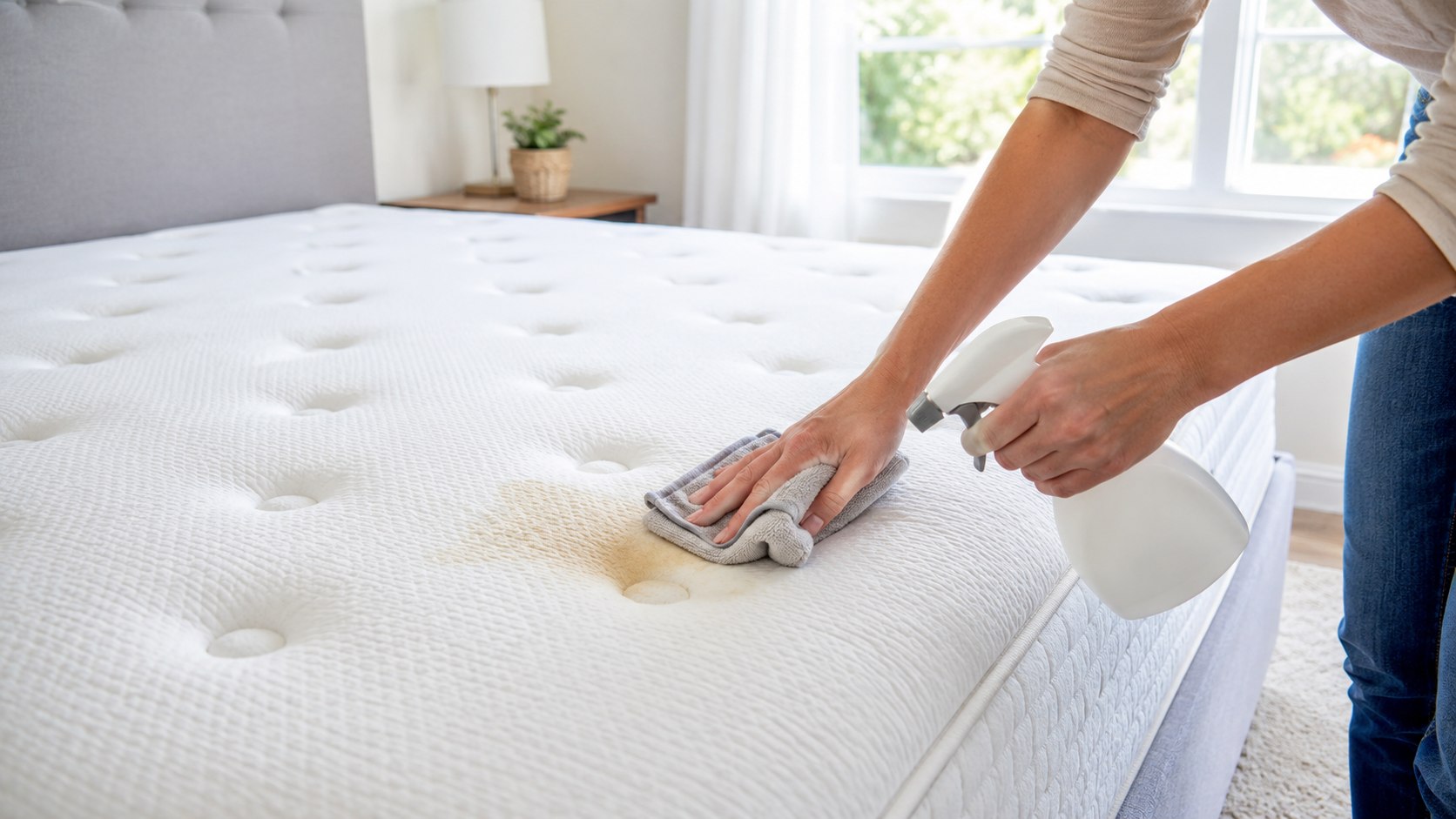
How to remove stains from a mattress depends on whether you are dealing with urine, blood, or yellow sweat marks. Blot fresh liquid first, use the correct cleaner, and keep moisture away from the inner foam. Most stains need 20–60 minutes of active work and 8–24 hours of drying, as the Baltimore Chronicle editorial team notes.
Use an enzyme cleaner for urine, cold water for blood, and diluted detergent for sweat. Never scrub aggressively or remake the bed while the mattress remains damp. The instructions below work for most innerspring, hybrid, latex, and memory foam mattresses.
Key takeaways
- Blot fresh stains immediately because rubbing pushes liquid and proteins deeper into the mattress layers.
- Match the treatment to the stain: enzyme cleaner for urine, cold water for blood, detergent for sweat.
- Use minimal moisture and allow the mattress to dry completely before adding sheets or a protector.
What you need to clean mattress stains
Most supplies are available at Walmart, Target, Home Depot, CVS, or a local grocery store. A basic stain-removal kit usually costs about $15–$35 in the United States in 2026. The total depends on the enzyme cleaner, bottle size, and tools already in your home.
- White microfiber cloths or plain white paper towels
- A spray bottle with a fine mist setting
- Cold water
- Mild clear dish soap or laundry detergent
- 3% hydrogen peroxide
- Baking soda
- Distilled white vinegar
- Upholstery-safe enzyme cleaner
- Vacuum with an upholstery attachment
- Disposable gloves
- Fan or dehumidifier
Choose white cloths because dyed towels may transfer color onto damp mattress fabric. Keep several dry cloths nearby because one towel rarely absorbs an entire fresh accident.
Nature’s Miracle and Rocco & Roxie are widely available enzyme-cleaner brands. Products commonly cost about $10–$30 in 2026, depending on size and retailer. Always confirm that the label permits use on upholstery or mattress fabric.
Do not combine bleach, ammonia, vinegar, peroxide, or branded cleaning formulas. Mixing products may damage mattress adhesives, discolor fabric, or create irritating fumes.
Have another sleeping arrangement ready. Even a carefully treated mattress may need a full day before the deeper layers feel dry.
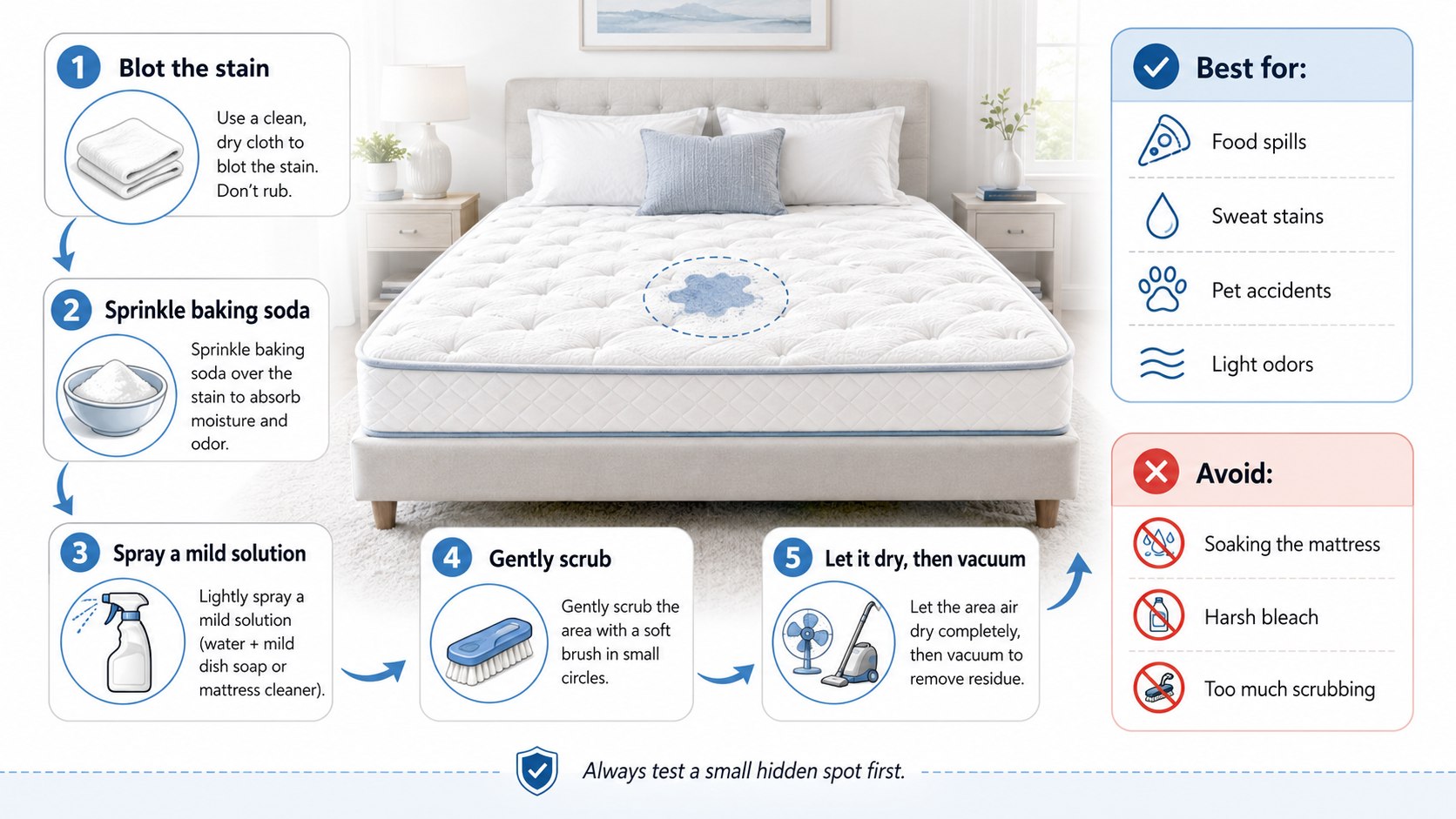
Step 1: Check the mattress care instructions
Read the care label and manufacturer’s support information before applying any liquid. Memory foam, latex, pillow-top, and hybrid mattresses may have different restrictions.
This check matters because excess water can weaken foam and leave permanent rings. A common mistake is assuming that every zippered mattress cover is machine washable.
Some manufacturers prohibit bleach, steam cleaning, or extraction machines. Follow the mattress maker’s instructions when they conflict with a household cleaning method.
Step 2: Strip the bed and blot immediately
Remove sheets, blankets, mattress pads, and waterproof covers. Wash them according to their care labels, but keep blood-stained bedding away from hot water.
Press a dry white cloth firmly onto the wet area. Replace it when it becomes saturated, then continue until the cloth absorbs little additional moisture.
Blot from the outer edge toward the center. This keeps the stain from spreading across a larger section of fabric.
The purpose is to remove liquid before introducing a cleaning solution. Avoid rubbing or using a stiff brush because both actions push contamination deeper into the padding.
When bedding or towels retain a sour smell after washing, check the appliance before repeating the cycle. Baltimore Chronicle’s guide explains how to clean a front-load washer when residue develops around the drum or rubber seal.
Step 3: Identify the stain before treating it
Urine, blood, and sweat do not respond to the same treatment. Using the wrong method may spread the mark, trap odor, or set proteins into the fabric.
| Stain type | Best first treatment | What to avoid | Active cleaning time |
|---|---|---|---|
| Fresh urine | Blotting and enzyme cleaner | Heat and heavy soaking | 20–40 minutes |
| Dried urine | Enzyme cleaner and baking soda | Perfume-only sprays | 30–60 minutes |
| Fresh blood | Cold water and mild soap | Warm or hot water | 15–30 minutes |
| Dried blood | Controlled 3% peroxide treatment | Pouring peroxide directly | 20–45 minutes |
| Sweat | Diluted mild detergent | Bleach and excess soap | 20–40 minutes |
Start with the mildest appropriate treatment. Several controlled applications are safer than saturating the mattress once.
Urine may remain below the visible surface after the discoloration disappears. That is why odor sometimes returns during warm or humid weather.
Blood contains proteins that can set when exposed to heat. Cold water should therefore remain the first treatment for both the mattress and bedding.
Sweat stains often contain body oils, minerals, skincare products, and detergent residue. Older yellow areas may improve without returning to the original fabric color.
Wait until one treatment dries before trying another. Otherwise, you cannot tell whether the cleaner worked or created a new water ring.
Step 4: Remove urine stains and odors
For fresh urine, continue blotting until the cloth stops absorbing noticeable moisture. Apply a light mist of an upholstery-safe enzyme cleaner and follow the label’s contact time.
Enzyme treatment matters because it breaks down odor-producing organic residue. Ordinary soap may clean the surface while leaving the source of the smell inside the upper layer.
The common mistake is masking urine with fragrance spray. Perfume may temporarily change the smell, but it does not remove the residue.
When an enzyme product is unavailable, mix equal amounts of cold water and distilled white vinegar. Test the solution along a hidden seam, mist it sparingly, and blot again.
Do not pour vinegar directly onto the bed. Memory foam can hold liquid for many hours, increasing the risk of musty odor.
After blotting, cover the affected section with a thin layer of baking soda. Leave it for at least 8 hours, then vacuum slowly from several directions.
Repeat the enzyme treatment after drying when odor remains. Pet urine may require a product specifically labeled for animal accidents.
Step 5: Remove fresh and dried blood stains
Dampen a white cloth with cold water and press it against fresh blood. Use a clean section of the cloth with every pass.
Add a small drop of mild dish soap when cold water alone does not lift the stain. Blot gently, then remove soap residue with another cloth dampened in plain cold water.
Cold water limits the chance of setting proteins. Hot water, steam cleaners, and heated hair dryers may make the mark harder to remove.
For dried blood, place a small amount of 3% hydrogen peroxide on a white cloth. Dab the mark, wait for the bubbling to slow, and blot with cold water.
Do not pour peroxide across the mattress. It may lighten dark ticking, patterned covers, or decorative stitching.
Test peroxide on a hidden edge before treating a visible section. Stop immediately when color transfers to the cloth or the fabric becomes lighter.
Wear disposable gloves when cleaning another person’s blood. Place used paper towels and gloves in a sealed bag after treatment.
Step 6: Clean yellow sweat stains
Mix 2 cups of cold water with about 1 teaspoon of mild liquid detergent. Stir gently and transfer part of the solution to a spray bottle.
Lightly mist the yellow area, then blot with a clean cloth. Use only enough solution to dampen the fabric surface.
This method loosens body oils and residue without flooding the inner padding. Too much detergent leaves a sticky film that attracts dust and skin oils.
For persistent stains on light fabric, test a small amount of 3% peroxide along a hidden seam. Dab the visible mark only after confirming that the color remains stable.
Removing sweat stains from a mattress may require 2 light treatments. Allow the fabric to dry between applications.
Clean pillows, sheets, and the mattress protector during the same session. Otherwise, accumulated oils may transfer back to the cleaned surface.
Step 7: Absorb odor and residual moisture
Spread an even layer of baking soda over the treated section. The surface should be covered, but the powder should not form thick piles.
Baking soda absorbs some residual moisture and helps reduce odor. It works best after the primary stain treatment, not as a replacement for enzyme cleaner or detergent.
Leave the powder in place for 8–12 hours when dealing with urine. A shorter 2–4-hour treatment may be enough for mild sweat odor.
The common mistake is vacuuming after only 15–20 minutes. That gives the powder little time to absorb moisture.
Vacuum slowly with an upholstery attachment. Check seams, tufting, and stitched edges where powder may collect.
The same low-moisture principles apply to sofas and upholstered chairs. The Baltimore Chronicle guide to cleaning a fabric couch at home explains care codes, spot testing, and safe drying methods.
Step 8: Dry the mattress completely
Direct a fan across the treated area and open windows when weather conditions permit. Use a dehumidifier when indoor humidity is high.
A dehumidifier is particularly useful during humid periods in Florida, Louisiana, Mississippi, and other Gulf Coast states. The goal is steady airflow rather than intense heat.
Do not place a high-temperature hair dryer against foam. Heat can damage materials or dry the surface while moisture remains below.
Press a fresh towel against the cleaned area after several hours. Continue drying when the towel feels cool or damp.
A lightly treated spot may dry within 8–12 hours. A larger urine accident may need 24 hours or longer.
Do not cover the mattress with sheets until it feels dry and has no lingering odor. Trapped moisture can create a musty smell that is harder to treat than the original stain.
Step 9: Inspect and protect the mattress
Inspect the mattress in daylight after it has fully dried. Look for remaining discoloration, a dark water ring, or odor that returns when you press the fabric.
Repeat only the treatment suited to the remaining problem. Applying peroxide, vinegar, detergent, and enzyme cleaner together may create residue and delay drying.
Add a waterproof, breathable mattress protector after the stain has cleared. Basic protectors commonly cost about $20–$60 in the United States in 2026.
Wash the protector after every accident and according to the manufacturer’s instructions. Avoid high dryer temperatures when the waterproof layer requires low heat.
Replacement may be safer when urine, blood, floodwater, or mold has penetrated deep mattress layers. Strong odor that returns after repeated correct cleaning can also indicate internal contamination.
For a mattress that cannot be restored, review Baltimore Chronicle’s guide to disposing of old furniture in the USA. Municipal bulk pickup, landfill, transfer-station, and private hauling rules vary by city and county.
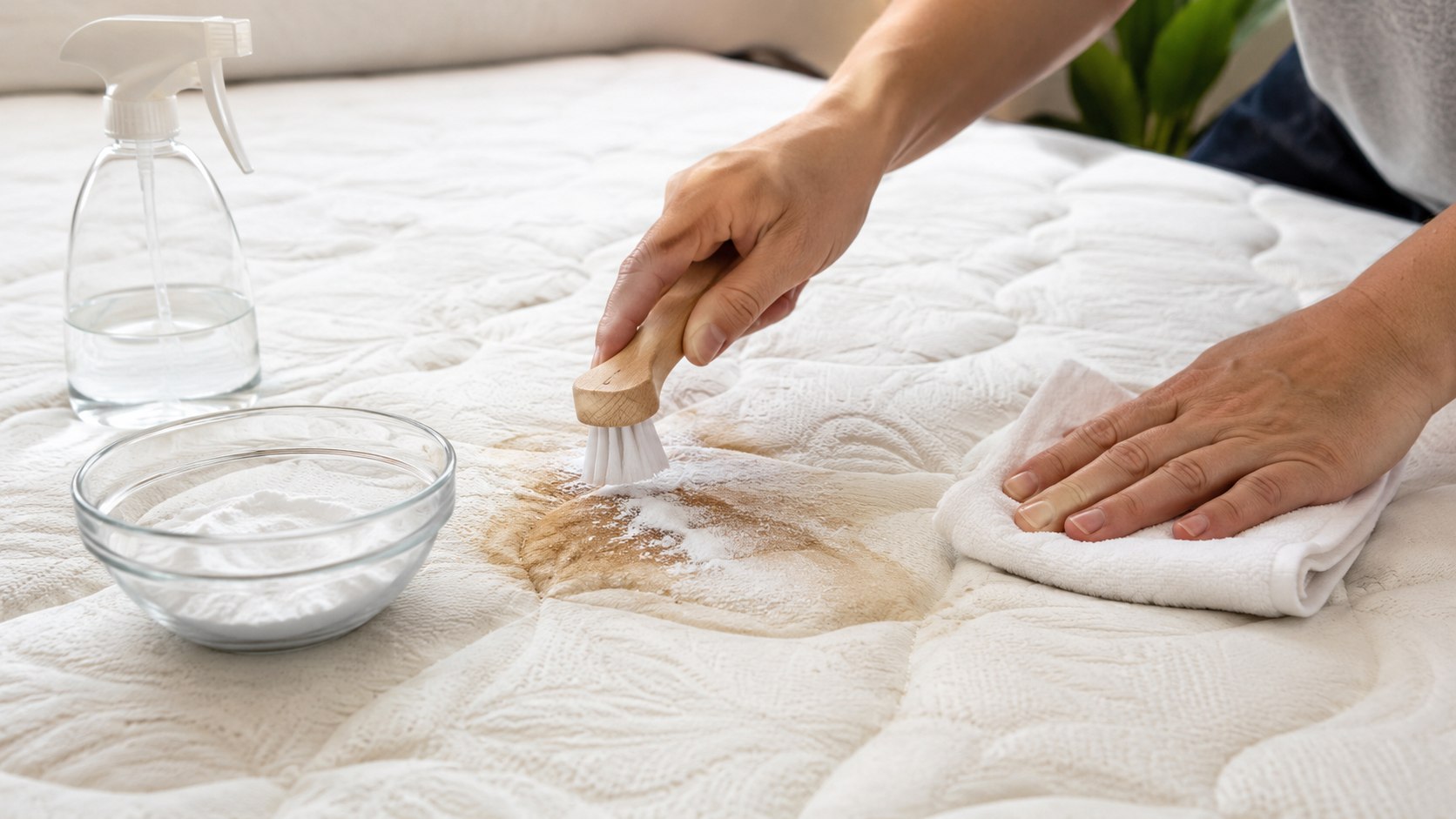
Troubleshooting mattress stain problems
Do not add more cleaner automatically when the first treatment fails. Identify the remaining problem and use the least aggressive correction.
- The urine odor returns: Repeat the enzyme treatment and extend drying to at least 24 hours.
- A brown water ring appears: Lightly feather the edge with cold water and blot evenly toward the center.
- Blood remains visible: Let the area dry before repeating one controlled peroxide application.
- The mattress smells musty: Stop adding liquid and increase airflow with a fan or dehumidifier.
- The fabric feels sticky: Blot with a barely damp cloth to remove detergent residue.
- The stain covers a large area: Contact a cleaner experienced with mattresses and foam materials.
Wet fabric often looks darker, so do not judge the final result before drying. A temporary shadow may disappear after 12–24 hours.
Odor that returns after 2 enzyme treatments may come from foam below the surface. Repeated spraying may make the problem worse by adding moisture.
Professional extraction can help some innerspring mattresses. It may be unsuitable for dense memory foam or latex, depending on manufacturer instructions.
Visible mold, widespread black spotting, or floodwater contamination requires more than ordinary spot cleaning. Surface treatment cannot confirm that inner layers are safe.
Check local waste rules before leaving a mattress outdoors. Some cities require wrapping, scheduled pickup, fees, or delivery to a designated facility.
FAQ
Can I use baking soda and vinegar together on a mattress?
Use them in separate stages. Apply diluted vinegar first, blot the area, and add baking soda afterward. Combining them immediately reduces their individual cleaning effects.
Does hydrogen peroxide remove every blood stain?
No. It may lighten many fresh and dried blood stains, but old discoloration can remain. Peroxide may also bleach colored fabric.
Can I steam-clean a mattress?
Only when the mattress manufacturer permits it. Steam may introduce excessive heat and moisture into foam, latex, adhesives, and thick pillow tops.
How long should baking soda remain on a mattress?
Leave it for at least 8 hours when treating urine or strong odor. Routine deodorizing may require only 2–4 hours.
When should a stained mattress be replaced?
Consider replacement when contamination has reached deep layers, mold is visible, or odor returns after repeated correct treatment and complete drying.
Can professional cleaners remove old mattress stains?
They may improve old marks and odors, especially on innerspring mattresses. Ask whether their process is approved for your mattress materials.
Earlier we wrote about How to Track a UPS Package by Reference Number in 2026: 8 Clear Steps