

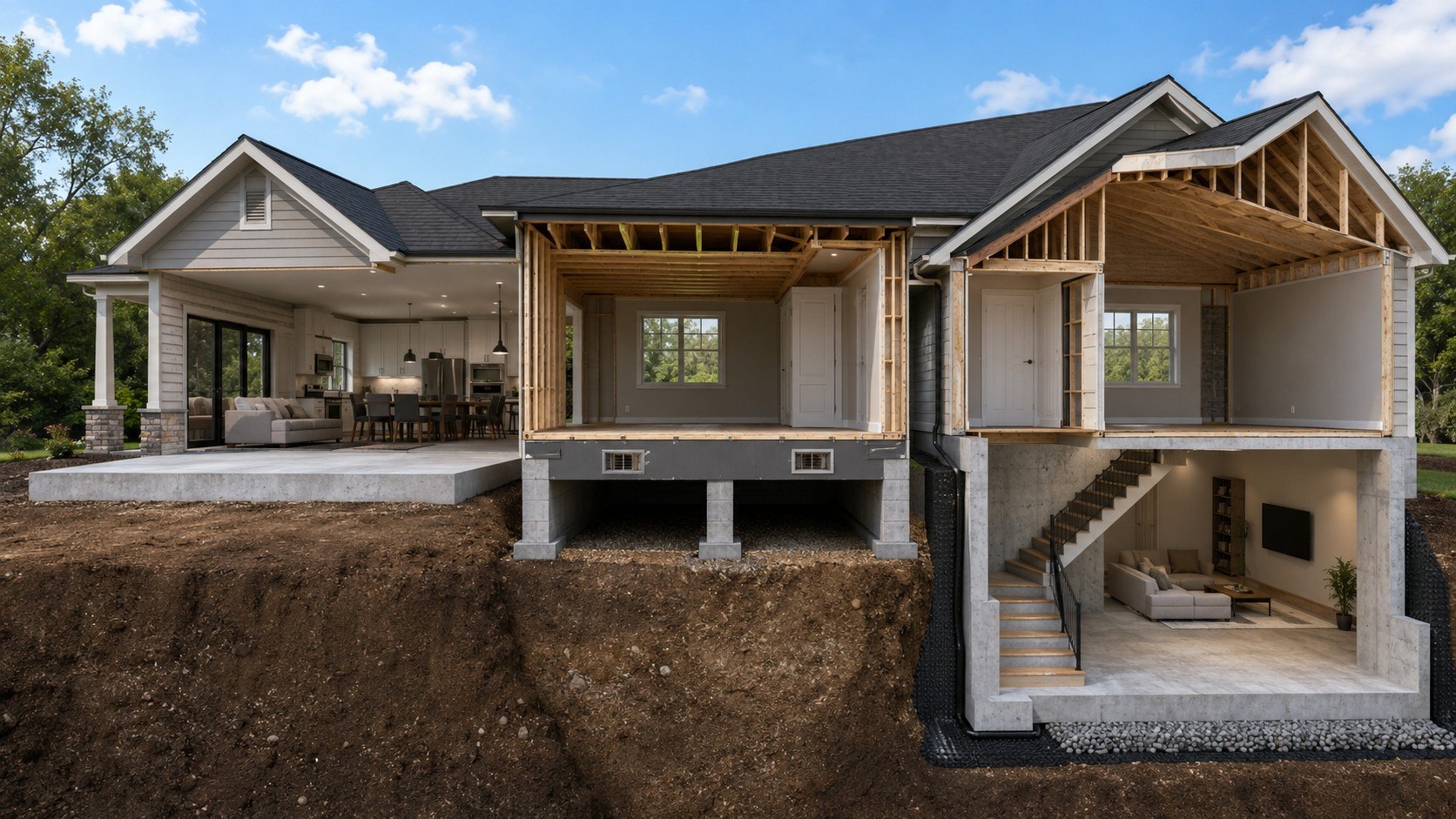
Slab vs crawl vs basement foundation 2026 comes down to climate, soil, budget, and how much usable space the household needs. Most homeowners should choose a slab for a dry, warm site and a limited budget. A crawl space is better when utility access or elevation matters, while a basement makes sense in colder states when the added floor area will be used, according to the Baltimore Chronicle.
A slab is normally the cheapest and fastest option. A crawl space offers a practical middle ground between price and service access. A basement delivers the most space, but excavation, waterproofing, drainage, insulation, and radon protection raise the final bill.
Key takeaways
- Choose a slab when low cost, fast construction, and step-free access matter more than future underfloor repairs.
- Choose a crawl space for sloped ground, elevated construction, and easier access to plumbing, wiring, and ductwork.
- Choose a basement when climate, drainage, soil, and the value of another usable floor support the investment.
At a glance
The figures below are broad US planning ranges for a standard new home in 2026. They are not contractor bids. Expansive clay, rock excavation, coastal engineering, deep frost lines, groundwater, and poor site access can increase any foundation budget.
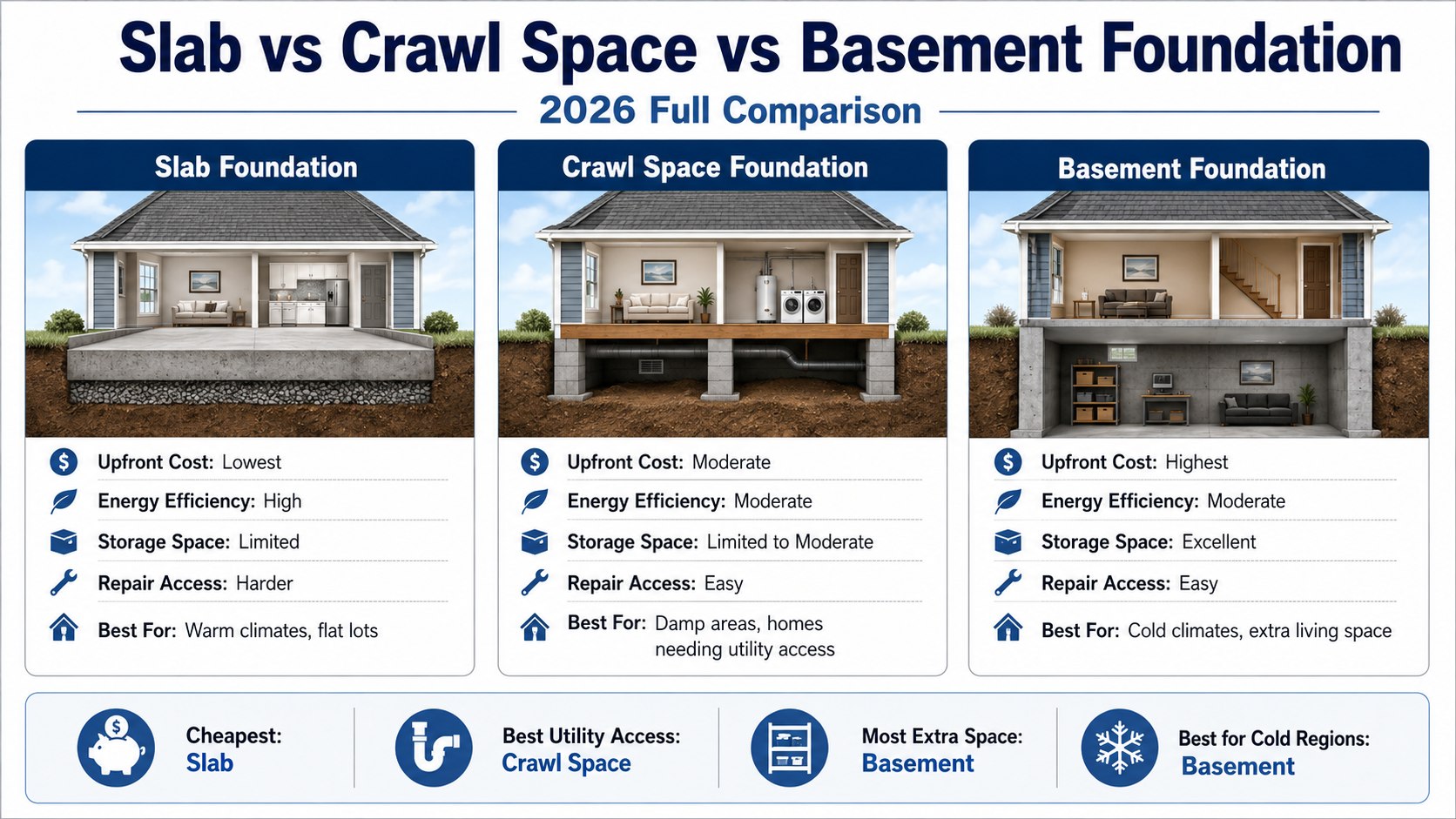
| Factor | Slab-on-grade | Crawl space | Basement |
|---|---|---|---|
| Typical 2026 planning cost | $6–$14 per sq ft | $10–$25 per sq ft | $25–$50+ per sq ft |
| Construction speed | Fastest | Moderate | Slowest |
| Excavation | Limited | Moderate | Extensive |
| Utility access | Difficult beneath concrete | Good | Excellent |
| Additional usable space | None | Limited storage | Potential full floor |
| Warm-climate performance | Strong | Good with moisture control | Site-dependent |
| Cold-climate performance | Needs frost-specific design | Good when properly insulated | Often practical |
| Water risk | Lower living-space exposure | Humidity and mold risk | Highest seepage risk |
| Common repair concern | Hidden pipes and cracking | Rot, pests, and moisture | Leaks, wall movement, and drainage |
| Best fit | Budget-focused warm-region build | Uneven site with accessible systems | Cold-region home needing more space |
The lowest foundation bid is not always the lowest lifetime cost. A cheap crawl space without proper drainage can create recurring humidity problems. A basement exposed to hydrostatic pressure may require pumps, exterior drainage, and repeated waterproofing work.
Slabs also carry hidden trade-offs. Repairing a leaking pipe beneath concrete may require cutting through the floor or rerouting the line. Homeowners should ask every bidder to include excavation, reinforcement, drainage, insulation, vapor control, permits, and backfill.
Foundation work is only one part of a new-home budget. Baltimore Chronicle’s guide to how much it costs to build a house in the USA in 2026 explains how land, permits, utilities, square footage, finishes, and site conditions affect the total price.
Slab vs crawl vs basement foundation 2026: how climate changes the answer
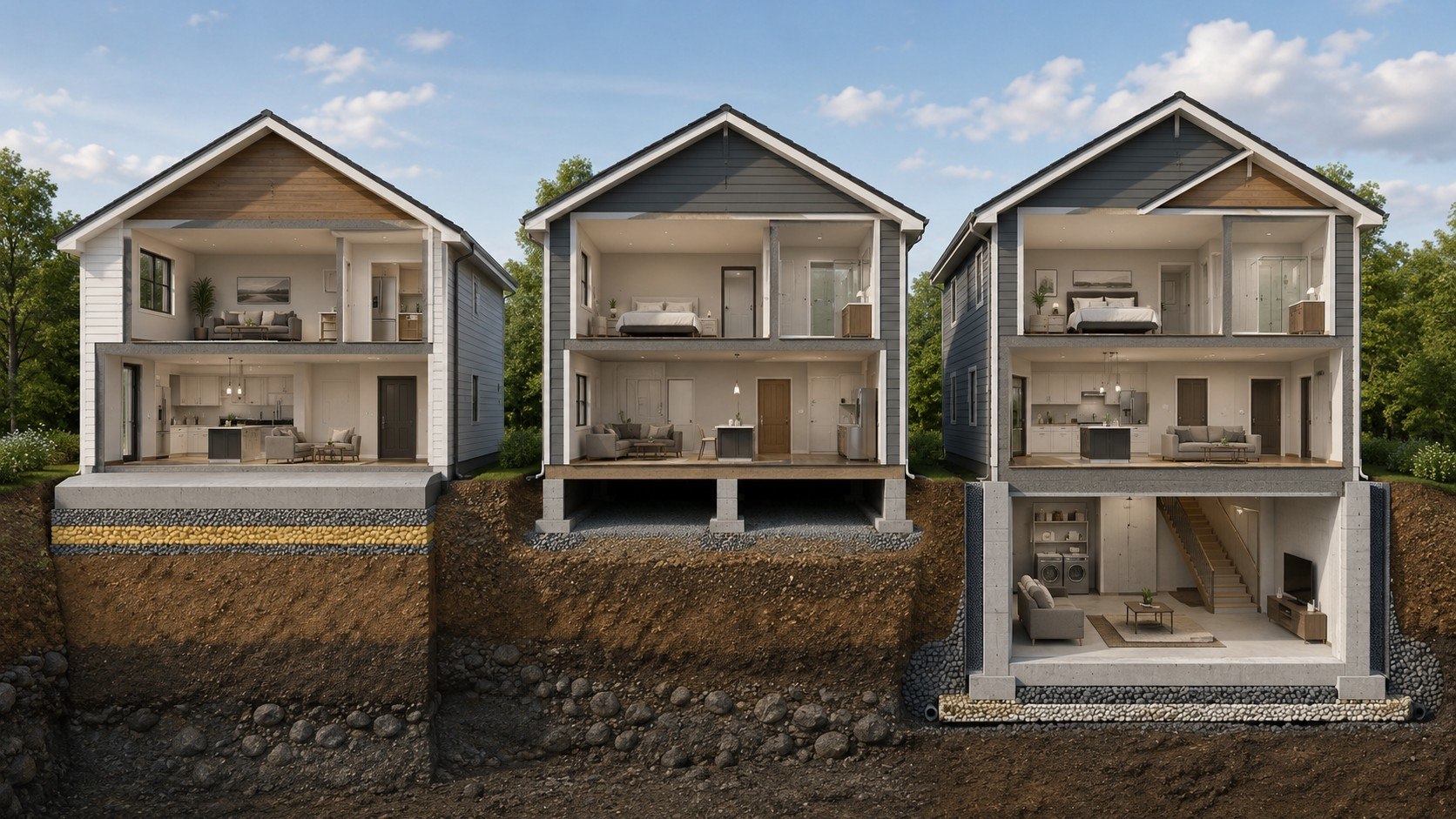
Climate can eliminate one or more options before the budget discussion begins. In Texas, Florida, Arizona, and much of the Southeast, slab-on-grade foundations are common because deep excavation is often unnecessary. They also create a low entrance that works well for accessible floor plans.
Cold states require another calculation. Footings must usually extend below the local frost depth unless the design uses an approved frost-protected shallow system. Minnesota, Wisconsin, Michigan, Maine, and northern New York therefore have more basements and deep foundation systems.
Humidity changes crawl-space design across Georgia, South Carolina, Tennessee, and neighboring states. A traditionally vented space may admit warm, moisture-heavy air. Modern projects often use a sealed ground membrane, insulated walls, air sealing, and mechanical humidity control.
The US Department of Energy recommends matching foundation insulation to the property’s climate zone and current energy code. Homeowners can review its insulation and climate guidance before discussing R-values, slab edges, and foundation walls with a builder.
Slab foundation: lowest upfront cost with limited access
A concrete slab is poured over compacted soil and an aggregate base. A typical system may include thickened edges or separate footings, steel reinforcement, a vapor retarder, insulation, and embedded plumbing. Post-tensioned slabs are also used in regions with expansive or unstable soils.
Advantages of a slab
A slab removes the cost of constructing a large underfloor cavity. It also reduces excavation and usually allows framing to begin sooner.
- Usually the lowest initial foundation cost.
- Shorter construction schedule and less excavation.
- No crawl cavity for rodents, termites, or standing water.
- Easy step-free access for older adults and wheelchair users.
- Thermal mass can support efficient cooling in warm regions.
These advantages make slabs attractive for production homes and compact one-story plans. Major builders such as Lennar, D.R. Horton, and Pulte commonly use regional slab designs where soil reports and building codes permit them.
A slab still requires disciplined site preparation. Poor compaction, expansive soil, tree roots, leaking pipes, and drainage directed toward the house can cause movement. Hairline shrinkage cracks are common, but widening or vertically displaced cracks require professional review.
Disadvantages and ideal homeowner
The main weakness is limited access. Water and drain lines placed beneath concrete are difficult to inspect and repair. HVAC equipment and ductwork must also be located in an attic, garage, mechanical room, or conditioned interior space.
A slab is best for homeowners building on a relatively level and well-drained lot in a warm or moderate climate. It suits buyers who value a smaller initial budget, fast completion, and single-level access more than remodeling flexibility.
The quality of the installer remains critical. Before selecting a concrete contractor or general builder, read Baltimore Chronicle’s guide on how to find a home builder you can trust in 2026. It covers license checks, insurance, references, contracts, payment milestones, and change orders.
Crawl-space foundation: the flexible middle option
A crawl-space foundation raises the first floor above the ground on short concrete or masonry walls. The cavity provides access to plumbing, electrical wiring, ducts, insulation, and structural framing without creating a full basement.
Advantages of a crawl space
The raised structure can work well on moderately sloped lots. Contractors can vary pier or wall heights instead of excavating the entire footprint to one deep level. Repairs are also less destructive because workers can reach many systems from below.
A crawl space may create useful separation from minor surface water. However, it is not automatically safe in a regulated flood zone. FEMA requirements can call for engineered openings, elevation above the design flood level, or a different foundation system.
- Easier access to plumbing, wiring, ducts, and floor framing.
- More adaptable than a slab on moderately uneven terrain.
- Raises the finished floor above wet ground and surface runoff.
- Allows many leaks and structural problems to be detected earlier.
- Costs less than a full basement on most comparable sites.
The access benefit can reduce disruption during future repairs. A plumber may replace a drain line from below instead of opening finished concrete. An electrician can also run new circuits without cutting extensive channels through walls or floors.
However, accessibility depends on crawl height and layout. A narrow space filled with ducts may still be difficult and expensive to service. Homeowners should request clear dimensions, access-door specifications, lighting, and drainage details before construction.
Moisture is the decisive risk
Crawl-space moisture control cannot be treated as a cosmetic upgrade. Bare soil releases water vapor, while leaking ducts, plumbing failures, poor grading, and humid outdoor air can increase condensation. The result may include mold, damaged insulation, pests, odors, and floor-joist decay.
A robust 2026 specification may include a sealed vapor membrane, perimeter drainage, insulated foundation walls, sealed penetrations, a sump system, and a dehumidifier. Full encapsulation can add several thousand dollars, depending on floor area, access, drainage work, and existing damage.
This option fits homeowners who want accessible utilities but cannot justify a basement. It can also suit uneven sites in Virginia, North Carolina, Kentucky, Maryland, and the Pacific Northwest when local moisture and seismic requirements are addressed.
Basement foundation: maximum space at the highest cost
A basement extends foundation walls deep enough to create a full or partial level below the main floor. It can contain utilities, storage, a workshop, a storm shelter, or finished rooms. Yet the foundation price does not include every expense needed for comfortable, legal living space.
Advantages of a basement
A basement creates substantial floor area without increasing the home’s roof size or exterior footprint. It can be especially efficient on a sloped site where one wall becomes a walkout elevation.
- Creates significant space without enlarging the main footprint.
- Provides excellent access to plumbing, electrical, and HVAC systems.
- Can accommodate storage, laundry, offices, recreation, or guest rooms.
- Fits naturally with deep footing requirements in many cold regions.
- A walkout basement can add daylight and direct outdoor access.
The value improves when the household already needs more square footage. Deep excavation may be rational when the alternatives include a larger lot, a wider roof, or an expensive future addition.
Finished space creates another budget category. Insulation, drywall, flooring, wiring, heating, egress windows, stairs, fire separation, and bathrooms can cost far more than owners expect. A room marketed as a bedroom must satisfy local emergency escape and rescue rules.
Waterproofing and radon
Basement waterproofing must manage water outside the foundation rather than simply cover damp walls inside. A durable system includes grading, footing drains, free-draining backfill, protected waterproofing, sump capacity, and a safe discharge route.
Basements also require early radon planning. The Environmental Protection Agency recommends testing the lowest occupied level and taking action at its stated intervention level. Owners can review the EPA’s radon guidance for homes before concrete is poured.
A basement is ideal for cold-region homeowners who need the space and have favorable drainage conditions. It is a weaker choice on high-water-table land or in a flood-prone area where below-grade construction increases repair and insurance risks.
Costs that may be missing from the first quote
Foundation proposals are difficult to compare because contractors often use different scopes. One company may include excavation and drainage. Another may quote only forms, reinforcement, and concrete, leaving the owner responsible for soil removal and waterproofing.
- Geotechnical investigation and soil testing.
- Surveying, engineering, permits, and inspections.
- Rock removal or unsuitable-soil replacement.
- Reinforcing steel, post-tensioning, or deeper footings.
- Exterior waterproofing and perimeter drainage.
- Vapor barriers, insulation, and termite treatment.
- Sump pumps, backup power, and discharge piping.
- Radon-resistant construction and post-build testing.
- Concrete pumping where truck access is limited.
- Backfill, final grading, gutters, and runoff control.
Request an itemized scope rather than a single price per square foot. The contract should identify concrete strength, wall thickness, reinforcement, membrane products, insulation values, drainage components, and warranty terms.
Brand names can make specifications easier to compare. A proposal might identify Stego vapor barriers, DELTA-MS drainage membranes, Zoeller sump pumps, or Owens Corning rigid insulation. A named product does not guarantee correct installation, but it reduces ambiguity between competing bids.
Keep a contingency for site uncertainty. Buried debris, undocumented fill, shallow bedrock, and groundwater may not appear until excavation begins. Change-order rules should explain pricing, written approval, schedule effects, and who can authorize additional work.
Buyers financing the project should organize the complete foundation estimate before approaching lenders. Baltimore Chronicle’s guide to getting a construction loan in the USA in 2026 explains builder approval, budgets, inspections, staged draws, borrower documents, and contingency requirements.
Which should you buy in 2026?
The correct choice should follow the site investigation rather than personal preference. Local engineering, flood rules, frost depth, and soil conditions can override any national recommendation.
- If the site is level, warm, dry, and budget-sensitive, then price a properly insulated slab first.
- If utilities need future access or the lot has moderate slope, then compare an encapsulated crawl space.
- If the home is in a cold climate and needs another floor, then assess a basement.
- If groundwater is high or flooding is credible, then avoid below-grade space until an engineer reviews the site.
- If expansive clay or unstable fill is present, then let the geotechnical report control the design.
For many Sun Belt projects, a properly engineered slab remains the rational default. A sealed crawl space offers better access and terrain flexibility, but its complete moisture-control package must be included from the beginning.
In northern markets, a basement can be economically defensible because deep frost protection may already be required. Buyers should still value it as unfinished space unless the budget includes code-compliant finishing, heating, ventilation, waterproofing, and emergency egress.
The best foundation is not the system with the lowest concrete price. It is the one that controls soil movement, water, temperature, and maintenance risk on the specific lot.
FAQ
Which foundation is cheapest in 2026?
A slab-on-grade foundation is generally the cheapest of the 3 options. Straightforward projects may begin near $6 per sq ft, while difficult soil, reinforcement, insulation, access, and regional labor can increase the price.
Is a crawl space better than a slab?
A crawl space is better when utility access, floor elevation, or adaptation to a sloped site matters. A slab is usually better when construction speed, step-free access, and lower initial cost are the priorities.
Does a basement add enough value to cover its cost?
Not automatically. Value depends on the local market, ceiling height, water history, egress, finish quality, and buyer expectations. Below-grade space may also be valued differently from above-grade living area.
Which foundation works best in a flood-prone area?
No single answer applies nationwide. Flood zones may require elevation, engineered openings, piers, piles, or restricted enclosures. Confirm the FEMA map, local ordinance, and required design elevation before choosing a system.
How long do these foundations last?
All 3 systems can remain serviceable for many decades when correctly engineered and kept dry. Lifespan depends more on soil preparation, reinforcement, drainage, waterproofing, and maintenance than on the foundation category.
Should I test the soil before choosing a foundation?
Yes, especially on expansive clay, filled land, steep slopes, coastal sites, or property with drainage concerns. A geotechnical report can identify bearing capacity, groundwater, settlement risk, and the need for specialized support.
Earlier we wrote about How to Buy a House with No Money Down 2026: VA, USDA and Gift Fund Rules